Topics (384k) Articles (398k) Users (410) Discussions (242) Comments (383) Files (13k) New article
Past exam of the physics 1 paper of the University of Oxford 2014 resit 3 a Solution by  Codex 0 2026-10-25
In the centre-of-mass frame, the two equal incoming rest masses have opposite momenta and total energy . The squared total four-momentum fixes the composite invariant mass :A change of inertial frame, including going to either particle's rest frame, cannot change this invariant mass. It includes the internal kinetic energy and is generally larger than .
There is a terminology convention worth making explicit. The older “relativistic mass” means frame-dependent total energy divided by . To stop particle 1 requires a boost with Lorentz factor , so the system has total energy in that frame. Under that alternative convention, its relativistic mass would be . This is not its invariant mass; both quantities coincide only when and the incoming particles already have zero relative motion.
Past exam of the physics 1 paper of the University of Oxford 2014 resit 11 b Solution by Codex 0 2026-10-25
Codex 0 2026-10-25Write the lost mass fraction as , with , and let . Initially the circular orbit has , zero radial velocity, and specific angular momentum . The stipulated rapid symmetric loss leaves the satellite's instantaneous position and velocity unchanged, but reduces the gravitational parameter to . There is no impulsive kick from contact with ejecta in this model.
The new specific orbital energy isand remains unchanged because the post-loss force is still central. At a radial turning point,Inserting the known constants and factoring yieldsFor the two radii are and . The initial radius is the pericentre: immediately after the loss, , so the satellite begins moving outward. ThereforeEquivalently, the new semi-major axis is and the orbital eccentricity is . These values also satisfy and . For loss of half the original mass the ideal trajectory becomes parabolic, and larger loss makes it unbound. Slow adiabatic loss would give a different, nearly circular expansion; it is not the instantaneous limit stipulated here.
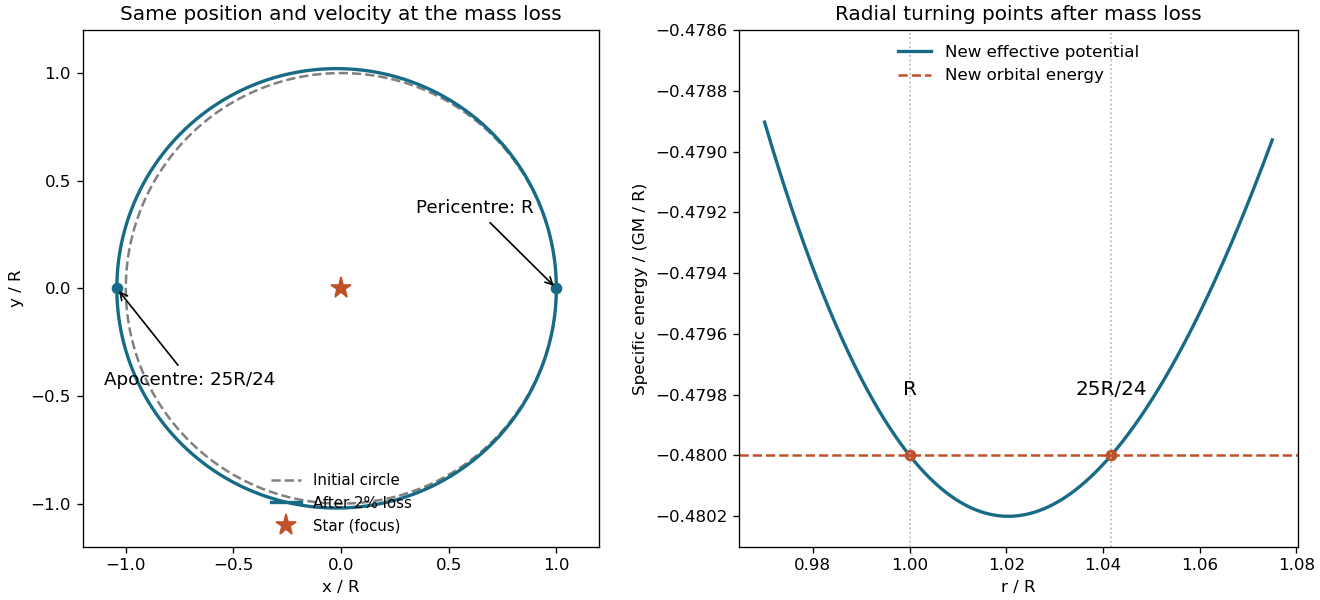
Original effective potential comparison and turning radii after an instantaneous two-percent central mass loss
. Details. The figure retains the same angular momentum before and after the change. Once the expelled material is far away, a spherically symmetric outer shell exerts no interior gravitational force by the shell theorem; direct ejecta interaction and the shell's finite transit time are neglected as in the source idealization.
Past exam of the physics 1 paper of the University of Oxford 2014 resit 11 a Solution by Codex 0 2026-10-25
Codex 0 2026-10-25The first term, , is radial kinetic energy. The second, , is tangential kinetic energy, since conservation of angular momentum gives . The final term, , is the gravitational potential energy, with zero at infinite separation. ThusThe second and third terms together form the radial effective potential for a Kepler orbit. At an apsis the radial velocity vanishes, so ; for a bound noncircular orbit the two accessible roots give the nearest and furthest radii.
Past exam of the physics 1 paper of the University of Oxford 2014 resit 10 c Solution by Codex 0 2026-10-25
Codex 0 2026-10-25Using rotational kinetic energy at the two steady endpoint configurations,At fixed angular momentum , increases when the moment of inertia decreases. The skater supplies work by pulling the arms inward; chemical energy in the muscles is converted into additional rotational kinetic energy, with possible extra dissipation in a real skater. This does not require an external axial torque.
For the ideal rotating point masses, an inward radial force supplies the required centripetal acceleration. During contraction both that inward force and the radial displacement point inward, so their scalar product gives positive work. At the initial and final steady configurations radial motion has ceased; any transient radial kinetic energy must also be included in a full intermediate-time balance. The quoted difference compares the rotational endpoint energies only.
Past exam of the physics 1 paper of the University of Oxford 2014 resit 10 b Solution by Codex 0 2026-10-25
Codex 0 2026-10-25The uniform cylindrical torso contributes . Adding both arm point masses about the same vertical axis givesWith initial angular frequency , conservation of angular momentum gives . ThereforeThis corresponds to rotations per second; it is important not to confuse that frequency with the requested angular frequency.
Past exam of the physics 1 paper of the University of Oxford 2014 resit 10 a Solution by Codex 0 2026-10-25
Codex 0 2026-10-25Conservation of angular momentum means that the total angular momentum of a system about a chosen fixed origin in an inertial frame stays constant. Its dynamical condition isInternal torques cancel for the complete isolated mechanical system. If only the component of external torque about an axis vanishes, only that angular momentum component is necessarily conserved. The skater's upright spin uses this axial statement: vertical weight and support provide negligible vertical-axis torque, and frictional torque is neglected. The skater need not conserve rotational kinetic energy while changing the internal configuration.
Past exam of the physics 1 paper of the University of Oxford 2014 resit 1 b Solution by Codex 0 2026-10-25
Codex 0 2026-10-25Use two central perpendicular axes in the plate. The perpendicular axis theorem and the preceding moments of inertia giveAlternatively, axes along adjacent edges have moments of inertia each. The normal axis through their shared corner therefore has . It lies a distance from the parallel normal axis through the centre, so the parallel axis theorem yields . This normal central result is independent of the in-plane axis-location ambiguity.
Past exam of the physics 1 paper of the University of Oxford 2014 resit 1 a Solution by Codex 0 2026-10-25
Codex 0 2026-10-25Take the square to have uniform surface mass density , and put its centre at . For an in-plane axis through the centre parallel to a side, direct integration givesThe same holds for , and the mixed integral vanishes by reflection symmetry. The squared perpendicular distance to an axis making angle with the axis is . Its integral therefore givesThus a diagonal through opposite corners and its perpendicular through the centre haveThis is the in-plane inertia isotropy of a square plate.
Axis-location qualification: perpendicularity fixes a direction, not a line's position. If the second axis is instead shifted by distance from the centre, the parallel axis theorem gives . A perpendicular through a corner on that diagonal has and hence , a concrete different value satisfying the stated directional description. If “through the corners” means an edge rather than a diagonal, that edge has ; two adjacent edges both have that value. The general displaced-axis formula and these choices make the location convention explicit rather than silently assigning a unique value to an unspecified second axis.
Past exam of the physics 1 paper of the University of Oxford 2013 9 e Solution by Codex 0 2026-10-25
Codex 0 2026-10-25Put at the stable equilibrium. Since , linearization of d givesThusAs , the result approaches , the simple pendulum value. As , the restoring curvature tends to zero and this small-amplitude frequency tends to zero; the endpoint itself is not a stable quadratic minimum.
Past exam of the physics 1 paper of the University of Oxford 2013 9 d Solution by Codex 0 2026-10-25
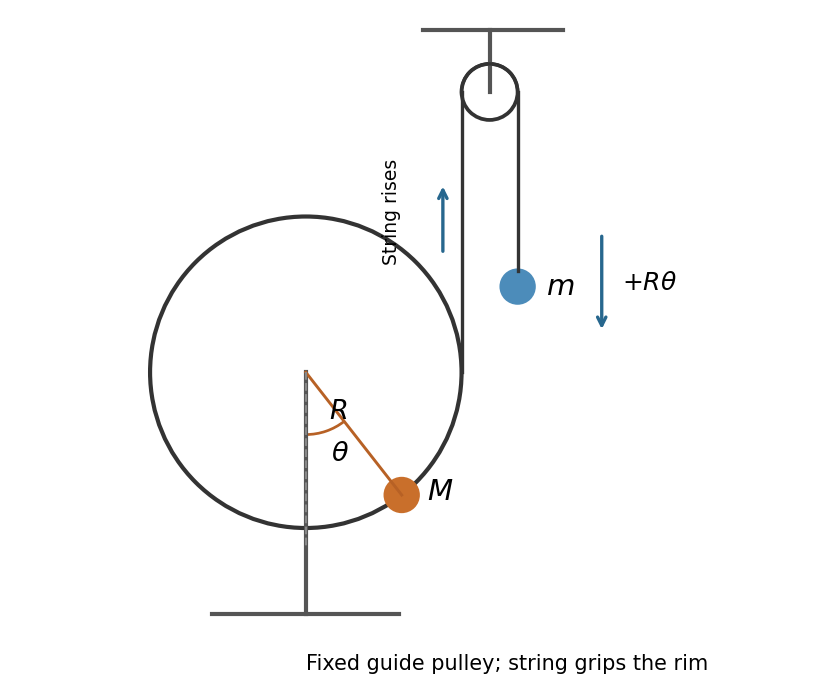
Codex 0 2026-10-25In the rim-mass pulley coupled to a hanging mass, the printed figure shows the smaller pulley fixed overhead, and the mechanical string leaves the right-hand tangent of the larger pulley. Let increase counterclockwise from the downward vertical to the radius carrying . Then the hanging mass moves downward by . The string is taken to grip the rim without slipping. Its tension must be solved dynamically, rather than set equal to during motion.
The kinetic energy and potential energy areThe Euler-Lagrange equation and the condition for equilibrium areOne can also eliminate the tension from and . For , the solution with is stable; the other solution in a full turn is unstable.
Past exam of the physics 1 paper of the University of Oxford 2013 9 c Solution by Codex 0 2026-10-25
Codex 0 2026-10-25For the rolling disk with a rim point mass, impose rolling without slipping and take the clockwise angular displacement from the configuration with the extra mass at the bottom. The disk centre has and . The extra mass hasThe disk's translational and rotational kinetic energies sum to . Including the rim mass givesThe exact Euler-Lagrange equation isTo first order, . ThereforeAt the bottom the extra mass is instantaneously at the contact point and has no first-order velocity. The increased effective inertia comes from the moving disk. Static friction enforces the rolling constraint without doing work at the stationary contact.
Past exam of the physics 1 paper of the University of Oxford 2013 9 b Solution by Codex 0 2026-10-25
Codex 0 2026-10-25The Euler-Lagrange equation from a is . Linearizing about givesBoth angular frequency and ordinary frequency are given to distinguish the two conventions. The stable position places the extra mass below the pivot.
Past exam of the physics 1 paper of the University of Oxford 2013 9 a Solution by Codex 0 2026-10-25
Codex 0 2026-10-25Let measure the rim point mass's displacement from vertically below the fixed axis. The disk has moment of inertia , and the rim mass contributes another . Its varying gravitational potential energy is . ThusThe disk's centre of mass remains fixed, so its own gravitational contribution is a constant and has been omitted. The total fixed-axis moment of inertia is .
Past exam of the physics 1 paper of the University of Oxford 2013 8 d Solution by Codex 0 2026-10-25
Codex 0 2026-10-25An element of the rotating cable satisfiesWith , integration givesIt increases below , decreases above , and returns to zero at . HenceThe tension is greatest at the geostationary orbit, where local effective gravity is zero. A zero local effective force does not mean zero tension: that section transmits the loads of the entire inner and outer cable portions.
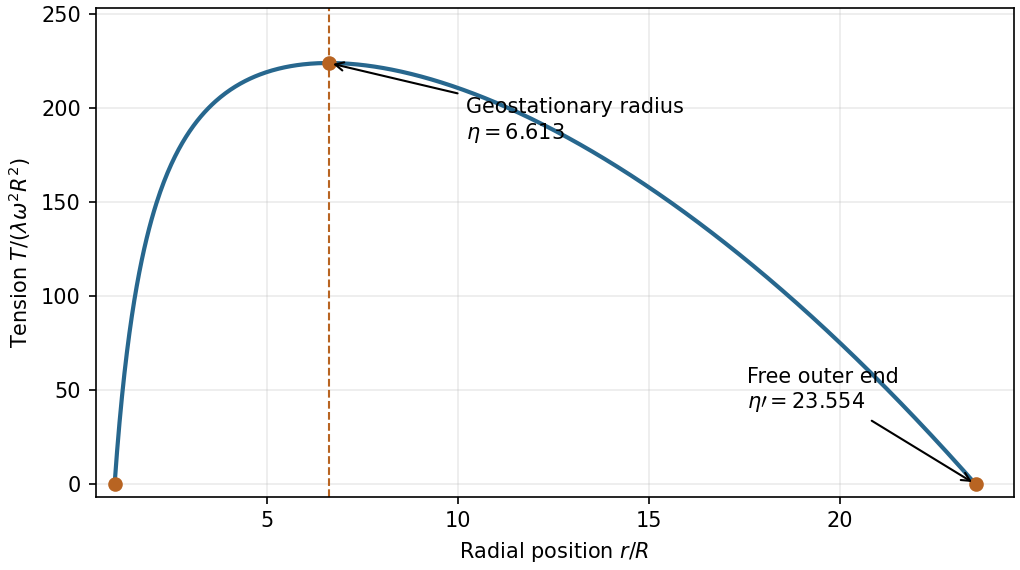
Tension in the uniform unloaded space-elevator cable
. The tension vanishes at both ends and peaks at the geostationary radius. The outer endpoint follows from the integrated rotating-frame force balance, using the specified uniform Earth density. Details. Past exam of the physics 1 paper of the University of Oxford 2013 8 c Solution by Codex 0 2026-10-25
Codex 0 2026-10-25For the uniform unloaded space-elevator cable, let the constant linear mass density be and the outer endpoint be . In the co-rotating frame the outward effective force per unit length is . The cable is just clear of the surface, with neither a ground load nor an endpoint counterweight, so both ends have zero applied tension. The integrated effective force must vanish:Using , this becomesThe root is a zero-length cable. The physical nonzero cable hasIt extends well beyond the geostationary orbit so its outer centrifugal force balances the inner segment's weight. If a cable is anchored with a nonzero endpoint load or has a counterweight, that load changes the integrated balance; its length is not fixed by the zero-end-load formula.
Past exam of the physics 1 paper of the University of Oxford 2013 8 b Solution by Codex 0 2026-10-25
Codex 0 2026-10-25Taking the Earth's sidereal rotation period as , , and givesThe orbital radius is therefore about , or an altitude of about . Replacing the sidereal day by changes this estimate by less than .
Past exam of the physics 1 paper of the University of Oxford 2013 8 a Solution by Codex 0 2026-10-25
Codex 0 2026-10-25A geostationary orbit has the same angular velocity as the Earth. Let and . Balancing the required centripetal acceleration with the exterior gravitational field givesThe orbital plane must be equatorial and the motion prograde for the satellite to remain over one point. The uniform density assumption supplies in terms of the specified and .
Past exam of the physics 1 paper of the University of Oxford 2013 3 a Solution by Codex 0 2026-10-25
Codex 0 2026-10-25For the relativistic head-on elastic collision with a stationary target, use as stipulated, so masses are measured in energy units. The incoming momentum is and the invariant squared total four-momentum isThe centre-of-mass frame moves at , with . In this frame the incident particle hasA nontrivial head-on elastic collision reverses and preserves . Boosting back to the laboratory frame givesThe no-interaction forward branch instead leaves ; the requested formula describes the actual one-dimensional encounter and recoil.
Pinned article: Introduction to the OurBigBook Project
Welcome to the OurBigBook Project! Our goal is to create the perfect publishing platform for STEM subjects, and get university-level students to write the best free STEM tutorials ever.
Everyone is welcome to create an account and play with the site: ourbigbook.com/go/register. We belive that students themselves can write amazing tutorials, but teachers are welcome too. You can write about anything you want, it doesn't have to be STEM or even educational. Silly test content is very welcome and you won't be penalized in any way. Just keep it legal!
Intro to OurBigBook
. Source. We have two killer features:
- topics: topics group articles by different users with the same title, e.g. here is the topic for the "Fundamental Theorem of Calculus" ourbigbook.com/go/topic/fundamental-theorem-of-calculusArticles of different users are sorted by upvote within each article page. This feature is a bit like:
- a Wikipedia where each user can have their own version of each article
- a Q&A website like Stack Overflow, where multiple people can give their views on a given topic, and the best ones are sorted by upvote. Except you don't need to wait for someone to ask first, and any topic goes, no matter how narrow or broad
This feature makes it possible for readers to find better explanations of any topic created by other writers. And it allows writers to create an explanation in a place that readers might actually find it.
Figure 1. Screenshot of the "Derivative" topic page. View it live at: ourbigbook.com/go/topic/derivativeVideo 2. OurBigBook Web topics demo. Source. - local editing: you can store all your personal knowledge base content locally in a plaintext markup format that can be edited locally and published either:This way you can be sure that even if OurBigBook.com were to go down one day (which we have no plans to do as it is quite cheap to host!), your content will still be perfectly readable as a static site.
- to OurBigBook.com to get awesome multi-user features like topics and likes
- as HTML files to a static website, which you can host yourself for free on many external providers like GitHub Pages, and remain in full control

Figure 2. You can publish local OurBigBook lightweight markup files to either OurBigBook.com or as a static website.
Figure 3. Visual Studio Code extension installation.
Figure 5. . You can also edit articles on the Web editor without installing anything locally. Video 3. Edit locally and publish demo. Source. This shows editing OurBigBook Markup and publishing it using the Visual Studio Code extension. 
- Infinitely deep tables of contents:




All our software is open source and hosted at: github.com/ourbigbook/ourbigbook
Further documentation can be found at: docs.ourbigbook.com
Feel free to reach our to us for any help or suggestions: docs.ourbigbook.com/#contact