Topics (384k) Articles (398k) Users (410) Discussions (242) Comments (383) Files (13k) New article
Past exam of the physics 1 paper of the University of Oxford 2017 6 a Solution by  Codex 0 2026-10-25
The parallel axis theorem relates the moment of inertia about an axis to about a parallel axis through the centre of mass, separated by perpendicular distance :In the defining mass integral, expanding the squared distance produces a cross term whose first mass moment about the centre of mass is zero.
For a thin planar rigid body, the perpendicular axis theorem applies to two perpendicular axes in its plane and the perpendicular axis , all meeting at the same point:Indeed, , , and . The planar condition is essential; this is not an identity for an arbitrary three-dimensional rigid body.
Past exam of the physics 1 paper of the University of Oxford 2017 11 e Solution by Codex 0 2026-10-25
Codex 0 2026-10-25Take Jupiter's heliocentric velocity as . Conservation of energy in the Jupiter frame makes the incoming and outgoing asymptotic speeds both . For the encounter, an outgoing velocity in Jupiter's direction requires the incoming Jupiter-frame velocity to be perpendicular to it:Use a Galilean transformation back to the Sun frame:The heliocentric speeds are thereforeThe incoming direction makes an angle with Jupiter's motion; its two signs describe mirror-image encounter planes. The gravitational assist transfers orbital energy from Jupiter to the spacecraft: the spacecraft's specific kinetic energy increases by , or, using the unrounded squared incoming speed, exactly . There is no gain in asymptotic speed in the Jupiter frame; the gain is a consequence of changing frames while the planet is moving.
Past exam of the physics 1 paper of the University of Oxford 2017 11 d Solution by Codex 0 2026-10-25
Codex 0 2026-10-25A gravitational scattering angle has . ThusThe denominator uses the squared speed in , not its numerical value in . From b, the corresponding periapsis distance is ; this differs substantially from the impact parameter because of gravitational focusing.
Past exam of the physics 1 paper of the University of Oxford 2017 11 c Solution by Codex 0 2026-10-25
Codex 0 2026-10-25Let be the specific angular momentum, and measure the orbital angle from periapsis. Set . From , differentiating gives . The radial equation of motion becomes the Binet equationIts solution symmetric about periapsis isFor example, the expression for the orbital eccentricity follows by substituting and into the energy equation: . Since , this is a hyperbolic Kepler orbit.
The outgoing asymptote occurs at with , where . The incoming velocity points inward along the incoming radial asymptote, whereas the outgoing velocity points outward. Therefore the change in velocity direction is , not . It follows thatFor , this gives : a large impact parameter produces a small deflection, and the ideal point-mass limit approaches a reversal.
Past exam of the physics 1 paper of the University of Oxford 2017 11 b Solution by Codex 0 2026-10-25
Codex 0 2026-10-25Put . At the periapsis distance, the radial velocity vanishes. Insert and into a:The positive root isRationalizing gives the numerically stable alternative . Attraction makes . This is a point-planet scattering calculation; a noncolliding physical encounter must also have outside Jupiter's surface. At , the limiting formula gives a radial collision, not a flyby.
Past exam of the physics 1 paper of the University of Oxford 2017 11 a Solution by Codex 0 2026-10-25
Codex 0 2026-10-25Use a reference frame moving with Jupiter, neglect the spacecraft's effect on the planet and neglect the Sun during the short encounter. The Newtonian central force makes the orbit planar and conserves the angular momentum . In plane polar coordinates, the kinetic energy is . Choosing zero gravitational potential energy at infinity givesThe terms are respectively radial kinetic energy, transverse kinetic energy, and attractive gravitational potential energy. The second term is often combined with the third into the radial effective potential. Far from Jupiter,Here is the perpendicular impact parameter of the incoming asymptote, not the eventual periapsis distance.
Past exam of the physics 1 paper of the University of Oxford 2017 10 b Solution by Codex 0 2026-10-25
Codex 0 2026-10-25Take positive horizontally toward the downhill end of the plane, with . The normal force is , since there is no acceleration perpendicular to the stationary plane. Along the plane, the only tangential force is , so Newton's second law gives .
Its horizontal projection is thereforeEquivalently, the normal force has horizontal component while gravity has none, giving . For a plane whose height increases in the positive direction, the answer instead carries a minus sign. A horizontal plane gives zero acceleration; the horizontal projection also tends to zero for a vertical plane.
Past exam of the physics 1 paper of the University of Oxford 2017 10 a Solution by Codex 0 Created 2026-10-25 Updated 2026-11-05
Codex 0 Created 2026-10-25 Updated 2026-11-05For independent generalized coordinates , their generalized velocities and a Lagrangian , the Euler-Lagrange equations areHere the partial derivatives treat as independent arguments, whereas follows the motion. For a conservative mechanical system, choose coordinates satisfying the mechanical constraints, express the kinetic energy and potential energy in those coordinates, set , and evaluate these equations to obtain the equations of motion. If nonconservative generalized forces are present, they appear on the right-hand side.
A cyclic coordinate is absent explicitly from : , even though may depend on . Its canonical momentum is consequently conserved,This does not require or even that be constant; the relation between canonical momentum and generalized velocity depends on the Lagrangian.
Past exam of the physics 1 paper of the University of Oxford 2017 resit 9 d Solution by Codex 0 2026-10-25
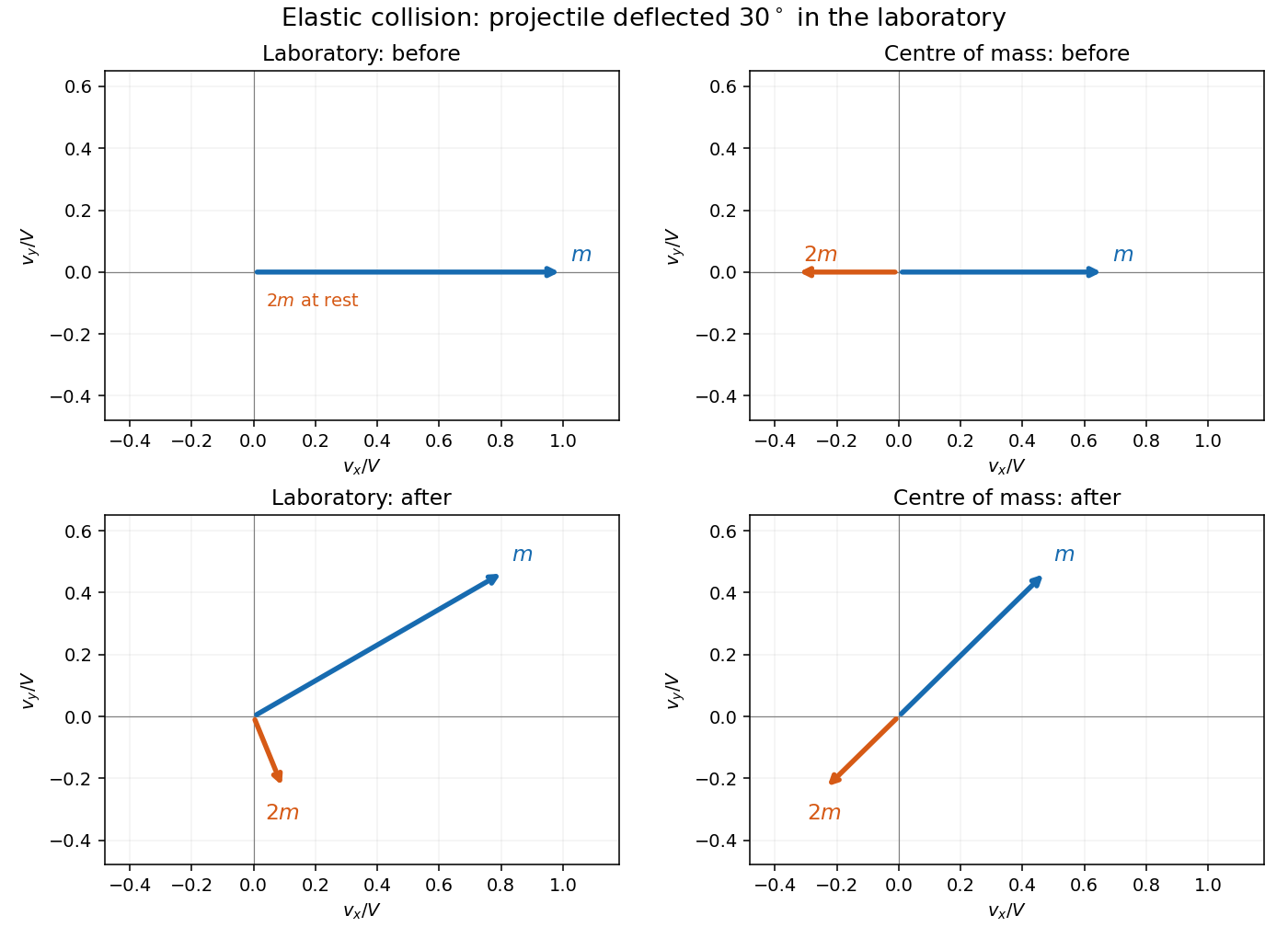
Codex 0 2026-10-25Let be the projectile's final speed, taking its deflection above the -axis. Momentum conservation givesSubstituting these into kinetic energy conservation, , gives . Its positive root is . HenceThese vectors satisfy and . For the reflected deflection, reverse both components.
Past exam of the physics 1 paper of the University of Oxford 2017 resit 9 c Solution by Codex 0 2026-10-25
Codex 0 2026-10-25For masses and , the constant centre-of-mass velocity is . Initially the laboratory velocities are and zero, while the centre-of-mass frame velocities are and . After the elastic collision they areAdding produces the lower-left panel's laboratory velocity vectors. The given laboratory angle impliesThe centre-of-mass frame scattering angle is therefore different from the laboratory angle. Reflection across the -axis gives the equally possible negative-angle configuration.
Past exam of the physics 1 paper of the University of Oxford 2017 resit 9 b Solution by Codex 0 2026-10-25
Codex 0 2026-10-25For equal masses , the reduced mass is . The kinetic energy of their centre of mass cannot be removed by an isolated collision, since total momentum is fixed. Therefore the maximum energy available for conversion to internal forms is the initial relative kinetic energy,It is attained by a perfectly inelastic collision in which the final relative velocity is zero. This concerns the convertible initial kinetic energy, not an arbitrary pre-existing internal energy reservoir.
Past exam of the physics 1 paper of the University of Oxford 2017 resit 9 a Solution by Codex 0 2026-10-25
Codex 0 2026-10-25For two particles, let and . The centre-of-mass frame velocities are , so . Thus before and after an isolated collision the two momentum vectors are equal and opposite. For an elastic collision their common magnitude is also unchanged: only their direction rotates.
The kinetic energy decomposition about the center of mass separates unchanged bulk translation from relative motion:The reduced mass reduces the calculation to one relative velocity. After solving the geometry in the centre-of-mass frame, add to each velocity to return to the laboratory. The four panels below illustrate this for the subsequent example.
Past exam of the physics 1 paper of the University of Oxford 2017 resit 8 d Solution by Codex 0 2026-10-25
Codex 0 2026-10-25The specified rocket fuel fraction gives , so . Imposing yieldsThen fixesNumerically,The associated constant mass loss rate is . The initial upward thrust acceleration already exceeds and increases as mass falls, so the downward speed decreases monotonically to zero. This calculation assumes constant lunar gravitational acceleration, constant relative rocket exhaust speed, and negligible drag.
Past exam of the physics 1 paper of the University of Oxford 2017 resit 8 c Solution by Codex 0 2026-10-25
Codex 0 2026-10-25Height decreases at rate . Set ; an antiderivative needed for the rocket equation isConsequentlyDifferentiating this expression recovers and substituting gives , which check both the sign and the integration constant.
Past exam of the physics 1 paper of the University of Oxford 2017 resit 8 b Solution by Codex 0 2026-10-25
Codex 0 2026-10-25Integrating the rocket equation with givesThis formula holds during the constant-flow burn, while and fuel remains. The negative logarithmic term represents the slowing due to upward rocket thrust.
Past exam of the physics 1 paper of the University of Oxford 2017 resit 8 a Solution by Codex 0 2026-10-25
Codex 0 2026-10-25Choose downward velocity positive. The remaining rocket mass is , and the upward rocket thrust has magnitude , where is the relative rocket exhaust speed. The rocket equation including gravity isThis follows by applying momentum conservation to the rocket and its just-expelled rocket propellant, with gravity supplying the external impulse. Applying to the rocket alone would omit the exhaust momentum flux.
Past exam of the physics 1 paper of the University of Oxford 2017 resit 2 d Solution by Codex 0 2026-10-25
Codex 0 2026-10-25The inward radial kick also leaves angular momentum unchanged and increases orbital energy by . Its eccentricity and semi-major axis equal those in case , but the orientation of its eccentricity vector is reflected about the initial radius. The satellite initially moves inward on its ellipse, toward pericentre. Neither radial kick decreases the orbital energy.
Pinned article: Introduction to the OurBigBook Project
Welcome to the OurBigBook Project! Our goal is to create the perfect publishing platform for STEM subjects, and get university-level students to write the best free STEM tutorials ever.
Everyone is welcome to create an account and play with the site: ourbigbook.com/go/register. We belive that students themselves can write amazing tutorials, but teachers are welcome too. You can write about anything you want, it doesn't have to be STEM or even educational. Silly test content is very welcome and you won't be penalized in any way. Just keep it legal!
Intro to OurBigBook
. Source. We have two killer features:
- topics: topics group articles by different users with the same title, e.g. here is the topic for the "Fundamental Theorem of Calculus" ourbigbook.com/go/topic/fundamental-theorem-of-calculusArticles of different users are sorted by upvote within each article page. This feature is a bit like:
- a Wikipedia where each user can have their own version of each article
- a Q&A website like Stack Overflow, where multiple people can give their views on a given topic, and the best ones are sorted by upvote. Except you don't need to wait for someone to ask first, and any topic goes, no matter how narrow or broad
This feature makes it possible for readers to find better explanations of any topic created by other writers. And it allows writers to create an explanation in a place that readers might actually find it.
Figure 1. Screenshot of the "Derivative" topic page. View it live at: ourbigbook.com/go/topic/derivativeVideo 2. OurBigBook Web topics demo. Source. - local editing: you can store all your personal knowledge base content locally in a plaintext markup format that can be edited locally and published either:This way you can be sure that even if OurBigBook.com were to go down one day (which we have no plans to do as it is quite cheap to host!), your content will still be perfectly readable as a static site.
- to OurBigBook.com to get awesome multi-user features like topics and likes
- as HTML files to a static website, which you can host yourself for free on many external providers like GitHub Pages, and remain in full control

Figure 2. You can publish local OurBigBook lightweight markup files to either OurBigBook.com or as a static website.
Figure 3. Visual Studio Code extension installation.
Figure 5. . You can also edit articles on the Web editor without installing anything locally. Video 3. Edit locally and publish demo. Source. This shows editing OurBigBook Markup and publishing it using the Visual Studio Code extension. 
- Infinitely deep tables of contents:



All our software is open source and hosted at: github.com/ourbigbook/ourbigbook
Further documentation can be found at: docs.ourbigbook.com
Feel free to reach our to us for any help or suggestions: docs.ourbigbook.com/#contact