Topics (384k) Articles (398k) Users (410) Discussions (242) Comments (383) Files (13k) New article
Past exam of the physics 1 paper of the University of Oxford 2015 10 e Solution by  Codex 0 2026-10-25
Take the natural release interpretation: both block and bob are initially at rest, the block starts at , and the bob has small horizontal displacement relative to the downward line through the pivot. Then , andThe bob's horizontal position isThe block and bob therefore oscillate in opposite phase about the fixed horizontal centre of mass . Their horizontal oscillation amplitudes are and respectively. They pass the centre-of-mass line together when the rod is vertical. If the bob were also given an unspecified initial velocity, the additional sine and translational terms in part (d) would be needed; the source's displacement-release case selects the cosine solution.
Past exam of the physics 1 paper of the University of Oxford 2015 10 d Solution by Codex 0 Created 2026-10-25 Updated 2026-11-05
Codex 0 Created 2026-10-25 Updated 2026-11-05When the block is free, becomes a dynamical generalized coordinate and its kinetic energy must be included. Expanding to quadratic order about the downward stationary state and dropping a constant givesThe coordinate is cyclic. Its conserved canonical momentum is the total horizontal momentum,The two linear Euler-Lagrange equations areEliminating givesThus the pendulum with a freely sliding support has a zero-frequency translational mode and an oscillatory mode. With four independent constants , the general solution isHere and is the horizontal centre of mass coordinate to first order, since . The oscillation is faster than that of a pendulum with a fixed pivot; the limit restores .
Past exam of the physics 1 paper of the University of Oxford 2015 10 c Solution by Codex 0 2026-10-25
Codex 0 2026-10-25As approaches , the driving motion couples resonantly to the pendulum. The particular-solution amplitude has denominator , so a steady harmonic-response formula alone is singular. For a specified finite initial state, the near-resonant motion instead develops beats, and its exact resonant limit has a growing envelope.
For example, with the vertical zero-angular-velocity initial condition above, taking the limit givesThe ideal undamped linear theory predicts amplitude growing linearly with time, not an infinite displacement at the first instant. In reality the motion leaves the small-angle regime, and damping and nonlinear changes of the pendulum's oscillation period alter the response. Below and above resonance, the sign of the harmonic response coefficient changes, corresponding to a phase reversal.
Past exam of the physics 1 paper of the University of Oxford 2015 10 b Solution by Codex 0 2026-10-25
Codex 0 2026-10-25The Euler-Lagrange equation for isFor small angles, set and . With and , the harmonic forcing of a horizontally driven pendulum obeysFor , its general solution isThe constants set the initial angle and angular velocity. If the bob starts vertical with zero angular velocity at , this reduces toThe solution remains an approximation only while the resulting angle is small.
Past exam of the physics 1 paper of the University of Oxford 2015 10 a Solution by Codex 0 2026-10-25
Codex 0 2026-10-25Let the pivot's prescribed horizontal position be and measure from the downward vertical. The bob's coordinates are and . ThereforeWith zero gravitational potential energy at pivot height, the bob's Lagrangian isHere is a prescribed input, not yet a free coordinate. Terms depending only on that prescribed time function can be dropped without changing the equation. The moving block's own kinetic energy becomes relevant when its motion is free in part (d).
Past exam of the physics 1 paper of the University of Oxford 2015 resit 8 b Solution by Codex 0 2026-10-25
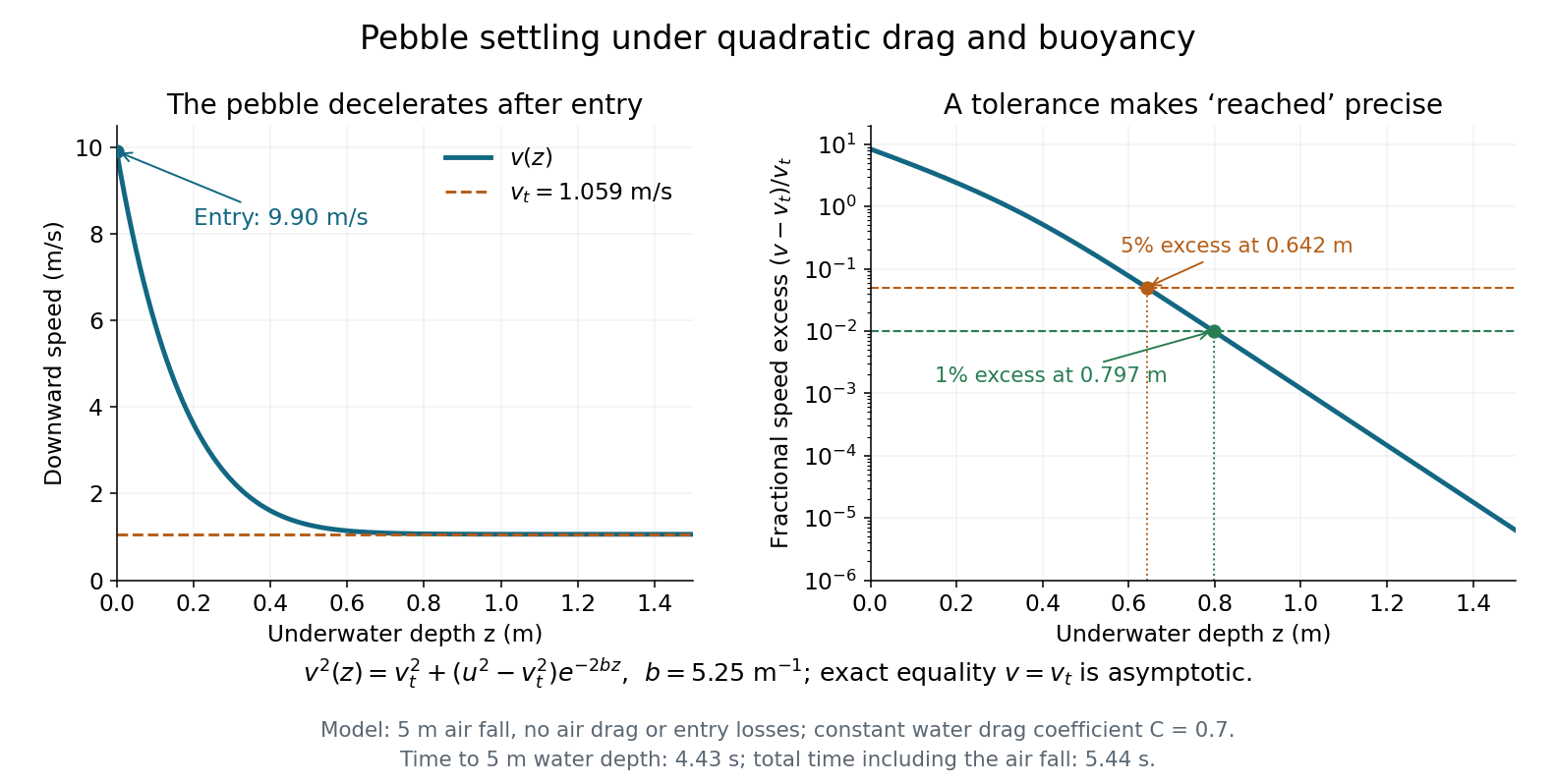
Codex 0 2026-10-25The air fall lastsRetain the underwater deceleration rather than replacing the whole water trajectory with motion at terminal velocity. DefineSeparation of the descent equation gives the hyperbolic cotangent solution and its integrated depth:where now means water entry. The derivative of the logarithm verifies , while . At water depth , inversion using the inverse hyperbolic sine yieldsThe total elapsed time is thereforeFor an estimate without evaluating the exact expression, permits here, givingThis gives the same to the quoted precision. The simpler overestimates the underwater time because the pebble initially moves faster than .
Past exam of the physics 1 paper of the University of Oxford 2015 resit 8 a Solution by Codex 0 2026-10-25
Codex 0 2026-10-25For superterminal descent under quadratic drag, use in . Equivalently,The speed approaches asymptotically from above. There is no finite exact distance at which it first equals the limiting speed. A practical estimate must specify an accuracy. Define “reached” as . ThenFor one-percent accuracy, givesA five-percent criterion gives . The characteristic decay length of the excess squared speed is , but several such lengths are needed because the entry speed is so far above the limiting value. These estimates depend on the stated water-entry idealization; the source gives no finite tolerance or entry-loss model.
Past exam of the physics 1 paper of the University of Oxford 2015 resit 10 Unlettered continuation Solution by Codex 0 2026-10-25
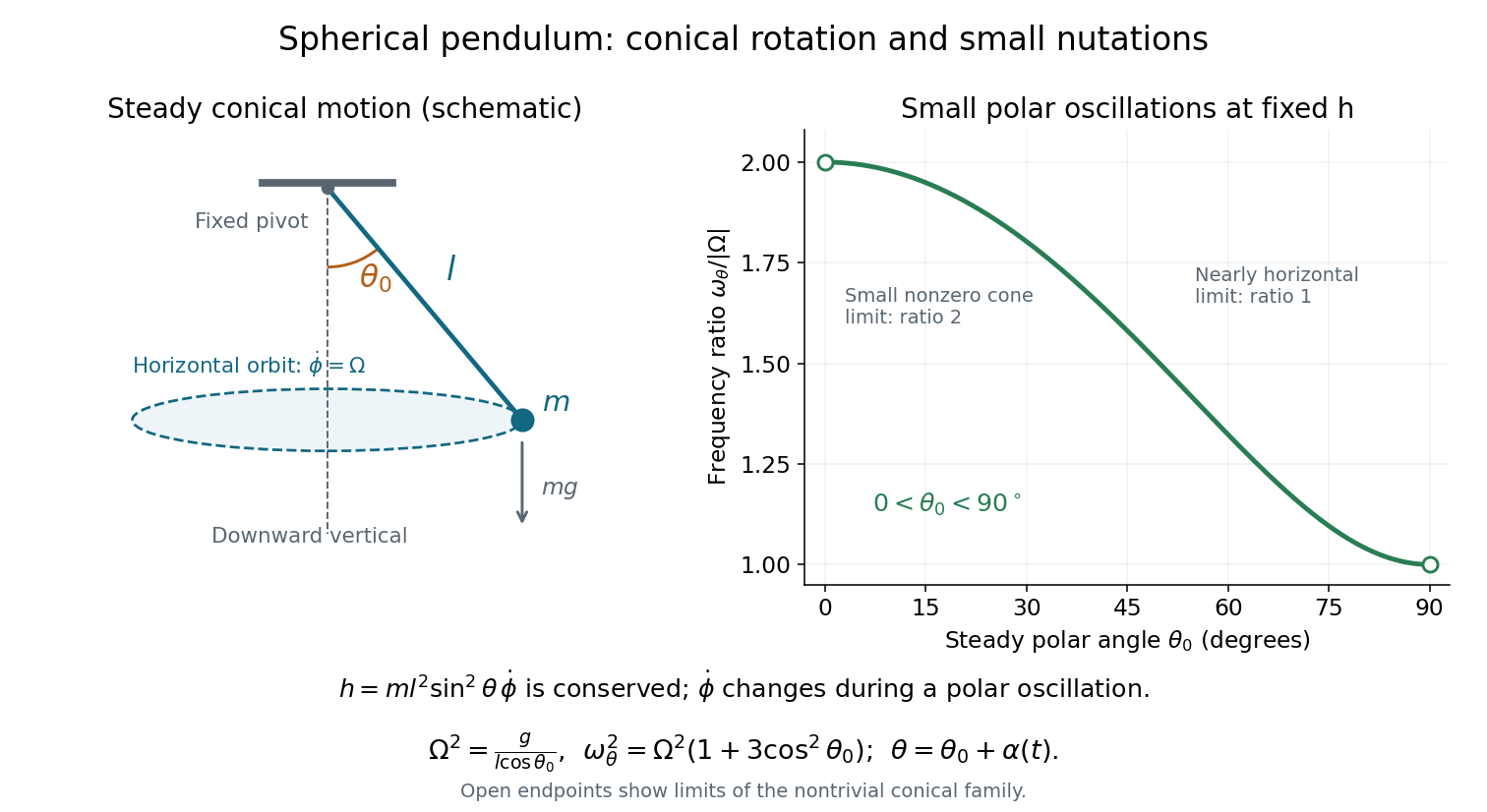
Codex 0 2026-10-25Fixed-angular-momentum form. Eliminating using the conserved angular momentum givesEquivalently, the polar motion has effective potentialFor the steady conical pendulum at , , soThe sign of agrees with the sign of ; substituting verifies the constant-angle result in part (d).
Period of small polar oscillations. Put , with and held fixed. This is the appropriate small nutation about a conical pendulum; keeping fixed instead would violate the angular momentum constraint during the oscillation. Ifthen andThe linearization is , givingSince , the coefficient is positive and these small polar oscillations are stable. To first order, , making the compensating change in azimuthal angular velocity explicit. The limit as concerns radial modulation of a small nonzero circular orbit; the exactly planar pendulum is a different, degenerate limit of these polar coordinates.
Past exam of the physics 1 paper of the University of Oxford 2015 resit 10 d Solution by Codex 0 2026-10-25
Codex 0 2026-10-25Constant azimuth. If is constant, and the motion is a planar simple pendulum:For the small-angle approximation, , giving simple harmonic motion withThe harmonic angular frequency requires small amplitude. At finite libration amplitude , the exact oscillation period is , where is the complete elliptic integral of the first kind; the nonlinear pendulum does not have the same amplitude-independent period.
Constant polar angle. If is nonzero and constant, the bob traces a horizontal circle: this is a conical pendulum. Setting and dividing by givesThe sign distinguishes the two senses of rotation. The exactly downward configuration is stationary; its azimuth is undefined and it must not be obtained by dividing by . A nontrivial constant-angle orbit of this gravity-only system needs even though the supporting rod can also push.
Past exam of the physics 1 paper of the University of Oxford 2015 resit 10 c Solution by Codex 0 2026-10-25
Codex 0 2026-10-25 Past exam of the physics 1 paper of the University of Oxford 2015 resit 10 b Solution by Codex 0 2026-10-25
Codex 0 2026-10-25The azimuth is a cyclic coordinate, since . Its Euler-Lagrange equation gives conservation of the vertical component of angular momentum:This is the actual angular momentum, not specific angular momentum. The Lagrangian also has no explicit time dependence. The conserved energy isAlong solutions, . These are the conserved quantities associated with rotational symmetry about the vertical and time-translation symmetry, respectively.
Past exam of the physics 1 paper of the University of Oxford 2015 resit 10 a Solution by Codex 0 2026-10-25
Codex 0 2026-10-25Use spherical coordinates about the fixed pivot, with fixed rod length , polar angle measured from the downward vertical, and azimuth . The bob's position iswhen the Cartesian axis points upward. Differentiation gives kinetic energy . Taking zero gravitational potential energy at pivot height gives . The spherical pendulum's Lagrangian is thereforeThe rod is light, rigid and of fixed length; pivot friction and air drag are neglected. A rigid rod, unlike a string, may sustain either tensile or compressive constraint force.
Past exam of the physics 1 paper of the University of Oxford 2014 9 c Solution by Codex 0 2026-10-25
Codex 0 2026-10-25The supplied PDF labels this equation clarified from original for tutorial purposes. Use the model of an eccentric wheel with missing-mass kinetic energy neglected: neglect the missing disc's contribution to kinetic energy, while retaining its subtraction from gravitational potential energy. Do not silently replace the gravitational mass by the full-disc mass as well.
Choose as the clockwise angle of from the upward vertical, and set . The rolling without slipping constraint makes changes in equal changes in the distance C travels down the slope. Choose its additive origin so when the hole is vertically above C. Then, up to an irrelevant height constant,The approximate kinetic energy is that of the complete uniform disc rolling at :Subtracting the missing disc's gravitational potential energy givesApply the Euler-Lagrange equation to :ThereforeHere have dimensions of acceleration and has dimensions of inverse length. The initial conditions are under the vertical-above interpretation. If an initial orientation is instead specified relative to the slope normal, the same coordinate convention produces a different initial , not different constants. With the equation becomes , the familiar solid-disc result. Retaining the hole's exact kinetic energy would introduce coordinate-dependent inertia and extra terms; the printed neglect is what permits the requested constant-coefficient form.
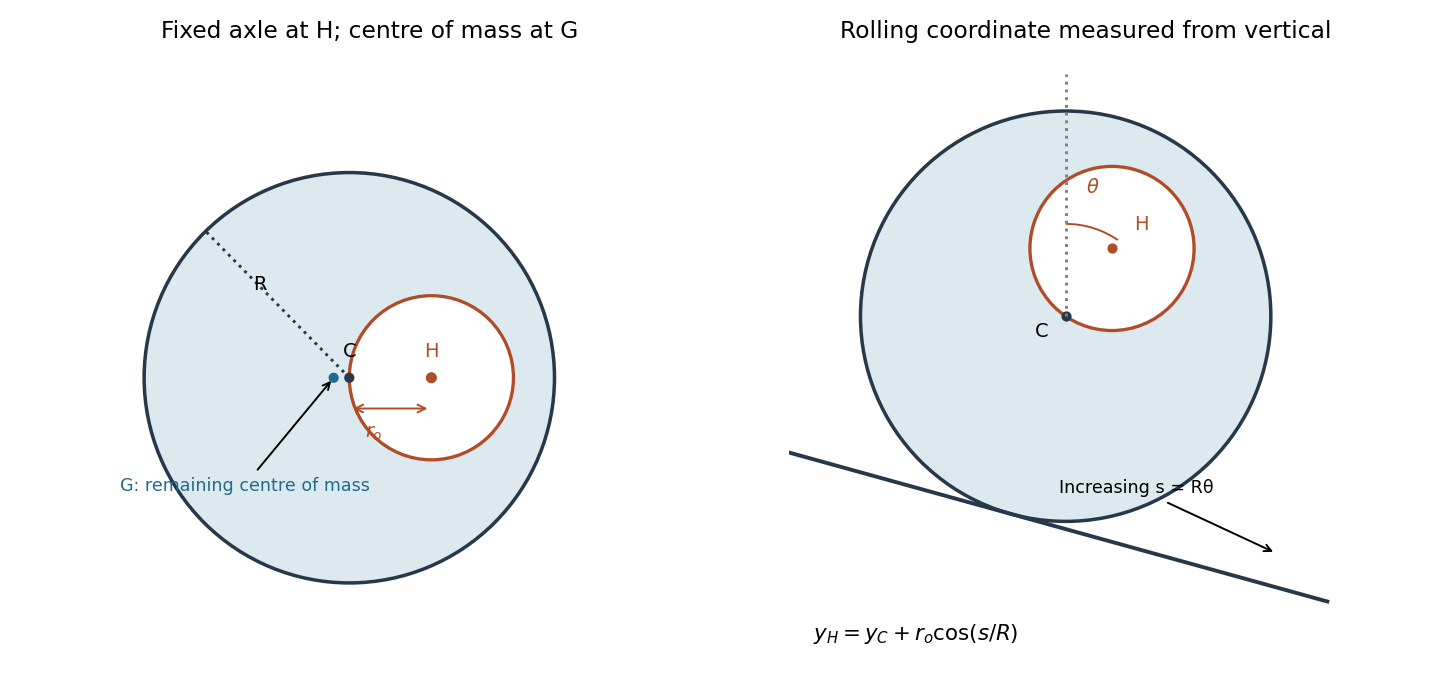
The axle, geometric centre and centre of mass of the perforated wheel
. Original geometric constructions. Left: fixed-axis inertia subtracts a missing disc about H. Right: the rolling coordinate is the hole angle from the upward vertical; the centre travels downhill by R times the angle, while the missing mass contributes a cosine to potential energy. Details. Past exam of the physics 1 paper of the University of Oxford 2014 9 b Solution by Codex 0 2026-10-25
Codex 0 2026-10-25For a freely rolling rigid body, decompose the kinetic energy into translation of its centre of mass G and rotation about G. The centre of mass after removing material lies on the side opposite H:Another use of the parallel axis theorem givesThus at the same angular speed,This compares the rotational component, not the total rolling kinetic energy. The total also contains and need not be smaller than . Describing all rolling motion as instantaneous rotation about its contact point includes that translational contribution; it is not the rotational component intended by this comparison.
Past exam of the physics 1 paper of the University of Oxford 2014 9 a Solution by Codex 0 2026-10-25
Codex 0 2026-10-25For the eccentric circular-hole disk inertia, let be the mass of the complete disc before removing material, the missing mass, and the wheel's remaining mass. Denote the complete disc's centre by C and the axle/hole centre by H; . Assume the hole fits inside the disc, . The parallel axis theorem gives the full disc's moment of inertia about H as . Subtract the absent little disc about its own centre H:The axle is a support, not part of the rotating wheel's stated mass. Its frictionless bearing does not alter this moment of inertia. For fixed-axis angular velocity ,The missing material must be subtracted with its actual displacement relative to the axis; treating the wheel as a concentric annulus would give the wrong result.
Past exam of the physics 1 paper of the University of Oxford 2014 8 d Solution by Codex 0 2026-10-25
Codex 0 2026-10-25Put and . At reversal the transferred mass is , leaving A with and, after capture of that exhaust, B with . The first burn givesAfter reversal A emits its remaining exhaust away from B, so B receives no further fuel and eventually coasts at this velocity. Applying the rocket equation with reversed thrust to A givesBoth now move toward negative x, but A moves faster in that direction. The asymptotic closing speed isThis conclusion does not require a burn rate or an initial separation: after a finite burn, the positive eventual closing speed closes any finite remaining gap. Those additional inputs would be required to calculate the meeting time. Any pre-reversal exhaust still in transit affects the timing, not B's eventual momentum after collecting that fixed amount.
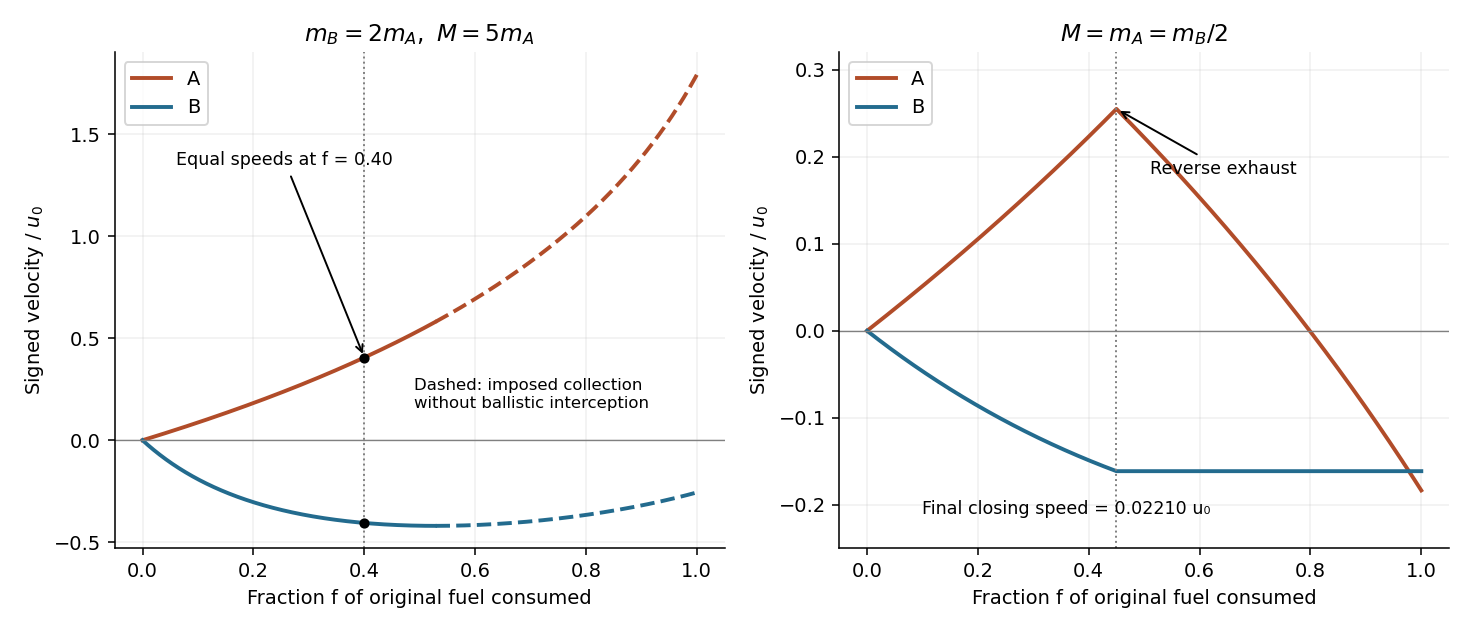
Signed velocities during exhaust collection and thrust reversal
. Original Newtonian calculations versus the fraction of original fuel consumed. Left: the equal-speed event in the ideal negligible-flight-time collection model; the later dashed extension is conditional on collection and can violate ballistic interception. Right: reversing thrust at 45 percent produces a small positive eventual closing speed. Details. Past exam of the physics 1 paper of the University of Oxford 2014 8 c Solution by Codex 0 2026-10-25
Codex 0 2026-10-25Neglecting exhaust flight time, no momentum is stored in transit andSince the velocities have opposite signs, equal nonzero speeds imply equality of the instantaneous masses. For and , this occurs at , or . ThereforeThe common-speed event occurs after of A's original fuel has been transferred, rather than when either rocket has its final mass. At this event the rearward exhaust still overtakes B: . Thus the interception restriction in b does not invalidate this event even though extending complete ballistic capture over the much later burn would need separate checking.
Past exam of the physics 1 paper of the University of Oxford 2014 8 b Solution by Codex 0 2026-10-25
Codex 0 2026-10-25Let be the transferred fuel mass. Before any engine reversal, rocket A has mass and velocityFor exhaust collection by a second rocket, under the stipulated eventual capture of all exhaust, final conservation of momentum for the complete initially stationary system gives . ThusCapture is inelastic: no kinetic energy conservation for B is assumed. Finite exhaust flight time changes the intermediate sharing of momentum but not this endpoint balance if the stated complete capture actually occurs.
The ballistic exhaust interception condition is a physical restriction on that idealization. For purely ballistic exhaust to reach a receding collector to the rear, its laboratory velocity must be more negative than B's while interception occurs. In the negligible-flight-time approximation this requires . Very large fuel ratios need not meet that condition throughout a complete burn; the boxed endpoint formula is conditional on the prompt's complete-collection stipulation, not an unconditional prediction for every ballistic two-rocket geometry.
Past exam of the physics 1 paper of the University of Oxford 2014 8 a Solution by Codex 0 2026-10-25
Codex 0 2026-10-25Choose positive x along the rocket's motion. If its instantaneous total mass is and it ejects a positive amount , the exhaust velocity in the original inertial frame is to first order. Conservation of momentum over that increment givesIntegrating the rocket equation from to givesThe constant exhaust speed is relative to the rocket, not the initial frame. Kinetic energy of rocket plus exhaust is not conserved because stored fuel energy is released. The calculation is Newtonian and requires resulting speeds small compared with the speed of light.
Past exam of the physics 1 paper of the University of Oxford 2014 5 b Solution by Codex 0 2026-10-25
Codex 0 2026-10-25Take the light to travel along positive x, while the water moves with signed velocity . In the water's rest frame its light phase velocity is . The relativistic velocity addition law from a gives the laboratory phase velocityExpanding to first order in , with , yieldsEquivalently : the counterflow reduces the forward light speed. This is the nondispersive Fresnel drag coefficient. The refractive index is taken as constant over the relevant frequencies; dispersion and its frequency-shift corrections are outside this approximation.
Pinned article: Introduction to the OurBigBook Project
Welcome to the OurBigBook Project! Our goal is to create the perfect publishing platform for STEM subjects, and get university-level students to write the best free STEM tutorials ever.
Everyone is welcome to create an account and play with the site: ourbigbook.com/go/register. We belive that students themselves can write amazing tutorials, but teachers are welcome too. You can write about anything you want, it doesn't have to be STEM or even educational. Silly test content is very welcome and you won't be penalized in any way. Just keep it legal!
Intro to OurBigBook
. Source. We have two killer features:
- topics: topics group articles by different users with the same title, e.g. here is the topic for the "Fundamental Theorem of Calculus" ourbigbook.com/go/topic/fundamental-theorem-of-calculusArticles of different users are sorted by upvote within each article page. This feature is a bit like:
- a Wikipedia where each user can have their own version of each article
- a Q&A website like Stack Overflow, where multiple people can give their views on a given topic, and the best ones are sorted by upvote. Except you don't need to wait for someone to ask first, and any topic goes, no matter how narrow or broad
This feature makes it possible for readers to find better explanations of any topic created by other writers. And it allows writers to create an explanation in a place that readers might actually find it.
Figure 1. Screenshot of the "Derivative" topic page. View it live at: ourbigbook.com/go/topic/derivativeVideo 2. OurBigBook Web topics demo. Source. - local editing: you can store all your personal knowledge base content locally in a plaintext markup format that can be edited locally and published either:This way you can be sure that even if OurBigBook.com were to go down one day (which we have no plans to do as it is quite cheap to host!), your content will still be perfectly readable as a static site.
- to OurBigBook.com to get awesome multi-user features like topics and likes
- as HTML files to a static website, which you can host yourself for free on many external providers like GitHub Pages, and remain in full control

Figure 2. You can publish local OurBigBook lightweight markup files to either OurBigBook.com or as a static website.
Figure 3. Visual Studio Code extension installation.
Figure 5. . You can also edit articles on the Web editor without installing anything locally. Video 3. Edit locally and publish demo. Source. This shows editing OurBigBook Markup and publishing it using the Visual Studio Code extension. 
- Infinitely deep tables of contents:




All our software is open source and hosted at: github.com/ourbigbook/ourbigbook
Further documentation can be found at: docs.ourbigbook.com
Feel free to reach our to us for any help or suggestions: docs.ourbigbook.com/#contact