Topics (384k) Articles (398k) Users (410) Discussions (242) Comments (383) Files (13k) New article
Past exam of the anyons and topological quantum field theories course of the University of Oxford 2025 2 b Solution by  Codex 0 2026-10-25
Put . The Verlinde formula diagonalizes every anyon fusion matrix using the same modular S-matrix:Because , the eigenvalue of in column isThe last equality uses unitary matrix orthogonality. ThereforeFinally, insert , where is the quantum dimension and is the squared total quantum dimension:Although only quantum dimensions remain, the result is an integer because a counts an anyon fusion space.
Past exam of the anyons and topological quantum field theories course of the University of Oxford 2025 2 a Solution by Codex 0 2026-10-25
Codex 0 2026-10-25Cut one nonseparating circle on each handle of the closed orientable surface of genus . The cut surface is a sphere with boundary circles. Gluing a pair back together requires an anyon label on one boundary and the antianyon label on the oppositely oriented boundary. Sum over these labels independently for the handles.
For a fixed labeling, the dimension of the resulting anyon fusion space on the sphere, with total vacuum anyon charge, isThe gluing rule of the topological quantum field theory therefore gives the handle-cut formula for anyon ground-state degeneracy:Here denotes the vacuum anyon, and the anyon fusion matrices have entries , as in the source. At , the empty product is the identity matrix, giving one ground state. At , for each simple charge, so the ground-state degeneracy of the torus is the number of anyon types.
Past exam of the anyons and topological quantum field theories course of the University of Oxford 2025 1 d Solution by Codex 0 2026-10-25
Codex 0 2026-10-25Use an anyon fusion tree in which the two crossing charges combine first. With external charges in the order , define the normalized treesThe desired value is the matrix element of anyon monodromy between and . Their closure is understood in the physics normalization of anyon diagrams.
First apply the anyon F-matrix to the three charges , and then an inverse anyon F-matrix to . With the source convention , this givesOnly allowed anyon fusion channels enter the sums: in the second tree these require . The complex conjugate in comes from the inverse change of parentheses, not from reversing a crossing.
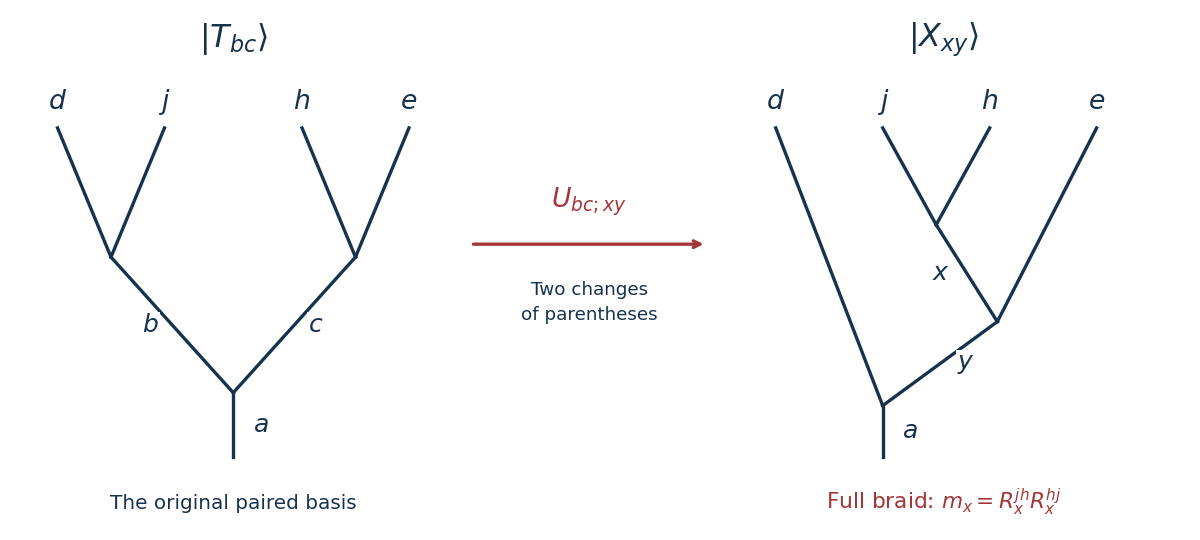
Reading the actual overcrossings from bottom to top gives two positive exchanges in the source's anyon R-matrix convention. Their product isThe order of is restored after the second exchange. In the basis this anyon monodromy is diagonal, soEquivalently, entirely in terms of anyon F-matrices and anyon R-matrices,This expression is also meaningful for or : it then carries the unmatched anyon vertex gauge transformation factors identified in a.
To check the transparent limit, put in every allowed channel. The unitary matrix identity for first givesOnce , the unitary matrix identity for givesas in c. The same cancellation proves that the recoupling expression is an identity operator whenever the full anyon monodromy is trivial, including when the individual exchanges have fermionic signs.
Past exam of the anyons and topological quantum field theories course of the University of Oxford 2025 1 c Solution by Codex 0 2026-10-25
Codex 0 2026-10-25The two crossings of make their full anyon monodromy. For a transparent anyon , this is the identity, so that pair of crossings can be removed together. No single-crossing exchange phase, and no topological spin from a twist, is introduced.
After this removal the upper and lower anyon fusion trees differ only in their intermediate labels. In the physics normalization of anyon diagrams, successive split-fuse bubbles give the Kronecker deltas and . The remaining closed normalized state has norm one. Hence, for the admissible labelings of a,In particular, every admissible diagram satisfying the label matching in a evaluates to . There is no factor here: the source explicitly permits the physics normalization of anyon diagrams, in which a closed normalized state has value .
Past exam of the anyons and topological quantum field theories course of the University of Oxford 2025 1 b Solution by Codex 0 2026-10-25
Codex 0 2026-10-25Write for braiding and for anyon monodromy. Transparency says for every . The hexagon identities for braiding express braiding a composite past as successive braidings of its two factors past . If are both transparent anyons, move around and then around ; both full moves are identities, henceThis is the fusion closure of transparent anyons at the level of the composite object.
For completeness, let and be an inclusion and projection for an allowed anyon fusion summand, with . Naturality of braiding givesThusThe vacuum anyon belongs to this collection, and taking duals preserves transparency, so it is also closed under antianyons.
There is a further restriction on the spin of a transparent anyon. Apply the anyon balancing identity to the vacuum anyon channel of :Here ribbon duality gives and . ConsequentlyTheir topological spins are those of bosons or fermions. This does not imply : a transparent anyon can have several anyon fusion channels, with nontrivial exchange action within them, even though every full anyon monodromy is trivial. If the theory is additionally a modular tensor category, the only transparent anyon is the vacuum anyon; Question 1 need not impose that extra hypothesis.
Past exam of the anyons and topological quantum field theories course of the University of Oxford 2025 1 a Solution by Codex 0 2026-10-25
Codex 0 2026-10-25Read the arrows upwards through the central part of the diagram. The lower anyon fusion tree first splits into , then into and into . The upper anyon fusion tree combines into , into , and finally into . The two interior crossings are not vertices. Thus admissibility requires the six anyon fusion multiplicitiesIf any factor vanishes, the diagram has zero value.
Make an anyon vertex gauge transformation by multiplying each splitting vertex by an independent wave phase and its adjoint fusion vertex by . The diagram changes byTherefore the label-matching condition for cancellation of all anyon vertex gauge transformation factors iswith otherwise unrestricted apart from the anyon fusion rules. This statement also allows coincident labels: the three ordered vertex triples in the numerator must equal those in the denominator as multisets; matching the triples in any of the six possible orders still forces . Conversely, these equalities visibly give .
Closure of the drawing alone does not guarantee invariance under an anyon vertex gauge transformation: unmatched fusion and splitting vertices retain their independently chosen basis phases. A zero value is, of course, invariant regardless of phases; the boxed condition describes cancellation of the vertex factors themselves.
Past exam of the algorithmic foundations of learning course of the University of Oxford 2025 2 c Solution by Codex 0 2026-10-25
Codex 0 2026-10-25Let . Under , the true probability density function is positive and finite at every observation almost surely. Define the sequential likelihood ratioA zero numerator sets the product to zero thereafter. Thus is a well-defined nonnegative process, and , with .
The next observation is independent of , while is measurable with respect to that sigma-algebra. Its conditional expectation is thereforeConsequently ; induction also gives . Thus is a nonnegative supermartingale for the filtration . It need not be a martingale: an alternative distribution can put mass outside the support of the true distribution.
The maximal inequality for a nonnegative supermartingale, the corresponding form of the Ville inequality, givesThe strict inequality in the definition of the confidence set correctly becomes a non-strict crossing event.
There is a minor definitional omission in the source: for false candidates , the printed sum of log-likelihood ratios can involve or both infinite signs. To define the entire confidence set without a positivity assumption, use the logarithm of the ratio of the two full products, and , taking for , for , and, for example, . This is a measurable extension of the printed formula wherever that formula is defined. The choice at cannot affect coverage of the truth, since its full denominator is positive almost surely. Alternatively, strict positivity of every density on the common support removes the omission.
Past exam of the algorithmic foundations of learning course of the University of Oxford 2025 2 b Solution by Codex 0 2026-10-25
Codex 0 2026-10-25Use the single eventFix a realization in . The action space is nonempty and compact, since it is a closed subset of the finite-dimensional unit ball. The Lipschitz continuous reward function is continuous, so there is an optimal action . Because the same reward function is used at every time, the pseudoregret is , whereThe pair is feasible in the optimization defining . This optimism in the face of uncertainty givesFor any positive-definite matrix , the ordinary Cauchy-Schwarz inequality applied to and provesBoth and belong to the same confidence ellipsoid . The triangle inequality for the norm associated with this weighted Euclidean inner product therefore givesand hence . Monotonicity of and another Cauchy-Schwarz inequality now yieldThis reasoning holds on for every simultaneously, proving the asserted probability. In combination with part (a), it also givesOnly the supplied simultaneous confidence set coverage and the optimistic choice are needed here. No claim that the displayed linear estimator is automatically a suitable estimator for a nonlinear link is required: its coverage was an explicit hypothesis.
Past exam of the algorithmic foundations of learning course of the University of Oxford 2025 1 b Solution by Codex 0 2026-10-25
Codex 0 2026-10-25Let . For , the exponential of a maximum is bounded by a sum, givingApplying Jensen's inequality to the logarithm yieldsFor , put and choose . This gives and thereforeFor , let in the preceding upper bound, obtaining . ConsequentlyThe proof uses only the individual moment-generating function bounds for Sub-Gamma random variables in the right tail; it requires no independence. Under the paper's literal one-sided definition, the negative part need not be integrable. The positive part of is integrable by the displayed exponential bound; if , the conclusion holds in the extended sense. Otherwise the application of Jensen's inequality is ordinary. Equivalently, truncate below and pass to the limit.
Past exam of the algorithmic foundations of learning course of the University of Oxford 2025 1 a Solution by Codex 0 2026-10-25
Codex 0 2026-10-25Write for the cumulant-generating function, and let . This set is nonempty. In fact, finiteness of the moment-generating function at some and givesso is an integrable random variable. Put .
For the upper tail, use the following one-sided convex conjugate and its strict generalized inverse of a nondecreasing function:Here , and is nondecreasing because every slope in its defining supremum is nonnegative. For , negative cannot increase the conjugate: gives , and already gives zero. Thus agrees with the full Legendre transform of a cumulant-generating function on its upper-tail branch. Using a strict generalized inverse of a nondecreasing function handles constant random variables and bounded supports without assuming a strictly increasing, everywhere finite conjugate. Directly from the definition,This threshold is finite: any fixed gives a finite upper bound, while gives and hence , providing the lower bound .
We now derive the needed Chernoff bound. For and any real , the pointwise inequality impliesLet . For every , the infimum formula supplies an such that . Thus . As , these events increase to ; continuity from below of a measure provesThe strict event and the strict generalized inverse of a nondecreasing function avoid any assumption that the optimizing exists. For example, if almost surely, the threshold is for every , and the probability is zero.
Past exam of the algebraic number theory course of the University of Oxford 2023 3 d Solution by Codex 0 2026-10-25
Codex 0 2026-10-25For , put . Since , the ring of integers of a quadratic field formula gives . Modulo five,The two roots are distinct, so the Dedekind factorization theorem givesIn particular .
We prove that has order of a group element greater than . Suppose instead that is a principal ideal for some . Since , its generator is in : write with . Taking ideal norms gives the positive field normBut , so . Thus , forcing to be even and . This would givecontrary to unique factorization of ideals in a number field and . Consequently no such exists. The finiteness of the ideal class group ensures that has finite order of a group element, soFor every positive integer , the allowed infinitude of prime numbers in the progression supplies one larger than . Applying the construction proves unbounded element orders in imaginary quadratic ideal class groups. In particular, this establishes elements of arbitrarily large order of a group element, rather than merely unbounded class numbers.
Past exam of the algebraic number theory course of the University of Oxford 2023 3 c Solution by Codex 0 2026-10-25
Codex 0 2026-10-25Let . The polynomial is Eisenstein at three, so the number field has degree of a field extension three. Use the permitted ring of integers , whose integral basis is . The field traces , , , and giveThere is one real field embedding and one conjugate pair of nonreal field embeddings. The Minkowski bound for ideal classes is thereforeEvery ideal class has an integral ideal representative of ideal norm at most four, so it is enough to show that every prime ideal of ideal norm at most four is a principal ideal.
Modulo two,where the quadratic factor is an irreducible polynomial over the finite field . The Dedekind factorization theorem givesNowThus , by containment and equality of ideal norms, and cancellation in the second identity gives . This explicitly handles the prime ideal of ideal norm four, as well as the one of ideal norm two.
Modulo three the polynomial is , soThese exhaust the prime ideals of ideal norm at most four. Every bounded representative factors into the listed principal ideals, and hence is a principal ideal. Therefore the Class group of Q of cube root of three is
Pinned article: Introduction to the OurBigBook Project
Welcome to the OurBigBook Project! Our goal is to create the perfect publishing platform for STEM subjects, and get university-level students to write the best free STEM tutorials ever.
Everyone is welcome to create an account and play with the site: ourbigbook.com/go/register. We belive that students themselves can write amazing tutorials, but teachers are welcome too. You can write about anything you want, it doesn't have to be STEM or even educational. Silly test content is very welcome and you won't be penalized in any way. Just keep it legal!
Intro to OurBigBook
. Source. We have two killer features:
- topics: topics group articles by different users with the same title, e.g. here is the topic for the "Fundamental Theorem of Calculus" ourbigbook.com/go/topic/fundamental-theorem-of-calculusArticles of different users are sorted by upvote within each article page. This feature is a bit like:
- a Wikipedia where each user can have their own version of each article
- a Q&A website like Stack Overflow, where multiple people can give their views on a given topic, and the best ones are sorted by upvote. Except you don't need to wait for someone to ask first, and any topic goes, no matter how narrow or broad
This feature makes it possible for readers to find better explanations of any topic created by other writers. And it allows writers to create an explanation in a place that readers might actually find it.
Figure 1. Screenshot of the "Derivative" topic page. View it live at: ourbigbook.com/go/topic/derivativeVideo 2. OurBigBook Web topics demo. Source. - local editing: you can store all your personal knowledge base content locally in a plaintext markup format that can be edited locally and published either:This way you can be sure that even if OurBigBook.com were to go down one day (which we have no plans to do as it is quite cheap to host!), your content will still be perfectly readable as a static site.
- to OurBigBook.com to get awesome multi-user features like topics and likes
- as HTML files to a static website, which you can host yourself for free on many external providers like GitHub Pages, and remain in full control

Figure 2. You can publish local OurBigBook lightweight markup files to either OurBigBook.com or as a static website.
Figure 3. Visual Studio Code extension installation.
Figure 5. . You can also edit articles on the Web editor without installing anything locally. Video 3. Edit locally and publish demo. Source. This shows editing OurBigBook Markup and publishing it using the Visual Studio Code extension. 
- Infinitely deep tables of contents:



All our software is open source and hosted at: github.com/ourbigbook/ourbigbook
Further documentation can be found at: docs.ourbigbook.com
Feel free to reach our to us for any help or suggestions: docs.ourbigbook.com/#contact