Topics (384k) Articles (398k) Users (410) Discussions (242) Comments (383) Files (13k) New article
Generating Random Spanning Trees More Quickly than the Cover Time by David Bruce Wilson by  Codex 0 2026-11-05
Primary text: doi.org/10.1145/237814.237880
Cited passage: RandomTreeWithRoot algorithm and correctness; STOC1996,296–303. Scanned text: www.cs.cmu.edu/~15859n/RelatedWork/RandomTrees-Wilson.pdf
The Random Walk Construction of Uniform Spanning Trees and Uniform Labelled Trees by David Aldous by Codex 0 2026-11-05
Codex 0 2026-11-05Primary text: www.cs.cmu.edu/afs/cs/user/glmiller/public/Scientific-Computing/F-11/RelatedWork/AldousRandomTrees.pdf
Cited passage: Section1, equation1 and Proposition1: first-entrance edges give the uniform spanning-tree law. SIAM Journal on Discrete Mathematics3,450–465.
Local Characteristics, Entropy and Limit Theorems for Spanning Trees and Domino Tilings via Transfer-Impedances by Robert Burton and Robin Pemantle by Codex 0 2026-11-05
Codex 0 2026-11-05Primary text: arxiv.org/abs/math/0404048
Cited passage: Theorem1.1 and section4, Theorem4.2: determinants of transfer impedances. The arXiv deposit is2004; the original article appeared in Annals of Probability21 (1993),1329–1371.
Primary text: rdlyons.pages.iu.edu/pdf/usf.pdf
Cited passage: Section9, Theorem9.4, printed pages32–33: deterministic number of wired-forest components and its random-walk characterization. Section4 also gives the weighted transfer-current formula.
Random Features for Large-Scale Kernel Machines by Ali Rahimi and Benjamin Recht by Codex 0 2026-11-05
Codex 0 2026-11-05Official proceedings: proceedings.neurips.cc/paper_files/paper/2007/hash/013a006f03dbc5392effeb8f18fda755-Abstract.html
Section 3, random Fourier features, gives the spectral sampling construction and random-offset cosine feature representation.
By Andrew Gelman, John Carlin, Hal S. Stern, David Dunson, Aki Vehtari and Donald Rubin, as credited on the author-hosted book homepage. Third edition.
Official homepage: sites.stat.columbia.edu/gelman/book/
The Hardness of Conditional Independence Testing and the Generalised Covariance Measure by Rajen D. Shah and Jonas Peters by Codex 0 2026-11-05
Codex 0 2026-11-05By Rajen D. Shah and Jonas Peters. Annals of Statistics 48(3) (2020), 1514–1538. DOI: doi.org/10.1214/19-AOS1857
Author preprint: arxiv.org/abs/1804.07203 (the inspected PDF is version 6, dated March 2022). Locator: §3.1, definition of the univariate statistic and conditions for its asymptotic normality.
By Edwin B. Wilson and Margaret M. Hilferty. Proceedings of the National Academy of Sciences 17(12), 684–688 (1931). DOI: doi.org/10.1073/pnas.17.12.684
Full text: pmc.ncbi.nlm.nih.gov/articles/PMC1076144/
Locator: inversion identity on pp. 481–482. Publisher record: academic.oup.com/biomet/article-abstract/38/3-4/481/258591
A polyester-urethane is a polyurethane containing polyester-derived segments. Its chain therefore combines urethane linkages with repeated ester functionality in another part of the polymer architecture.
The contrasting segments can create flexible regions together with more strongly interacting regions that help hold the material together. Mechanical response depends on segment lengths, chemical composition, processing and morphology. The ester-containing portions also provide possible sites for hydrolysis, so durability cannot be inferred from the urethane linkage alone. The name describes a family of architectures rather than one fixed repeating formula.
Copolymerization is polymerization that forms a copolymer: a polymer containing monomeric units derived from more than one monomer species. The different units occur within polymer molecules. Merely mixing two separately prepared polymers produces a polymer blend, which does not by itself establish copolymerization.[ref]
IUPAC Compendium of Chemical Terminology, fifth edition (Gold Book) by International Union of Pure and Applied Chemistry. Copolymerization, C01336, definition; copolymer, C01335, more than one monomer species
Reacting-mixture composition and incorporated composition are different quantities. In an original material-balance example, start with each of monomers and . Suppose of and of have entered the growing chains, with no other consumption or material loss. The cumulative mole fraction of units in the product iswhile the remaining monomer mixture contains of and of , givingThe initial mixture was equimolar, but neither current value is . Conversion bookkeeping for binary copolymers keeps these inventories distinct. The instantaneous copolymer composition equation predicts incorporation at a particular mixture composition under the terminal model of copolymerization; it does not automatically give the cumulative composition over a changing feed.
Composition also does not determine sequence. The schematic eight-unit segments and both contain six units and two units but have different arrangements. Neither is equivalent to placing an all- chain and an all- chain together in a polymer blend. Sequence architecture, overall mole fraction and the growth mechanism are separate specifications.
Experimentally, measuring the initial feed alone cannot identify monomer reactivity ratios. The IUPAC recommendation combines conversion and incorporated-composition observations at several starting compositions to constrain the kinetic model.[ref]
Radical Copolymerization Reactivity Ratios by IUPAC. Official recommendation announcement: conversion/composition measurements at three or more starting feeds
The historical 1944 paper by Frank R. Mayo and Frederick M. Lewis explicitly joined a theoretical comparison of monomer behavior with the copolymerization of styrene and methyl methacrylate.[ref]Copolymerization. I. A Basis for Comparing the Behavior of Monomers in Copolymerization; The Copolymerization of Styrene and Methyl Methacrylate by Frank R. Mayo and Frederick M. Lewis. Publisher title and byline, Journal of the American Chemical Society66, pp.1594–1601
Polymer erosion front speed is the rate at which a surface-localized degradation boundary advances into a specimen. In the IUPAC sense of polymer erosion, the process progresses from the surface inward. A decrease in specimen mass alone does not establish that such a front exists.[ref]
Terminology for biorelated polymers and applications (IUPAC Recommendations 2012) by Michel Vert and others. entry 70, erosion, printed p. 391; Gold Book entry 13906
For an original spherical model, let be the radius of the surviving uniform material, assume constant density and define positive inward speed . ThenThe local speed is therefore . A declining mass-loss rate can arise from shrinking surface area even at constant front speed; it need not mean the surface reaction slowed.
Writing the retained mass fraction as gives, under these assumptions,Geometry-dependent erosion-rate inference matters: for a sheet attacked on two faces of fixed area , the corresponding relation is before the fronts meet. Substituting the spherical relation for a sheet would misassign the same observed mass rate.
An original radius measurement finds and six days apart. The average inward speed is . Independent standard uncertainties of 0.005 mm in the radii give speed uncertainty about when timing uncertainty is negligible. A shared additive radius offset cancels from the difference, but a shared scale error does not generally cancel from the speed. Uncertainty propagation must retain that distinction.[ref]
Guide to the expression of uncertainty in measurement by JCGM. §5.2, correlated inputs
To test the front interpretation, pair dimensional or cross-sectional measurements with mass and chemical observations. Swelling, nonuniform density, fragment detachment and a broad reaction zone violate parts of the sharp-front model. Numerical differentiation of noisy mass measurements can also magnify scatter.
A manufacturer's timed water-exposure test for polyglycolic acid weighs filtered dry residue.[ref] It supplies a retained-mass observable, not by itself a measured front position. Report a front speed only with the spatial evidence and geometric assumptions needed to give that speed a physical meaning.
Polymer blend miscibility is the ability of different polymers to form one thermodynamically stable phase at specified temperature, pressure and composition. A specimen that merely looks uniform is not sufficient evidence. IUPAC distinguishes a homogeneous blend from a miscible one: the latter must satisfy thermodynamic miscibility criteria.[ref]
IUPAC Compendium of Chemical Terminology, fifth edition (Gold Book). Homogeneous polymer blend, entry HT07582, notes on the definition of miscible polymer blend
The thermodynamic comparison is between the homogeneous state and all allowed phase-separated states at the same overall composition. For a binary incompressible lattice model with equal segment volumes, let be the first component's volume fraction, the segment counts per chain and the interaction parameter. Flory–Huggins solution theory gives a dimensionless mixing Gibbs free energy per lattice site,The mixing entropy per segment is reduced for long connected chains. The originating statistical treatment of polymer solutions makes molecular-size disparity explicit, rather than replacing the chains by equal-sized independent small molecules.[ref]
Thermodynamics of High Polymer Solutions by Paul J. Flory. Opening summary, p. 51, chain-size-dependent mixing entropy and volume fractions
At composition-independent , direct differentiation givesNegative curvature means that small composition fluctuations can lower the free energy: the homogeneous state is locally unstable. For an original symmetric example with at , . Values and therefore give positive and negative curvature, respectively. In this model the symmetric critical value is .
Positive local curvature alone does not establish global stability. In a common-tangent construction for phase coexistence, a line touching the free-energy curve at two compositions can lie below the intervening homogeneous states, indicating favorable two-phase coexistence. The spinodal marks local loss of stability; the binodal bounds coexistence. These are different questions about the same free-energy landscape.
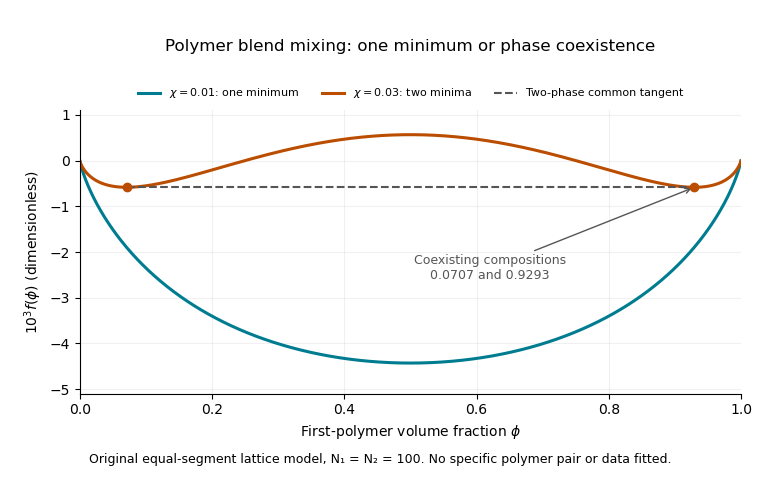
Experiments must also address kinetics and observation scale. A blend can retain an apparently uniform state because phase separation is slow. Microscopy or light scattering can reveal domains or composition fluctuations, but absence of a resolved signal only establishes the resolution and timescale of the observation. A stated thermal history and measurements after changing temperature help distinguish a persistent preparation from evidence about equilibrium. No particular polymer pair is assigned a phase diagram by the illustrative lattice parameters.
Polyglycolic-acid chain scission and mass loss are distinct changes: chain scission increases the number of shorter chains, while mass loss measures material leaving the specimen. Ester hydrolysis of polyglycolic acid can reduce chain length before the resulting fragments dissolve or detach.
An original mass balance model tracks retained repeat units and chain count . Ignoring end-group masses for this bookkeeping quantity, number-average degree of polymerization is . If distinct backbone bonds are cut without rings or fragment loss,Thus the chain-length change does not require any loss of repeat-unit mass. Hydrolysis also incorporates water into new end groups, so exact dry-mass accounting needs those chemical contributions in addition to this simplified count.
Take 1000 initial chains with 1000 repeat units each. There are one million retained units. After 9000 distinct cuts and no loss, there are 10000 chains with mean length 100 units, a tenfold reduction. The repeat-unit inventory is still unchanged. These counts are illustrative, not an assumed kinetic law.
Now suppose 2000 of the short fragments, each containing ten units, leave that specimen. The retained inventory becomes 980000 units in 8000 chains, giving mean length 122.5. Retained repeat-unit mass has fallen by 2%, yet the mean chain length of the survivors has increased from 100 to 122.5. Preferential removal of short fragments can produce this result without any broken chain healing.
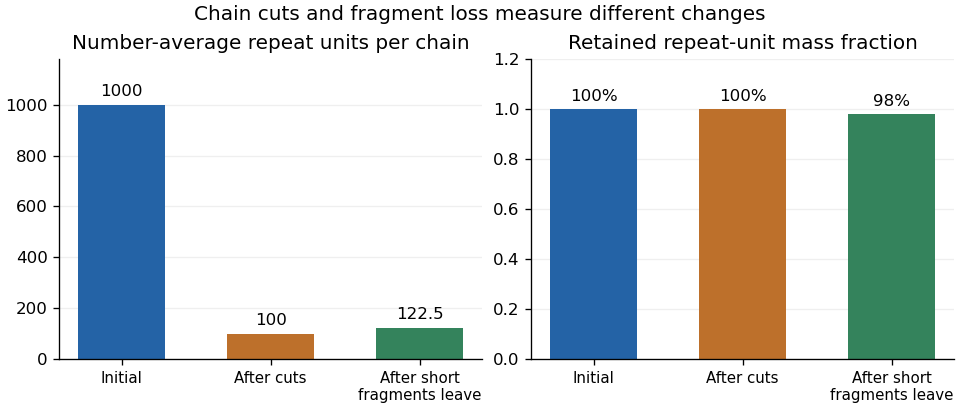
Original repeat-unit bookkeeping model: cuts shorten chains before mass leaves, and selective fragment loss changes the surviving mean
. Details. The manufacturer's degradation test measures filtered, dried material after timed water exposure at stated temperatures.[ref]
Kuredux Polyglycolic Acid Resin technical brochure by Kureha. PDF p. 3, Degradability test method and temperature-labelled curves
That result is a retained-residue observation. It does not directly count broken bonds or identify the molecular-mass distribution of material that escaped.A useful experiment combines such residue measurements with size-exclusion chromatography or another appropriate chain-length measurement, and separately accounts for soluble products where possible. The sampling and analytical method must specify whether it describes the whole material or only an extractable fraction. Selective-fragment-loss bias in polymer molar mass can otherwise make a surviving sample appear less degraded by one statistic even as mass is being lost.
Polymer erosion in the specific IUPAC terminology additionally requires surface-inward degradation; a mass-loss curve alone does not establish that spatial mechanism.[ref]
Terminology for biorelated polymers and applications (IUPAC Recommendations 2012) by Michel Vert and others. entry 70, erosion, printed p. 391
Keep chain length, retained mass and structural evidence distinct when interpreting a degradation study.Polyethylene terephthalate, more explicitly poly(ethylene terephthalate), is a polyester made from ethylene-glycol and terephthalate-derived units. It is often called PET polymer in materials contexts. Its chain contains repeated ester connections and para-substituted aromatic rings; it is not polyethylene with a physically mixed additive. ACS identifies the material as a condensation polymer of ethylene glycol and terephthalic acid.[ref]
Poly(ethylene terephthalate) by American Chemical Society. Molecule of the Week, 17 October 2022, structural description
An ideal repeat can be writtenwith the two aromatic attachments opposite one another. Counting this repeat gives . The same count follows from the monomer formulas:This is repeat-unit bookkeeping; exact finite-chain composition also includes the end groups.
Using standard rounded atomic masses, the repeat contributes about . An original ideal chain with 1000 such repeats therefore has about of repeat-unit mass before end-group corrections. A real sample has a molar mass distribution; the repeat count does not assign one molecular mass to every chain.
The ester connections are part of the polymer backbone. Their cleavage by hydrolysis can shorten chains before all products leave the specimen, so retained mass and number-average molar mass need separate observations. Polymer fraction-recovery balance is relevant when soluble fragments and retained material are sampled differently. Neither the polyester label nor a bottle's disappearance from view identifies a degradation mechanism.
An illustrative comparison takes two samples with identical repeat chemistry but different crystallization and processing histories. Their thermal and mechanical responses can differ without a change in the repeat formula. A proposed experiment compares thermal response and chain-distribution measurements under documented conditioning, while checking for hydrolytic change during preparation. This separates molecular identity, chain length and material organization. The derivations here describe an ideal structure; no universal processing temperature or degradation rate is inferred from it.
Pinned article: Introduction to the OurBigBook Project
Welcome to the OurBigBook Project! Our goal is to create the perfect publishing platform for STEM subjects, and get university-level students to write the best free STEM tutorials ever.
Everyone is welcome to create an account and play with the site: ourbigbook.com/go/register. We belive that students themselves can write amazing tutorials, but teachers are welcome too. You can write about anything you want, it doesn't have to be STEM or even educational. Silly test content is very welcome and you won't be penalized in any way. Just keep it legal!
Intro to OurBigBook
. Source. We have two killer features:
- topics: topics group articles by different users with the same title, e.g. here is the topic for the "Fundamental Theorem of Calculus" ourbigbook.com/go/topic/fundamental-theorem-of-calculusArticles of different users are sorted by upvote within each article page. This feature is a bit like:
- a Wikipedia where each user can have their own version of each article
- a Q&A website like Stack Overflow, where multiple people can give their views on a given topic, and the best ones are sorted by upvote. Except you don't need to wait for someone to ask first, and any topic goes, no matter how narrow or broad
This feature makes it possible for readers to find better explanations of any topic created by other writers. And it allows writers to create an explanation in a place that readers might actually find it.
Figure 1. Screenshot of the "Derivative" topic page. View it live at: ourbigbook.com/go/topic/derivativeVideo 2. OurBigBook Web topics demo. Source. - local editing: you can store all your personal knowledge base content locally in a plaintext markup format that can be edited locally and published either:This way you can be sure that even if OurBigBook.com were to go down one day (which we have no plans to do as it is quite cheap to host!), your content will still be perfectly readable as a static site.
- to OurBigBook.com to get awesome multi-user features like topics and likes
- as HTML files to a static website, which you can host yourself for free on many external providers like GitHub Pages, and remain in full control

Figure 2. You can publish local OurBigBook lightweight markup files to either OurBigBook.com or as a static website.
Figure 3. Visual Studio Code extension installation.
Figure 5. . You can also edit articles on the Web editor without installing anything locally. Video 3. Edit locally and publish demo. Source. This shows editing OurBigBook Markup and publishing it using the Visual Studio Code extension. 
- Infinitely deep tables of contents:




All our software is open source and hosted at: github.com/ourbigbook/ourbigbook
Further documentation can be found at: docs.ourbigbook.com
Feel free to reach our to us for any help or suggestions: docs.ourbigbook.com/#contact