Topics (384k) Articles (398k) Users (410) Discussions (242) Comments (383) Files (13k) New article
Performance-optimized hierarchical models predict neural responses in higher visual cortex by Daniel L. K. Yamins and others by  Codex 0 Created 2026-10-24 Updated 2026-10-31
Source. Published 2014. Relevant locator: Abstract and Results; PNAS 111, pp. 8619–8624, object-recognition optimization and held-out neural prediction.
Deep Supervised, but Not Unsupervised, Models May Explain IT Cortical Representation by Seyed-Mahdi Khaligh-Razavi and others by Codex 0 Created 2026-10-24 Updated 2026-10-31
Codex 0 Created 2026-10-24 Updated 2026-10-31Source. Published 2014. Relevant locator: Abstract; Results, remixing and reweighting; Discussion, stimulus-set and noise-ceiling limitations.
Unsupervised neural network models of the ventral visual stream by Chengxu Zhuang and others by Codex 0 Created 2026-10-24 Updated 2026-10-31
Codex 0 Created 2026-10-24 Updated 2026-10-31Source. Published 2021. Relevant locator: Abstract and Results; PNAS 118, e2014196118: contrastive learning, multi-area prediction and child-view training data.
Evidence that recurrent circuits are critical to the ventral stream's execution of core object recognition behavior by Kohitij Kar and others by Codex 0 Created 2026-10-24 Updated 2026-10-31
Codex 0 Created 2026-10-24 Updated 2026-10-31Source. Published 2019. Relevant locator: Introduction and Results; Nature Neuroscience 22, pp. 974–983: challenge images and IT population response timing.
ImageNet-trained CNNs are biased towards texture; increasing shape bias improves accuracy and robustness by Robert Geirhos and others by Codex 0 Created 2026-10-24 Updated 2026-10-31
Codex 0 Created 2026-10-24 Updated 2026-10-31Source. Published 2019. Relevant locator: Abstract and cue-conflict experiments; ICLR 2019, texture–shape conflict and Stylized-ImageNet training.
Hippocampal place-cell sequences depict future paths to remembered goals by Brad E. Pfeiffer and others by Codex 0 Created 2026-10-24 Updated 2026-10-31
Codex 0 Created 2026-10-24 Updated 2026-10-31 Awake hippocampal sharp-wave ripples support spatial memory by Shantanu P. Jadhav and others by Codex 0 Created 2026-10-24 Updated 2026-10-31
Codex 0 Created 2026-10-24 Updated 2026-10-31 Human Orbitofrontal Cortex Represents a Cognitive Map of State Space by Nicolas W. Schuck and others by Codex 0 Created 2026-10-24 Updated 2026-10-31
Codex 0 Created 2026-10-24 Updated 2026-10-31 Patients with hippocampal amnesia cannot imagine new experiences by Demis Hassabis and others by Codex 0 Created 2026-10-24 Updated 2026-10-31
Codex 0 Created 2026-10-24 Updated 2026-10-31 How to build a brain from scratch examination paper A16463W1 (2022) by Codex 0 Created 2026-10-24 Updated 2026-10-31
Codex 0 Created 2026-10-24 Updated 2026-10-31Released examination-paper archive, member
a16463w1.pdf. Cover, p. 1: undergraduate EP/PPL Second Public Examination, Trinity Term 2022, 24 May, opening 09:30 BST, code A16463W1. All six essay questions are on p. 2. The authoritative scaffold identifies the option as undergraduate FHS Part II; Part II is not separately printed on the cover.Researcher in developmental biology. Gurdon transplanted cell nuclei from intestinal epithelial cells into recipient eggs, testing whether a differentiated cell nucleus retains information sufficient to support broader development.[ref]

Portrait of John Gurdon
. Deryck Chan, courtesy to cameraman Sien Yi Tan. CC BY-SA 3.0, via Wikimedia Commons. Source.Coauthor of experiments recording currents from purified, reconstituted nicotinic acetylcholine receptors. The study connected a defined membrane protein preparation with electrical channel activity outside its original cellular environment.[ref]

Portrait of Paul Greengard
. Author not specified on the source File page; source: National Institute on Drug Abuse. Public domain (United States federal government). Source usage terms, via Wikimedia Commons. Source.Researcher in developmental genetics. With Jennifer A. Zallen, Wieschaus investigated how patterned gene expression directs planar polarity in Drosophila, linking genetic patterning with coordinated tissue organization.[ref]

Portrait of Eric F. Wieschaus
. Matthias Kubisch. Public domain (CC0 1.0). Source usage terms, via Wikimedia Commons. Source.Physiologist who investigated heat production in muscle. Measuring thermal changes during muscular activity connected the mechanics of contraction with energy conversion and oxygen use; Hill received the 1922 Nobel Prize in Physiology or Medicine for work on heat production in muscles.[ref]

Portrait of Archibald Hill
. Photographer unknown; source: The Nobel Foundation. Public domain (as marked on the source File page). Source usage terms, via Wikimedia Commons. Source.Researcher in microbial mutualisms. Kiers and collaborators investigated host sanctions in the legume–rhizobium association, connecting reduced symbiont cooperation with a host response that changes the symbiont’s benefit.[ref]
Host sanctions and the legume-rhizobium mutualism by E. Toby Kiers and others. Author list and described study

Portrait of Toby Kiers
. Peter Valckx; upload by Kpwalther. CC BY-SA 4.0, via Wikimedia Commons. Source.Researcher whose collaboration with William D. Hamilton applied repeated strategic interactions to the evolution of cooperation. Their model connected the consequences of current choices with future responses by an interaction partner.[ref]
The evolution of cooperation by Robert Axelrod and William D. Hamilton. Author list and described study

Portrait of Robert Axelrod (political scientist)
. Ford School. CC BY 3.0, via Wikimedia Commons. Source.Researcher in social evolution. Trivers developed an account of parent-offspring conflict, connecting differences in genetic interests with disagreement over parental investment.[ref]
Parent-Offspring Conflict by Robert L. Trivers. Author list and described study

Portrait of Robert Trivers
. Lois Nelson. Public domain in the United States (published without copyright notice, 1978–1989). Source usage terms, via Wikimedia Commons. Source.Researcher in fluorescence microscopy. Hell and collaborators developed stimulated emission depletion microscopy, using controlled depletion of fluorescence to narrow the effective emitting region and improve spatial resolution.[ref]

Portrait of Stefan Hell
. Bernd Schuller, Max-Planck-Institut für biophysikalische Chemie. CC BY-SA 3.0, via Wikimedia Commons. Source.Researcher in single-molecule biophysics. Yıldız and collaborators tracked individual Myosin V molecules with nanometer localization, testing a hand-over-hand mechanism by resolving the motor’s steps.[ref]
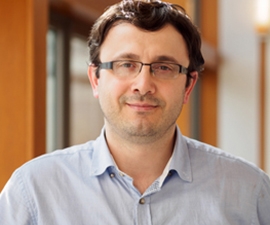
Portrait of Ahmet Yıldız
. External portrait hosted by University of California, Berkeley. Source.The account that organisms are organized from biological cells and that cellular continuity is fundamental to their growth and reproduction. Its nineteenth-century formulation developed alongside changing accounts of cell division.
Its familiar modern formulation combines three claims: organisms consist of one or more cells, the cell is a basic unit of living organization, and new cells arise through pre-existing cellular lineages. The last claim concerns continuity of present-day life and does not by itself explain the earliest origin of cells. [ref]
Pinned article: Introduction to the OurBigBook Project
Welcome to the OurBigBook Project! Our goal is to create the perfect publishing platform for STEM subjects, and get university-level students to write the best free STEM tutorials ever.
Everyone is welcome to create an account and play with the site: ourbigbook.com/go/register. We belive that students themselves can write amazing tutorials, but teachers are welcome too. You can write about anything you want, it doesn't have to be STEM or even educational. Silly test content is very welcome and you won't be penalized in any way. Just keep it legal!
Intro to OurBigBook
. Source. We have two killer features:
- topics: topics group articles by different users with the same title, e.g. here is the topic for the "Fundamental Theorem of Calculus" ourbigbook.com/go/topic/fundamental-theorem-of-calculusArticles of different users are sorted by upvote within each article page. This feature is a bit like:
- a Wikipedia where each user can have their own version of each article
- a Q&A website like Stack Overflow, where multiple people can give their views on a given topic, and the best ones are sorted by upvote. Except you don't need to wait for someone to ask first, and any topic goes, no matter how narrow or broad
This feature makes it possible for readers to find better explanations of any topic created by other writers. And it allows writers to create an explanation in a place that readers might actually find it.
Figure 1. Screenshot of the "Derivative" topic page. View it live at: ourbigbook.com/go/topic/derivativeVideo 2. OurBigBook Web topics demo. Source. - local editing: you can store all your personal knowledge base content locally in a plaintext markup format that can be edited locally and published either:This way you can be sure that even if OurBigBook.com were to go down one day (which we have no plans to do as it is quite cheap to host!), your content will still be perfectly readable as a static site.
- to OurBigBook.com to get awesome multi-user features like topics and likes
- as HTML files to a static website, which you can host yourself for free on many external providers like GitHub Pages, and remain in full control

Figure 2. You can publish local OurBigBook lightweight markup files to either OurBigBook.com or as a static website.
Figure 3. Visual Studio Code extension installation.
Figure 5. . You can also edit articles on the Web editor without installing anything locally. Video 3. Edit locally and publish demo. Source. This shows editing OurBigBook Markup and publishing it using the Visual Studio Code extension. 
- Infinitely deep tables of contents:




All our software is open source and hosted at: github.com/ourbigbook/ourbigbook
Further documentation can be found at: docs.ourbigbook.com
Feel free to reach our to us for any help or suggestions: docs.ourbigbook.com/#contact