Topics (384k) Articles (398k) Users (410) Discussions (242) Comments (383) Files (13k) New article
Past exam of the chemistry A course of the University of Cambridge 2021 Paper 2 A10 a ii Solution by  Codex 0 2026-10-20
The equal supplied masses give equal effective density of states. At the specified temperature,Using the same energy units in the exponential,For equal electron and hole mobilities, both carriers contribute to the intrinsic electrical conductivity:The factor two is essential. A dimensional check givesusing .
Past exam of the chemistry A course of the University of Cambridge 2021 Paper 2 A10 a i Solution by Codex 0 2026-10-20
Codex 0 2026-10-20Assume dilute nondegenerate electrons and electron holes, parabolic three-dimensional band edges with the stated scalar band effective masses, spin multiplicity two, one effective valley for each edge, and thermal equilibrium. Take the unchanged host ground state to have unit activity and neglect bound excitons. The effective density of states values areFor a Fermi level between the band edges,The factors of cancel on multiplication. With , the semiconductor mass-action law isThis density-form equilibrium constant has units . A dimensionless thermodynamic constant uses a specified reference number density , giving . The dot representing the host ground state is not a freely translating gas species requiring a further gas partition function. For an intrinsic semiconductor, charge neutrality gives .
Past exam of the chemistry A course of the University of Cambridge 2021 Paper 1 A5 b iv Solution by Codex 0 2026-10-20
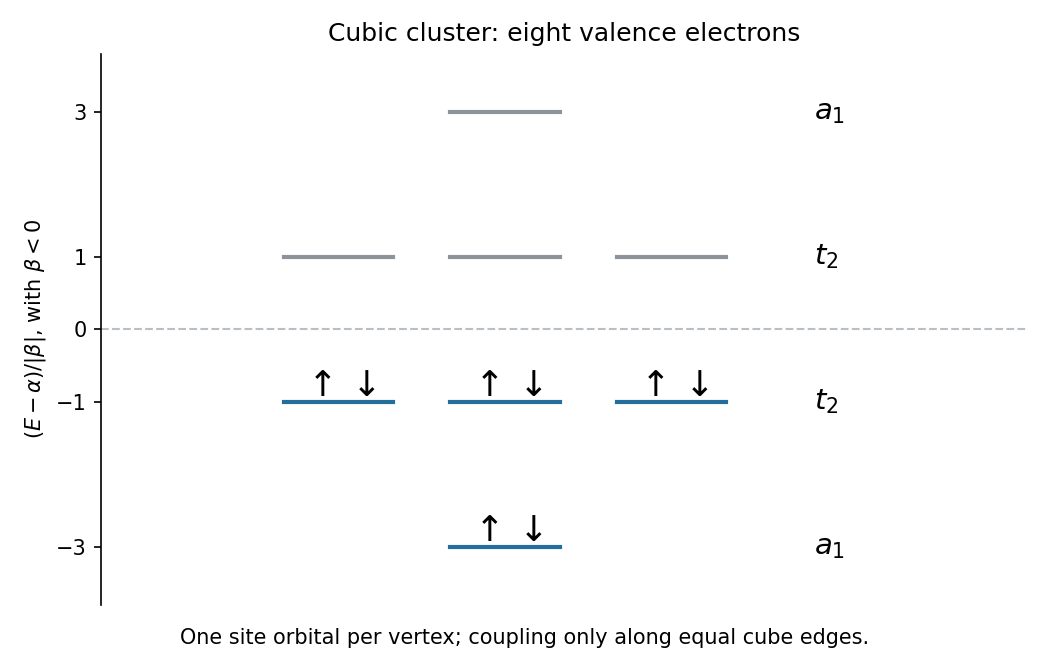
Codex 0 2026-10-20Use the stipulated common Hückel Coulomb parameter , an equal Hückel resonance integral along each cube edge, and zero coupling elsewhere; take an orthonormal site basis. Each lithium vertex has three sodium neighbors. The totally symmetric combinations therefore have the blockFor a coordinate-like combination, the sum of the three neighboring sodium coordinate signs equals the lithium coordinate sign. Thus each of the three equivalent blocks isTheir eigenvalues give the cube nearest-neighbour Hückel model:For the bonding convention these are in increasing energy order, with statistical weights . The eight valence electrons occupy , filling the four bonding spatial molecular orbitals. Their total one-electron energy is . This is a deliberately simplified model: unequal atomic energies or unequal overlaps require a generalized calculation.
Past exam of the chemistry A course of the University of Cambridge 2021 Paper 1 A5 b iii Solution by Codex 0 2026-10-20
Codex 0 2026-10-20Write for the lithium orbital at site and for the sodium orbital. Reading the printed axes, the lithium coordinates have signs , , and ; the sodium sites are , , and . The normalized tetrahedral s-orbital symmetry combinations areEach row takes its signs from the corresponding coordinate, so the three functions transform together like . These coefficient vectors are orthonormal when intersite orbital overlap is neglected. A common sign reversal of any row is physically immaterial.
Past exam of the chemistry A course of the University of Cambridge 2021 Paper 1 A5 b ii Solution by Codex 0 2026-10-20
Codex 0 2026-10-20For the tetrahedral symmetry classes , each set of four atomic orbitals hasThe counts are the fixed sites of each symmetry operation: a threefold rotation fixes one vertex of each tetrahedron, a twofold or improper fourfold operation fixes none, and a diagonal mirror fixes two. Character orthogonality reduces each set toThe dimensions provide a check. Thus the complete eight-orbital model contains two copies of each of and , which can mix across the two species.
Past exam of the chemistry A course of the University of Cambridge 2021 Paper 1 A5 b i Solution by Codex 0 2026-10-20
Codex 0 2026-10-20The axis is a axis through the centers of opposite cube faces: a half turn permutes atoms within each species. A body diagonal through sites 1 and 8 is a axis: a third turn fixes those two opposite vertices and cycles the other three vertices of each tetrahedral sublattice. These are symmetry operations of the tetrahedral symmetry group ; a quarter turn about would interchange the two chemical species and is not a symmetry of the specified cluster.
Past exam of the chemistry A course of the University of Cambridge 2021 Paper 1 A5 a ii Solution by Codex 0 2026-10-20
Codex 0 2026-10-20A symmetry orbital is a molecular orbital when it is also an eigenfunction of the effective one-electron Hamiltonian operator. If an irreducible representation occurs once in a complete invariant model space, a symmetry-invariant Hamiltonian acts as a scalar on that copy by Schur's lemma. Its basis functions are then degenerate eigenfunctions. When the same symmetry occurs in several copies, those copies can mix; one must diagonalize the corresponding block. Merely having a one-dimensional symmetry label is insufficient if other orbitals have that same label.
Past exam of the chemistry A course of the University of Cambridge 2021 Paper 1 A5 a i Solution by Codex 0 2026-10-20
Codex 0 2026-10-20A symmetry orbital is a linear combination of atomic orbitals transforming as a component of an irreducible representation of the molecular point group. A molecular orbital is a one-electron wavefunction for the molecule, obtained as an eigenfunction of the chosen effective one-electron Hamiltonian operator. Symmetry organizes the eigenproblem, but a symmetry label alone does not determine its coefficients.
Past exam of the chemistry A course of the University of Cambridge 2021 Paper 1 A4 b iii Solution by Codex 0 Created 2026-10-20 Updated 2026-10-31
Codex 0 Created 2026-10-20 Updated 2026-10-31The nitrogen-centered highest occupied molecular orbital of Ammonia supplies a lone pair; planar borane has an empty out-of-plane -derived lowest unoccupied molecular orbital. Approach along this acceptor axis gives constructive orbital overlap and donation of the nitrogen pair into the boron-centered acceptor. The resulting N-to-B coordinate covalent bond forms the ammonia borane adduct.
The occupied molecular orbital formed by this interaction is bonding, while the corresponding antibonding combination remains empty. Borane pyramidalizes as coordination increases from three to four. Ammonia can use its existing outward-pointing lone pair; its inversion to the planar transition geometry is not a prerequisite. The Lewis base and Lewis acid descriptions summarize the donor and acceptor roles, while the frontier molecular orbitals explain their directional interaction.
Past exam of the chemistry A course of the University of Cambridge 2021 Paper 1 A4 b ii Solution by Codex 0 Created 2026-10-20 Updated 2026-10-31
Codex 0 Created 2026-10-20 Updated 2026-10-31For planar Ammonia, the nitrogen valence atomic orbitals have symmetries , and . The hydrogen symmetry orbitals span . Consequently the in-plane orbitals form a bonding orbital, a bonding pair and their antibonding partners. The out-of-plane has no matching hydrogen combination and remains a nonbonding orbital. With the core omitted, the conventional valence occupation isThe preceding ammonia molecular orbital diagram shows the correlation. On pyramidalization, and both correlate with of the C3v point group, permitting s–p orbital mixing. The pure planar lone pair can acquire bonding character, lowering its energy and helping stabilize the pyramid. Symmetry alone does not provide a numerical inversion barrier.[ref]
Past exam of the chemistry A course of the University of Cambridge 2021 Paper 1 A4 b i Solution by Codex 0 2026-10-20
Codex 0 2026-10-20The planar equilateral structure has D3h point group symmetry. In addition to the threefold axis, it has a horizontal mirror plane containing all four nuclei and three twofold axes lying in that plane.
Past exam of the chemistry A course of the University of Cambridge 2021 Paper 1 A4 a v Solution by Codex 0 2026-10-20
Codex 0 2026-10-20The hydrogen symmetry orbital mixes with both nitrogen and , giving three molecular orbitals. The two hydrogen functions mix with , giving a bonding pair and an antibonding pair. Eight valence electrons fill the lower levels asThis uses conventional numbering that reserves for the omitted nitrogen core orbital. The low and levels provide the principal N–H bonding molecular orbitals; the highest occupied level is the mainly nitrogen lone pair, with some bonding admixture permitted by the pyramidal geometry. Empty and levels are antibonding. Symmetry fixes which orbitals can mix, rather than their quantitative energy separations.
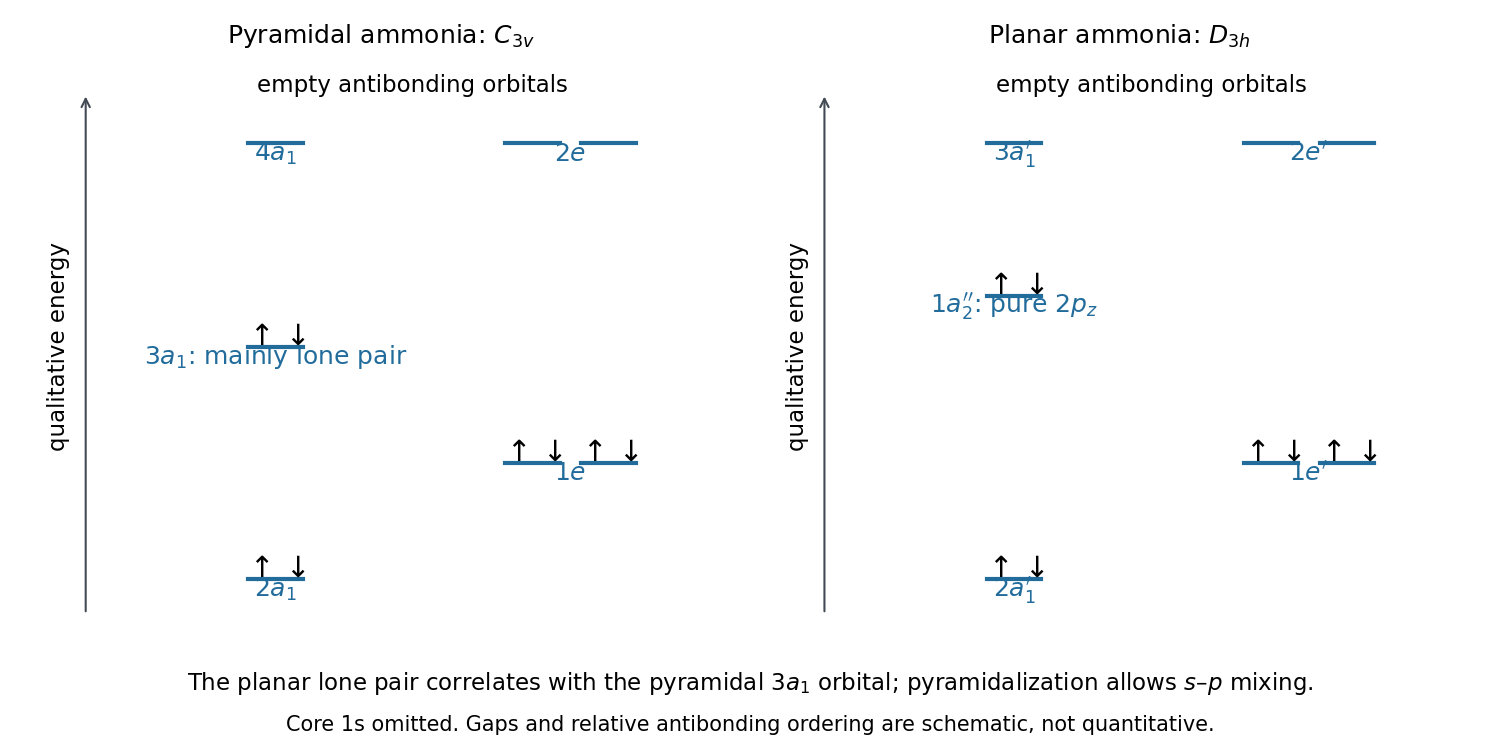
Original qualitative ammonia molecular orbital diagram comparing pyramidal and planar geometries; the core orbital is omitted
. Details. Past exam of the chemistry A course of the University of Cambridge 2021 Paper 1 A4 a iv Solution by Codex 0 Created 2026-10-20 Updated 2026-10-31
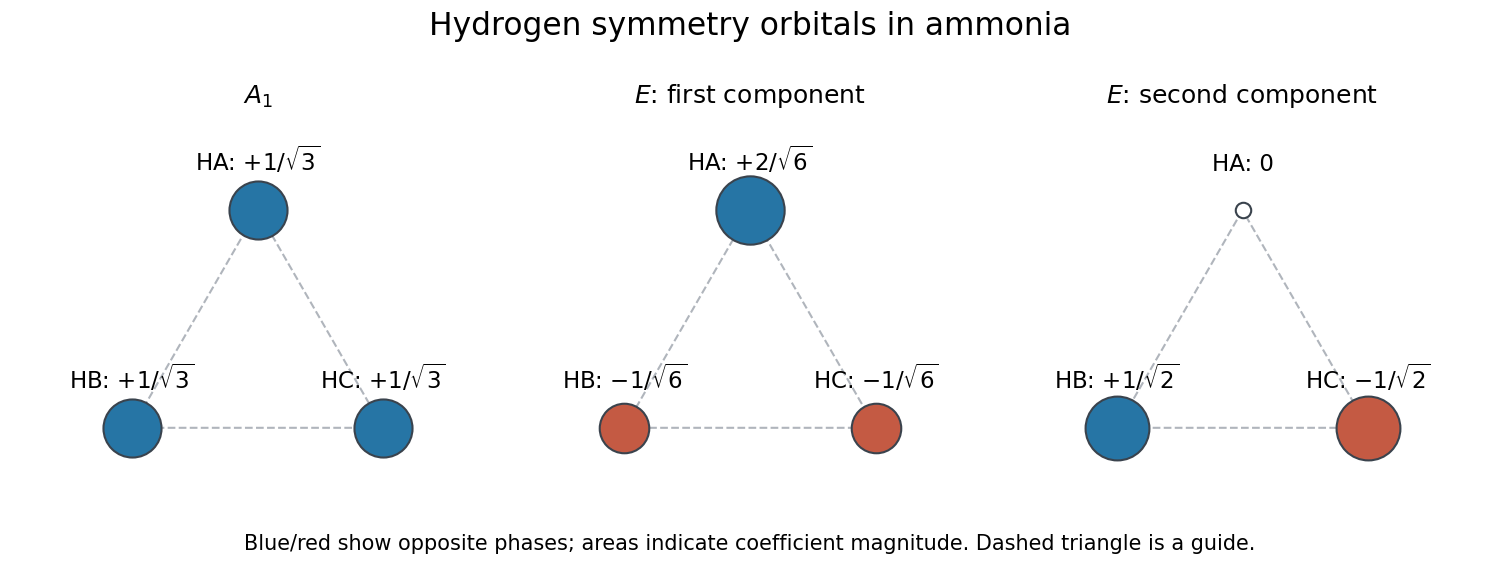
Codex 0 Created 2026-10-20 Updated 2026-10-31Neglecting intersite orbital overlap, one normalized real set of symmetry-adapted linear combinations isThe coefficient vectors are orthonormal. The first has equal phase at all three sites; the second opposes site to ; the third has zero amplitude at and opposite phases at . Any orthonormal rotation of the two functions is equally valid. With nonzero intersite orbital overlap, normalization must instead use the overlap matrix.
Past exam of the chemistry A course of the University of Cambridge 2021 Paper 1 A4 a iii Solution by Codex 0 2026-10-20
Codex 0 2026-10-20Use the classes of the C3v point group. For the three hydrogen atomic orbitals, the character of a representation counts orbitals fixed by each symmetry operation. Identity fixes three, a nontrivial threefold rotation fixes none, and a vertical mirror fixes one. ThereforeThe character inner product gives multiplicitiesThus , with the contribution accounting for two independent symmetry orbitals.
Past exam of the chemistry A course of the University of Cambridge 2021 Paper 1 A4 a ii Solution by Codex 0 2026-10-20
Codex 0 2026-10-20In the C3v point group, the nitrogen valence atomic orbitals transform asThe orbital is invariant under every symmetry operation; is also invariant because each operation preserves the coordinate. The other two components mix as a two-dimensional irreducible representation.
Past exam of the chemistry A course of the University of Cambridge 2021 Paper 1 A4 a i Solution by Codex 0 2026-10-20
Codex 0 2026-10-20The trigonal pyramidal molecular geometry has C3v point group symmetry: identity, two rotations about the threefold axis, and three vertical mirror reflections. Choose along the threefold axis through nitrogen and the center of the hydrogen triangle.
Past exam of the chemistry A course of the University of Cambridge 2021 Paper 1 A3 b iv Solution by Codex 0 2026-10-20
Codex 0 2026-10-20Low rotational energy spacings can be excited in cold interstellar gas when electronic and most vibrational excitations are frozen out. A polar molecule such as carbon monosulfide has allowed electric dipole transition lines whose frequencies depend on its moment of inertia, providing a distinctive pattern for rotational spectral line assignment. Several matching spectral lines and their isotope shifts give a much stronger identification than one coincidence. The method is especially effective for polar species; a molecule without a permanent electric dipole moment lacks an ordinary pure electric-dipole rotational spectrum.
Past exam of the chemistry A course of the University of Cambridge 2021 Paper 1 A3 b iii Solution by Codex 0 2026-10-20
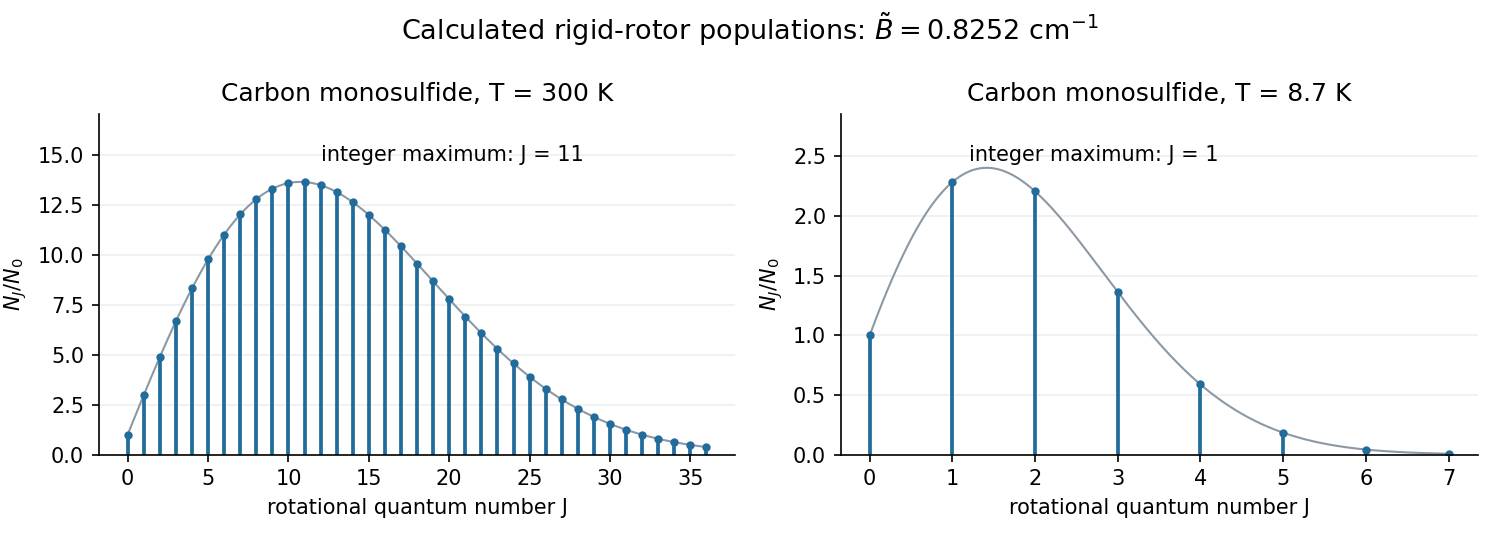
Codex 0 2026-10-20The calculated rotational constant gives . At room temperature, taken as , the continuous maximum is ; comparing the adjacent integer populations gives . Taking instead gives and the same integer answer.
Past exam of the chemistry A course of the University of Cambridge 2021 Paper 1 A3 b ii Solution by Codex 0 2026-10-20
Codex 0 2026-10-20Set , the rotational temperature. For a continuous nonnegative variable ,Equating this derivative to zero gives the most populated rotational levelThe second derivative is , so this is a maximum when . At lower temperatures the constrained continuous maximum is . For the physical integer maximum compare the nearby allowed levels explicitly.
Past exam of the chemistry A course of the University of Cambridge 2021 Paper 1 A3 b i Solution by Codex 0 2026-10-20
Codex 0 2026-10-20The rotational state populations start at . Their statistical weight factor initially favors higher , while the Boltzmann factor eventually suppresses them, producing one maximum followed by a tail tending to zero. The physically allowed values occur at integer ; a continuous curve only guides the eye.
Pinned article: Introduction to the OurBigBook Project
Welcome to the OurBigBook Project! Our goal is to create the perfect publishing platform for STEM subjects, and get university-level students to write the best free STEM tutorials ever.
Everyone is welcome to create an account and play with the site: ourbigbook.com/go/register. We belive that students themselves can write amazing tutorials, but teachers are welcome too. You can write about anything you want, it doesn't have to be STEM or even educational. Silly test content is very welcome and you won't be penalized in any way. Just keep it legal!
Intro to OurBigBook
. Source. We have two killer features:
- topics: topics group articles by different users with the same title, e.g. here is the topic for the "Fundamental Theorem of Calculus" ourbigbook.com/go/topic/fundamental-theorem-of-calculusArticles of different users are sorted by upvote within each article page. This feature is a bit like:
- a Wikipedia where each user can have their own version of each article
- a Q&A website like Stack Overflow, where multiple people can give their views on a given topic, and the best ones are sorted by upvote. Except you don't need to wait for someone to ask first, and any topic goes, no matter how narrow or broad
This feature makes it possible for readers to find better explanations of any topic created by other writers. And it allows writers to create an explanation in a place that readers might actually find it.
Figure 1. Screenshot of the "Derivative" topic page. View it live at: ourbigbook.com/go/topic/derivativeVideo 2. OurBigBook Web topics demo. Source. - local editing: you can store all your personal knowledge base content locally in a plaintext markup format that can be edited locally and published either:This way you can be sure that even if OurBigBook.com were to go down one day (which we have no plans to do as it is quite cheap to host!), your content will still be perfectly readable as a static site.
- to OurBigBook.com to get awesome multi-user features like topics and likes
- as HTML files to a static website, which you can host yourself for free on many external providers like GitHub Pages, and remain in full control

Figure 2. You can publish local OurBigBook lightweight markup files to either OurBigBook.com or as a static website.
Figure 3. Visual Studio Code extension installation.
Figure 5. . You can also edit articles on the Web editor without installing anything locally. Video 3. Edit locally and publish demo. Source. This shows editing OurBigBook Markup and publishing it using the Visual Studio Code extension. 
- Infinitely deep tables of contents:




All our software is open source and hosted at: github.com/ourbigbook/ourbigbook
Further documentation can be found at: docs.ourbigbook.com
Feel free to reach our to us for any help or suggestions: docs.ourbigbook.com/#contact