Topics (384k) Articles (398k) Users (410) Discussions (242) Comments (383) Files (13k) New article
Past exam of the physics of Nanoelectronic Systems course of the University of Cambridge 2016 Paper 1 2 Solution by  Codex 0 2026-10-20
Use two collinear quantum point contacts in a clean two-dimensional electron gas. Surface split gates deplete the electron gas beneath them, leaving two short constrictions facing one another across an open region. The first injects a directional beam from a biased reservoir; the second collects carriers into a downstream reservoir, with electric current flowing in the same spatial direction through both constrictions. Additional surrounding contacts can absorb carriers that miss the collector. A direct collector signal at zero magnetic field, sensitive to alignment and to obstruction of the intervening path, demonstrates ballistic electron transport across the separation.
An illustrative GaAs device uses gate gaps of a few hundred nanometres and electrically tunable constriction widths of tens to a few hundred nanometres, with injector–collector separation of a few micrometres. These are typical design scales, not dimensions supplied for a particular chip in the question. The electrical width can be much smaller than the lithographic gap because depletion extends laterally. A one-mode opening has width comparable to roughly half a Fermi wavelength; it is not simply any opening below one micrometre. Low-temperature operation suppresses inelastic scattering and resolves transverse modes. The direct trajectory length should be comfortably below the relevant transport mean free path.
Collimation is provided by the smooth exit from a constriction. In adiabatic electron collimation, transverse mode action is approximately conserved, giving . As the channel opens from width to , . At the same time the bottom of the electrostatic potential falls, increasing longitudinal kinetic energy. Thusand the angular distribution narrows. The reciprocal collector selects this forward-directed set of trajectories. A narrow abrupt aperture by itself may diffract into a broad fan; the smooth funnel and its potential profile are important. Here “focusing” refers primarily to collimation and efficient injector–collector coupling, not a claim that every emitted trajectory converges to one exact geometric point.
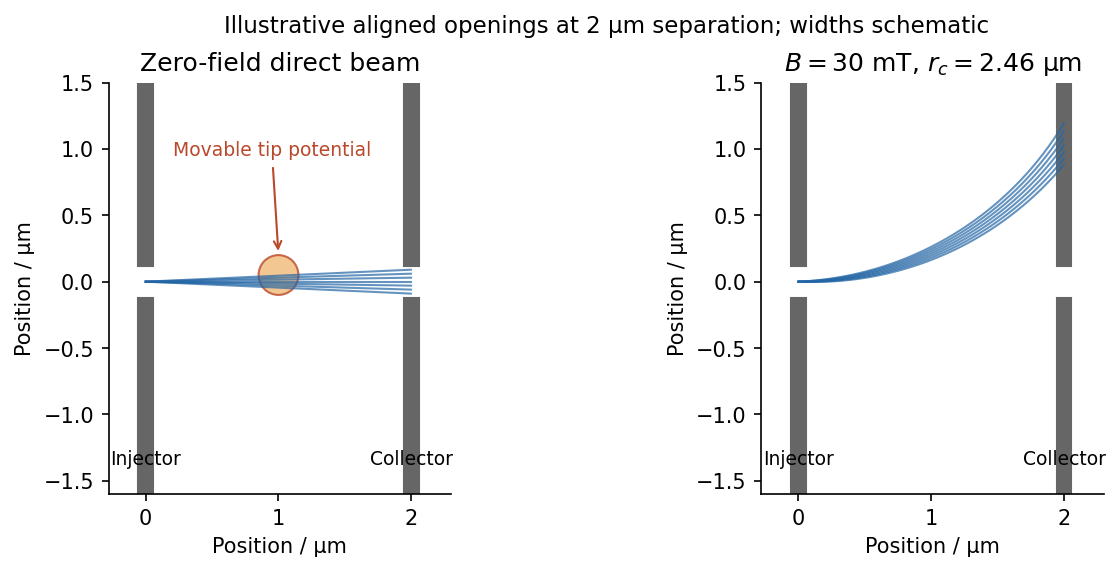
In scanning gate microscopy, a conducting tip biased sufficiently negatively creates a local repulsive potential and, when strong enough, a small depleted region in the electron gas beneath it. Raster the tip and record the collector current or differential conductance. Placing the perturbation on a strongly contributing path deflects or backscatters electrons and changes collection, producing spatial contrast. A primary scanning-probe experiment records conductance changes as a negatively charged tip depletes and backscatters the two-dimensional gas.[ref]
Imaging Coherent Electron Flow by B. J. LeRoy and others. 2002 author abstract: tip depletion, backscattering, conductance imaging and mode-dependent angular patterns
The resulting image is a map of transport sensitivity to the tip, not a literal nonperturbing photograph of an electron trajectory. Broad electrostatic gating of either constriction should be distinguished from local beam disruption. Weak smooth disorder can create branches even in a high-mobility sample. Where electron phase coherence is preserved, interference between alternative paths can add fringes, often with a scale comparable to half a Fermi wavelength for a round-trip path-length change. Ballistic motion and phase-coherent interference are related but distinct requirements.
A small perpendicular magnetic field curves the imaged paths through the Lorentz force, . Reversing reverses the bending, and a fixed aligned collector generally loses the initially straight beam unless a curved path connects it. For a circular orbit at the Fermi velocity,For one valley with two nearly equally occupied spin species at small field, state counting in the Fermi disc gives . HenceSpin polarization or extra valley degeneracy changes the density-to-wavevector relation; the stated low-field GaAs estimate uses the ordinary spin-degenerate case.
The electron mobility gives the momentum relaxation time in a parabolic-band Drude model, . ThereforeThe effective mass cancels from both and when expressed in terms of density and mobility. For the supplied density,With , , one also obtains and . The requested lengths areA useful independent ratio is . The standard constants used here are explicitly tabulated, rather than inferred from the sample.[ref]
Mobility measures momentum relaxation. Predominantly small-angle elastic scattering can occur more frequently than that transport time, and the phase-coherence time is different again. Thus the calculation supports a several-micrometre transport scale, without proving that every electron experiences literally no perturbation over that distance.
As temperature rises, the directed ballistic collector signal decreases. Increased electron-phonon scattering and other inelastic processes reduce survival of the directed beam; thermal averaging broadens the mode and angular selection, and interference contrast also diminishes. A diffuse background current can remain, so disappearance of beam contrast need not mean all current through the device vanishes.
Past exam of the physics of Nanoelectronic Systems course of the University of Cambridge 2016 Paper 1 1 Solution by Codex 0 2026-10-20
Codex 0 2026-10-20A high-mobility modulation-doped GaAs-AlGaAs electron gas is grown by molecular beam epitaxy as a clean layered semiconductor heterostructure. An undoped gallium arsenide region is followed by an undoped aluminium gallium arsenide spacer and a donor-doped barrier region, commonly with a protective cap. The closely matched crystal structures allow a high-quality heterojunction. The spacer supplies a crucial separation: the mobile electrons reside away from the ionized donors, reducing impurity scattering compared with putting the donors directly in the conducting layer.
The larger conduction band energy on the aluminium gallium arsenide side permits donor electrons to transfer into gallium arsenide. The resulting charge separation creates band bending; together with the band offset, it forms a roughly triangular quantum well at the interface. The normal-direction wavefunction is confined, while motion parallel to the interface remains approximately free:When only the lowest confinement subband is occupied, this is a two-dimensional electron gas. It is the quantized normal motion, not a physically zero layer thickness, that makes the low-energy system two-dimensional.
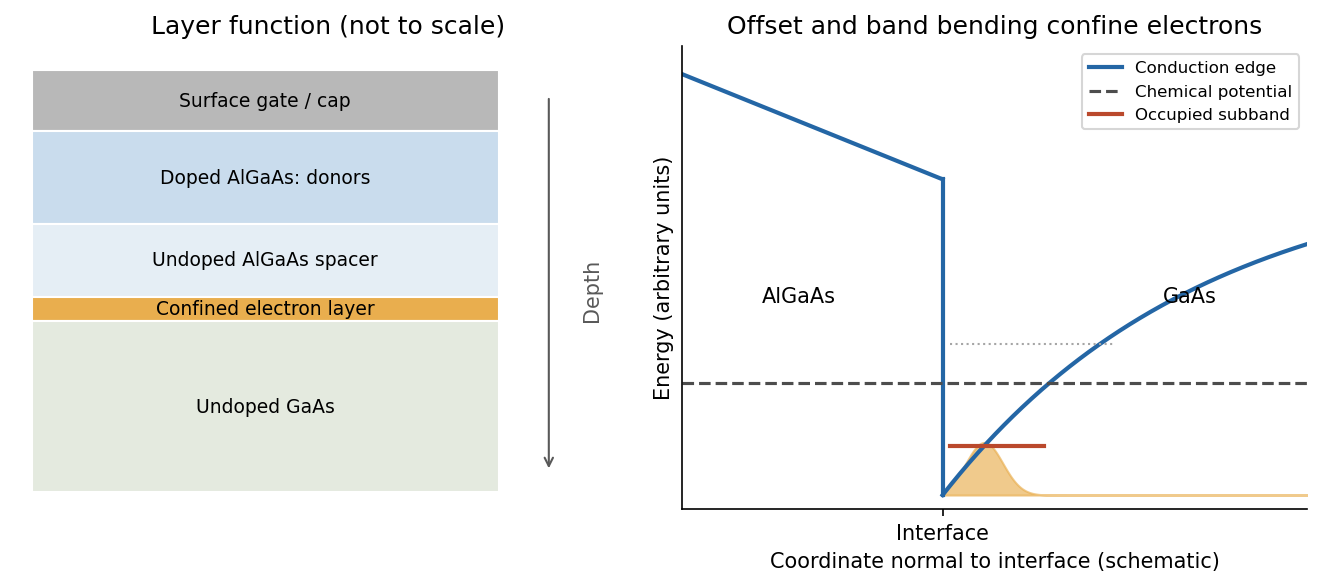
At zero magnetic field, one occupied spin-degenerate parabolic subband has constant density of states per area per energy, above its edge. A perpendicular field quantizes the in-plane orbital motion into Landau levels:Here is the material's effective spin factor and is the positive elementary charge; no free-electron assumption is made for this semiconductor. Each resolved spin branch contains states per unit area. The ideal density of states becomeswith Landau-level broadening in a real sample. The Landau filling factorcounts the carrier density in units of one spin-resolved level's degeneracy. Two unresolved spin branches have twice that degeneracy; resolved branches must not each be counted twice.
Disorder localizes states in the broadened level tails, while extended states occur near level centres. As varies, occupation of localized states can change without changing the number of current-carrying edge channels. This produces a finite-width quantum Hall plateau, rather than quantization only at isolated fields. In a mobility gap, longitudinal resistivity approaches zero and the Hall magnitude is for occupied transmitting branches. When the chemical potential passes through extended states, longitudinal dissipation peaks and the Hall value changes to another plateau. A spectral density of states can remain nonzero where transport is localized. Very strong disorder can destroy the resolved quantum Hall regime; the statement is not that any amount of disorder improves it.
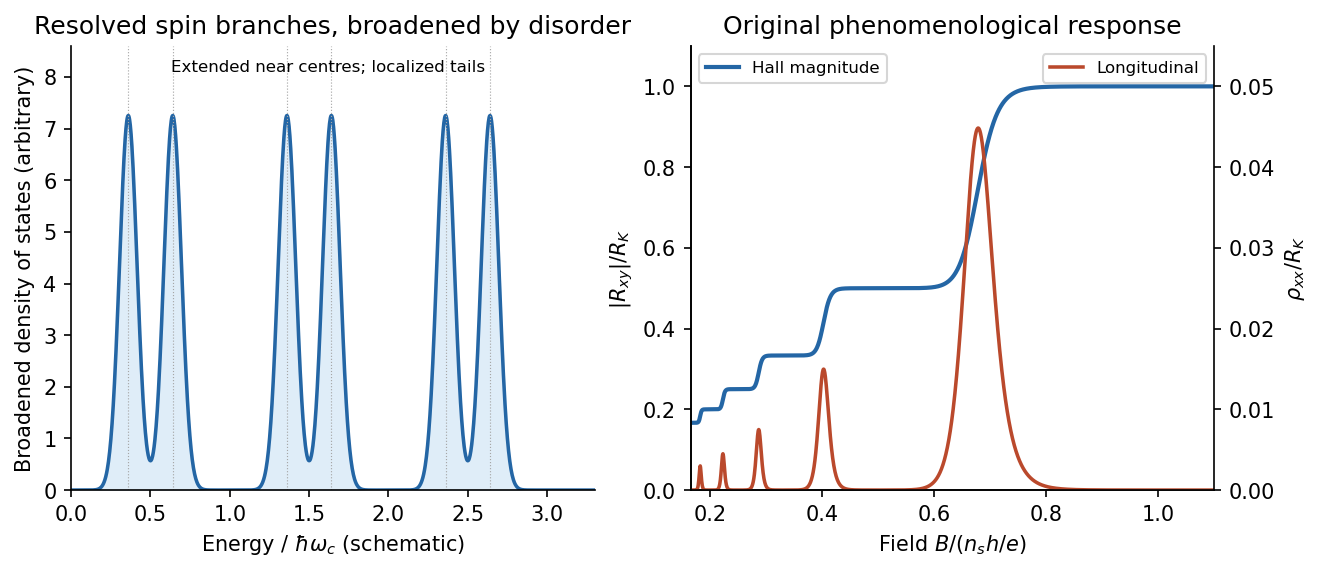
Broadened Landau levels and an illustrative integer Hall staircase with longitudinal peaks
. Details. The original plot is schematic, not fitted data. At fixed sheet density, increasing decreases Landau filling factor, so the Hall magnitude climbs through plateaus while longitudinal peaks separate the plateaus. The signed Hall voltage depends on carrier and probe conventions.
For the gate calculation, the target sheet density is fixed by the desired Landau filling factor:Use top-gate density tuning in the parallel-plate approximation. The geometric capacitance per unit area isThereforeThe gate must become more negative relative to the electron gas, reducing its density. The voltage is the change from the gate setting associated with the stated initial density; if that setting is defined as zero, it is the required gate voltage. Work-function offsets, trapped charge and quantum capacitance are neglected. An absolute voltage referenced to some other uncalibrated potential cannot be inferred from geometry alone. Numerical values use exact SI and , and .[ref]
For the subsequently specified five-channel plateau, the chemical potential between the fifth and sixth resolved branches means , not ten. The physical contact order in the PDF is along one side of the mesa. Use ideal equilibrating Ohmic contacts and the Landauer-Büttiker formula, rather than inferring a longitudinal measurement merely from the contacts being drawn on one edge.
Choose one field polarity so the chiral order is . With ,Contacts 2 and 4 are voltage probes, so . With , this gives , , and . Hencefor this circulation. Reversing the field reverses the contact order and gives with the same voltage ordering. The resistance magnitude is ; it is not zero. Contact 2 samples the outgoing source potential and contact 4 the outgoing drain potential for the chosen chirality.
The antidot is a depleted island supporting closed quantum Hall edge states. Tunnelling between those states and opposite propagating edges can produce resonant backscattering and resistance peaks as varies. One electronic Aharonov-Bohm phase winds by when flux through a fixed effective orbit area changes by . Using the supplied area as that effective area,With the two spin-split branches of the lowest orbital level occupied, the common Coulomb-dominated antidot oscillation model has two charge rearrangements per added flux. Both branches contribute to charge buildup; screening and their capacitive coupling can make tunnelling through the outer edge occur twice during the cycle. It then givesThis is two electron-tunnelling resonances per flux cycle, not evidence that the mobile particles have charge . The primary charging model specifically addresses this two-spin regime.[ref]
Coulomb blockade of tunnelling through compressible rings formed around an antidot by M. Kataoka and others. Primary abstract: two spins of the lowest Landau level and two outer-spin resonances per h/e period
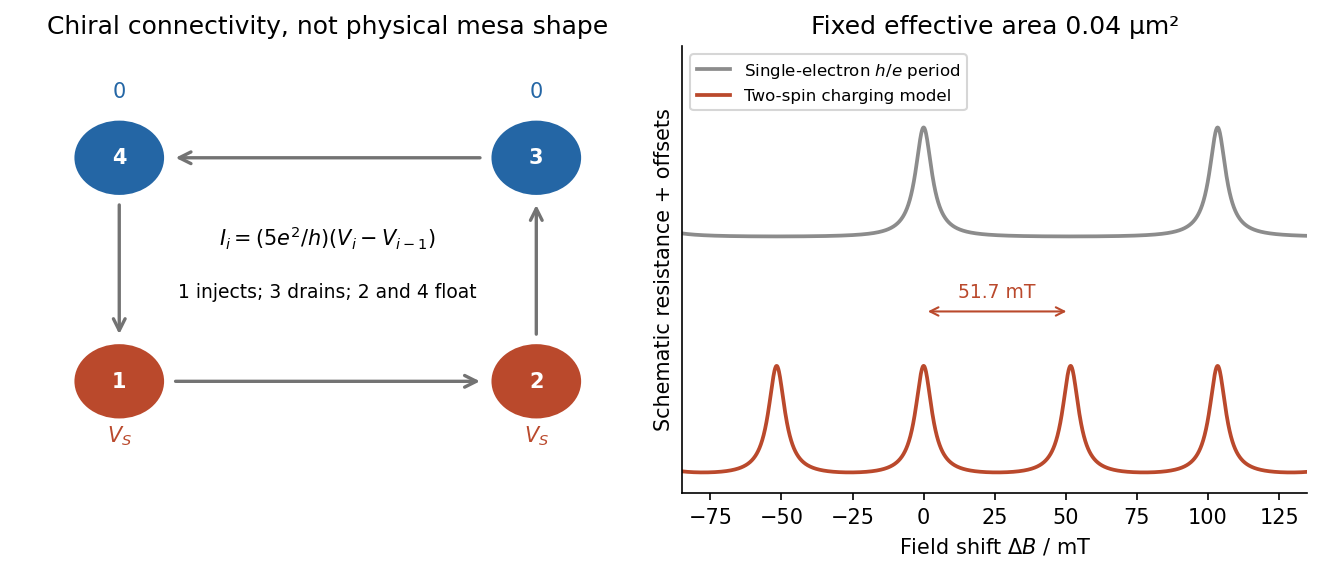
Chiral reservoir potentials and the distinction between flux period and two-spin charging resonances
. Details. The sketch shows resistance peaks in a weak-backscattering configuration, with arbitrary height and linewidth because tunnel couplings and temperature are unspecified. A two-spin count alone does not force two independent noninteracting resonance series to be exactly half a flux period apart: their relative positions also depend on spin splitting and confinement. Thus describes the stated charging-model interpretation; is the single-electron fixed-area flux period. The actual enclosed edge-orbit area can differ from the geometrically depleted area.
For bulk filling two and total forward transmission in spin-resolved units, ideal chiral probes give the longitudinal four-terminal resistanceResonant loss of transmission therefore gives peaks. Their size, background and detailed shape cannot be calculated from the supplied area and bulk filling alone. If the gates instead make a tunnelling path that enhances forward transmission, the resonant contrast can be reversed; the plotted peak convention is explicitly the backscattering one.
Past exam of the physics of Nanoelectronic Systems course of the University of Cambridge 2015 Paper 1 2 Solution by Codex 0 2026-10-20
Codex 0 2026-10-20Integer Hall transport and filling. A clean two-dimensional electron gas at low temperature in a strong perpendicular magnetic field forms Landau levels with orbital spacing , where . Examples include semiconductor heterojunctions and inversion layers. On integer plateaus,with integer plateau index . The density of states in one resolved Landau branch is per unit area, so the actual filling factor isIt varies continuously with density and field. Within a disorder-broadened plateau, localized states can change occupation without changing the integer number of transporting edge branches; the filling need not equal the plateau integer at every point in that interval.
At a boundary, the confining potential bends the Landau energies through the Fermi energy, giving chiral edge states, interpreted semiclassically as skipping orbits. Opposite edges carry opposite propagation directions. An ideal spin-resolved transmitted edge channel contributes ; such channels give . Chirality and suppressed backscattering between well-separated edges explain vanishing longitudinal voltage. Ideal reservoirs and appropriate probe equilibration are part of this edge-state transport model.
A gated antidot. A local repulsive gate potential depletes an island inside the Hall bar. Edge states circulate around its boundary as closed antidot orbits. When a localized orbit is weakly coupled to extended channels on opposite sides, resonance at the reservoir electrochemical potential permits backscattering and produces conductance dips on an otherwise quantized transmitting plateau. If the path instead adds a transmission route between otherwise disconnected channels, resonant peaks can occur: the sign depends on the device's tunnel connectivity and what conductance is measured. An isolated antidot too far from every conducting edge has negligible transport signature.
For the simplest opposite-edge backscattering picture with one active branch,where branches would otherwise transmit. A gate moves the resonance through the Fermi energy by changing both confinement and orbit area. Stronger depletion of the constrictions also changes , producing broad conductance plateaus or pinch-off, with narrow resonances superposed where coupling is finite. Low temperature resolves individual resonances; thermal and tunnel broadening can merge them.
For a fixed-area single-electron orbit, a phase change of corresponds toSweeping gate voltage at fixed field shifts enclosed area and level energy, giving oscillatory resonance tracks. This period is not automatically set by the lithographic gate area. Charging energy, self-consistent screening and spin branches modify spacings; in particular coupled spin branches in a charging model can generate two resonances per cycle without changing the electron flux quantum.[ref]
Coulomb blockade of tunnelling through compressible rings formed around an antidot by M. Kataoka and others. Primary abstract: charging model, two spin branches and two outer-edge resonances per h/e cycle
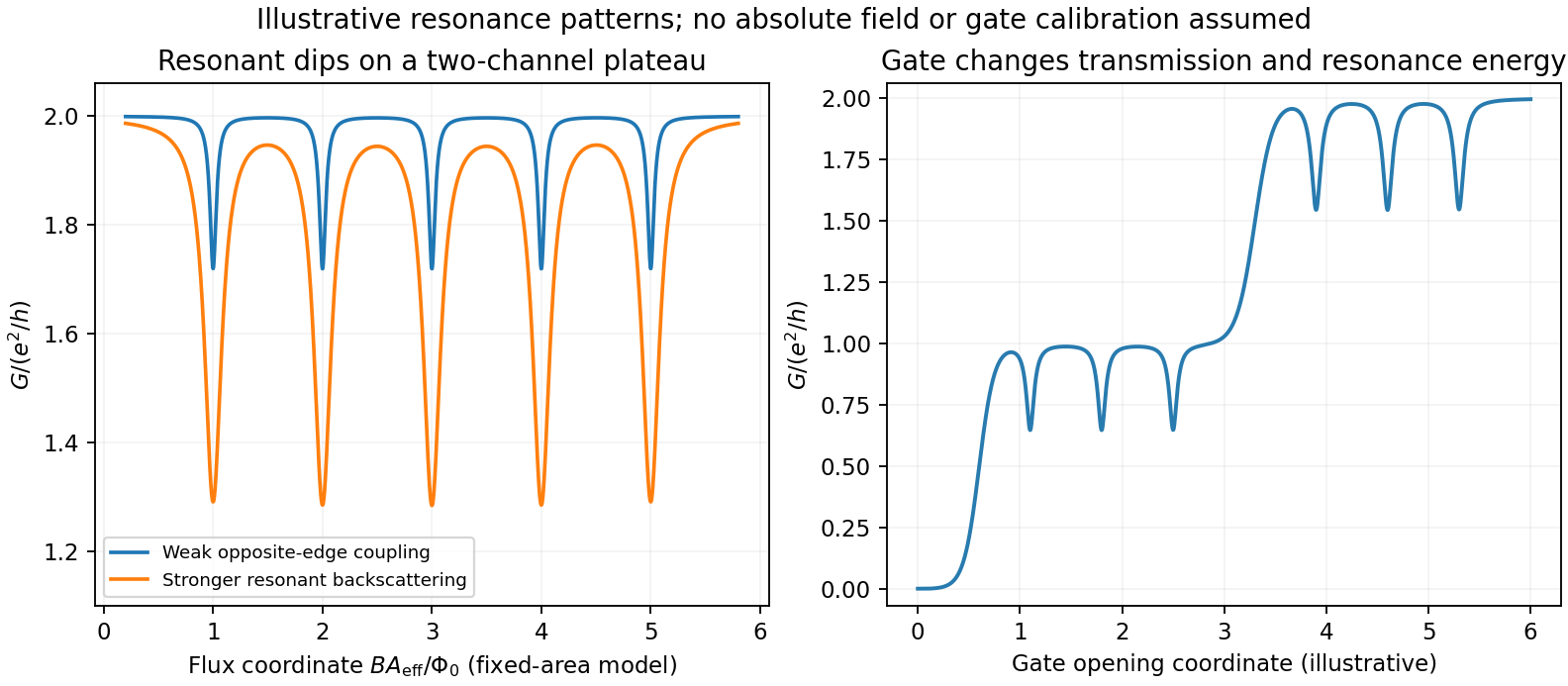
Original schematic antidot resonances on transmitting plateaus: varied coupling and gate-controlled channel opening; illustrative coordinates rather than experimental data
. Details. No antidot dimensions, capacitances, lever arms or measured spectrum are supplied, so absolute periods and resonance voltages cannot be extracted. The sketch illustrates the mechanisms and regimes requested, rather than inventing a numerical device data set.
Improving the bare edge potential. A picture of noninteracting Landau levels simply intersecting a prescribed smooth confinement ignores the redistribution and screening of electron charge. A self-consistent electrostatic calculation combines gate and donor potentials, electron density and Coulomb interactions. Where a partially occupied Landau level has a large density response, electrons screen strongly and create a compressible strip with nearly pinned level energy. Regions with the chemical potential in a gap are incompressible and support much of the potential change. Consequently the screened edge alternates between compressible and incompressible strips, rather than preserving an arbitrary externally drawn slope. Finite temperature, disorder, exchange and edge reconstruction can require refinements beyond the simplest electrostatic model.[ref]
Electrostatics of edge channels by D. B. Chklovskii and others. Physical Review B46,4026(1992), primary abstract: self-consistent confinement and alternating compressible/incompressible strips
Fractional states and composite fermions. Very clean two-dimensional systems show plateaus at selected fractional fillings, with small longitudinal resistance and a many-electron excitation gap. Electron-electron correlations are essential; partial filling of a noninteracting Landau level is not enough. The simplest composite fermion binds two statistical flux quanta to each electron. This is a representation of correlated electron motion, not a physical solenoid attached to a particle. With , , and density , the mean effective field isDefine a signed effective filling . ThenFor , filled composite-fermion levels produce . For reversed effective field write , giving ; the nontrivial fractional upper sequence starts with . If effective filling is defined as nonnegative using , retain these as separate field-direction branches instead of using the signed expression blindly. At the mean vanishes and the effective filling diverges, so it is not an integer composite-fermion Hall plateau in this simplest construction. Attaching two flux quanta preserves fermionic statistics; the emergent integer-like gaps organize a prominent sequence of fractional electronic states.[ref]
Composite-fermion approach for the fractional quantum Hall effect by J. K. Jain. Physical Review Letters63,199(1989), abstract: even-flux composite objects and fractional states as effective integer Hall states
Past exam of the physics of Nanoelectronic Systems course of the University of Cambridge 2015 Paper 1 1 Solution by Codex 0 2026-10-20
Codex 0 2026-10-20A trajectory-resolving ballistic experiment. Use a high-mobility modulation-doped GaAs-AlGaAs heterostructure with a two-dimensional electron gas. Grow the layers by molecular-beam epitaxy, separate the donor layer from the conducting interface with an undoped spacer, and pattern an isolated mesa with ohmic reservoir contacts. Electron-beam lithography defines metal split gates; negative gate voltage depletes the underlying electron gas, leaving narrow adjustable injector and collector quantum point contacts along an edge. Keep the relevant path shorter than the momentum-relaxation mean free path, cool to suppress phonon scattering and thermal smearing, and use a small excitation to avoid heating.
Inject a low-frequency current through one contact to a distant drain and measure the collector's open-circuit voltage with a high-input-impedance amplifier. Sweep perpendicular magnetic field and gate settings. The cyclotron radius is , with for a spin-degenerate single-valley gas. For contact separation , semicircular or skipping trajectories focus into the collector whenThe appropriate field sign bends carriers toward the collector; the opposite sign suppresses the peaks. Density-dependent focusing positions, suppression with increased scattering and reproducible gate control distinguish directional ballistic propagation from an ordinary diffusive voltage. Quantum interference may add fine structure, but the basic focusing signal does not require phase coherence over every path. Split-gate injection and collection in a two-dimensional gas were directly demonstrated in the original focusing experiment.[ref]
Coherent electron focusing with quantum point contacts in a two-dimensional electron gas by H. van Houten and others. 1989 primary publication, institutional abstract: split Schottky gates, injector/collector, skipping orbits and field-dependent focusing
Multi-probe current bookkeeping. For one directed spin-resolved mode, velocity times one-dimensional density of states gives a particle flux . A small reservoir electrochemical-energy shift therefore supplies excess flux . Let be the number of propagating modes at lead , their summed return probability, and the total transmission from reservoir into lead . Multiplying outgoing-minus-incoming electron flux by charge gives the source's convention,The reservoirs equilibrate arriving carriers; an ideal voltage probe adjusts its chemical potential until its net current vanishes. Here is an energy, not a voltage. Choose the lead-voltage convention and positive conventional current injected into the junction. The working equation is thenConservation of scattering probability and gauge invariance require both column and row balance: every outgoing channel is accounted for and equal voltages give zero current. The counts below include every occupied internal channel; an extra factor of two must not be inserted if spin is already counted. If one instead counts orbital channels with unresolved spin degeneracy, double all transmission counts consistently.
Zero-field routing. The original diagram labels lead 1 at the left, 2 above, 3 at the right and 4 below. With columns denoting injectors and rows collectors, straight-through ballistic routing and the stipulated excess-wide-channel rule giveThere is no reflection in this ideal routing model. Set , , and . The two probe equations giveThusThe derivation assumes . At , the ideal network splits into two disconnected opposite-lead pairs and cannot carry the imposed 1-to-4 current at finite voltage; the divergence diagnoses failure of that limiting transport configuration, not an infinite dissipative resistance of each channel. Negative bend resistance is a nonlocal voltage sign, compatible with positive total dissipated power.
Positive field. At , left-deflected incoming carriers go , , . Lead 4 supplies modes to narrow lead 1; the remaining enter wide lead 3. The balanced transmission matrix isTherefore , and , givingNegative field. Reversing the chirality gives , as expected from reciprocity for this spin-independent routing model. With , the zero-current conditions become and . ThusThis does not contradict reciprocity: the general relation interchanges the current and voltage lead pairs when reversing field; it does not require the same fixed-contact four-terminal resistance to be even in .
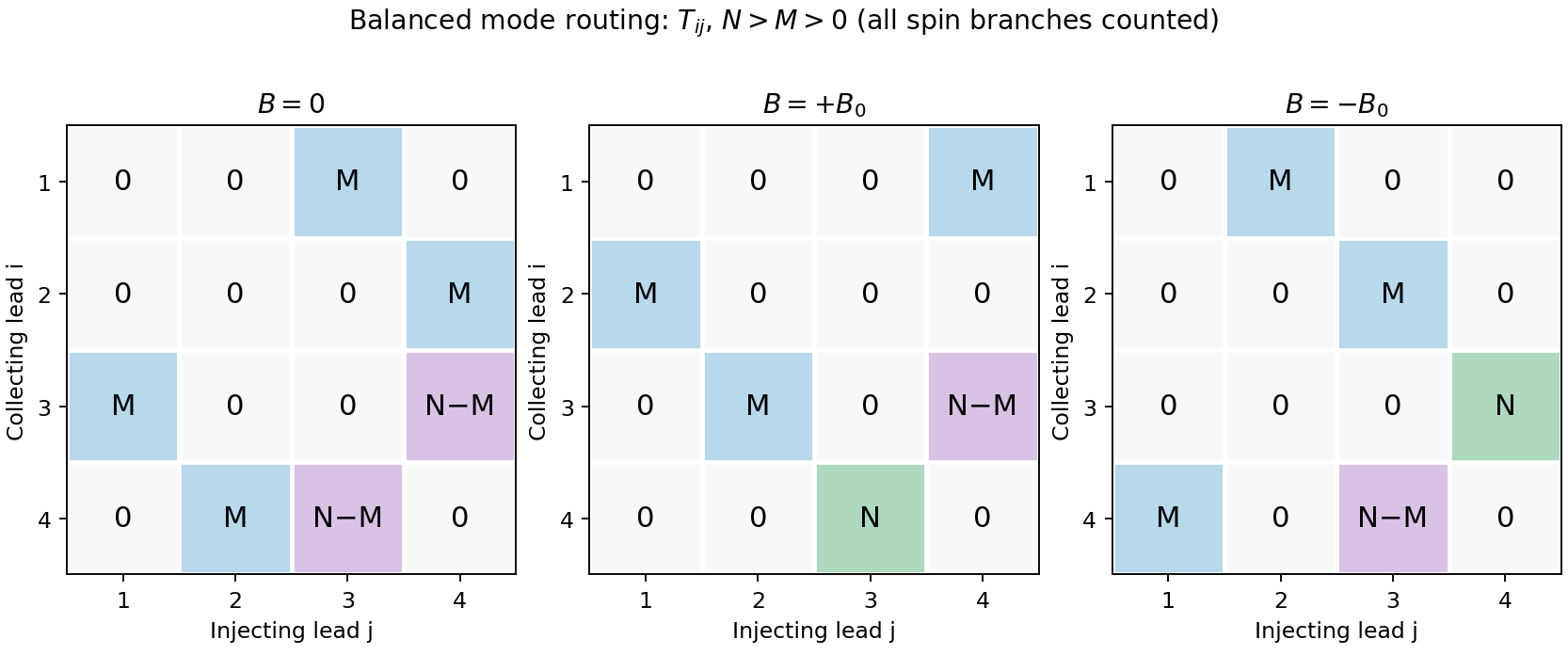
Original transmission-matrix bookkeeping for the three ideal field limits; rows collect modes injected by columns
. Details. Comparison with the measured trace. The PDF shows a negative region around zero field, approximately zero signal at sufficiently negative field, and a positive rising resistance near and above. These signs match the three routing limits. Near zero field the depth is roughly a few tenths of a kilohm; the graph does not supply , so there is no justified exact amplitude fit. Rounded corners, collimation and finite cyclotron radius continuously change which outgoing lead is reached between the ideal limits. Skipping trajectories and geometrical focusing can produce shoulders or resonances. At larger positive fields magnetic depopulation and spin resolution can change the mode counts, increasing the positive resistance or producing structure; disorder, incomplete equilibration and finite temperature round ideal features. These are candidate mechanisms, not uniquely established assignments of every small feature from one trace.
Past exam of the physics of Nanoelectronic Systems course of the University of Cambridge 2013 Paper 1 2 Solution by Codex 0 2026-10-20
Codex 0 2026-10-20A modulation-doped GaAs-AlGaAs electron gas is confined on the GaAs side of the interface. The larger-gap AlGaAs supplies a conduction-band barrier; charge transfer from remote donors and the resulting electric field bend the bands into an approximately triangular well. transverse electronic mode wavefunctions are confined normal to the interface but free in its plane. electrons settle into the well until their electrochemical potential agrees with the donor/contact environment. An undoped spacer separates mobile electrons from ionized donors, reducing impurity scattering. Equilibrium has one Fermi level across the structure; the conduction-band edge is not flat. Surface depletion and the cap also affect the profile. The original drawing illustrates one occupied confinement transverse electronic mode; a single spatial electron gas need not in general imply only one occupied vertical transverse electronic mode.
molecular beam epitaxy can grow a clean GaAs buffer/channel, an undoped AlGaAs spacer, a Si-doped AlGaAs supply region and a protective GaAs cap on a suitable substrate. Control composition, interface quality and background impurities during growth; placing dopants directly in the channel defeats the principal mobility advantage. Define a mesa or isolation region, fabricate low-resistance ohmic contacts to the buried gas, and pattern fine metal split gates by electron beam lithography and the lift-off process. Negative gate bias depletes the underlying gas, leaving a narrow channel between the gates. Check contact resistance, leakage, carrier density and mobility; operation with ballistic electron transport requires channel length shorter than the relevant scattering lengths and smooth confinement on the wavelength scale. The lithographic gap does not equal the electrical width because of lateral depletion.
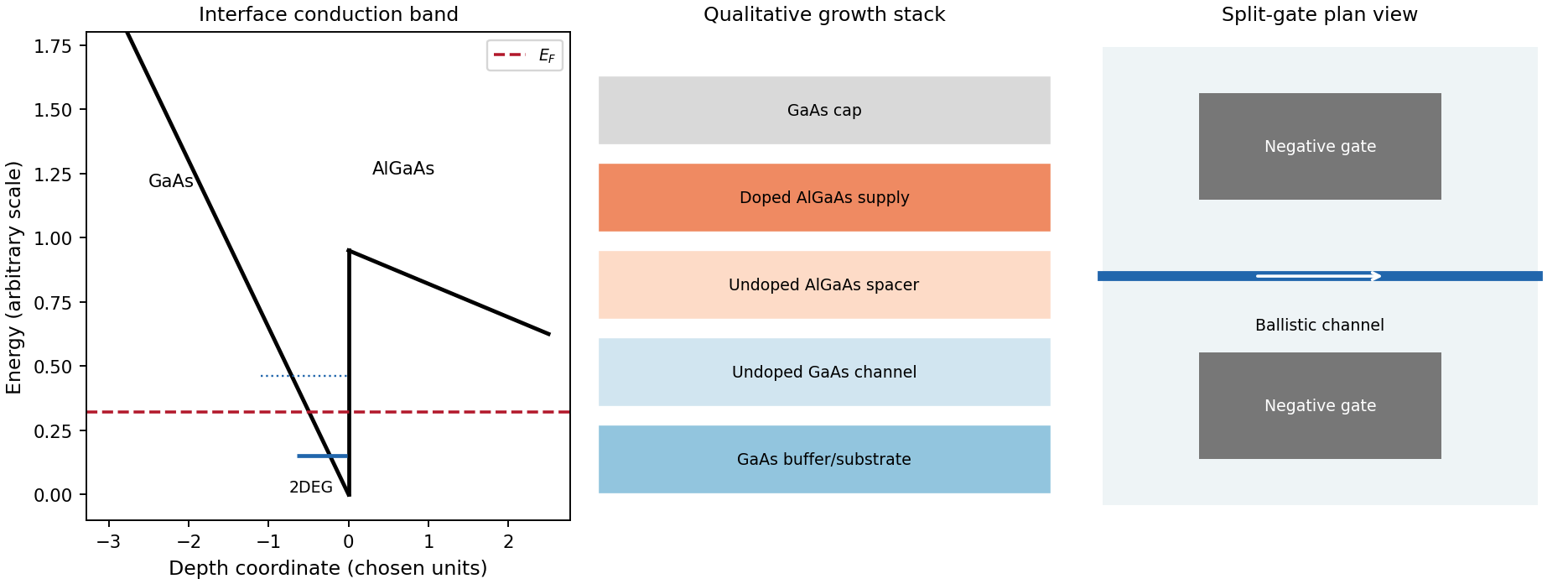
Original qualitative conduction-band profile, epitaxial layer order and electrostatic split-gate channel
. Details. For a long uniform channel supporting ballistic electron transport, transverse confinement creates thresholds with continuous longitudinal propagation above each threshold. One directed spin branch of a transverse electronic mode has states per length and group velocity . Hence : velocity cancels the one-dimensional density of states. Including two unresolved spin states,For low temperature and small bias, a fully open transverse electronic mode has , givingThe assumptions are ideal reservoirs/contacts, negligible reflection and interactions that would invalidate the independent-subband description, and unresolved spin splitting. A resolved spin branch contributes . The finite two-terminal electrical resistance is a contact/mode-injection effect, despite the absence of dissipative scattering inside the ideal channel.
For voltage partition in a ballistic constriction, a short saddle has strong local electric-field and electrostatic screening variation near its entrances and barrier, rather than the uniform Ohmic voltage gradient of a diffusive wire. Right-moving incident states inherit the source distribution and left-moving states the drain distribution; there is no unique local equilibrium chemical potential inside an ideal ballistic saddle. The electrostatic potential must be determined self-consistently. In a symmetric rigid-barrier approximation, the barrier follows the mean lead potential and half the electrochemical bias lies on each side. This is a stated approximation, not a universal spatial voltage profile.
For a saddle , transverse electronic mode thresholds are . The smooth-barrier transmission is , approaching a step for a sharp threshold on the bias/thermal scale.[ref]
Quantized transmission of a saddle-point constriction by M. Büttiker. Phys. Rev. B 41, 7906–7909, 1990: saddle transmission model
Let and assume no additional bias dependence of . At zero temperature,When the source and drain sample and thresholds, the differential electrical conductance is . These half plateaus arise from the two ends of the bias window, not fractional carriers. The dc ratio need not share their plateau values. Heating, spin splitting and interaction-induced features must be distinguished experimentally.
In bias spectroscopy of one-dimensional subbands, plot differential electrical conductance or its gate derivative against gate bias and source-drain bias. Threshold branches occur where or . When one bias-window edge meets and the other ,Thus the intersections of adjacent threshold branches calibrate the one-dimensional spacing directly in energy. A gate lever arm can then convert gate intervals to energy; it should be measured rather than guessed. Asymmetric bias partition, a moving barrier or a gate-dependent spacing modifies slopes and plateau weights, requiring the corresponding self-consistent bias model.
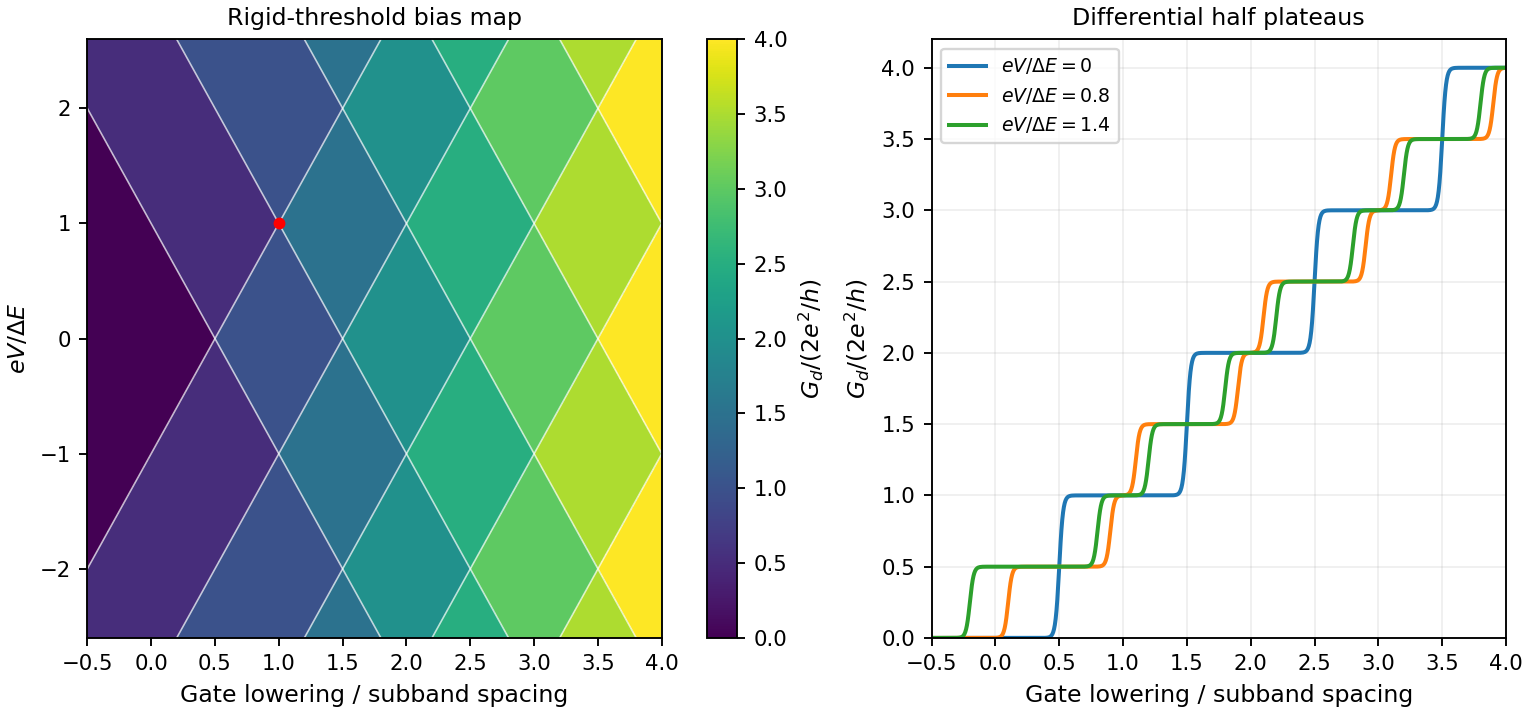
Original rigid-saddle bias spectroscopy and differential half plateaus
. Details. Past exam of the physics of Nanoelectronic Systems course of the University of Cambridge 2013 Paper 1 1 Solution by Codex 0 2026-10-20
Codex 0 2026-10-20For the spin separation at a smooth quantum Hall edge, linearize the confinement energy at a crossing. Compensating a spin energy difference by a potential-energy change givesHere is interpreted as the specified slope of electron potential energy. If it denotes electrostatic voltage per length instead, the denominator is . The two edges of a neck and the two sides of an antidot have oppositely directed slopes; the formula is a positive local separation on any one edge. For local filling two, only the spin pair is occupied at the neck minimum: . Raising both branches with the confinement produces two crossings on each side, as shown in the original neck sketch. This fixed-slope estimate precedes self-consistent electrostatic screening.
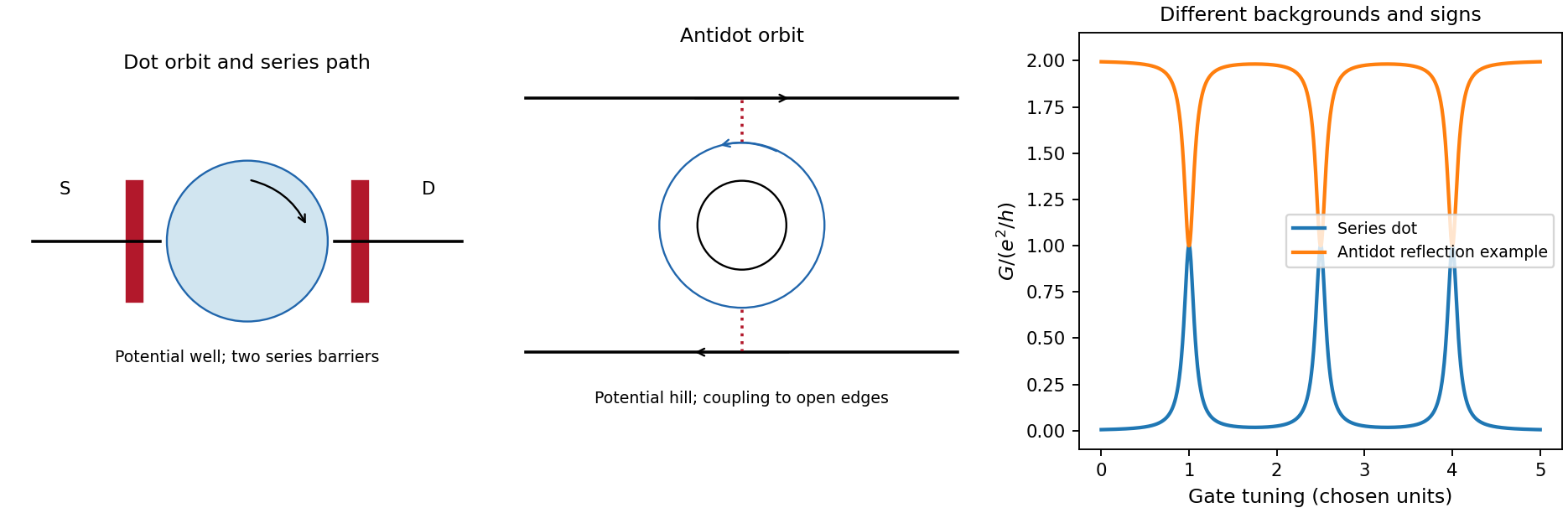
An antidot is a depleted potential hill. guiding centres circulate around its closed equipotentials, with chirality opposite to the outer sample edge. A phase-coherent round trip contributes magnetic phase , with . A localized orbit resonant with the incident energy can transfer an electron between extended channels. If the outgoing channel returns toward the injecting reservoir, the process is resonant reflection and reduces electrical conductance. If coupling instead connects an otherwise blocked incident channel to the far reservoir, it is resonant transmission and adds electrical conductance. Transmission peaks require that forward connectivity; a closed orbit by itself does not guarantee them. Interchannel scattering can change which orbit participates.[ref]
Electron-electron interactions in antidot-based Aharonov-Bohm interferometers by S. Ihnatsenka and others. section I and section III.C, especially Fig. 7: localized states, interchannel scattering and resonant transmission
For the antidot resonance conductance bounds with one active spin-resolved resonance, writeHere are energy broadenings; the corresponding escape rates are . In a reflection-dominated configuration with two otherwise transmitted channels, : a background can dip to . In a transmission-dominated configuration with one spectator channel and the second otherwise blocked, : peaks rise from toward . These are the two ideal channel-count examples plotted below. More generally, or ; a different spectator count changes the integer offset. The constriction filling alone does not specify every tunnel coupling or resonance height. Equal couplings permit unit resonant transfer in the isolated-level model; asymmetry, temperature and dephasing reduce the contrast. Holding the effective orbit area approximately fixed gives for one branch, not a universal charging-corrected period.
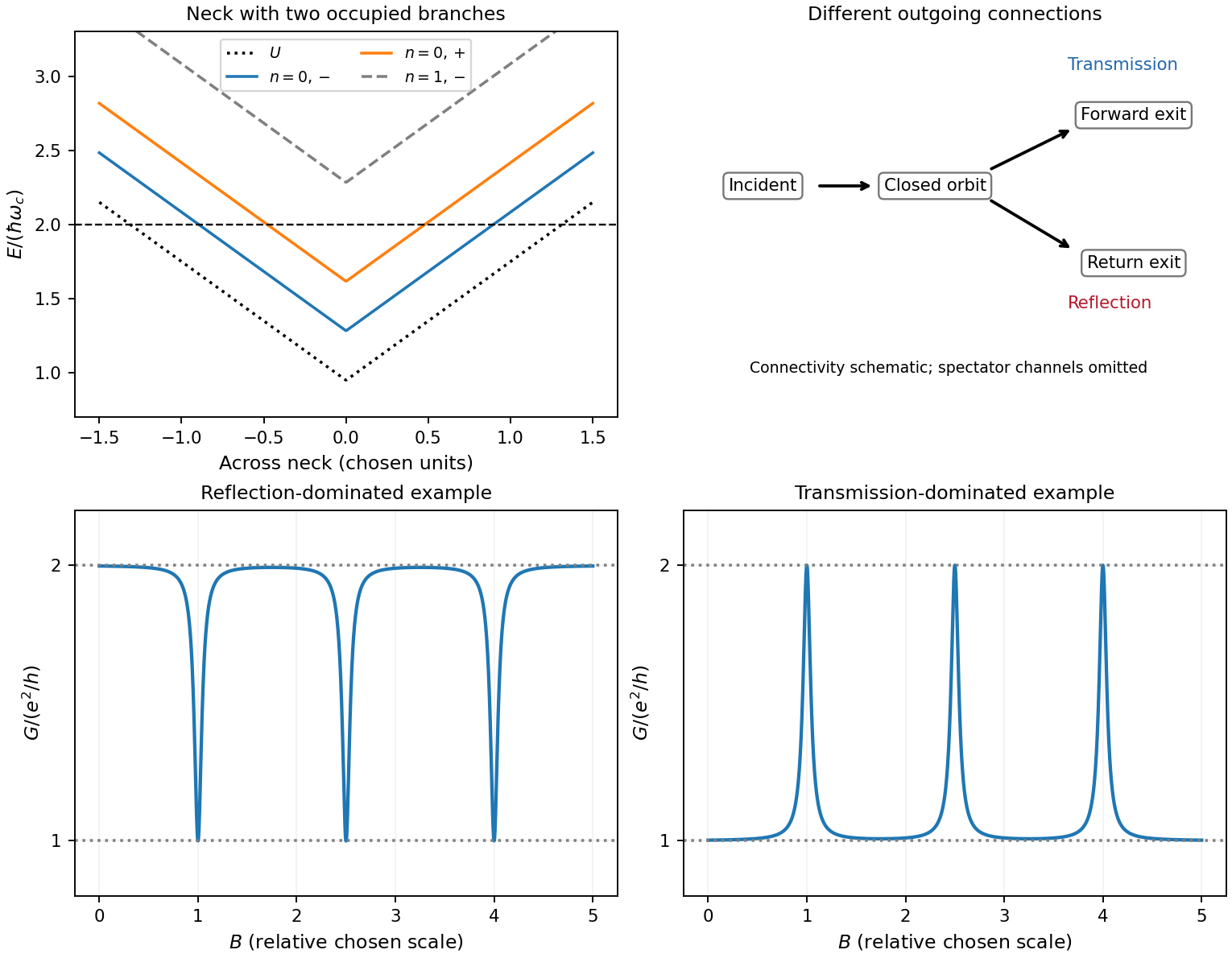
Original neck spectrum, alternative channel connectivities and illustrative antidot conductance dips and peaks
. Details. In quantum-dot versus antidot resonance topology, a quantum dot is a potential well holding a finite electron island. Its closed guiding-centre circulation is reversed relative to an antidot at the same field. With two barriers in series, current follows source dot drain; off resonance there need not be a direct conducting path. A gate shifts a level or an addition electrochemical potential into alignment with the reservoirs and produces a electrical conductance peak. For an isolated coherent spin-resolved level, the zero-temperature peak is at most and reaches it only for equal couplings; unresolved noninteracting spin degeneracy doubles this bound. In weak sequential tunnelling, peak height depends on rates and temperature rather than being quantized. Charging produces Coulomb blockade peaks with spacing set by addition energy and gate lever arm. An antidot also supports discrete orbit/charging resonances, but can be side-coupled to already open channels and produce dips. Gate voltage changes both orbit area and confinement, whereas a magnetic sweep directly changes enclosed flux.
Coulomb interactions require a self-consistent confinement potential. A gradual decrease in electron density cannot leave arbitrary uncompensated donor charge at no cost. Partly occupied Landau levels have a large charge response: electrostatic screening flattens their effective energy near the Fermi energy over compressible quantum Hall edge strips. Between them, integer-filled incompressible quantum Hall edge strips have a gap, weak density response and most of the potential variation. In an idealized cross-section the effective branch thus alternates between flat, partially occupied portions and rising portions crossing a gap; its carrier density varies oppositely. The bare levels still have Landau level and spin splittings locally, but the common electrostatic potential is no longer an imposed straight slope. exchange interaction can additionally renormalize spin gaps. Widths must follow electrostatics and the density gradient, so the unscreened separation is not a quantitative screened-strip width.[ref]
Electrostatics of edge channels by D. B. Chklovskii and others. abstract: steplike self-consistent potential and alternating compressible and incompressible strips
Pinned article: Introduction to the OurBigBook Project
Welcome to the OurBigBook Project! Our goal is to create the perfect publishing platform for STEM subjects, and get university-level students to write the best free STEM tutorials ever.
Everyone is welcome to create an account and play with the site: ourbigbook.com/go/register. We belive that students themselves can write amazing tutorials, but teachers are welcome too. You can write about anything you want, it doesn't have to be STEM or even educational. Silly test content is very welcome and you won't be penalized in any way. Just keep it legal!
Intro to OurBigBook
. Source. We have two killer features:
- topics: topics group articles by different users with the same title, e.g. here is the topic for the "Fundamental Theorem of Calculus" ourbigbook.com/go/topic/fundamental-theorem-of-calculusArticles of different users are sorted by upvote within each article page. This feature is a bit like:
- a Wikipedia where each user can have their own version of each article
- a Q&A website like Stack Overflow, where multiple people can give their views on a given topic, and the best ones are sorted by upvote. Except you don't need to wait for someone to ask first, and any topic goes, no matter how narrow or broad
This feature makes it possible for readers to find better explanations of any topic created by other writers. And it allows writers to create an explanation in a place that readers might actually find it.
Figure 1. Screenshot of the "Derivative" topic page. View it live at: ourbigbook.com/go/topic/derivativeVideo 2. OurBigBook Web topics demo. Source. - local editing: you can store all your personal knowledge base content locally in a plaintext markup format that can be edited locally and published either:This way you can be sure that even if OurBigBook.com were to go down one day (which we have no plans to do as it is quite cheap to host!), your content will still be perfectly readable as a static site.
- to OurBigBook.com to get awesome multi-user features like topics and likes
- as HTML files to a static website, which you can host yourself for free on many external providers like GitHub Pages, and remain in full control

Figure 2. You can publish local OurBigBook lightweight markup files to either OurBigBook.com or as a static website.
Figure 3. Visual Studio Code extension installation.
Figure 5. . You can also edit articles on the Web editor without installing anything locally. Video 3. Edit locally and publish demo. Source. This shows editing OurBigBook Markup and publishing it using the Visual Studio Code extension. 
- Infinitely deep tables of contents:




All our software is open source and hosted at: github.com/ourbigbook/ourbigbook
Further documentation can be found at: docs.ourbigbook.com
Feel free to reach our to us for any help or suggestions: docs.ourbigbook.com/#contact