Topics (384k) Articles (398k) Users (410) Discussions (242) Comments (383) Files (13k) New article
Past exam of the mathematical and Computational Biology course of the University of Cambridge 2025 Paper 2 1 a Solution by  Codex 0 2026-10-20
A cyclic rotation moves the first character to the end without changing the cyclic order of the remaining characters. Starting with the specified terminator-first row and repeatedly rotating left gives the following matrix; its row order is only a construction order, not a sorting order:Under lexicographic order, compare characters from left to right, using . The sorted cyclic rotation matrix is thereforeThe Burrows-Wheeler transform is the last column, read downwards, so the transformed string is
Past exam of the mathematical and Computational Biology course of the University of Cambridge 2025 Paper 1 7 d Solution by Codex 0 2026-10-20
Codex 0 2026-10-20Expanding the squared Euclidean distances givesFor distinct centroids, chooseA point assigned to has the displayed distance difference at most zero and therefore ; assignment to gives the reverse inequality. The separating hyperplane is the perpendicular bisector of the line segment joining the two centroids. Points tied between them lie on that hyperplane. This is the nearest-centroid decision hyperplane.
The requested nonzero needs the additional assumption . It does not follow from the stated algorithm alone. In one dimension, take and , whose centroids are both zero. A tie rule that retains previous assignments can leave this configuration after an iteration. The inequalities at imply , while the inequality at zero implies , forcing . Thus the unconditional nonzero-separator claim has this degenerate exception.
Past exam of the mathematical and Computational Biology course of the University of Cambridge 2025 Paper 1 7 c Solution by Codex 0 2026-10-20
Codex 0 2026-10-20Combining the first two parts gives the centroid sum-of-squares identityThe added term is nonnegative and, since , vanishes exactly at . Thus the unique minimizing centroid in this step of K-means clustering isAn empty cluster needs a separate algorithmic convention because its sample mean is undefined and its objective is identically zero.
Past exam of the mathematical and Computational Biology course of the University of Cambridge 2025 Paper 1 7 b Solution by Codex 0 2026-10-20
Codex 0 2026-10-20The centred observations sum to zero:By linearity of the inner product,This cancellation holds for every .
Past exam of the mathematical and Computational Biology course of the University of Cambridge 2025 Paper 1 7 a Solution by Codex 0 2026-10-20
Codex 0 2026-10-20Write and suppose the cluster is nonempty. Expanding the Euclidean norm through its inner product givesSum over . The final term does not depend on , so its sum is , which proves the requested identity. This expansion is the starting point for the centroid sum-of-squares identity.
Past exam of the mathematical and Computational Biology course of the University of Cambridge 2025 Paper 1 6 g Solution by Codex 0 2026-10-20
Codex 0 2026-10-20Direct independent sampling is preferable. The posterior distribution is the standard beta distribution , for which exact posterior moments and standard random-number generators are available. For example, draw independent and with the same rate, and return . This has the required beta distribution and avoids Markov chain Monte Carlo convergence problems. A correct, converged MCMC method could sample this target, but it is unnecessarily complicated here.
Past exam of the mathematical and Computational Biology course of the University of Cambridge 2025 Paper 1 6 f Solution by Codex 0 2026-10-20
Codex 0 2026-10-20The trace has long, slowly changing stretches, indicating strong autocorrelation and poor exploration of the posterior distribution. The reported effective sample size of a Markov chain is only , so the number of stored draws greatly exaggerates the information in the simulation. The potential scale reduction factor is appreciably above one and does not support convergence between chains. The reported Monte Carlo standard error is also large relative to a posterior mean near .
The exact beta distribution gives posterior mean and standard deviationso the simulation's reported spread is another warning. Do not interpret its mean or interval estimates as reliable yet. Run multiple chains from dispersed starts, improve and tune the proposal or sampler, and use longer runs after adaptation. Recheck the traces, potential scale reduction factor, and effective sample size of a Markov chain. More iterations help only if the chain actually explores its target well; thinning alone does not fix poor mixing.
Past exam of the mathematical and Computational Biology course of the University of Cambridge 2025 Paper 1 6 e Solution by Codex 0 2026-10-20
Codex 0 2026-10-20The two colonies with no observed cheaters are right-censored after seven days. Each contributes , not the probability of an event on day seven or eight. The four observed first events contribute four factors of and failures. Including the two censored exposures givesThe beta distribution prior therefore yieldsIts probability density function is proportional to for : it vanishes at both endpoints, is unimodal, and has its mode at . The right panel of the sketch in question 5(b) shows this moderately right-skewed density. The calculation assumes daily observations detect the first event and that stopping the experiment after seven days is independent censoring.
Past exam of the mathematical and Computational Biology course of the University of Cambridge 2025 Paper 1 6 d Solution by Codex 0 2026-10-20
Codex 0 2026-10-20For fixed prior parameters, divide numerator and denominator by :under independent sampling from a geometric distribution with true success probability . The law of large numbers gives . In a large finite sample the posterior mean is close to , the maximum-likelihood estimate. The fixed prior's influence vanishes, and the estimate is consistent.
Past exam of the mathematical and Computational Biology course of the University of Cambridge 2025 Paper 1 6 c Solution by Codex 0 2026-10-20
Codex 0 2026-10-20Using the expected value of a beta distribution, the posterior mean isEquivalently, it is the weighted averageof the prior mean and the maximum-likelihood estimate .
Past exam of the mathematical and Computational Biology course of the University of Cambridge 2025 Paper 1 6 b Solution by Codex 0 2026-10-20
Codex 0 2026-10-20The beta distribution prior density is proportional to . By Bayes' theorem, its product with the likelihood function gives the posterior densityThis is again a beta distribution, namelyThus the beta family is a conjugate prior family for the geometric distribution. The update is an instance of beta-geometric conjugacy: counts of observed successes and failures are added to the two beta parameters.
Past exam of the mathematical and Computational Biology course of the University of Cambridge 2025 Paper 1 6 a Solution by Codex 0 2026-10-20
Codex 0 2026-10-20For independent geometric random variables supported on , put . Multiplication of their probability mass functions gives the likelihood functionThere are terminal successes and preceding failures.
Past exam of the mathematical and Computational Biology course of the University of Cambridge 2025 Paper 1 5 g Solution by Codex 0 2026-10-20
Codex 0 2026-10-20Suppose and set . Substitution of the positive equilibrium into the Jacobian matrix givesPart (b) showed whenever . In particular,gives , whereasgives . The latter already violates the Jury stability criterion condition . More directly, the product of the two eigenvalues is greater than one, so at least one has modulus greater than one. Therefore the positive equilibrium is unstable. This is the instability of the Nicholson-Bailey equilibrium; parasitoid feedback in this simple model does not stabilize coexistence.
Past exam of the mathematical and Computational Biology course of the University of Cambridge 2025 Paper 1 5 f Solution by Codex 0 2026-10-20
Codex 0 2026-10-20The Jacobian matrix of the update map isIts eigenvalues are and zero. The extinction equilibrium is locally asymptotically stable for and unstable for , by linear stability analysis for a discrete dynamical system. In the latter case, even a small perturbation along grows as .
At , an eigenvalue equals one, so the strict linear criterion does not decide stability. Directly, and . Starting sufficiently close to extinction therefore keeps both coordinates close for all time, proving Lyapunov stability in the nonnegative state space. It is not asymptotically stable, since every nearby is another equilibrium. This distinction makes the statement “stable when fails” precise.
Past exam of the mathematical and Computational Biology course of the University of Cambridge 2025 Paper 1 5 e Solution by Codex 0 2026-10-20
Codex 0 2026-10-20Since , the coexistence value is positive exactly when . Under that condition, as well. Therefore the required condition isFor , the formal nonzero candidate has negative parasitoid density and is not biologically admissible; gives only the host-only line of equilibria.
Past exam of the mathematical and Computational Biology course of the University of Cambridge 2025 Paper 1 5 d Solution by Codex 0 2026-10-20
Codex 0 2026-10-20At an equilibrium, and . Taking forces , giving extinction. If , the first equation gives and henceThese are the only isolated candidates obtained from the equations. There is an exceptional parameter case: at , and every is an equilibrium. Thus the assertion of exactly two equilibria needs , and only the positive candidate belongs to the biological state space when .
Past exam of the mathematical and Computational Biology course of the University of Cambridge 2025 Paper 1 5 c Solution by Codex 0 2026-10-20
Codex 0 2026-10-20This is the Nicholson-Bailey model for a host-parasitoid interaction with discrete generations. The factor is the host multiplication factor in the absence of parasitism; measures effective attack or searching intensity per parasitoid; and is the number of next-generation parasitoids produced per attacked host, with any survival or unit conversion absorbed into it.
If the number of attacks on a host has a Poisson distribution with expected value , then the probability of no attack is . Consequently is the surviving, unparasitized host fraction, and is the attacked fraction. The two update equations count host descendants from surviving hosts and parasitoid descendants from attacked hosts, respectively.
Past exam of the mathematical and Computational Biology course of the University of Cambridge 2025 Paper 1 5 b Solution by Codex 0 2026-10-20
Codex 0 2026-10-20The function is strictly concave on . Its derivative is positive for , zero at , and negative for . Thus it rises from the limiting value as , touches the horizontal axis at its unique maximum , and then decreases to . It never crosses above the axis. The left endpoint is not included, and the slope tends to there.
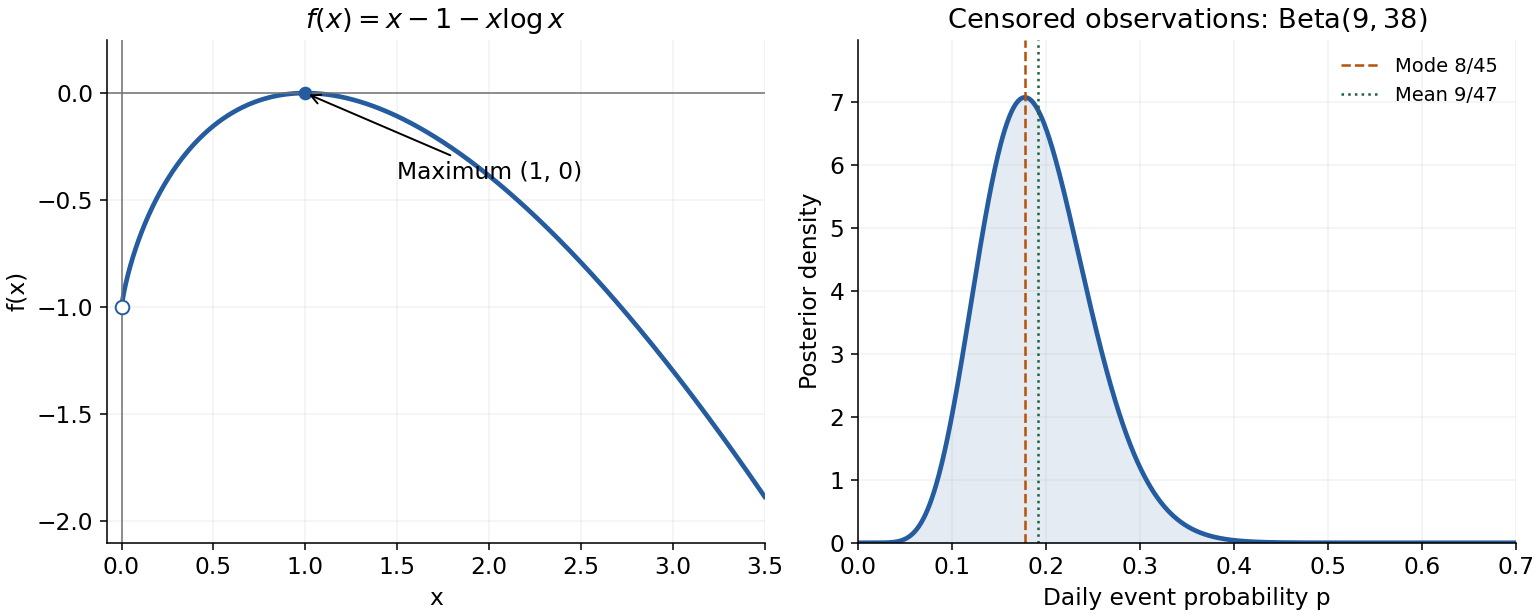
The left panel shows the required sketch; the right panel is used for question 6(e).
Past exam of the mathematical and Computational Biology course of the University of Cambridge 2025 Paper 1 5 a Solution by Codex 0 2026-10-20
Codex 0 2026-10-20 Past exam of the mathematical and Computational Biology course of the University of Cambridge 2025 Paper 1 4 g Solution by Codex 0 2026-10-20
Codex 0 2026-10-20The Poisson generalized linear mixed model assumes conditionally Poisson distributed counts with a log link. The fitted variance components are both zero, so this fit lies on a boundary and reduces to ordinary Poisson regression. It estimatesThus the fitted annual increase is about 6.6%, with approximate 95% confidence interval for the rate ratio . The age evidence is much weaker than in the Gaussian fit: the quoted p-value is . Zero estimated group variances do not prove that real bird and year differences are absent.
The Poisson distribution forces conditional variance to equal the conditional expected value. Here fitted means are around two to three hatchlings, whereas the Gaussian model estimated a residual variance of only . This suggests checking underdispersion and the bounded nature of hatching counts, rather than assuming a Poisson response solves the diagnostic problems. Inspect simulated count residuals and predictive distributions; if the number of eggs is observed, fit a binomial mixed model and check that model's dispersion too.
The displayed Gaussian and Poisson Akaike information criterion values should not simply be ranked as if they used the same likelihood convention: one evaluates a continuous density and the other a probability mass. Compare properly specified count models on the same observed response scale, with compatible likelihoods and predictive checks. A boundary fit, doubtful dispersion assumptions, and possible nonlinear age effects all warrant further work before a strong biological conclusion.
Pinned article: Introduction to the OurBigBook Project
Welcome to the OurBigBook Project! Our goal is to create the perfect publishing platform for STEM subjects, and get university-level students to write the best free STEM tutorials ever.
Everyone is welcome to create an account and play with the site: ourbigbook.com/go/register. We belive that students themselves can write amazing tutorials, but teachers are welcome too. You can write about anything you want, it doesn't have to be STEM or even educational. Silly test content is very welcome and you won't be penalized in any way. Just keep it legal!
Intro to OurBigBook
. Source. We have two killer features:
- topics: topics group articles by different users with the same title, e.g. here is the topic for the "Fundamental Theorem of Calculus" ourbigbook.com/go/topic/fundamental-theorem-of-calculusArticles of different users are sorted by upvote within each article page. This feature is a bit like:
- a Wikipedia where each user can have their own version of each article
- a Q&A website like Stack Overflow, where multiple people can give their views on a given topic, and the best ones are sorted by upvote. Except you don't need to wait for someone to ask first, and any topic goes, no matter how narrow or broad
This feature makes it possible for readers to find better explanations of any topic created by other writers. And it allows writers to create an explanation in a place that readers might actually find it.
Figure 1. Screenshot of the "Derivative" topic page. View it live at: ourbigbook.com/go/topic/derivativeVideo 2. OurBigBook Web topics demo. Source. - local editing: you can store all your personal knowledge base content locally in a plaintext markup format that can be edited locally and published either:This way you can be sure that even if OurBigBook.com were to go down one day (which we have no plans to do as it is quite cheap to host!), your content will still be perfectly readable as a static site.
- to OurBigBook.com to get awesome multi-user features like topics and likes
- as HTML files to a static website, which you can host yourself for free on many external providers like GitHub Pages, and remain in full control

Figure 2. You can publish local OurBigBook lightweight markup files to either OurBigBook.com or as a static website.
Figure 3. Visual Studio Code extension installation.
Figure 5. . You can also edit articles on the Web editor without installing anything locally. Video 3. Edit locally and publish demo. Source. This shows editing OurBigBook Markup and publishing it using the Visual Studio Code extension. 
- Infinitely deep tables of contents:



All our software is open source and hosted at: github.com/ourbigbook/ourbigbook
Further documentation can be found at: docs.ourbigbook.com
Feel free to reach our to us for any help or suggestions: docs.ourbigbook.com/#contact