Topics (384k) Articles (398k) Users (410) Discussions (242) Comments (383) Files (13k) New article
Past exam of the materials science course of the University of Cambridge 2015 Paper 1 1 d Solution by  Codex 0 2026-10-20
For indexing a diamond-cubic powder pattern, and Bragg's law gives . Using half of each printed scattering angle, the ratios to the first peak are approximatelyMultiplying by3 gives the allowed sequence . ThusThe numerical calculation, expressed without assuming a historical Data Book wavelength, isTherefore . As a separately identified reference convention, choosing Cu K with givesThat wavelength follows from the copper transition near in the NIST transition database, using .[ref]
X-Ray Transition Energies Database by National Institute of Standards and Technology. Copper, experimental KL3 transition energy
The paper says Cu K but does not give the line-selection convention or an explicit wavelength. A rounded unresolved-doublet wavelength, for example , would instead give about . These are conditional wavelength evaluations, not claims about the unavailable historical Data Book. The angles are internally consistent with one cubic parameter; they should not be replaced by literature peak positions simply to obtain a familiar silicon value.
Past exam of the materials science course of the University of Cambridge 2015 Paper 1 1 c Solution by Codex 0 2026-10-20
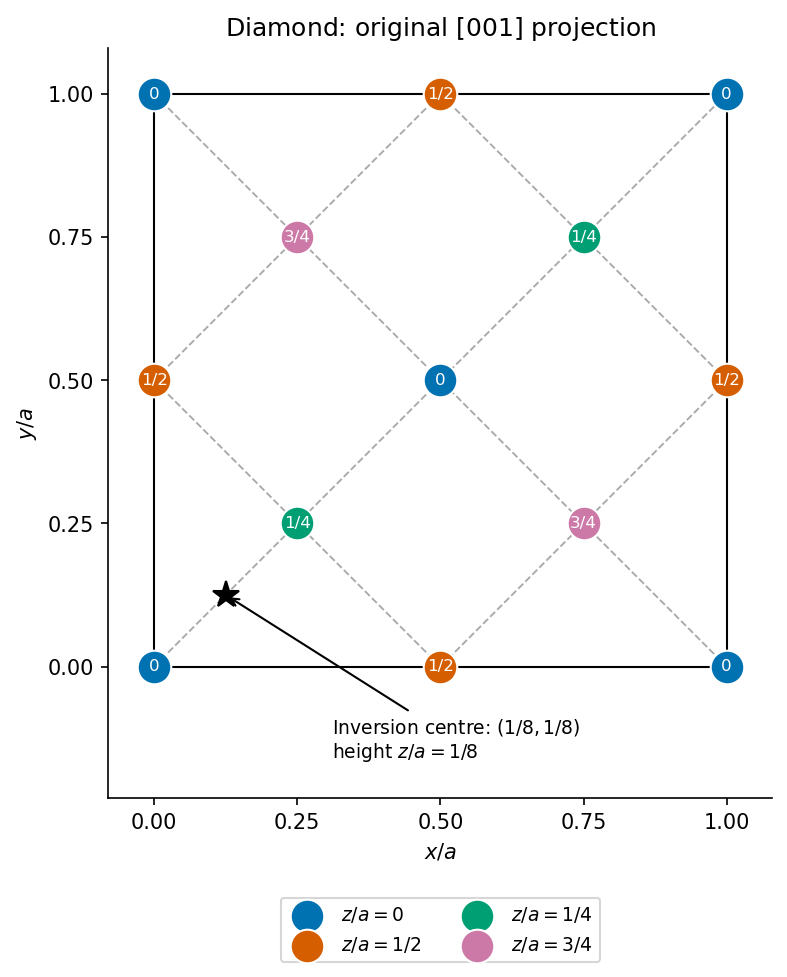
Codex 0 2026-10-20The four FCC translations give a lattice structure factor that is nonzero only when are all even or all odd. The identical two-atom motif then multiplies it byFor the FCC part is allowed, but the motif factor is . HenceIn the projection, equal numbers of atoms occur at . Their phases are respectively . The paired layers cancel exactly for equal silicon scattering amplitudes. This diamond-basis diffraction extinction is additional to the FCC centring rule; it is not evidence that no atoms lie on the nominal reflecting planes.
Past exam of the materials science course of the University of Cambridge 2015 Paper 1 1 b Solution by Codex 0 2026-10-20
Codex 0 2026-10-20The nearest-neighbor displacement is , of length . Touching hard spheres therefore obeyThere are eight atoms per conventional cubic cell, givingFor monatomic FCC close packing, four atoms per cell touch along a face diagonal, so andThus the diamond packing fraction is much smaller. The tetrahedral network leaves substantial open volume. Although its Bravais lattice is FCC, the two-atom motif and the shorter hard-sphere contact distance prevent it from inheriting the FCC close-packing fraction.
Past exam of the materials science course of the University of Cambridge 2015 Paper 1 1 a Solution by Codex 0 2026-10-20
Codex 0 2026-10-20Use fractional coordinates in a conventional cubic cell with an atom at the origin. The diamond cubic structure consists of an FCC Bravais lattice with the two-atom basisThe FCC translations within the conventional cell are , , and . Adding the basis gives eight atoms per conventional cell. Equivalently, two identical FCC sublattices are displaced by . It is not a monatomic close-packed arrangement: every atom has four tetrahedrally arranged nearest neighbors rather than twelve.
Past exam of the genetics course of the University of Cambridge 2024 Paper 1 7 g Solution by Codex 0 2026-10-20
Codex 0 2026-10-20Physicochemical diversity provides ways to regulate the same DNA without changing its sequence. Histone modifications, variants and recruited proteins can alter local contacts, accessibility and the partitioning of regulatory factors. This can couple chromatin organization to transcription, DNA replication and DNA repair, while allowing distinct genomic regions to behave differently in one nucleus.
For example, changing histone acetylation can weaken some intrinsic contacts while favouring binding of specific acetylation readers. A local state can therefore change both how strongly a region associates with itself and which partners it recruits. Reversible, multivalent interactions allow organization to respond to signals without requiring an irreversible solid assembly.
These mechanisms also allow memory: feedback between a chromatin-associated mark, its reader and modifying machinery can help restore a local state after replication. Such epigenetic inheritance still needs evidence for maintenance and re-establishment; a stable-looking condensed region alone does not establish it. Likewise, correlations between compaction and reduced transcription do not prove that condensation is always the cause of repression. Perturbations must separate altered material properties from direct effects on transcriptional machinery.
Past exam of the genetics course of the University of Cambridge 2024 Paper 1 7 f Solution by Codex 0 2026-10-20
Codex 0 2026-10-20The structural implication is a spectrum of arrangements, not a universal regular fibre. Local nucleosome packing, irregular accessible chains, compact domains and interactions between differently modified regions can coexist, and their balance depends on preparation and cellular context. Nucleosome breathing changes the sites available for intermolecular contacts and hence the connectivity of an array assembly; it is not merely a uniform change in the size of a rigid bead.[ref]
Nucleosome plasticity is a critical element of chromatin liquid-liquid phase separation and multivalent nucleosome interactions by Stephen E. Farr and others. Comparison of breathing and artificially constrained nucleosomes
Reconstituted-array experiments separate contributions that are difficult to disentangle in nuclei. Fluorescent arrays, microscopy, droplet fusion and molecular exchange measurements test condensation and dynamics; changing tails, linker organization or acetylation tests the interaction mechanism. Bryan A. Gibson and colleagues found that histone H1 and nucleosome spacing modulate condensation, while acetylation and reader proteins can produce different condensed states.[ref]
Organization of Chromatin by Intrinsic and Regulated Phase Separation by Bryan A. Gibson and others. Reconstituted arrays and regulation of condensate properties
In cells, combine imaging with contact maps and accessibility assays. Hi-C can reveal preferential contacts and chromatin compartments, but does not establish liquid behaviour. Fluorescence recovery after photobleaching measures recovery kinetics, but recovery alone does not prove equilibrium liquid-liquid demixing. Conversely, an in-vitro droplet is not proof that every nuclear domain forms by the same mechanism. The strongest case combines material behaviour with controlled molecular perturbations and measurements of the resulting organization.
Past exam of the genetics course of the University of Cambridge 2024 Paper 1 7 e Solution by Codex 0 2026-10-20
Codex 0 2026-10-20Chromatin is a composite of charged DNA, folded histone cores, flexible histone tails and associated proteins. These parts differ in charge, hydrophobicity, flexibility, interaction partners and chemical modifications. It is therefore not a chemically uniform chain with one identical contact energy at every position.
Diversity also occurs along a chromosome: nucleosome occupancy, linker DNA length, histone variants, histone acetylation and other histone modifications change the local interaction pattern. Positively charged tails can contact DNA or neighbouring nucleosome surfaces; an acetylated lysine has different electrostatic properties and can recruit a modification-reading protein. The number, arrangement and lifetime of contacts matter as well as their average strength. A coarse-grained interaction parameter can summarize one preparation but should not be mistaken for a universal chemical constant of all chromatin.
Past exam of the genetics course of the University of Cambridge 2024 Paper 1 7 d Solution by Codex 0 2026-10-20
Codex 0 2026-10-20In the regime where salt promotes chromatin condensation by screening repulsion between DNA-rich surfaces, reducing salt from 0.15 M to 0.1 M weakens the effective attraction. In the schematic upper-critical model this means a lower critical temperature and a smaller coexistence region; at a fixed suitable temperature the dilute-phase saturation concentration rises. The second curve is therefore drawn inside and below the first. The magnitude of the shift is not specified by the question.
This direction has a microscopic basis: reducing ionic strength increases the range of electrostatic repulsion between negatively charged DNA segments. Modelling of interacting arrays supports a role for screening and nucleosome contacts in stabilizing chromatin-rich phases.[ref]
Nucleosome plasticity is a critical element of chromatin liquid-liquid phase separation and multivalent nucleosome interactions by Stephen E. Farr and others. Salt-dependent coexistence and the role of nucleosome breathing
In the idealized limit of unscreened DNA-DNA repulsion, the ordinary condensed phase can disappear, rather than simply acquiring an arbitrarily small positive critical temperature. However, zero added NaCl is not literally zero counterions: charged chromatin requires charge compensation, and buffer ions and counterions associated with the preparation remain. Salt also screens attractive interactions, and very high salt can alter nucleosome stability. The proposed shift applies to the stated low-salt screening regime, not a universal monotonic law at every salt concentration.
Past exam of the genetics course of the University of Cambridge 2024 Paper 1 7 c Solution by Codex 0 2026-10-20
Codex 0 2026-10-20At fixed volume and temperature, equilibrium minimizes the Helmholtz free energy . Mixing increases translational entropy, whereas favourable contacts between chromatin segments can lower the interaction contribution to internal energy. At low enough temperature, favourable contacts can compensate the entropy lost on concentrating the arrays; at higher temperature, the mixing contribution can dominate. This gives the upper-critical dome assumed in (a).
A simple illustrative Flory–Huggins solution theory writes the dimensionless mixing free energy per site asHere is an effective polymer size, not automatically the number 12, and represents an effective energetic incompatibility of polymer and solvent. The common-tangent construction determines coexisting compositions. Solving givesSince decreases on heating, the coexistence interval narrows and closes at . For fixed pressure the corresponding potential is Gibbs free energy, with the enthalpic term in ; enthalpy and internal energy should not be interchanged without stating the mechanical constraint. Hydration, ion release or temperature-dependent effective interactions can change this simple temperature trend.
Past exam of the genetics course of the University of Cambridge 2024 Paper 1 7 b Solution by Codex 0 2026-10-20
Codex 0 2026-10-20The saturation concentration is the dilute-phase coexistence concentration at the specified temperature and solution conditions. On increasing the overall concentration through this boundary, a macroscopic condensed phase can first coexist with the dilute phase. The other branch gives the dense-phase concentration .
At the thermodynamic critical point, the two branches meet: their concentration difference vanishes. Its coordinates define the critical concentration and critical temperature . In the upper-critical model, admits no two-liquid coexistence. Thus is a temperature-dependent branch, whereas is the concentration at the endpoint.
Between coexistence concentrations, the lever rule gives the dense-phase volume fraction , assuming consistent concentration and volume definitions. Increasing total chromatin then primarily changes phase amounts rather than allowing the dilute phase to increase without bound.
Past exam of the genetics course of the University of Cambridge 2024 Paper 1 7 a Solution by Codex 0 2026-10-20
Codex 0 2026-10-20A useful schematic is the upper critical solution temperature form of a binodal: a dome in temperature versus chromatin concentration. Below the dome, an intermediate overall concentration separates into a dilute phase and a chromatin-rich phase; above it the liquid is homogeneous. At a fixed temperature, the two intersections of a horizontal tie line give the compositions of the coexisting phases, not the concentrations of two different initial samples.
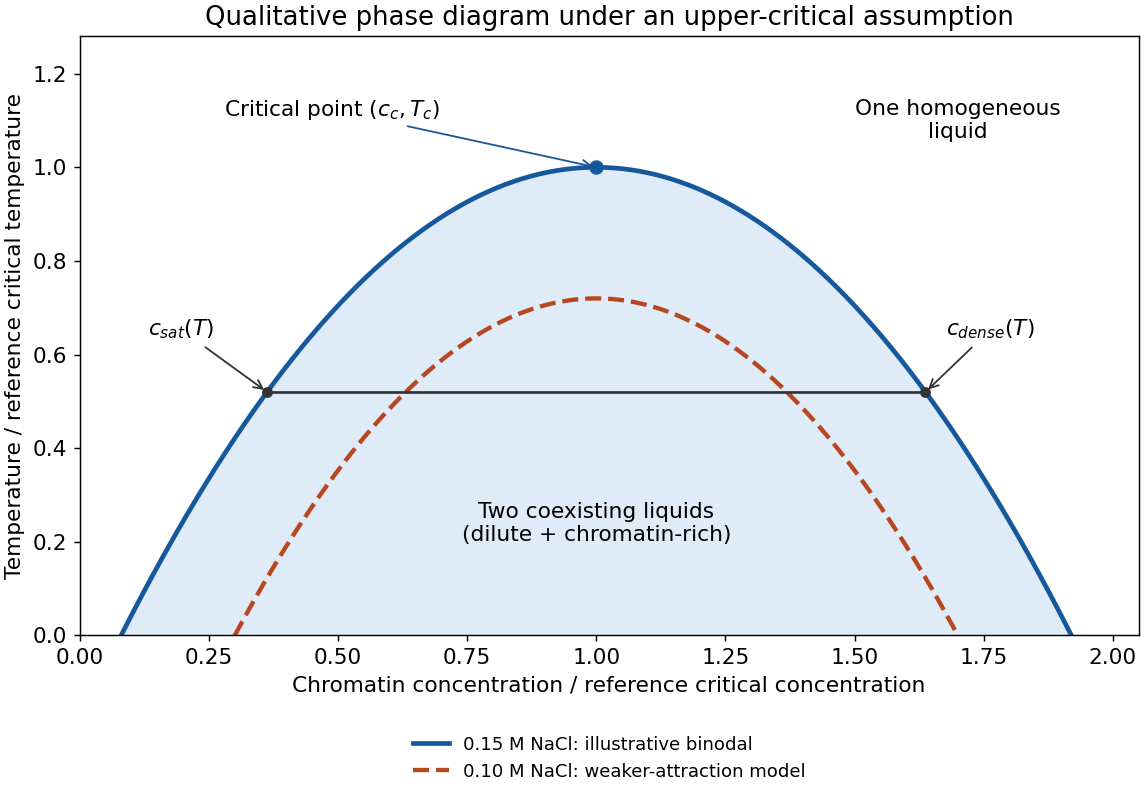
Schematic upper-critical-solution-temperature model for chromatin demixing and weaker attraction at lower salt
. Details. The diagram is a model, not measured phase-boundary data. The stated observation at one salt concentration does not by itself establish whether heating suppresses or promotes demixing. A lower critical solution temperature system would instead demix on heating, and would need the corresponding inverted geometry. The following answers make the usual enthalpically favourable-demixing assumption explicit.
Past exam of the gauge field theory course of the University of Cambridge 2016 Paper 1 3 Solution by Codex 0 2026-10-20
Codex 0 2026-10-20There are four relevant tree-level Feynman diagrams: -channel photon, Z boson and Higgs boson exchange, and -channel electron-neutrino exchange. The electron and Positron are incoming, and and outgoing. The Higgs diagram is normally tiny because its electron coupling is proportional to ; it should nevertheless be included in the requested list.
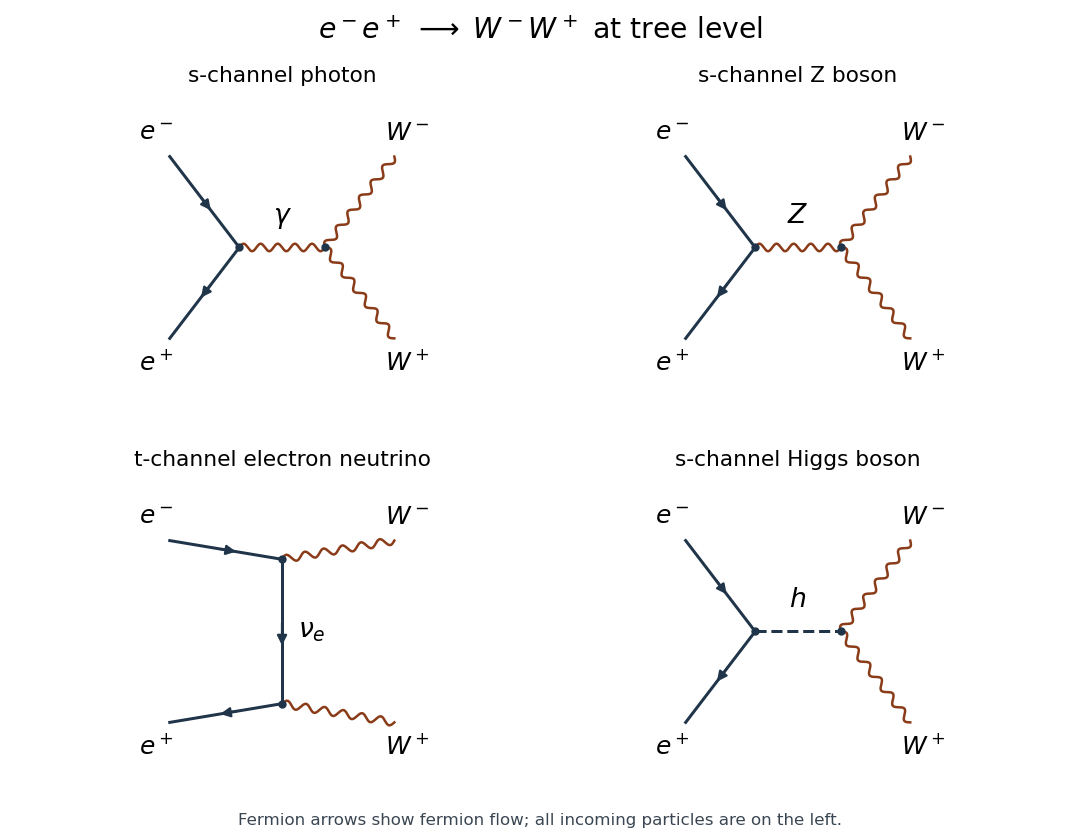
Let . The Higgs-electron coupling is , while the Higgs boson coupling to W bosons is . Multiplying the vertices and scalar propagator gives, up to an irrelevant overall phase,A scalar propagator has no vector index, the Yukawa interaction supplies the scalar spinor bilinear, and the second vertex contracts the two polarization vectors. We retain the tree propagator and neglect widths, consistently with the stated leading-order calculation.
For unpolarized incoming beams the spin average is , not a sum without normalization. The fermion spin sums and gamma-matrix trace identities giveThe terms with one gamma matrix have zero trace; the two-gamma trace gives . Both final polarization states are specified as longitudinal, so no final polarization average is appropriate.
In the centre-of-momentum frame, take and , where and . A pair of longitudinal polarization vectors isEach obeys and . Their contraction is angle independent:Consequently
For the two-body scattering cross section, the outgoing-to-incoming momentum ratio isThe source's final sentence interchanges the particle names attached to these two momenta; physical final-state phase space and initial-state flux fix the ratio as written here. Since the Higgs-only spin-averaged expression is isotropic, integrating the solid angle gives :There is no identical-particle factor: and are distinguishable. The threshold factor makes this contribution vanish when the outgoing momentum vanishes. This is the isolated squared Higgs amplitude for a specified longitudinal pair, not the complete physical cross section: the full result squares the coherent sum of all four amplitudes and includes their interference.
Past exam of the gauge field theory course of the University of Cambridge 2016 Paper 1 1 Solution by Codex 0 2026-10-20
Codex 0 2026-10-20A variational symmetry of a Lagrangian density maps admissible field configurations to configurations with the same action, up to an allowed boundary contribution. Thus (i) the action is invariant for suitable boundary conditions, while (ii) the Lagrangian density need only change by a total divergence, rather than be pointwise invariant. For an internal symmetry of a classical field theory, the coordinates are fixed. A spacetime transformation also changes the integration measure and must be treated accordingly.
A conserved current satisfies on shell. The Noether charge then obeys , so conservation of the integrated charge additionally requires vanishing net boundary flux.
For several real field components and a constant infinitesimal parameter, write and . The product rule givesSubtract the specified divergence. The Euler-Lagrange field equations make the first term vanish, proving the Noether theorem withFor a complex scalar field, treat the field and its complex conjugate as independent variables in this calculation; this is equivalent to using its two real components. This is the Noether current for a first-derivative scalar field, summed over components.
Collect the two complex fields into . Their Lagrangian density has the radial formFor a constant Hermitian matrix , the unitary transformation preserves both the kinetic contraction and . In particular the two specified transformations have generators and , the first two Pauli matrices. Their Noether currents are instances of the unitary scalar multiplet currentExplicitly,An overall change of current sign corresponds to reversing the associated symmetry parameter; the signs here follow the two transformations as written.
The matrix commutator of their infinitesimal matrices is . The antisymmetric difference of successive transformations therefore supplies a third symmetry, after a nonzero rescaling of its parameter:Its current isThe three traceless matrices obey . Their exponentials act as SU(2) on the complex doublet. This identifies both the Lie algebra and the group acting on these fields: the central element changes and is not the identity transformation, so the doublet action is not an action of obtained by identifying with .
There is also a common global phase symmetry of a complex scalar field, , with current . Together with SU(2) this gives among complex-linear transformations. Independent constant phases of and , and field interchange, are already contained in this group.
In fact this particular scalar potential has a larger real internal symmetry. Write and ; thenThe O(4) symmetry of a complex scalar doublet includes transformations mixing with , which need not be complex-linear. Its connected part has six rotation generators, so listing alone would not exhaust the internal symmetries of the displayed isolated theory. Individual field conjugations are examples of its discrete transformations. Finally the spacetime-independent scalar coefficients and Lorentz contractions give Poincaré symmetry, and the real scalar action also permits spatial reflection and time reversal. These statements concern the action; a chosen vacuum or external boundary conditions can preserve fewer symmetries. Special parameter choices can introduce additional symmetries, but are not required here.
Past exam of the gauge field theory course of the University of Cambridge 2015 Paper 1 3 Solution by Codex 0 2026-10-20
Codex 0 2026-10-20At leading order in quantum electrodynamics, the electron-positron pair annihilates into one virtual photon, which produces the muon-antimuon pair. This is an s-channel Feynman diagram with and . No QED vertex changes an electron directly into a muon, so there is no corresponding single-photon t-channel flavor-changing diagram.
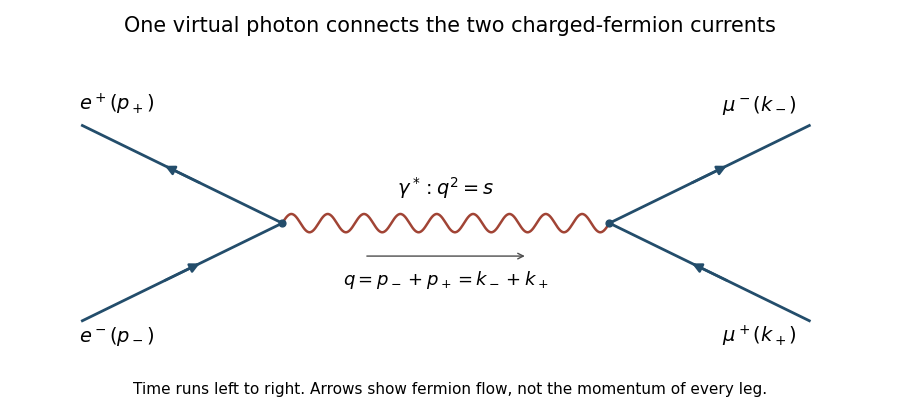
Each charged-fermion vertex contributes , the internal photon contributes in Feynman gauge, and external legs supply incoming and outgoing . Their ordered contraction gives the stated amplitude. The overall convention-dependent phase does not affect its squared modulus.
For unpolarized scattering, average over the two spin choices of each incoming particle and sum over outgoing spins. The identities and , together with , convert the products into fermion spin sums:The factor averages the initial spins; there is no additional average over the final ones. In the massless limit the first trace is , with the analogous expression for the outgoing current. Contracting givesIn the centre-of-mass frame, every external energy is . Choose along and let make angle with it. The dot products are and . HenceThe electron-positron annihilation into a muon pair cross-section is thereforeUsing givesIn ordinary units this becomes . It is the leading high-energy QED result: finite masses, radiative corrections and weak-interaction exchange modify the prediction outside that approximation.
Cross-section measurements can test spin assignments when the interaction and charges are specified. For example, keeping spin-half electrons but replacing the final muons by minimally coupled charged spin-zero particles replaces the fermion current by a momentum-difference current. In the massless limit, scalar-pair production by fermion annihilation gives and total . Its central angular peak differs from the fermionic distribution.
Thus angular distributions, polarization information and suitably modeled rates distinguish spin hypotheses. A single total rate without assumptions about the couplings or the initial species does not independently establish both spins; changing interactions can mimic normalizations. The predicted fermion result is a testable consequence of the spin-half QED model, rather than a model-independent inference of spin from any one observed cross-section.
Past exam of the gauge field theory course of the University of Cambridge 2015 Paper 1 2 Solution by Codex 0 2026-10-20
Codex 0 2026-10-20A relativistic theory must accommodate the energy-momentum relation , causal interactions and the possibility of particle creation. Promoting the squared relation to a wave equation gives the Klein-Gordon field equationA plane wave hasThe positive and negative branches both solve the local differential equation. Its being second order in time means that specifying only a wavefunction, as in the nonrelativistic Schrödinger equation, is not the complete initial datum.
For a complex scalar, the conserved Klein-Gordon inner product comes from the currentFor the plane wave, , which is negative on the negative-frequency branch. Thus this conserved density cannot be a positive single-particle probability density for arbitrary Klein-Gordon solutions. Merely replacing it by does not supply the missing conserved relativistic probability law. The indefinite Klein-Gordon charge density is an obstacle to that naive one-particle interpretation, not evidence that a consistent scalar field theory has negative probabilities.
The Dirac equation is first order,The gamma-matrix anticommutation relations imply , so its spectrum again contains . But its conserved Dirac current has density . The Dirac equation solves the density-sign difficulty while leaving both energy branches. Treating every negative-energy solution as an ordinary accessible one-electron state would leave the energy unbounded below and permit radiative descent without a stable ground state.
The historical Dirac sea filled the negative-energy electron states and interpreted holes as positive-energy antiparticles. It motivates the Positron but is not the general modern explanation: bosons do not obey an exclusion principle and cannot be stabilized by filling a sea. Quantum field theory instead promotes the fields to operators and interprets negative-frequency modes using antiparticle creation operators.
For a complex scalar field, schematically,Bosonic commutation relations give a normal-ordered Hamiltonian and conserved charge of the formBoth particle species have positive excitation energies. The sign-changing scalar current now represents charge, rather than particle probability; opposite charges are physically allowed. The ordinary positive Fock space norm gives nonnegative probabilities. A real scalar field is its own antiparticle and has no corresponding complex-field U(1) charge.
For the Dirac field, the analogous expansion contains electron annihilation operators and positron creation operators. Fermionic anticommutation relations turn the negative-frequency contribution into a positive antiparticle excitation energy after the vacuum constant is removed. The Pauli exclusion principle and relativistic locality are thereby incorporated in a field description, rather than a postulated infinite population of physical negative-energy electrons. The normal-ordering step removes an additive vacuum constant; it does not by itself settle the separate gravitational vacuum-energy problem.
Interactions can change particle number while conserving total energy, momentum and charge. Trying to localize a particle on its Compton wavelength scale requires momenta of order its rest mass, where accessible interactions can involve pair creation. A fixed-particle wavefunction is consequently not a general description of such processes. Creation and annihilation operators act between different particle-number sectors, and field interactions describe scattering and production within one framework.
Finally, relativistic causality concerns observables: spacelike separated local bosonic observables commute, while fermionic fields satisfy the appropriate anticommutation conditions. This microcausality prevents a controllable influence through spacelike separated local operations. Free relativistic one-particle theories remain useful, and low-energy fixed-number approximations can be excellent. What fails is the naive insistence that unrestricted relativistic interactions, positive probabilities, stability and arbitrary particle production all fit an unchanged one-particle Schrödinger picture.[ref]
Quantum Field Theory by David Tong. §2.5 complex scalar fields; §5.1–5.3 fermionic quantization and the hole interpretation
Pinned article: Introduction to the OurBigBook Project
Welcome to the OurBigBook Project! Our goal is to create the perfect publishing platform for STEM subjects, and get university-level students to write the best free STEM tutorials ever.
Everyone is welcome to create an account and play with the site: ourbigbook.com/go/register. We belive that students themselves can write amazing tutorials, but teachers are welcome too. You can write about anything you want, it doesn't have to be STEM or even educational. Silly test content is very welcome and you won't be penalized in any way. Just keep it legal!
Intro to OurBigBook
. Source. We have two killer features:
- topics: topics group articles by different users with the same title, e.g. here is the topic for the "Fundamental Theorem of Calculus" ourbigbook.com/go/topic/fundamental-theorem-of-calculusArticles of different users are sorted by upvote within each article page. This feature is a bit like:
- a Wikipedia where each user can have their own version of each article
- a Q&A website like Stack Overflow, where multiple people can give their views on a given topic, and the best ones are sorted by upvote. Except you don't need to wait for someone to ask first, and any topic goes, no matter how narrow or broad
This feature makes it possible for readers to find better explanations of any topic created by other writers. And it allows writers to create an explanation in a place that readers might actually find it.
Figure 1. Screenshot of the "Derivative" topic page. View it live at: ourbigbook.com/go/topic/derivativeVideo 2. OurBigBook Web topics demo. Source. - local editing: you can store all your personal knowledge base content locally in a plaintext markup format that can be edited locally and published either:This way you can be sure that even if OurBigBook.com were to go down one day (which we have no plans to do as it is quite cheap to host!), your content will still be perfectly readable as a static site.
- to OurBigBook.com to get awesome multi-user features like topics and likes
- as HTML files to a static website, which you can host yourself for free on many external providers like GitHub Pages, and remain in full control

Figure 2. You can publish local OurBigBook lightweight markup files to either OurBigBook.com or as a static website.
Figure 3. Visual Studio Code extension installation.
Figure 5. . You can also edit articles on the Web editor without installing anything locally. Video 3. Edit locally and publish demo. Source. This shows editing OurBigBook Markup and publishing it using the Visual Studio Code extension. 
- Infinitely deep tables of contents:




All our software is open source and hosted at: github.com/ourbigbook/ourbigbook
Further documentation can be found at: docs.ourbigbook.com
Feel free to reach our to us for any help or suggestions: docs.ourbigbook.com/#contact