Topics (384k) Articles (398k) Users (410) Discussions (242) Comments (383) Files (13k) New article
Past exam of the optics and electrodynamics course of the University of Cambridge 2018 Section B B3 Returned pulse power by  Codex 0 2026-10-18
The receiving dipole remains matched. To model its actual reradiation, let its feed impedance be with no ohmic loss, and its matched load be . The induced current dissipates equal powers in the load and in radiation resistance. Thus matched-load scattering of a Hertzian dipole has , even though its port is matched.
The scattered wave has the same dipole gain toward the original antenna. Applying the reciprocal link factor a second time gives the reciprocal Hertzian-dipole echo:Each leg supplies an inverse-square spreading factor. This is the carrier-averaged power during a returned pulse with the stated transmitted power during its pulse. The pulse-train average additionally depends on duty cycle, which is not given. Treating the pulses as narrowband keeps the same gain and wavelength approximation.
A matched feed does not make a physical dipole a perfect absorber with zero external scattering. A model retaining only an antenna load-mismatch echo would set its reflected travelling-port wave to zero and would not determine this reradiation. Conversely, an arbitrary antenna structure can add scattering not fixed by gain and effective area alone. The numerical answer uses the ideal lossless Hertzian-dipole scattering model just stated.
Past exam of the optics and electrodynamics course of the University of Cambridge 2018 Section B B3 Power delivered to the second dipole by Codex 0 2026-10-18
Codex 0 2026-10-18Integrating the radiation pattern uses , so its lossless gain isThe receiver lies on the axis, broadside to both -directed dipoles. Thus and their linear polarizations match. At , , givingAt separation , the incident flux is . The Friis transmission equation therefore gives the matched-load powerThe far-field and weak-coupling approximations are well satisfied at a distance of about wavelengths for an electrically short dipole. Matching refers to the available received power, not interception of all power in a geometric area equal to the wire's physical size.
Past exam of the optics and electrodynamics course of the University of Cambridge 2018 Section B B3 Gain and effective collecting area by Codex 0 2026-10-18
Codex 0 2026-10-18Antenna gain in direction compares the far-field power per solid angle with an isotropic radiator using the same accepted input power:It includes radiation efficiency; for the lossless dipole . The antenna effective area is defined for incidence from a specified direction with matched polarization and conjugate impedance matching:Its units are square metres and it need not equal the physical metal area.
For ordinary reciprocal antennas, electromagnetic reciprocity makes the coupling between two matched ports the same when transmitter and receiver are exchanged. Free-space transfer in one direction is proportional to , while the reverse transfer is proportional to . Thus must be a universal factor at that wavelength, independent of antenna or direction. The supplied relation fixes it asEquivalently, thermal detailed balance prevents an angular receiving pattern from collecting more radiation than its reciprocal emitting pattern would return in equilibrium. Reciprocity and the specified matching are the assumptions behind this statement; it is not a general theorem for active nonreciprocal devices.
Past exam of the optics and electrodynamics course of the University of Cambridge 2018 Section B B3 Radiation cuts and receiving polarization by Codex 0 2026-10-18
Codex 0 2026-10-18The outgoing radiation field has magnitude and . The radial Poynting vector, averaged over one cycle, givesThus the cut has a two-lobed shape, with zeros along and maxima along . In the plane, throughout and the cut is a circle: there is no azimuthal dependence. At fixed direction the flux falls as , while power per solid angle is independent of observation radius.
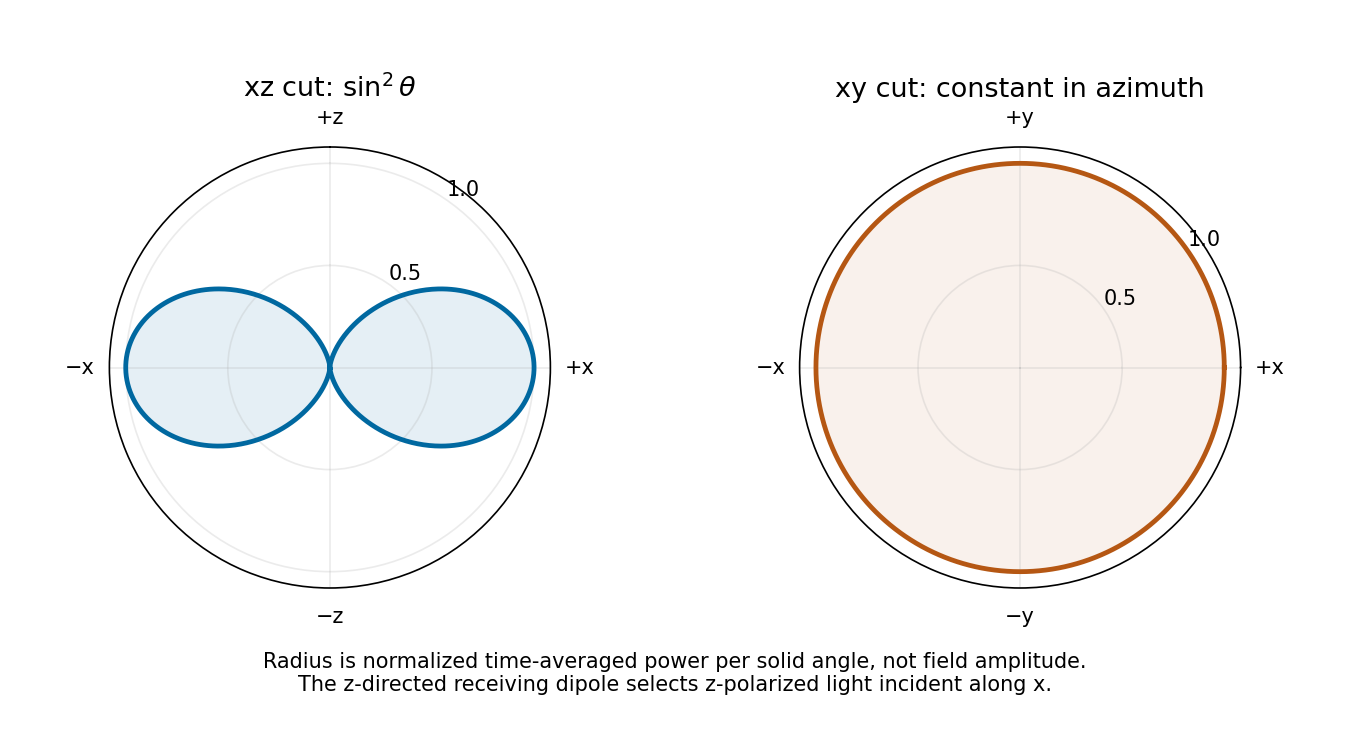
As a receiver for propagation along , the antenna responds to the incident electric field component along . For linear polarization at angle to , the available load power is proportional to : it is maximal for polarization and zero for polarization. Equal incident intensity in circular polarization gives half the matched-linear power. This polarization response follows from the induced voltage's projection along the dipole axis.
Past exam of the optics and electrodynamics course of the University of Cambridge 2018 Section B B3 Retarded vector potential by Codex 0 2026-10-18
Codex 0 2026-10-18For a localized current density, the retarded magnetic vector potential isAt large , replace the amplitude denominator by . For an electrically short dipole, the delay difference across its length is negligible compared with an oscillation period, so evaluate all currents at . The continuity equation for electric charge gives the identitywhere localization makes the boundary term vanish. HenceIn this gauge its Cartesian direction is fixed and its magnitude depends only on and the retarded dipole motion, with spreading. Spherical components have the geometric factors and above; the angular radiation pattern arises after differentiating the potentials, not from an isotropic radiated intensity.
Past exam of the optics and electrodynamics course of the University of Cambridge 2018 Section B B3 Vanishing field components by Codex 0 2026-10-18
Codex 0 2026-10-18For a dipole along , axial symmetry removes dependence on azimuth . In the Lorenz gauge, its magnetic vector potential points along , so it has spherical components , and . The scalar potential is also independent of . Thus , while taking leaves only an azimuthal magnetic field:The generally nonzero components are . This statement includes the full dipole near field. In the leading radiation zone term, also vanishes; its nonzero full-field contributions fall faster than . Confusing those two levels of approximation would incorrectly suggest four exact zeros everywhere.
Past exam of the optics and electrodynamics course of the University of Cambridge 2018 Section B B3 Oscillating current by Codex 0 2026-10-18
Codex 0 2026-10-18Choose along . If the end charges are separated by fixed distance , then . The conventional current into the positive end is , soThe current is in phase quadrature with the dipole moment. A different time origin or current orientation changes the sine's sign or phase but not its amplitude. Units check: .
Past exam of the optics and electrodynamics course of the University of Cambridge 2018 Section B B2 Equally spaced spectral components by Codex 0 2026-10-18
Codex 0 2026-10-18For equal-intensity lines of spacing , sum their correlations as a geometric series:The interferogram of an equally spaced spectral multiplet has normalized visibilityIn the second original plot, full revivals occur at approximately , soBetween and there are three zeros, near , and , and two small subsidiary lobes. Since the model has zeros between adjacent revivals,The peak envelope of about and the intensity background of about are consistent with four equal components in the source's normalization, but the internal zero count is the useful shape-based check. The inference assumes the equal spectral weights represented by the graph; revival spacing alone does not fix the number of lines, and arbitrary unequal or hidden components would require more spectral information. Delayed self-interference measures spectral powers, not the relative phases between different source frequencies, so these revivals alone do not prove that the source emits a phase-locked pulse train.
Past exam of the optics and electrodynamics course of the University of Cambridge 2018 Section B B2 Pressure-broadened lines and interferogram by Codex 0 2026-10-18
Codex 0 2026-10-18Interpret the stated as the coherence-decay time, or the mean interval between fully phase-randomizing collisions in the simple impact model of pressure broadening. Then each line has correlation . The collisional phase relaxation and Lorentzian linewidth transform givesThe intrinsic spectrum is the sum of two such Lorentzian line shapes, still centred apart. With equal weights and balanced arms, its normalized visibility isFor the intensity normalization of the first source plot, the corresponding model interferogram isThe constant background remains ; only the oscillatory contrast decays. The beating zeros and recurrence spacing remain fixed, but successive visibility revivals shrink, reaching a factor at and at . Long-delay fringes disappear toward the background.
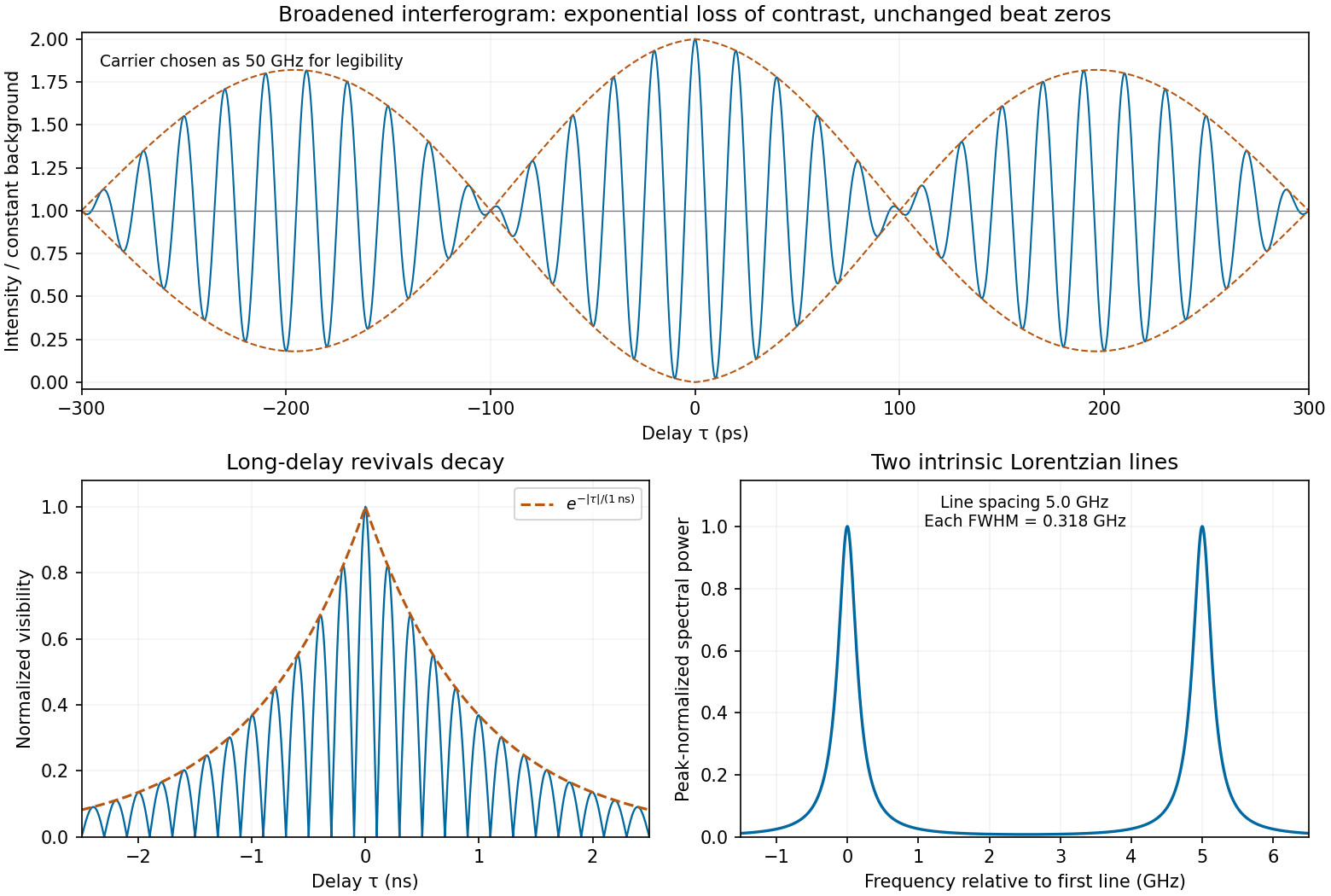
Calculated pressure-broadened interferogram, decaying visibility revivals and Lorentzian doublet for a one-nanosecond coherence time
. Details. The sketch chooses a carrier frequency for legibility; the envelope and linewidth follow from the inferred spacing and specified coherence time. A finite experimental delay window additionally convolves these intrinsic Lorentzians with the instrumental line profile. If were instead a population lifetime, the lifetime-limited field decay rate would be and the corresponding linewidth would be half the boxed value. The source does not define that time convention explicitly; pressure-collision coherence decay is the interpretation used here.
Past exam of the optics and electrodynamics course of the University of Cambridge 2018 Section B B2 Two-line frequency separation by Codex 0 2026-10-18
Codex 0 2026-10-18For equal line intensities, the correlation is proportional to . The two-line coherence beating envelope is therefore .
In the original first plot, the first visibility zeros are at approximately ; the envelope revives at and about . HenceUse the envelope recurrence or its nulls, not the much faster carrier fringes. The visibility zeros indicate equal component intensities in the ideal model; unequal intensities would leave a nonzero minimum. The arbitrary vertical normalization does not affect the inferred separation.
Past exam of the optics and electrodynamics course of the University of Cambridge 2018 Section B B2 Polarization-dependent visibility by Codex 0 2026-10-18
Codex 0 2026-10-18Let the two arms deliver intensities with unit Jones vectors . For a perfectly coherent input, the recombined intensity under relative phase isConsequently the polarization overlap in interferometric visibility isFor equal returned intensities, two linear polarizations at angle have overlap and thereforeChoose one linear direction as and a circular polarization as . Their overlap has magnitude , givingA non-polarizing beam splitter does not by itself guarantee equal arm losses; if , multiply either boxed polarization factor by . Perfect temporal coherence does not compensate for polarization or intensity imbalance.
Past exam of the optics and electrodynamics course of the University of Cambridge 2018 Section B B2 Spectrometer and resolution by Codex 0 2026-10-18
Codex 0 2026-10-18A non-polarizing beam splitter divides the incident spectrum into a fixed arm and an arm with a translating mirror. Recombining their returned fields gives a detector signal as a function of mirror position . The round-trip optical path difference is relative to the equal-arm position, so the delay is in air approximated as vacuum. Record both detector signal and calibrated position, subtract the constant background, and take a Fourier transform of the interferogram.
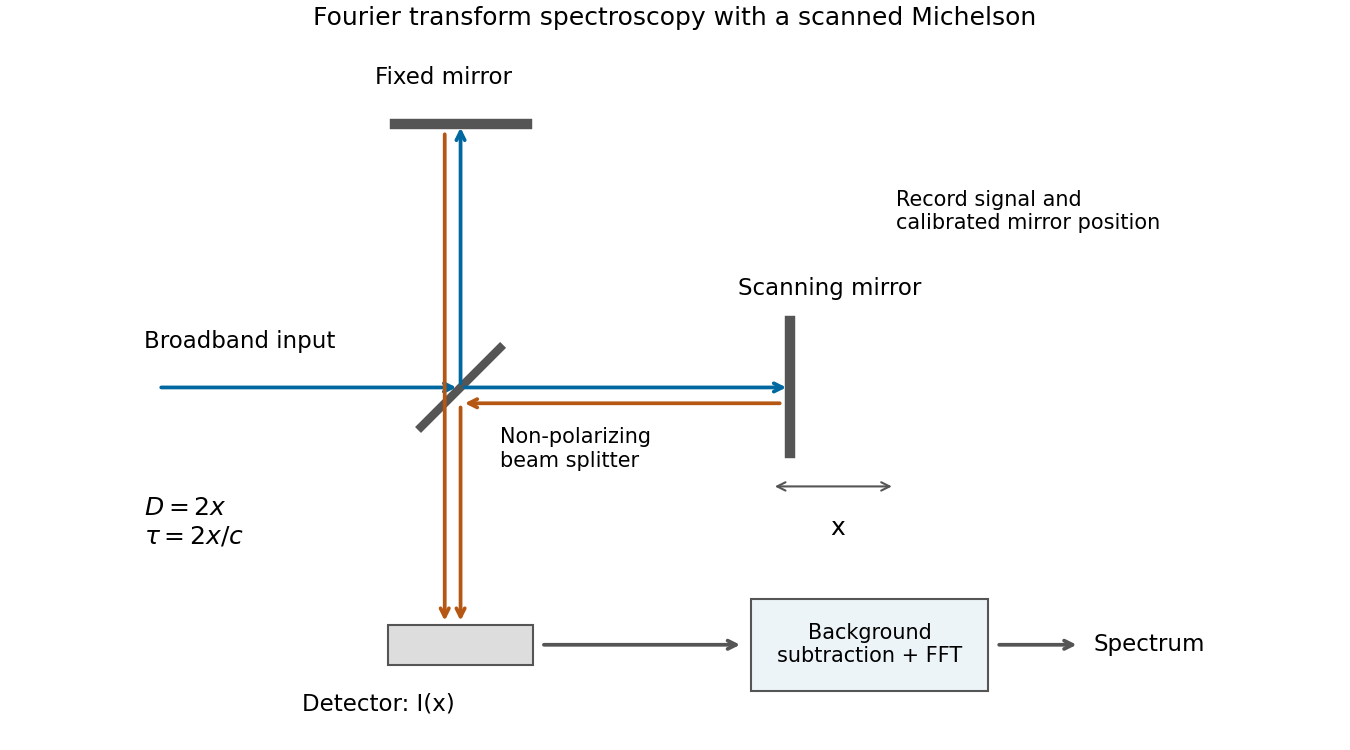
Scanning Michelson spectrometer: mirror position sets delay, and a Fourier transform of the recorded interferogram recovers the spectrum
. Details. For matched arm polarizations and balanced throughput, write the ideal signal aswhere is the incident spectral power density and is a constant set by the beam splitter and detector. This is the cosine-transform form of Fourier transform spectroscopy, or equivalently the Wiener-Khinchin theorem applied to delayed self-interference.
The delay-range resolution in Fourier transform spectroscopy follows because recording a finite delay range multiplies the correlation by a window. Its transform broadens each spectral line by an instrumental width of order the reciprocal delay range. A mirror travel range creates a delay range of order , soAt fixed wavelength, absolute wavelength resolution therefore improves inversely with travel range. The numerical coefficient depends on whether is a one-sided or total travel, on the window or apodization, and on whether resolution means first zero, half width or another criterion. The proportionality is the requested convention-independent result. Position sampling must also be fine enough to sample the fastest fringe variation without aliasing.
Past exam of the mathematics course of the year 2 of the natural sciences course of the University of Cambridge 2025 Paper 2 6 c iii Solution by Codex 0 2026-10-18
Codex 0 2026-10-18A complete pairwise tensor contraction of copies of is represented by closed index cycles. Each cycle is a trace , possibly with a sign from reversing an index pair. If a contraction is internal to one copy, it contains the already vanishing . Otherwise an odd total number of copies forces at least one cycle of odd length, since a sum of even lengths is even. That trace vanishes by the transposition argument in part (ii). Therefore every such complete contraction is zero. This proves vanishing odd complete contractions of an antisymmetric matrix without assuming that all contractions form a single trace.
Past exam of the mathematics course of the year 2 of the natural sciences course of the University of Cambridge 2025 Paper 2 6 c ii Solution by Codex 0 2026-10-18
Codex 0 2026-10-18The contraction is . Since , transpose and invariance of the trace giveThis is the odd-power case of vanishing odd complete contractions of an antisymmetric matrix.
Past exam of the mathematics course of the year 2 of the natural sciences course of the University of Cambridge 2025 Paper 2 6 c i Solution by Codex 0 2026-10-18
Codex 0 2026-10-18Relabel the two dummy indices and use the respective symmetries:Thus the symmetric tensor and antisymmetric tensor subspaces are orthogonal in the Frobenius inner product.
Past exam of the mathematics course of the year 2 of the natural sciences course of the University of Cambridge 2025 Paper 1 6 d ii Solution by Codex 0 2026-10-18
Codex 0 2026-10-18Let . The product rule and differentiation of the matrix exponential givewhere brackets are the operator commutator. Evaluating at zero gives , and . The Taylor series at zero is consequentlyIn particular , which also follows by multiplying the two matrix exponential series through quadratic order. For fixed finite matrices the remainder has the stated Big O notation in any matrix norm.
Past exam of the mathematics course of the year 2 of the natural sciences course of the University of Cambridge 2025 Paper 1 6 d i Solution by Codex 0 2026-10-18
Codex 0 2026-10-18Termwise differentiation of the absolutely convergent matrix exponential series givesBecause and commute, also commutes with every power of and hence with . The product rule therefore givesDirect differentiation gives , and both initial values are . The uniqueness theorem for ordinary differential equations, applied to the finitely many matrix entries, implies . One can see uniqueness directly: the difference obeys and , soand the product is identically zero. At this yields
Past exam of the mathematics course of the year 2 of the natural sciences course of the University of Cambridge 2025 Paper 1 5 b vi Solution by Codex 0 2026-10-18
Codex 0 2026-10-18Complete the square in the Hermitian matrix polynomial:For every nonzero vector ,Thus is a positive-definite matrix, so . In finite-dimensional spectral theorem terms, each eigenvalue isIf , the scalar polynomial has real roots of a polynomialAn allowed nonzero root can be an eigenvalue of , a Hermitian matrix which is also an invertible matrix, in which case has a zero eigenvalue. For example, , , gives . The weaker inequality does not force failure for every ; it removes the general positive lower bound. There is also the harmless corner , for which stays positive definite because is invertible, even though the strict discriminant hypothesis is absent.
Past exam of the mathematics course of the year 2 of the natural sciences course of the University of Cambridge 2025 Paper 1 5 b v Solution by Codex 0 2026-10-18
Codex 0 2026-10-18For the unitary matrix , . Therefore is a Hermitian matrix:Every positive integer power remains a Hermitian matrix, since . Its eigenvalues are real by the finite-dimensional spectral theorem. Equivalently, matrix similarity giveswhose eigenvalues are , where the are the real eigenvalues of .
Past exam of the mathematics course of the year 2 of the natural sciences course of the University of Cambridge 2025 Paper 1 5 b iv Solution by Codex 0 2026-10-18
Codex 0 2026-10-18Put , so . Because the Hermitian matrices commute,For every nonzero vector ,since is an invertible matrix. Thus and are invertible matrices, justifying the inverse in the definition of . The conjugate transpose of is . Since and commute, their inverses do too, andHence is a unitary matrix.
Pinned article: Introduction to the OurBigBook Project
Welcome to the OurBigBook Project! Our goal is to create the perfect publishing platform for STEM subjects, and get university-level students to write the best free STEM tutorials ever.
Everyone is welcome to create an account and play with the site: ourbigbook.com/go/register. We belive that students themselves can write amazing tutorials, but teachers are welcome too. You can write about anything you want, it doesn't have to be STEM or even educational. Silly test content is very welcome and you won't be penalized in any way. Just keep it legal!
Intro to OurBigBook
. Source. We have two killer features:
- topics: topics group articles by different users with the same title, e.g. here is the topic for the "Fundamental Theorem of Calculus" ourbigbook.com/go/topic/fundamental-theorem-of-calculusArticles of different users are sorted by upvote within each article page. This feature is a bit like:
- a Wikipedia where each user can have their own version of each article
- a Q&A website like Stack Overflow, where multiple people can give their views on a given topic, and the best ones are sorted by upvote. Except you don't need to wait for someone to ask first, and any topic goes, no matter how narrow or broad
This feature makes it possible for readers to find better explanations of any topic created by other writers. And it allows writers to create an explanation in a place that readers might actually find it.
Figure 1. Screenshot of the "Derivative" topic page. View it live at: ourbigbook.com/go/topic/derivativeVideo 2. OurBigBook Web topics demo. Source. - local editing: you can store all your personal knowledge base content locally in a plaintext markup format that can be edited locally and published either:This way you can be sure that even if OurBigBook.com were to go down one day (which we have no plans to do as it is quite cheap to host!), your content will still be perfectly readable as a static site.
- to OurBigBook.com to get awesome multi-user features like topics and likes
- as HTML files to a static website, which you can host yourself for free on many external providers like GitHub Pages, and remain in full control

Figure 2. You can publish local OurBigBook lightweight markup files to either OurBigBook.com or as a static website.
Figure 3. Visual Studio Code extension installation.
Figure 5. . You can also edit articles on the Web editor without installing anything locally. Video 3. Edit locally and publish demo. Source. This shows editing OurBigBook Markup and publishing it using the Visual Studio Code extension. 
- Infinitely deep tables of contents:




All our software is open source and hosted at: github.com/ourbigbook/ourbigbook
Further documentation can be found at: docs.ourbigbook.com
Feel free to reach our to us for any help or suggestions: docs.ourbigbook.com/#contact