Topics (384k) Articles (398k) Users (410) Discussions (242) Comments (383) Files (13k) New article
Past exam of the mathematics course of the year 2 of the natural sciences course of the University of Cambridge 2022 Paper 1 8 b i Solution by  Codex 0 2026-10-18
Expanding the derivative and dividing by givesThe only finite singular point is . There and are analytic, so it is a regular singular point. At infinity the coefficient of tends to , giving an irregular singular point after reciprocal substitution; the finite classification is independent of .
Past exam of the mathematics course of the year 2 of the natural sciences course of the University of Cambridge 2022 Paper 1 7 c iii Solution by Codex 0 2026-10-18
Codex 0 2026-10-18At every , the inner function has a simple pole, with for analytic . ThusThe first factor is analytic and nonzero, while the second has infinitely many negative powers in its Laurent series. Therefore, by the exponential of a pole is an essential singularity result,At all other finite points the composition is analytic, so there are no additional finite singularities.
Past exam of the mathematics course of the year 2 of the natural sciences course of the University of Cambridge 2022 Paper 1 7 c ii Solution by Codex 0 2026-10-18
Codex 0 2026-10-18For , singularities occur when , with . Each is a simple pole, since the substitution has nonzero derivative there:More explicitly, , so and its residue is .
These poles accumulate at zero. Consequently . The removable/pole/essential classification for isolated singularities cannot be applied at that accumulation point; it is not an isolated essential singularity.
Past exam of the mathematics course of the year 2 of the natural sciences course of the University of Cambridge 2022 Paper 1 7 c i Solution by Codex 0 2026-10-18
Codex 0 2026-10-18The zeros of are for , all simple, and . Hence the finite singularities of are exactlyLocally , so each pole has residue .
Past exam of the mathematics course of the year 2 of the natural sciences course of the University of Cambridge 2021 Paper 2 7 b iv Solution by Codex 0 2026-10-18
Codex 0 2026-10-18For distinct nonzero recurrence roots, the determinant formula givesThe ratio one is excluded: at that repeated root, part (iii) gives . Thus the naive extra root corresponding to equal recurrence roots is spurious.
To count the physical solutions without ambiguity from exchanging and , write and with . ThenIts distinct zeros occur at , . They give exactly distinct positive normal frequencies, or equivalently distinct roots in :If signed is counted, the characteristic equation has roots . The sine quotient is the Chebyshev polynomial of the second kind representation of the fixed-end spring-chain determinant and its repeated-root limit.
Past exam of the mathematics course of the year 2 of the natural sciences course of the University of Cambridge 2021 Paper 2 7 b iii Solution by Codex 0 2026-10-18
Codex 0 2026-10-18Substitute into the recurrence. Since , its roots are nonzero and satisfyFor distinct roots, the general recurrence solution is . The initial values require and , givingAt a repeated root, and , this quotient must be replaced by its limit:It also follows by solving the repeated-root recurrence as . This exceptional case is necessary to avoid introducing a false root in the next part; it is included in the fixed-end spring-chain determinant and its repeated-root limit.
Past exam of the mathematics course of the year 2 of the natural sciences course of the University of Cambridge 2021 Paper 2 7 b ii Solution by Codex 0 2026-10-18
Codex 0 2026-10-18Expand the tridiagonal determinant along its first row. The diagonal entry contributes . In the off-diagonal cofactor, expansion along its first column supplies the other factor , and the cofactor sign makes the net contribution . ThereforeThe initial values are and . Writing the same formula at forces , the empty determinant convention. This is the tridiagonal determinant recurrence.
Past exam of the mathematics course of the year 2 of the natural sciences course of the University of Cambridge 2021 Paper 2 7 b i Solution by Codex 0 2026-10-18
Codex 0 2026-10-18Introduce the fixed endpoint values . The Lagrangian isThus , , andThis is a symmetric tridiagonal matrix, reflecting that only nearest-neighbour masses are coupled.
Past exam of the mathematics course of the year 2 of the natural sciences course of the University of Cambridge 2021 Paper 2 7 a iii Solution by Codex 0 2026-10-18
Codex 0 2026-10-18Using the three real eigenvectors and positive frequencies in part (ii), the general motion isThere are six independent real constants, , corresponding to the three initial displacements and three initial velocities. With the displayed orthonormal eigenvectors, and . This spans all solutions because the normal-mode eigenvectors form a basis.
Past exam of the mathematics course of the year 2 of the natural sciences course of the University of Cambridge 2021 Paper 2 7 a ii Solution by Codex 0 2026-10-18
Codex 0 2026-10-18Write . The characteristic determinant of the tridiagonal matrix isThe three values of are , and . Therefore the normal mode frequencies and convenient Euclidean-normalized generalized eigenvectors areEach pair satisfies . The first mode moves all masses in phase, the middle mode leaves the central mass fixed, and the last has the central mass moving opposite to the outer masses. All squared frequencies are positive, consistent with the positive spring potential and fixed endpoints.
Past exam of the mathematics course of the year 2 of the natural sciences course of the University of Cambridge 2021 Paper 2 7 a i Solution by Codex 0 2026-10-18
Codex 0 2026-10-18The four spring extensions are , , and . Hooke's law therefore gives potential energy , while the kinetic energy is . Thuswith the matrices in the requested quadratic formThe equilibrium offsets disappear because the expansion is in displacements from static equilibrium.
Past exam of the mathematics course of the year 2 of the natural sciences course of the University of Cambridge 2021 Paper 2 6 b ii Solution by Codex 0 2026-10-18
Codex 0 2026-10-18Put . The normal to the lamina is already an eigenvector, with moment . The planar block has characteristic polynomialso the principal moments of inertia areA corresponding orthonormal set of principal axes isThe sign of each axis vector is immaterial. The smaller-moment axis makes angle with the positive direction, approximately ; the other planar axis is perpendicular. As a check, , the perpendicular axis theorem for a planar lamina.
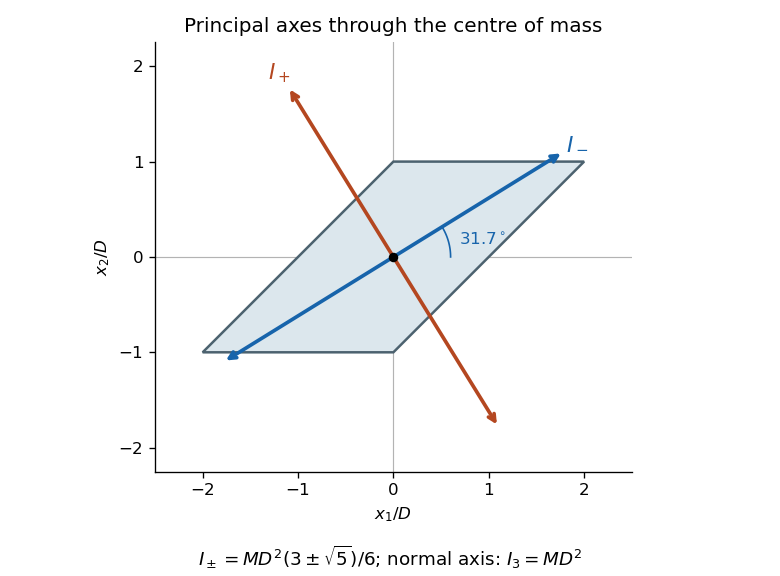
The two planar principal axes of the sheared square lamina, with the third axis normal to the page
. Details. Past exam of the mathematics course of the year 2 of the natural sciences course of the University of Cambridge 2021 Paper 2 6 b i Solution by Codex 0 2026-10-18
Codex 0 2026-10-18Integrating the Dirac delta distribution in reduces the inertia integral to the planar lamina. Use , , so and the parallelogram becomes the square , with unit Jacobian determinant. The mass is , and symmetry gives a centre of mass at the origin.
Odd rectangular integrals vanish. The required second moments areThe mixed moments involving vanish. Hence the inertia tensor isThe off-diagonal entries are minus the product moment, not the product moment itself. This is the unit-shear case of the inertia tensor of a sheared rectangular lamina.
Past exam of the mathematics course of the year 2 of the natural sciences course of the University of Cambridge 2021 Paper 2 6 a ii Solution by Codex 0 2026-10-18
Codex 0 2026-10-18A pseudotensor has an additional determinant factor under an orthogonal transformation. Thus its rank-three transformation law isThe contracted expression is fully antisymmetric in , so it equals a scalar multiple of . For it is precisely the determinant expansion of , fixing that scalar to . ThereforeThe Levi-Civita symbol consequently has the same numerical entries in every orthonormal frame when interpreted as a pseudotensor. With an ordinary rank-three tensor transformation law alone it would instead acquire a minus sign under an orientation-reversing transformation.
Past exam of the mathematics course of the year 2 of the natural sciences course of the University of Cambridge 2021 Paper 2 6 a i Solution by Codex 0 2026-10-18
Codex 0 2026-10-18Under the specified passive change of orthonormal basis, each Cartesian tensor index acquires one copy of . Thus a tensor of order transforms asRepeated old-basis indices are summed from one to three. Orthogonality of the new basis gives . Taking determinants yields , hence . The positive case preserves orientation and the negative case reverses it.
Past exam of the mathematics course of the year 2 of the natural sciences course of the University of Cambridge 2021 Paper 2 5 b iii Solution by Codex 0 2026-10-18
Codex 0 2026-10-18Expand in the complete Fourier sine series and apply Fourier inversion. Substitution of part (ii) givesTo check the source normalization, apply mode by mode. It cancels the denominator; the remaining inverse transform gives , and completeness givesThe endpoints vanish termwise. These identities establish the equation in the distributional sense, with classical validity wherever the series and derivatives converge suitably.
The displayed real-axis integrals in the paper are not ordinary convergent integrals at their poles. One definite choice is the Cauchy principal value at each . If a causal solution is wanted, use instead. Its inverse transform is , so the causal solution iswhen the past integral exists. The principal-value choice instead uses the time-symmetric kernel . No temporal initial data are given, so homogeneous sine and cosine modes remain permissible additions. This is the causal Fourier resolvent of a point-driven fixed string.
Past exam of the mathematics course of the year 2 of the natural sciences course of the University of Cambridge 2021 Paper 2 5 b ii Solution by Codex 0 2026-10-18
Codex 0 2026-10-18Multiply the transformed equation by and integrate from zero to . Two integrations by parts, using the zero endpoint values of both and the sine, giveThe delta source contributes . Multiplying by and using the coefficient definition therefore yieldsAway from the resonant frequencies this givesAt the quotient must be interpreted with a pole prescription if the source excites that mode. In distributional form, arbitrary delta terms at those frequencies may also be added; they are the free homogeneous oscillations. This is the frequency-space issue addressed explicitly in part (iii).
Past exam of the mathematics course of the year 2 of the natural sciences course of the University of Cambridge 2021 Paper 2 5 b i Solution by Codex 0 2026-10-18
Codex 0 2026-10-18Transform only the time variable. Two integrations by parts give , when the ordinary transform boundary terms vanish; the same derivative rule holds for tempered distributions. Spatial derivatives and the fixed spatial delta commute with the transform. ThusorThe spatial Dirichlet boundary conditions transform to .
Past exam of the mathematics course of the year 2 of the natural sciences course of the University of Cambridge 2021 Paper 2 5 a iv Solution by Codex 0 2026-10-18
Codex 0 2026-10-18Multiply by the exponential form of the sine and use the modulation property of the Fourier transform:Inserting part (iii) givesThe reciprocal terms are real principal-value distributions and the delta terms are imaginary. Equivalently, exponential damping gives , whose distributional limit is the boxed expression. The shifted-difference formula remains valid at , where all terms cancel.
Past exam of the mathematics course of the year 2 of the natural sciences course of the University of Cambridge 2021 Paper 2 5 a iii Solution by Codex 0 2026-10-18
Codex 0 2026-10-18The reciprocal in this transform must mean the principal-value reciprocal distribution. Its inverse transform isusing the given Dirichlet integral and the sign of . Also . The inverse of the proposed expression is consequently . Comparison with for givesThe value assigned at the single point does not affect the distribution. This is the Fourier transform of the Heaviside step function; treating as an ordinary integral would miss the required prescription.
Pinned article: Introduction to the OurBigBook Project
Welcome to the OurBigBook Project! Our goal is to create the perfect publishing platform for STEM subjects, and get university-level students to write the best free STEM tutorials ever.
Everyone is welcome to create an account and play with the site: ourbigbook.com/go/register. We belive that students themselves can write amazing tutorials, but teachers are welcome too. You can write about anything you want, it doesn't have to be STEM or even educational. Silly test content is very welcome and you won't be penalized in any way. Just keep it legal!
Intro to OurBigBook
. Source. We have two killer features:
- topics: topics group articles by different users with the same title, e.g. here is the topic for the "Fundamental Theorem of Calculus" ourbigbook.com/go/topic/fundamental-theorem-of-calculusArticles of different users are sorted by upvote within each article page. This feature is a bit like:
- a Wikipedia where each user can have their own version of each article
- a Q&A website like Stack Overflow, where multiple people can give their views on a given topic, and the best ones are sorted by upvote. Except you don't need to wait for someone to ask first, and any topic goes, no matter how narrow or broad
This feature makes it possible for readers to find better explanations of any topic created by other writers. And it allows writers to create an explanation in a place that readers might actually find it.
Figure 1. Screenshot of the "Derivative" topic page. View it live at: ourbigbook.com/go/topic/derivativeVideo 2. OurBigBook Web topics demo. Source. - local editing: you can store all your personal knowledge base content locally in a plaintext markup format that can be edited locally and published either:This way you can be sure that even if OurBigBook.com were to go down one day (which we have no plans to do as it is quite cheap to host!), your content will still be perfectly readable as a static site.
- to OurBigBook.com to get awesome multi-user features like topics and likes
- as HTML files to a static website, which you can host yourself for free on many external providers like GitHub Pages, and remain in full control

Figure 2. You can publish local OurBigBook lightweight markup files to either OurBigBook.com or as a static website.
Figure 3. Visual Studio Code extension installation.
Figure 5. . You can also edit articles on the Web editor without installing anything locally. Video 3. Edit locally and publish demo. Source. This shows editing OurBigBook Markup and publishing it using the Visual Studio Code extension. 
- Infinitely deep tables of contents:



All our software is open source and hosted at: github.com/ourbigbook/ourbigbook
Further documentation can be found at: docs.ourbigbook.com
Feel free to reach our to us for any help or suggestions: docs.ourbigbook.com/#contact