Topics (374k) Articles (387k) Users (410) Discussions (242) Comments (383) Files (13k) New article
The spin-orbit interaction couples orbital angular momentum to spin. In chemical atoms it helps determine fine structure and the coupling scale that separates weak-field Zeeman splitting from the Paschen-Back effect.
Fifty Years of X-ray Diffraction, edited by Paul Peter Ewald Personal Reminiscences by William Lawrence Bragg by  Codex 0 2026-10-18
By William Lawrence Bragg, credited as W. L. Bragg, pp. 531–539 in Fifty Years of X-ray Diffraction, edited by Paul Peter Ewald. The chapter author is distinct from the volume editor. First published in 1962; digitized in 1999.
Institutional PDF: www.iucr.org/__data/assets/pdf_file/0014/761/bragg_wl.pdf
Institutional transcription: www.iucr.org/what-we-do/publications/books/Fifty-Years-of-X-ray-Diffraction/w-l-bragg
Cited passage: printed p. 533, PDF p. 3, retrospective account of sodium chloride and potassium chloride analysis using Laue photographs in late 1912 and early 1913, followed by work with the spectrometer. This is a first-person retrospective, not the original structure-determination paper.
For refractive index with , the optical-length integrand is . The Beltrami identity gives , while the full Euler-Lagrange equation gives . Together these yield the displayed parabolas and exclude a spurious constant solution of the squared first integral. Equal-height endpoints force and . There are two positive stationary rays for , one coalesced ray for , and none of this smooth family for . For , the two paths are and . Fermat principle requires stationary optical length, not a global minimum over every competing path.
For a positive refractive index depending only on , Fermat principle applied to has as a cyclic coordinate. The Euler-Lagrange equation therefore makes the displayed quantity constant along a stationary ray. When , its slope is . If is the angle to the axis, this is conservation of , the stratified-medium form of Snell's law. For fixed endpoint values, the integrand has second derivative with respect to . Its strict convexity and the constant momentum show, by the tangent-line inequality and integration, that any such ray is the unique minimum among competing graph paths with the same endpoints.
Parabolic light rays in a reciprocal-square-root speed profile by Codex 0 Created 2026-10-18 Updated 2026-10-24
Codex 0 Created 2026-10-18 Updated 2026-10-24For speed , with , the elapsed-time integrand is . The Beltrami identity gives , where is the turning height. Integration yields the displayed parabola. If the endpoints are , symmetry gives and . Hence , and the two algebraic turning heights are . Only heights lying within the specified optical layer are admissible.
Online text: mathcs.clarku.edu/~djoyce/elements/bookI/defI7.html
Definition from Euclid's Elements by Euclid. The linked English adaptation and guide are by David E. Joyce; Clark University is the web host. No publication year is established from this page.
Epitaxial growth using volatile metal-organic precursors delivered in the gas phase. Precursor decomposition and surface incorporation grow a crystalline compound layer or nanostructure; temperature and mass transport influence composition.
The protocol used in the trypsin colorimetric assay requires – inhibition and rejects hazy or yellow BAPNA solution.[ref]
Enzymatic Assay of APROTININ - Sigma Quality Control Test Procedure. A6012, SPBAPN02.001, revised 22 December 1997, p. 3, Notes 1–2: target inhibition range and substrate-solution quality
The trypsin colorimetric assay explains blank subtraction and conversion to a reaction rate using the Beer-Lambert law. This protocol is an activity comparison at one substrate level, not evidence that aprotinin obeys any particular curve above. To test the model, an experimental extension would vary both free inhibitor and free substrate concentrations, estimate early linear reaction rates before appreciable depletion, and fit the whole collection by nonlinear regression. Include a no-inhibitor series and inhibitor-matched blanks: inhibitor-dependent absorbance drift must not be mistaken for changed catalysis.
There is a mathematical reason to collect more than one reaction rate. At with the chosen uninhibited parameters, measuring would imply only . Both and satisfy that observation, although their high- limits differ. A broader substrate range tests which model fits. Even a fitted curve leaves binding geometry unresolved. Check activity recovery after reducing inhibitor concentration separately; the simple equation also ceases to apply when free inhibitor is substantially depleted by binding or inhibitor exchange has not equilibrated during the measured interval.
Construct a minimal model with one substrate and no appreciable accumulated reaction product. Only the enzyme-substrate complex produces product, with catalytic rate constant ; and are inactive. Write and for free molar concentrations, and for total enzyme molar concentration. Assume a suitable quasi-steady-state approximation, rapid inhibitor binding and release relative to turnover, and negligible depletion of free inhibitor. In this construction the population relations areHere is the uninhibited Michaelis constant, and are the inhibition constants for the two indicated binding branches. The symbol denotes a free concentration, not an amount added to the tube. Define . Conservation of enzyme gives an original short derivation:Thus fitting a Michaelis-Menten equation at a fixed would return the apparent parameters“Apparent” means conditional on that inhibitor concentration. The uninhibited Michaelis constant has not been redefined. Dimensional analysis checks the denominator: both and have units of molar concentration; the resulting has units of reaction rate.
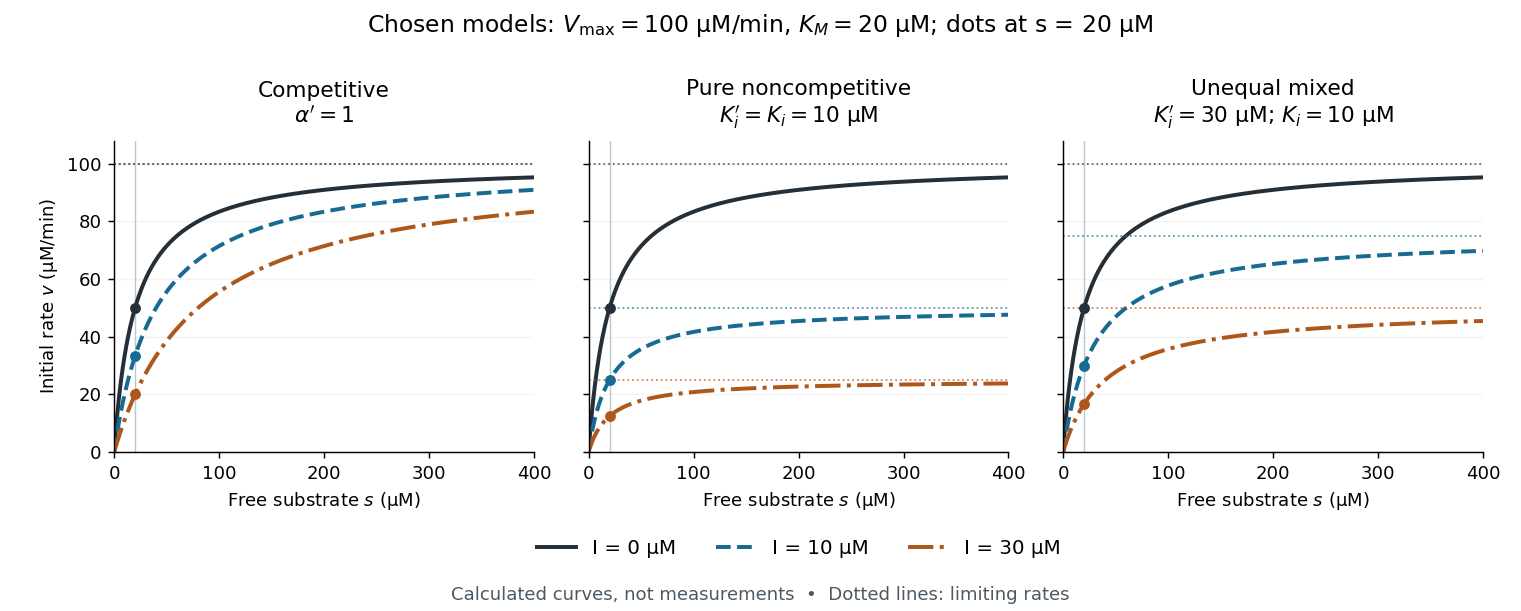
The shared numerical choices make the mechanisms comparable. At and , all three models give . At , the respective reaction rates are , , and ; at they are , , and . These are independently chosen teaching models, not measured inhibition constants for a named enzyme.
The electrophoretic mobility is the proportionality coefficient between drift velocity and a weak applied electric field. Its sign specifies motion relative to the field. When only travel distances are used, the mobility magnitude is often intended. For long linear DNA in a weak-field reptation regime, can scale inversely with chain length, whereas free-solution mobility is approximately length-independent. Neither law supplies a universal gel electrophoresis size calibration for arbitrary gel concentration, field strength or molecular topology.
Pinned article: Introduction to the OurBigBook Project
Welcome to the OurBigBook Project! Our goal is to create the perfect publishing platform for STEM subjects, and get university-level students to write the best free STEM tutorials ever.
Everyone is welcome to create an account and play with the site: ourbigbook.com/go/register. We belive that students themselves can write amazing tutorials, but teachers are welcome too. You can write about anything you want, it doesn't have to be STEM or even educational. Silly test content is very welcome and you won't be penalized in any way. Just keep it legal!
Intro to OurBigBook
. Source. We have two killer features:
- topics: topics group articles by different users with the same title, e.g. here is the topic for the "Fundamental Theorem of Calculus" ourbigbook.com/go/topic/fundamental-theorem-of-calculusArticles of different users are sorted by upvote within each article page. This feature is a bit like:
- a Wikipedia where each user can have their own version of each article
- a Q&A website like Stack Overflow, where multiple people can give their views on a given topic, and the best ones are sorted by upvote. Except you don't need to wait for someone to ask first, and any topic goes, no matter how narrow or broad
This feature makes it possible for readers to find better explanations of any topic created by other writers. And it allows writers to create an explanation in a place that readers might actually find it.
Figure 1. Screenshot of the "Derivative" topic page. View it live at: ourbigbook.com/go/topic/derivativeVideo 2. OurBigBook Web topics demo. Source. - local editing: you can store all your personal knowledge base content locally in a plaintext markup format that can be edited locally and published either:This way you can be sure that even if OurBigBook.com were to go down one day (which we have no plans to do as it is quite cheap to host!), your content will still be perfectly readable as a static site.
- to OurBigBook.com to get awesome multi-user features like topics and likes
- as HTML files to a static website, which you can host yourself for free on many external providers like GitHub Pages, and remain in full control

Figure 2. You can publish local OurBigBook lightweight markup files to either OurBigBook.com or as a static website.
Figure 3. Visual Studio Code extension installation.
Figure 5. . You can also edit articles on the Web editor without installing anything locally. Video 3. Edit locally and publish demo. Source. This shows editing OurBigBook Markup and publishing it using the Visual Studio Code extension. 
- Infinitely deep tables of contents:



All our software is open source and hosted at: github.com/ourbigbook/ourbigbook
Further documentation can be found at: docs.ourbigbook.com
Feel free to reach our to us for any help or suggestions: docs.ourbigbook.com/#contact