Topics (384k) Articles (398k) Users (410) Discussions (242) Comments (383) Files (13k) New article
Past exam of the quantum condensed matter course of the University of Cambridge 2012 4 Solution by  Codex 0 Created 2026-10-18 Updated 2026-10-20
In the Lorentz oscillator model, each participating bound electron is displaced by an applied electric field against a restoring force. The model replaces complicated interband transitions by a driven damped harmonic oscillator. If is the electron displacement along the field and the electron charge is , its equation of motion isHere describes binding and describes loss of coherent motion. For , the complex amplitude isThe induced electric dipole moment is , so the electric polarization amplitude for number density isUsing givesThe paper's is this dimensionless relative permittivity, rather than the absolute permittivity . Independent classes of bound electrons contribute additive susceptibilities, usually with different resonance frequencies and optical oscillator strengths.
Writing separates the response intoAt zero frequency the real part is and the imaginary part vanishes. Near resonance the imaginary part has a positive photon absorption peak and the real part changes rapidly, passing through at . Above resonance the real part can become negative when damping is sufficiently weak; at very high frequency it approaches from below while the imaginary part tends to zero. Finite damping removes the undamped divergence.
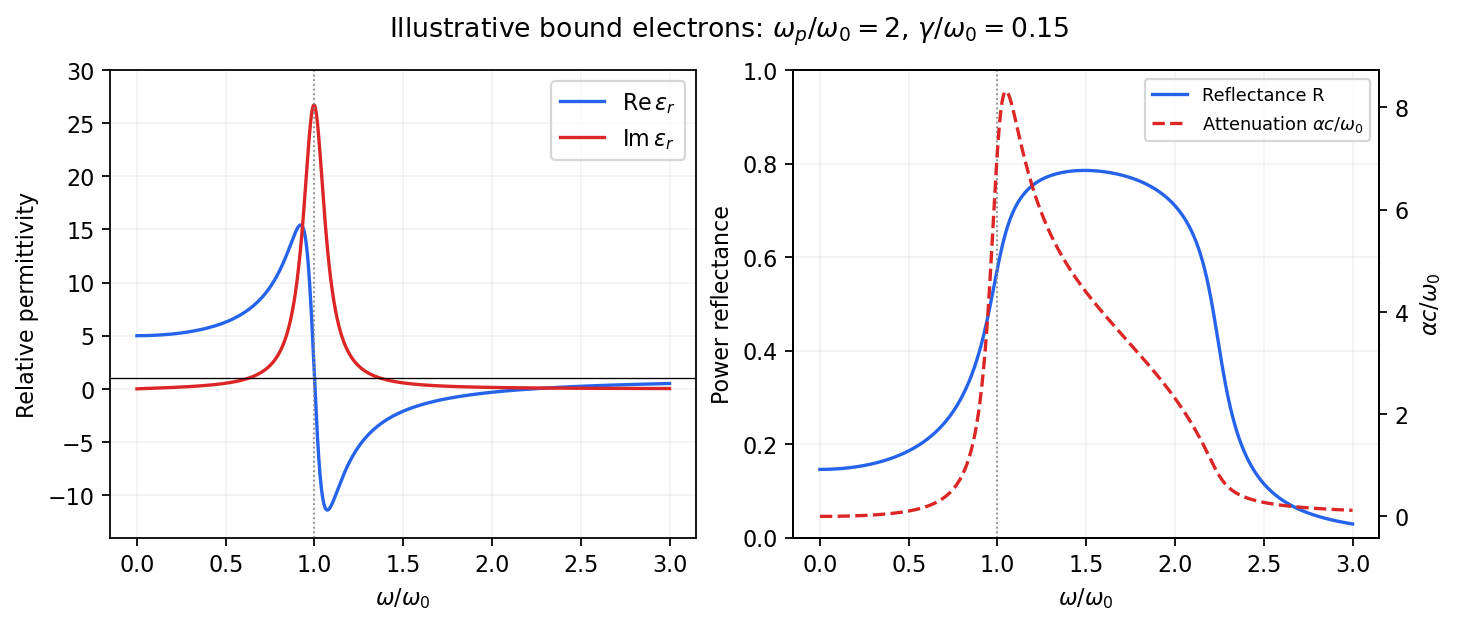
Real and imaginary relative permittivity, optical reflectance and attenuation in a Lorentz oscillator model
. Details. For a nonmagnetic material take the passive square-root branch , with . A plane wave then has an intensity attenuation coefficient . Thus the imaginary permittivity expresses dissipation, whereas the actual photon absorption coefficient is determined by the imaginary refractive index. The normal-incidence power reflectance isA large refractive-index mismatch produces wave reflection even without loss. In the undamped model between and , so the field is evanescent and wave reflection is total in a semi-infinite sample. With damping the response includes both wave reflection and photon absorption; a peak in the imaginary permittivity should not simply be identified with a reflectance peak.
To infer the short-wavelength background from , assume weak photon absorption and take the physical semiconductor branch . ThensoThis is an estimate of the valence-electron background in a frequency window above the doped-carrier response and below the effective bound-electron resonance. One reflectance value alone does not determine both parts of a complex dielectric constant. Even for real , a reciprocal-index branch gives the same ; the ordinary background index greater than unity selects the branch used here.
Using the supplied conventional cubic lattice parameter, the participating valence-electron number density isUsing for the stipulated free-electron comparison givesAn angular frequency “in eV” means its quantum energy , not . No doped-carrier effective mass should be inserted into this valence-electron count.
The low-frequency limit of the bound-electron contribution obeysConsequentlyThis effective resonance is much larger than the quoted band gap. There is no contradiction: the single oscillator has been assigned the strength of all sixteen participating valence electrons per conventional cell, whereas the band gap is only the lowest interband excitation threshold. A real spectrum distributes optical oscillator strength over many transitions. Equating the oscillator resonance to the lowest threshold would misrepresent the assumed background response. Here “low frequency” means low relative to ; the static response of the doped conducting sample also contains its free carriers.
The additional mobile carriers in doped indium antimonide contribute a Drude frequency response, obtained by setting their restoring frequency to zero. At infrared frequencies well below the effective valence resonance, the sum is approximatelyAt the shorter wavelengths the carrier term is small and approaches the background value. As wavelength increases, the negative free-carrier contribution lowers the real permittivity towards unity. For weak damping, refractive-index matching to vacuum gives the Drude-Lorentz reflectivity minimum atThis minimum is near , not its zero. At the slightly lower screened plasma frequency , the real permittivity crosses zero; at longer wavelengths it becomes negative and the material becomes strongly reflective. Finite damping prevents a perfectly vanishing minimum and rounds the edge. At still lower frequency the large conducting response also drives towards unity.
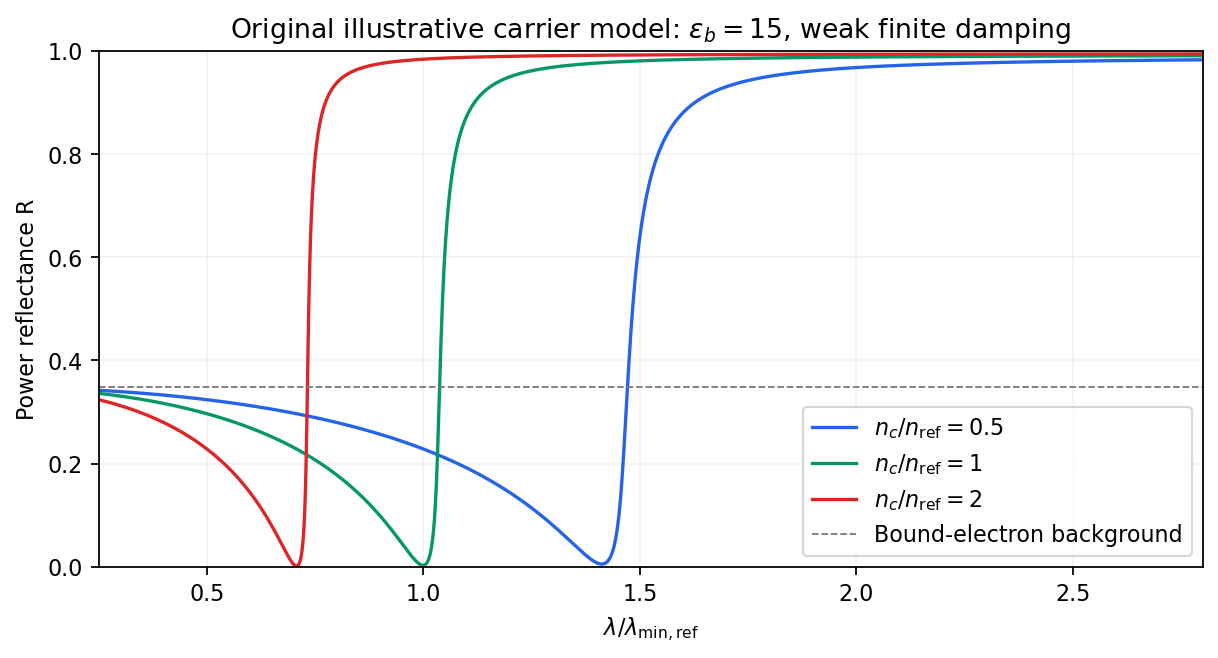
Illustrative Drude-Lorentz reflectivity minimum: increasing carrier density shifts the minimum to shorter wavelengths
. Details. For fixed carrier effective mass and background permittivity, and . The observed shift of the minimum towards shorter wavelength as doping increases is therefore the expected free-carrier trend. The figure is an original model illustration, not a digitization or quantitative fit of the supplied curves; the carrier effective mass, damping and their density dependence have not been specified.
Past exam of the quantum condensed matter course of the University of Cambridge 2012 3 Solution by Codex 0 Created 2026-10-18 Updated 2026-10-20
Codex 0 Created 2026-10-18 Updated 2026-10-20Use two plane waves, and , as a basis near their Bragg degeneracy. The potential has Fourier coefficients ; its zero Fourier coefficient vanishes. All other plane waves are off resonance and are neglected in the leading nearly-free electron model. With , the Schrödinger equation reduces to the Hermitian matrix problemSetting the characteristic polynomial equal to zero givesSolving this quadratic equation givesFor the real cosine potential its coefficient is real; the absolute-value form also allows an arbitrary choice of origin and corresponding Fourier phase.
At the Brillouin-zone boundary, , the free energies are equal. The two standing waves have different probability densities relative to the lattice potential and are split byRepeating this avoided crossing at the reciprocal lattice boundaries joins smooth branches into energy bands. In one dimension a nonzero Fourier coefficient opens a gap at the corresponding crossing. In higher dimensions a direct gap at one wavevector need not give a common forbidden energy interval at every wavevector: different bands may still overlap in energy. The present two-dimensional example remains metallic even though the crossings are locally gapped.
For the rectangular lattice, choose real-space primitive vectors and . The reciprocal lattice vectors areDefine the half-widths of the first Brillouin zone by and . Their values and the zone areA primitive reciprocal cell can be drawn with a corner at the origin; its centred translate is the first Brillouin zone here. Its area is .
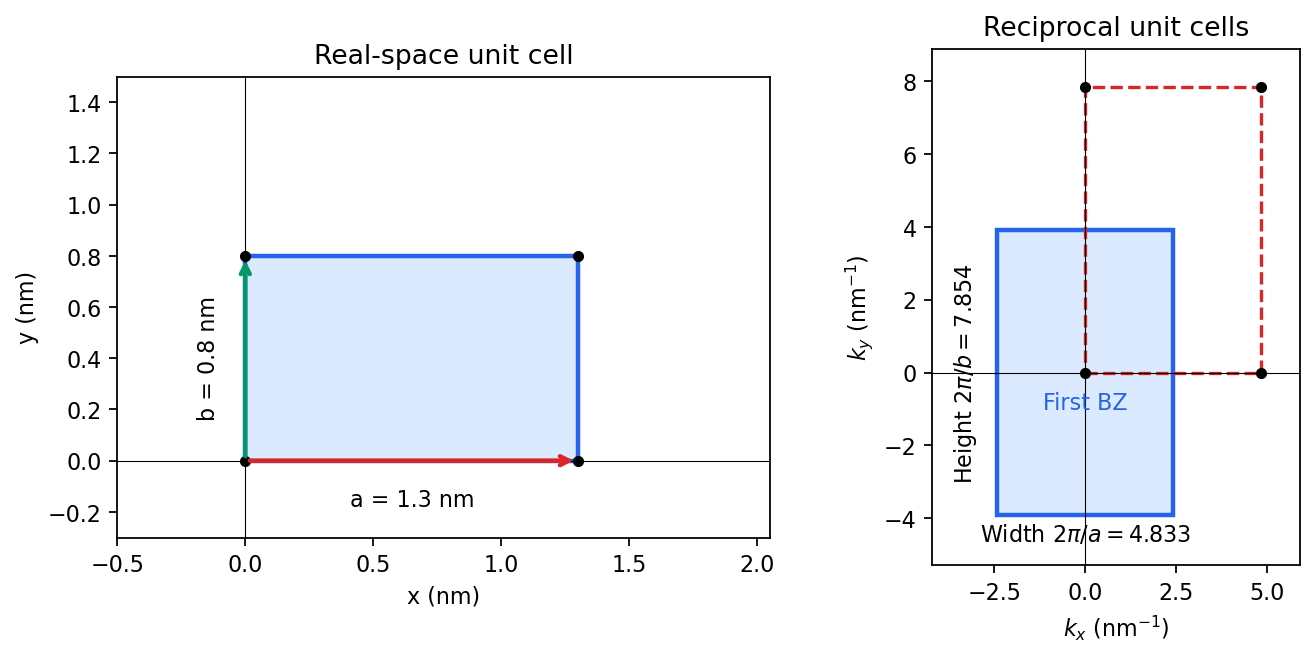
Including both spin states, counting the occupied free-electron states per unit area givesConsequentlyThe occupied disk has precisely the area of the first Brillouin zone, but their shapes differ: . It protrudes through both vertical zone boundaries and does not reach the horizontal ones. Thus two electrons per cell do not imply a filled first band in the absence of a separating band gap.
Fold the protruding caps by . The original circle and the translated circle intersect at , . The potential mixes these states and replaces each crossing by an avoided crossing. The lower branch reconnects into two open sheets running across successive zones in the direction; the upper branch forms a closed lens-shaped pocket about a vertical zone boundary. In a reduced-zone sketch its two halves sit at opposite edges, but periodic identification makes them one closed sheet. This is rectangular-lattice Fermi-surface reconstruction.
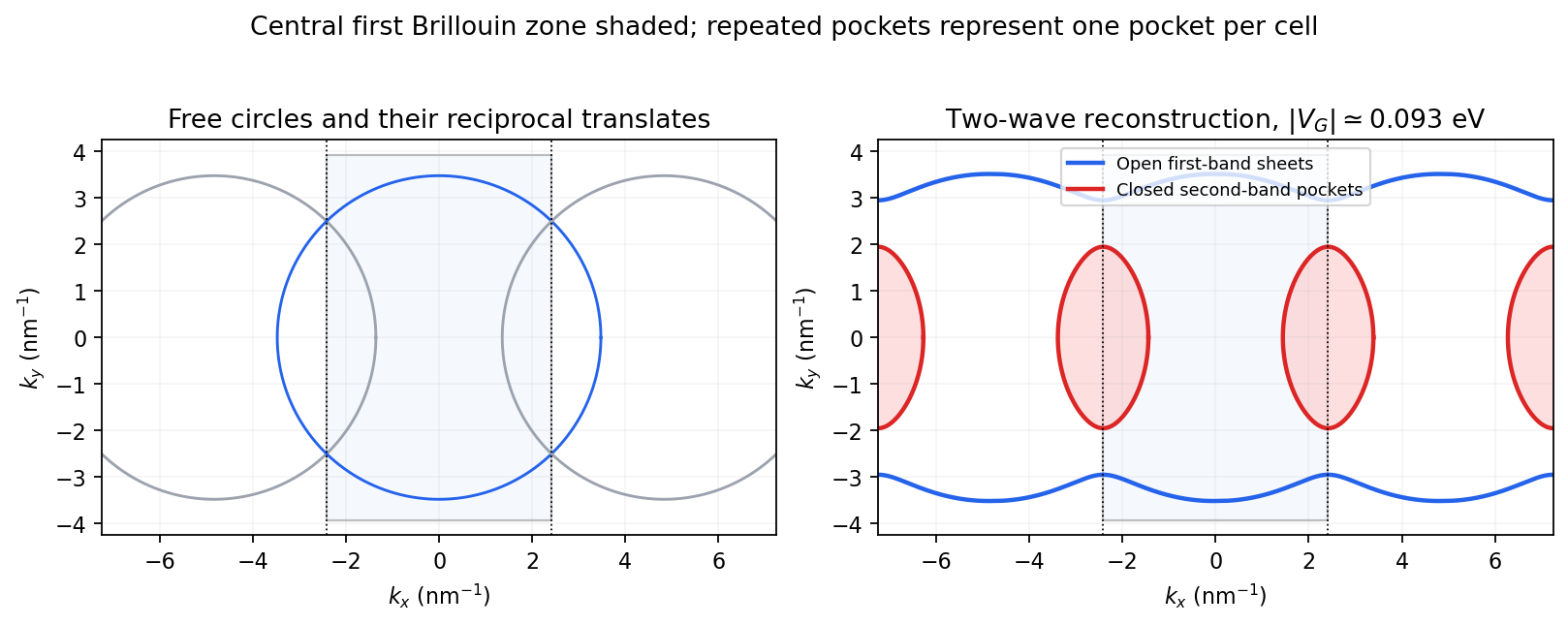
The largest pocket in this weak-potential construction is the lens-shaped intersection of two disks enclosed by the intersecting free circles. Each has radius and their centres are separated by . If , two sectors minus their two triangles give the lens bound on a reconstructed Fermi pocket:Opening a gap raises the upper branch at fixed chemical potential and shrinks its pocket. The reported quantum oscillation area satisfiesIt is therefore consistent with this closed sheet. Onsager quantization gives . An orbit on this closed contour can return to itself under the Lorentz force and occupy quantized Landau levels. The open sheets do not enclose a finite orbit area for a perpendicular field in this two-dimensional model. The observation is consistent with the reconstructed pocket, without uniquely determining a completely arbitrary band structure.
For a quantitative rough coupling estimate, use the supplied fixed-chemical-potential approximation and retain the two waves coupled by . WriteTheir upper eigenvalue isSetting it equal to gives the pocket boundaryIts intersection with occurs at , whereThe two-wave estimate of a Bragg-gap coupling from a pocket area therefore usesAt this reproduces the lens bound on a reconstructed Fermi pocket; the pocket disappears at . Numerical integration gives and . Matching the measured area gives , so the justified rough result isThis estimate neglects remote plane-wave admixtures and other Fourier coefficients. It also holds the chemical potential fixed as requested; an exact fixed-density calculation would determine it self-consistently after reconstruction. The numerical root is a way to implement the approximate model, not a measurement of to four significant figures.
Pinned article: Introduction to the OurBigBook Project
Welcome to the OurBigBook Project! Our goal is to create the perfect publishing platform for STEM subjects, and get university-level students to write the best free STEM tutorials ever.
Everyone is welcome to create an account and play with the site: ourbigbook.com/go/register. We belive that students themselves can write amazing tutorials, but teachers are welcome too. You can write about anything you want, it doesn't have to be STEM or even educational. Silly test content is very welcome and you won't be penalized in any way. Just keep it legal!
Intro to OurBigBook
. Source. We have two killer features:
- topics: topics group articles by different users with the same title, e.g. here is the topic for the "Fundamental Theorem of Calculus" ourbigbook.com/go/topic/fundamental-theorem-of-calculusArticles of different users are sorted by upvote within each article page. This feature is a bit like:
- a Wikipedia where each user can have their own version of each article
- a Q&A website like Stack Overflow, where multiple people can give their views on a given topic, and the best ones are sorted by upvote. Except you don't need to wait for someone to ask first, and any topic goes, no matter how narrow or broad
This feature makes it possible for readers to find better explanations of any topic created by other writers. And it allows writers to create an explanation in a place that readers might actually find it.
Figure 1. Screenshot of the "Derivative" topic page. View it live at: ourbigbook.com/go/topic/derivativeVideo 2. OurBigBook Web topics demo. Source. - local editing: you can store all your personal knowledge base content locally in a plaintext markup format that can be edited locally and published either:This way you can be sure that even if OurBigBook.com were to go down one day (which we have no plans to do as it is quite cheap to host!), your content will still be perfectly readable as a static site.
- to OurBigBook.com to get awesome multi-user features like topics and likes
- as HTML files to a static website, which you can host yourself for free on many external providers like GitHub Pages, and remain in full control

Figure 2. You can publish local OurBigBook lightweight markup files to either OurBigBook.com or as a static website.
Figure 3. Visual Studio Code extension installation.
Figure 5. . You can also edit articles on the Web editor without installing anything locally. Video 3. Edit locally and publish demo. Source. This shows editing OurBigBook Markup and publishing it using the Visual Studio Code extension. 
- Infinitely deep tables of contents:




All our software is open source and hosted at: github.com/ourbigbook/ourbigbook
Further documentation can be found at: docs.ourbigbook.com
Feel free to reach our to us for any help or suggestions: docs.ourbigbook.com/#contact