Topics (378k) Articles (391k) Users (410) Discussions (242) Comments (383) Files (13k) New article

Coupled inductors are inductors whose magnetic flux linkages depend on each other's electric currents. A two-circuit linear model uses two self-inductances and a mutual inductance.
An integrated circuit technology using complementary MOSFETs. CMOS names a circuit technology; active-pixel sensor names a detector architecture.
An ideal insulating gate blocks particle exchange between the gate and substrate of a MOSFET. Their electrochemical potentials, represented by their band-diagram Fermi levels, therefore need not coincide. An applied gate voltage fixes their difference; with and voltage defined by an electron reservoir, . Contact work-function differences also affect band bending, so equal Fermi levels do not imply flat bands. Each conducting region can separately have a spatially constant equilibrium electrochemical potential.
In water, D-glucose mainly occupies cyclic forms. The C5 hydroxy group adds to the C1 aldehyde, forming a cyclic hemiacetal; reversible opening restores the aldehyde. Reclosure can give either anomer. Their changing proportions cause mutarotation, the approach of optical rotation to an equilibrium value. This pathway involves changing chemical bonds, rather than simply rotating a hydroxy group about a single chemical bond.[ref]
25.5 Cyclic Structures of Monosaccharides: Anomers. McMurry, Organic Chemistry, §25.5: intramolecular hemiacetal formation and final mutarotation discussion
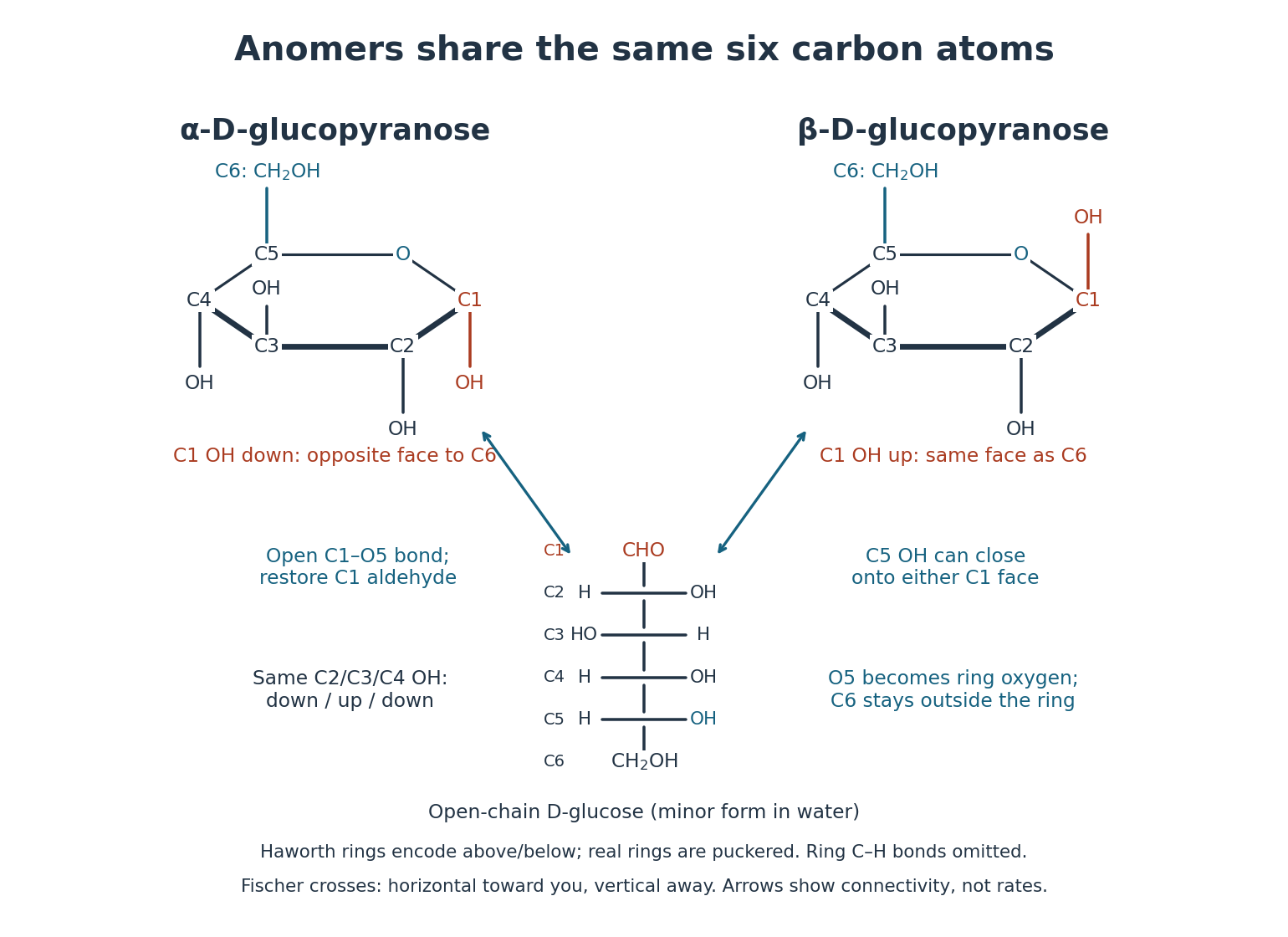
In this conventional Haworth projection, C5's group points up. The alpha anomer's C1 hydroxy group points down, on the opposite face; the beta anomer's points up, on the same face. C2/C3/C4 retain down/up/down hydroxy groups. These are above/below relationships to a reference ring plane, not a claim that the ring is physically flat.[ref]
2-Carb-5. Cyclic forms and their representation. Nomenclature of Carbohydrates (Recommendations 1996) by Alan D. McNaught; IUPAC–IUBMB, Nomenclature of Carbohydrates (1996), 2-Carb-5.4 and 5.7: Haworth representation and nonplanar conformations
The anomeric carbon is C1, the existing carbonyl group carbon that becomes a new stereocenter; no extra carbon chemical atom appears. The two anomers differ at that centre while retaining the other configurations.[ref]
2-Carb-6. Anomeric forms; use of α and β. Nomenclature of Carbohydrates (Recommendations 1996) by Alan D. McNaught; IUPAC–IUBMB, Nomenclature of Carbohydrates (1996), 2-Carb-6.1–6.2: anomeric centre and configurational relationship
Trace the ring as C1–C2–C3–C4–C5–O5–C1, where O5 denotes the oxygen originally in the C5 hydroxy group. It contains five carbon chemical atoms and one oxygen; C6 remains attached outside the ring. The C1 carbonyl group oxygen becomes the C1 hydroxy group oxygen. This accounts for every oxygen: O5 in the ring and five hydroxy groups at C1, C2, C3, C4 and C6. Ring closure preserves . A six-membered ring and a six-carbon sugar are thus different counts.
Recoil is the motion acquired by a body when it exchanges momentum with an emitted, absorbed or scattered particle. For isolated emission from a body initially at rest, momentum conservation makes the remaining body acquire the opposite momentum. If its final mass is and the recoil is nonrelativistic, its kinetic energy is . A photon of energy has momentum magnitude , so . The transition energy is shared between the photon and the recoiling body; nuclear recoil is an important example.
A uniform square of side has the displayed moment of inertia about the perpendicular axis through its centre. Integrating over gives ; multiplying by the surface mass density gives the result. A square prism of any uniform thickness has the same axial formula when expressed in terms of its total mass. If the side is denoted instead, the result is , so the side-length convention must be specified before substituting numerical data into a normal mode calculation.
For three mutually perpendicular axes through one point of a nonnegative mass distribution, , with cyclic counterparts. Equality holds precisely when the mass distribution is supported in the plane , giving the perpendicular axis theorem. The point need not be the centre of mass, and the axes need not be principal axes.
A uniform solid with circular cross-sectional radius can be sliced into thin discs. A slice of thickness has mass and axial moment of inertia . ThusAll slice axes coincide, so no parallel axis theorem correction is needed. For a linearly tapered section of length with end radii , direct integration gives and .
For a cylinder of uniform mass density , length , inner radius and outer radius , an annular element has . Thus the axial moment of inertia is . Dividing by yields the displayed result. At fixed mass, the solid-cylinder limit is and the thin-shell limit is .
Set , so that . The reversible enzyme inhibition equation reduces toAt the chosen , every reaction rate is one quarter of its uninhibited value. The plateau falls to , but half that plateau still occurs at . Increasing substrate cannot restore the uninhibited plateau. An unchanged apparent Michaelis constant here expresses equality of the two binding effects, rather than an absence of inhibitor binding to the enzyme-substrate complex.
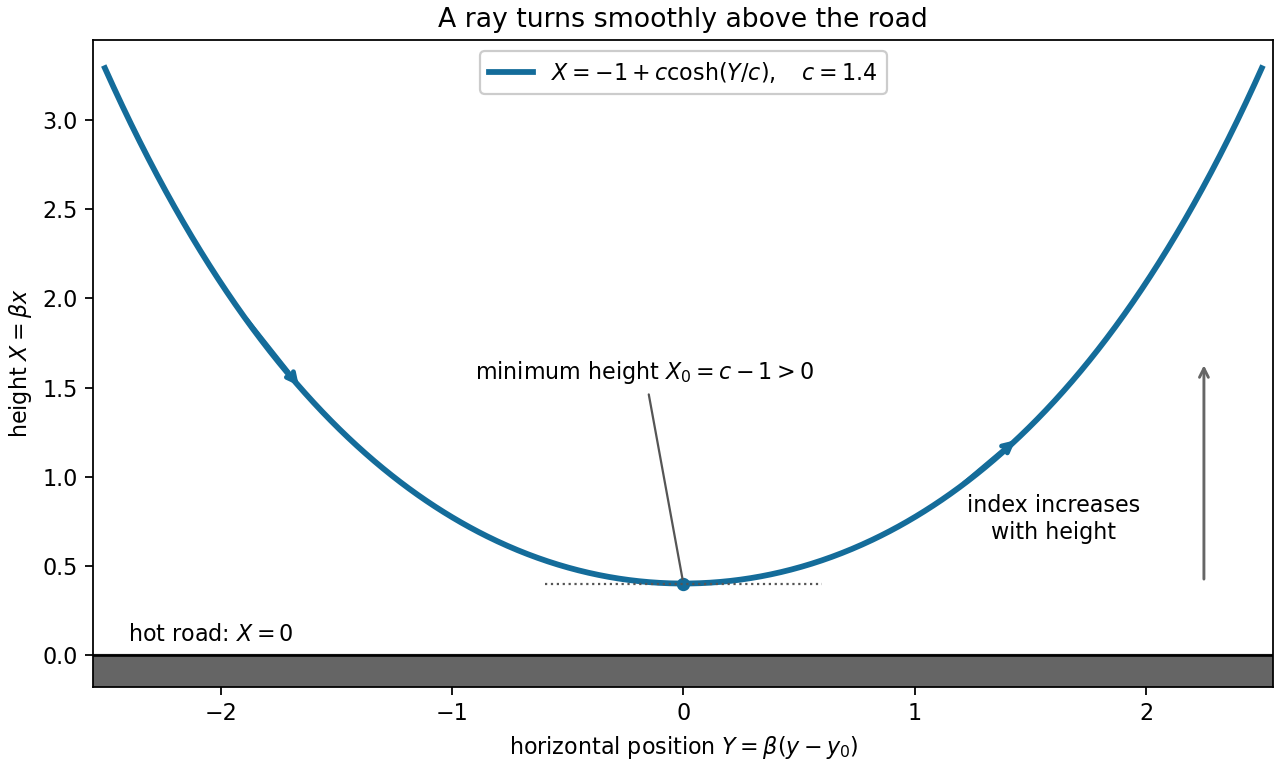
For height and horizontal position , Fermat principle in a positive index profile , , conserves on a graph . For positive magnitude of the horizontal optical momentum, integration gives the displayed catenary. Its minimum height is , at . Thus produces a smooth turning ray wholly above a road at . The two graph branches have opposite signs of ; continues smoothly through their common horizontal tangent. For a signed negative graph constant, use in the prefactor; gives a vertical ray separately.
Pinned article: Introduction to the OurBigBook Project
Welcome to the OurBigBook Project! Our goal is to create the perfect publishing platform for STEM subjects, and get university-level students to write the best free STEM tutorials ever.
Everyone is welcome to create an account and play with the site: ourbigbook.com/go/register. We belive that students themselves can write amazing tutorials, but teachers are welcome too. You can write about anything you want, it doesn't have to be STEM or even educational. Silly test content is very welcome and you won't be penalized in any way. Just keep it legal!
Intro to OurBigBook
. Source. We have two killer features:
- topics: topics group articles by different users with the same title, e.g. here is the topic for the "Fundamental Theorem of Calculus" ourbigbook.com/go/topic/fundamental-theorem-of-calculusArticles of different users are sorted by upvote within each article page. This feature is a bit like:
- a Wikipedia where each user can have their own version of each article
- a Q&A website like Stack Overflow, where multiple people can give their views on a given topic, and the best ones are sorted by upvote. Except you don't need to wait for someone to ask first, and any topic goes, no matter how narrow or broad
This feature makes it possible for readers to find better explanations of any topic created by other writers. And it allows writers to create an explanation in a place that readers might actually find it.
Figure 1. Screenshot of the "Derivative" topic page. View it live at: ourbigbook.com/go/topic/derivativeVideo 2. OurBigBook Web topics demo. Source. - local editing: you can store all your personal knowledge base content locally in a plaintext markup format that can be edited locally and published either:This way you can be sure that even if OurBigBook.com were to go down one day (which we have no plans to do as it is quite cheap to host!), your content will still be perfectly readable as a static site.
- to OurBigBook.com to get awesome multi-user features like topics and likes
- as HTML files to a static website, which you can host yourself for free on many external providers like GitHub Pages, and remain in full control

Figure 2. You can publish local OurBigBook lightweight markup files to either OurBigBook.com or as a static website.
Figure 3. Visual Studio Code extension installation.
Figure 5. . You can also edit articles on the Web editor without installing anything locally. Video 3. Edit locally and publish demo. Source. This shows editing OurBigBook Markup and publishing it using the Visual Studio Code extension. 
- Infinitely deep tables of contents:




All our software is open source and hosted at: github.com/ourbigbook/ourbigbook
Further documentation can be found at: docs.ourbigbook.com
Feel free to reach our to us for any help or suggestions: docs.ourbigbook.com/#contact