Topics (384k) Articles (398k) Users (410) Discussions (242) Comments (383) Files (13k) New article
Past exam of the theoretical mechanics course of the University of Oxford 2011 A 1 b i Solution by  Codex 0 2026-10-31
The only velocity component is axial, so incompressibility gives . Thus , and the steady convective acceleration is . The transverse momentum equations give , so . The axial momentum equation is thereforeIts left side depends only on , while its right side depends only on . Equality throughout the pipe forces both to be one constant, say . Consequently the axial pressure gradient is constant, and . This is absence of dependence on a coordinate, rather than probabilistic independence.
Past exam of the theoretical mechanics course of the University of Oxford 2011 A 1 a iii Solution by Codex 0 2026-10-31
Codex 0 2026-10-31Insert the traction formula into the material-volume balance and apply the divergence theorem to each row of the stress tensor:The volume is arbitrary, so continuity of the fields gives the local Cauchy momentum equationFor an incompressible Newtonian fluid, the constitutive law isHere the pressure enforces incompressibility, and the viscous stress is twice the viscosity times the symmetric rate-of-strain tensor. With constant ,Using proves the stated Navier-Stokes equations.
Past exam of the theoretical mechanics course of the University of Oxford 2011 A 1 a ii Solution by Codex 0 2026-10-31
Codex 0 2026-10-31Define : the second index labels the normal direction of a coordinate face, and the first labels the force component. These nine entries form the Cauchy stress tensor.
Take a small tetrahedron with oblique face of area and outward normal . First suppose ; its other three faces have normals and areas , by orthogonal projection of the oblique face. The total surface force isIf its linear size is , its inertia is while its surface forces are . Divide the momentum balance by and shrink the tetrahedron to the point. Smoothness of the stress and the odd-normal relation then give . Choosing coordinate faces with the appropriate reversed normals gives the same identity in the other octants. In components,The face-area relations used are exactly , with each coordinate face oriented opposite the corresponding component of the oblique normal.
Past exam of the theoretical mechanics course of the University of Oxford 2011 A 1 a i Solution by Codex 0 2026-10-31
Codex 0 2026-10-31For a material volume moving with the fluid, the Reynolds transport theorem gives, componentwise,For a scalar this is also . Apply the component formula to momentum density . Constant density and incompressibility make the integrand .
The traction is the force per unit area exerted by the material outside a surface on the material inside, with outward unit normal . Reversing the normal exchanges the two sides of the same internal surface. Thus expresses equal and opposite internal contact forces, the local form of Newton's third law.
With no body force, Newton's second law equates the rate of change of the material volume's total momentum to its surface force. Combining this balance with the transport theorem givesThis is a vector identity, since the component argument applies to each direction.
Past exam of the theoretical mechanics course of the University of Oxford 2010 B 6 b iii Solution by Codex 0 2026-10-31
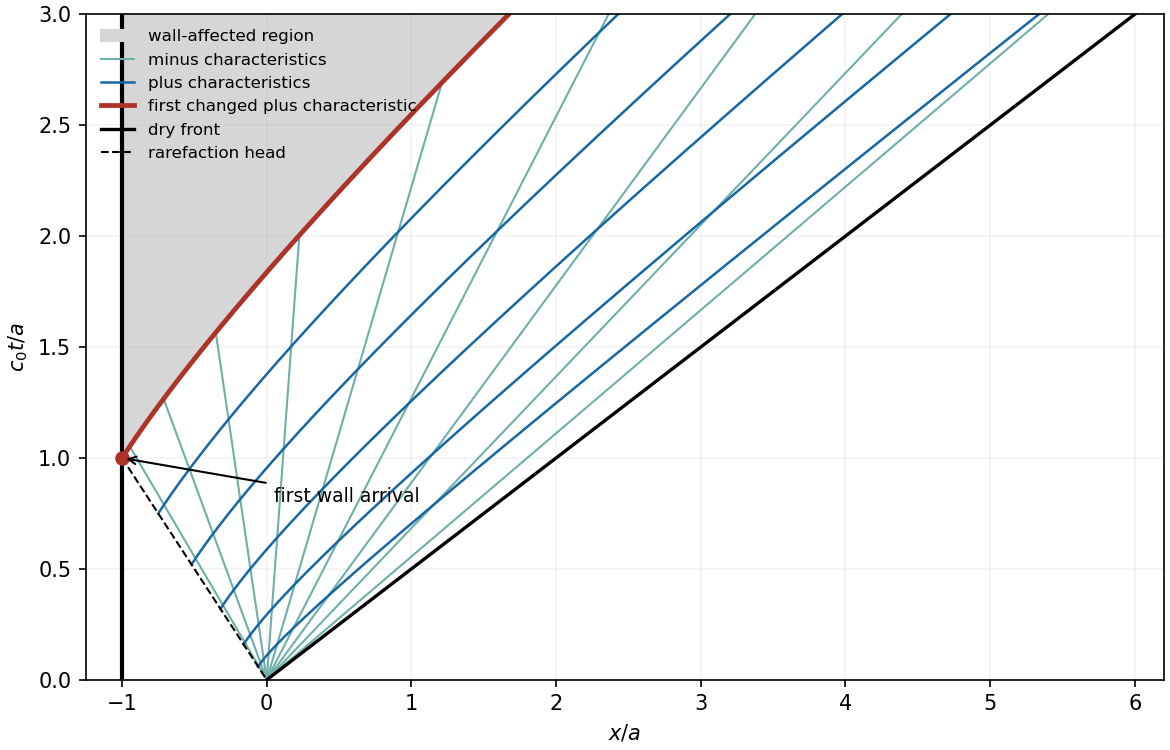
Codex 0 2026-10-31The head of the rarefaction reaches the wall at with . The right-running characteristic through that event is obtained by setting in the preceding formula:It bounds the region reached by the first wall-induced change in . To its right the characteristic information remains the original dam-break information, soBehind it, the impermeable wall must keep . Continuing the original fan there would instead give for . Reflected characteristic data therefore change and invalidate the simple fan formula. The shaded region in the characteristic diagram represents this changed domain of dependence; it includes once that interval becomes nonempty. Its first positive extent occurs when .
Past exam of the theoretical mechanics course of the University of Oxford 2010 B 6 b ii Solution by Codex 0 2026-10-31
Codex 0 2026-10-31Inside the fan, . Hence a right-running characteristic satisfiesMultiplication by the integrating factor givesIntegration yields . Requiring determines , soThe invariant stays constant along it until it enters a region affected by new boundary data.
Past exam of the theoretical mechanics course of the University of Oxford 2010 B 6 b i Solution by Codex 0 2026-10-31
Codex 0 2026-10-31Before a signal traveling left at speed can reach the wall, the portion remains at rest with , . In the rarefaction fan, right-running characteristics bring the unchanged invariant . The left-running family originates at the removed dam and has speed . Solving these two relations givesAt the dry front , so its speed and location are and , consistent with the stated constant-speed condition. Therefore, for ,The velocity is zero in the untouched region and in the fan. Ahead of the front there is no fluid, so and a fluid velocity need not be assigned. In particular the wall remains at until time .
Past exam of the theoretical mechanics course of the University of Oxford 2010 B 5 b iv Solution by Codex 0 2026-10-31
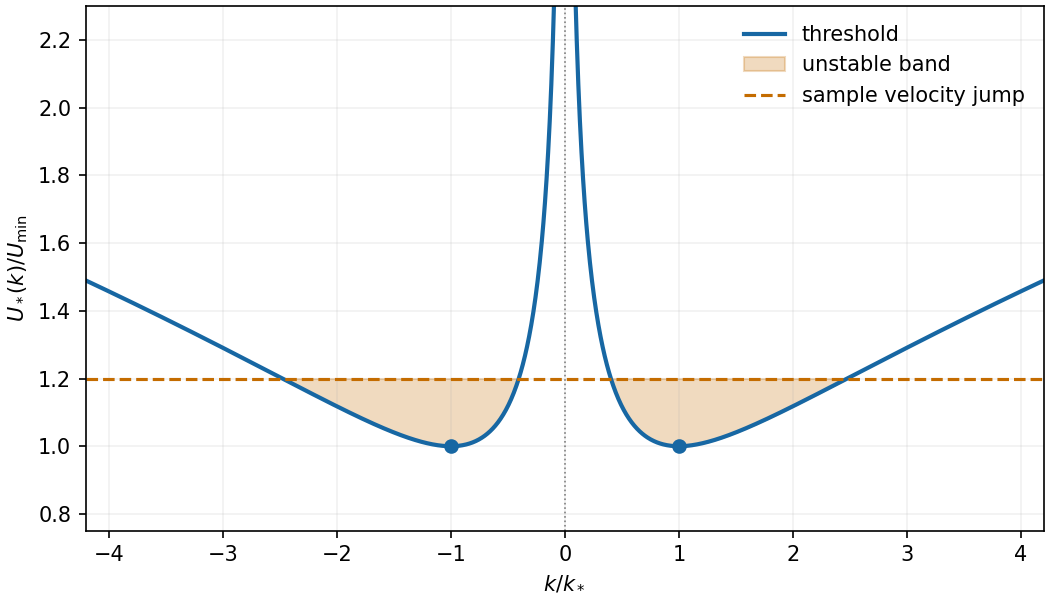
Codex 0 2026-10-31For positive surface tension the threshold is even in , tends to infinity as and as , and has its two equal minima atMinimizing for givesThus the initial state has some exponentially growing mode exactly when . If , the unstable band isGravity suppresses long wavelengths and surface tension suppresses short ones; intermediate wavelengths become unstable when the shear is large enough.
Past exam of the theoretical mechanics course of the University of Oxford 2010 B 5 b iii Solution by Codex 0 2026-10-31
Codex 0 2026-10-31Let , . Completing the square in the dispersion relation givesThe coefficients are real. There is an exponentially growing temporal mode exactly when the right side is negative, because one root then has positive imaginary part in . Rearrangement givesEquality is the marginal threshold rather than exponential growth.
Past exam of the theoretical mechanics course of the University of Oxford 2010 B 5 b ii Solution by Codex 0 2026-10-31
Codex 0 2026-10-31 Past exam of the theoretical mechanics course of the University of Oxford 2010 B 5 b i Solution by Codex 0 2026-10-31
Codex 0 2026-10-31Each perturbation potential is harmonic in its own half-space:Write and . Linearizing the material-interface condition at givesBernoulli's equation at the displaced interface gives . Using the supplied pressure jump therefore yieldsThe potentials decay toward their respective infinities. The hydrostatic displacement terms are retained in this dynamic condition.
Past exam of the theoretical mechanics course of the University of Oxford 2010 B 4 b iii Solution by Codex 0 2026-10-31
Codex 0 2026-10-31Use . Periodicity gives or , , with only the cosine branch for . The end-wall conditions give , . With radial separation constant , the remaining equation isFor , boundedness on the axis selects . The cylindrical wall then requires . Thus the modes are real and imaginary parts ofHere take the positive derivative zeros and include the separate constant radial mode , . For zero radial separation constant, regularity gives when , which fails the wall condition, and a constant for . This avoids counting a formal derivative zero at the origin that would make identically zero. The completely constant mode has zero frequency and no velocity; the remaining modes are acoustic oscillations. The self-adjoint Neumann Laplacian has these separated modes as a complete system, so no additional nonzero natural frequencies occur.
Past exam of the theoretical mechanics course of the University of Oxford 2010 B 4 b ii Solution by Codex 0 2026-10-31
Codex 0 2026-10-31 Past exam of the theoretical mechanics course of the University of Oxford 2010 B 4 b i Solution by Codex 0 2026-10-31
Codex 0 2026-10-31Linearization about the uniform resting state givesFor irrotational motion write . The momentum equation integrates to after choosing the time-dependent potential gauge. Substituting into the pressure equation yieldsThe constant is the adiabatic sound speed, also given by at the base state.
Past exam of the theoretical mechanics course of the University of Oxford 2010 B 4 a iii Solution by Codex 0 2026-10-31
Codex 0 2026-10-31 Past exam of the theoretical mechanics course of the University of Oxford 2010 B 4 a ii Solution by Codex 0 2026-10-31
Codex 0 2026-10-31 Past exam of the theoretical mechanics course of the University of Oxford 2010 B 4 a i Solution by Codex 0 2026-10-31
Codex 0 2026-10-31The material derivative measures change while following a moving gas parcel. The four equations respectively express mass conservation, momentum conservation, internal-energy balance, and the ideal gas law. The first accounts for density change under expansion or compression. The second is Newton's law with pressure as the only force. In the third the specific internal energy is and pressure work heats compression and cools expansion. The fourth relates thermodynamic pressure, density and temperature; is the gas constant per unit mass.
Past exam of the stochastic differential equations and Brownian motion in complex analysis course of the University of Oxford 2010 B 5 b iii Solution by Codex 0 2026-10-31
Codex 0 2026-10-31Put . The triangle inequality gives , so the Poisson kernel for the unit disk obeysIf , replace the lower bound by and the upper bound by . Integrating against the positive measure givesHere is exactly the uniform boundary average from part (a). Positivity permits multiplication of the pointwise kernel bounds; continuity on the compact circle ensures all integrals are finite. This is the Harnack inequality on the unit disk.
Past exam of the stochastic differential equations and Brownian motion in complex analysis course of the University of Oxford 2010 B 5 b ii Solution by Codex 0 2026-10-31
Codex 0 2026-10-31By Brownian scaling, is planar Brownian motion started at . Its unit-disk exit angle is exactly the original radius- exit angle. Substitute into the supplied Poisson kernel for the unit disk:This density is with respect to angle . Its density with respect to arc length would be smaller by a factor .
Past exam of the stochastic differential equations and Brownian motion in complex analysis course of the University of Oxford 2010 B 5 b i Solution by Codex 0 2026-10-31
Codex 0 2026-10-31By conformal invariance of planar Brownian motion, has the uniform boundary law from part (a), because the image process starts at zero. A disk automorphism extends to an orientation-preserving boundary diffeomorphism. Choose a continuous angular lift satisfyingThe principal-angle version may have a branch jump, which is harmless for the density. The change of variables for probability densities yields the exit-angle density . Differentiating the boundary relation givesTaking absolute values proves . ThereforeThe angular lift explains rigorously the derivative appearing in the printed hint despite the principal-angle branch cut.
Pinned article: Introduction to the OurBigBook Project
Welcome to the OurBigBook Project! Our goal is to create the perfect publishing platform for STEM subjects, and get university-level students to write the best free STEM tutorials ever.
Everyone is welcome to create an account and play with the site: ourbigbook.com/go/register. We belive that students themselves can write amazing tutorials, but teachers are welcome too. You can write about anything you want, it doesn't have to be STEM or even educational. Silly test content is very welcome and you won't be penalized in any way. Just keep it legal!
Intro to OurBigBook
. Source. We have two killer features:
- topics: topics group articles by different users with the same title, e.g. here is the topic for the "Fundamental Theorem of Calculus" ourbigbook.com/go/topic/fundamental-theorem-of-calculusArticles of different users are sorted by upvote within each article page. This feature is a bit like:
- a Wikipedia where each user can have their own version of each article
- a Q&A website like Stack Overflow, where multiple people can give their views on a given topic, and the best ones are sorted by upvote. Except you don't need to wait for someone to ask first, and any topic goes, no matter how narrow or broad
This feature makes it possible for readers to find better explanations of any topic created by other writers. And it allows writers to create an explanation in a place that readers might actually find it.
Figure 1. Screenshot of the "Derivative" topic page. View it live at: ourbigbook.com/go/topic/derivativeVideo 2. OurBigBook Web topics demo. Source. - local editing: you can store all your personal knowledge base content locally in a plaintext markup format that can be edited locally and published either:This way you can be sure that even if OurBigBook.com were to go down one day (which we have no plans to do as it is quite cheap to host!), your content will still be perfectly readable as a static site.
- to OurBigBook.com to get awesome multi-user features like topics and likes
- as HTML files to a static website, which you can host yourself for free on many external providers like GitHub Pages, and remain in full control

Figure 2. You can publish local OurBigBook lightweight markup files to either OurBigBook.com or as a static website.
Figure 3. Visual Studio Code extension installation.
Figure 5. . You can also edit articles on the Web editor without installing anything locally. Video 3. Edit locally and publish demo. Source. This shows editing OurBigBook Markup and publishing it using the Visual Studio Code extension. 
- Infinitely deep tables of contents:




All our software is open source and hosted at: github.com/ourbigbook/ourbigbook
Further documentation can be found at: docs.ourbigbook.com
Feel free to reach our to us for any help or suggestions: docs.ourbigbook.com/#contact