Topics (384k) Articles (398k) Users (410) Discussions (242) Comments (383) Files (13k) New article

An experimental atomic physicist who coauthored a measurement of degeneracy pressure in trapped lithium. Collisions with a cooled bosonic component lowered the fermionic component's temperature; its spatial extent then revealed the pressure caused by the Pauli exclusion principle. The experiment connected a microscopic occupancy rule to the visible size of an atomic cloud.[ref]
Institutional profile: physics.rice.edu/graduate-awards
Randall G. Hulet developed experiments with quantum-degenerate atomic gases, including the observation of Fermi pressure in trapped lithium. The comparison of bosonic and fermionic isotopes made their different population statistics experimentally accessible.
A degenerate fermionic cloud remains spread over many occupied one-particle states because of the Pauli exclusion principle. Its size and distribution therefore reflect quantum statistics as well as temperature and confinement. The experiment connected the same pressure mechanism important in dense astrophysical matter to a dilute laboratory gas.[ref]

Andrew G. Truscott measured Fermi pressure in a trapped dilute atomic gas. The experiment compared the spatial distributions of fermionic and bosonic lithium under conditions where their different quantum statistics become important.
Even at low temperature, the Pauli exclusion principle prevents identical fermions from all occupying the lowest one-particle state. Filling higher states gives the trapped cloud a finite extent beyond a classical thermal expectation. The distribution therefore probes degeneracy pressure through the size of a controllable atomic sample.[ref]
Observation of Fermi Pressure in a Gas of Trapped Atoms by Andrew G. Truscott and others. Abstract and cloud-distribution comparison: fermionic and bosonic lithium

William Henry Bragg developed experimental methods that turned crystal diffraction into X-ray spectroscopy. A crystal selects reflected radiation at particular angles, while a movable detector measures the reflected intensity. Relating these peaks to lattice-plane spacing connects an instrument reading with the wavelength of the incident radiation. His joint work with Lawrence Bragg established a quantitative relation between crystal geometry and X-ray reflection, helping make diffraction a practical probe of both radiation and structure.[ref]
The Reflection of X-rays by Crystals by William Henry Bragg and William Lawrence Bragg. Proceedings of the Royal Society A 88, 428–438 (1913), reflection measurements and crystal geometry

Portrait of William Henry Bragg
. Nobel Foundation; portrait dated 1915, published in Sweden in Les Prix Nobel 1915 (1916), page 101; individual photographer unspecified. Commons PD-Sweden-photo: Swedish public-domain status under its simple-photograph or anonymous-photograph provisions., via Wikimedia Commons. Source.Arthur Holly Compton explained the angle-dependent change of X-ray wavelength by treating a photon as carrying both energy and momentum. For scattering from an initially stationary free electron, conservation gives . The Compton scattering shift therefore depends on angle and the electron mass, rather than on the illuminating wavelength alone. Comparing the measured scattered lines with this relation tested the particle-like energy–momentum account of radiation.[ref]
A Quantum Theory of the Scattering of X-rays by Light Elements by Arthur Holly Compton. 1923, quantum scattering derivation and experimental tests, especially pp. 494–495
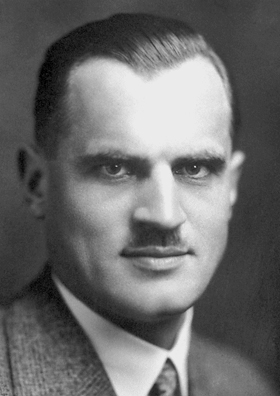
Portrait of Arthur Holly Compton
. Source. An optical physicist who coauthored a teaching text connecting electromagnetic wave descriptions with optical measurement. Its accounts of polarization and interference make the coherence assumptions behind an intensity prediction explicit, an essential step when applying ideal wave models to real sources.[ref]
An optical physicist who coauthored an interactive teaching text on wave optics. Its polarization and coherence chapters relate field components and correlations to measurable intensity, helping explain why combining beams does not always produce stable interference fringes.[ref]
Interactive Optics by Sander Konijnenberg, Aurèle J.L. Adam and H. Paul Urbach. Author record; polarization and interference/coherence chapters
A physicist who coauthored Interactive Optics by Sander Konijnenberg, Aurèle J.L. Adam and H. Paul Urbach. Its treatment connects wave polarization, interference and coherence to optical experiments. Writing those topics in a common wave framework helps readers move from a field equation to a prediction for the intensity measured by an instrument.[ref]
Interactive Optics by Sander Konijnenberg, Aurèle J.L. Adam and H. Paul Urbach. Author record and chapters on polarization, interference and coherence
Simon Foner developed a sensitive vibrating-sample magnetometer. A magnetized specimen oscillates relative to pickup coils, producing a periodic change of magnetic flux and hence an induced voltage. Calibration converts that signal into a magnetic moment. Moving the specimen makes its contribution oscillatory, allowing it to be separated from many static background fields. The apparatus turns the geometry and frequency of mechanical motion into a reproducible magnetic measurement.[ref]
Versatile and Sensitive Vibrating-Sample Magnetometer by Simon Foner. Review of Scientific Instruments 30 (1959), sample vibration, pickup coils and calibration

Portrait of Simon Foner
. Source. William Shockley developed the theory of semiconductor p-n junctions and junction transistors. Forward bias injects minority carriers across a junction; diffusion and recombination then determine how those carriers move through the neighboring material. In a transistor, a thin base allows much of the injected population to reach the collecting junction, making one electrical signal control another. The theory connects junction structure and carrier transport with quantitative current-voltage behavior.[ref]
The Theory of p-n Junctions in Semiconductors and p-n Junction Transistors by William Shockley. Bell System Technical Journal 28, 435–489 (1949), junction injection and transistor transport

Portrait of William Shockley
. Source. Ernst Ising solved the one-dimensional nearest-neighbor version of the spin model now called the Ising model. For ferromagnetic coupling and zero external field, its correlations decay with separation as . At every positive temperature the factor has magnitude below one, so correlations vanish at arbitrarily large distance and there is no finite-temperature long-range ferromagnetic order in this model. The result makes the role of dimensionality and fluctuations concrete, rather than assuming that an ordering interaction automatically creates macroscopic order.[ref]
Beitrag zur Theorie des Ferromagnetismus by Ernst Ising. 1925 paper, linear-chain calculation and absence of positive-temperature magnetic ordering
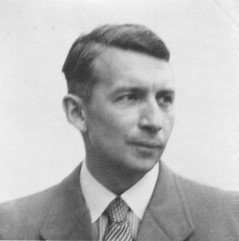
Portrait of Ernst Ising
. Michel H. Devoret coauthored a 1985 measurement of macroscopic quantum tunnelling in a current-biased Josephson junction. At higher temperatures, escape from the zero-voltage state characterized the junction in a thermal regime. At low temperatures, the escape rate stopped depending on temperature and agreed with the predicted quantum escape rate using those independently determined parameters. The comparison supplied quantitative evidence for tunnelling of the collective circuit coordinate, rather than merely observing an unexplained low-temperature switching rate.[ref]

Portrait of Michel H. Devoret
. Portrait identified on the cited institutional profile. Source.A condensed matter physicist who coauthored the quantronium circuit experiment. The superconducting device combined microwave state manipulation with a separate pulsed measurement circuit, allowing coherent evolution and readout of an electrical qubit. It supplied an experimental connection between circuit design and the dynamics of a controllable quantum state.[ref]
Manipulating the Quantum State of an Electrical Circuit by Denis Vion and others. Byline and abstract: controlled evolution and pulsed readout
An experimental condensed matter physicist who coauthored coherent control of a superconducting electrical circuit. Microwave pulses programmed evolution between two circuit states, while a pulsed readout circuit measured the result. The device behaved as an artificial two-level system, making a fabricated circuit a controllable carrier of quantum information.[ref]
Manipulating the Quantum State of an Electrical Circuit by Denis Vion and others. Abstract: quantronium, microwave control and projective readout
Daniel Esteve coauthored the quantronium demonstration of coherent superconducting-circuit control. Its combination of programmable microwave evolution and pulsed readout made an electrical circuit a candidate carrier of quantum information.[ref]
Identity source: iramis.cea.fr/en/spec/gq/membres-gq-en/

Portrait of Daniel Esteve
. Portrait identified on the cited institutional profile.Cristian Urbina coauthored manipulation and readout of a superconducting electrical qubit. Microwave pulse sequences programmed its quantum state, while a separate pulsed subcircuit measured the outcome.[ref]
Identity source: iramis.cea.fr/en/spec/gq/membres-gq-en/

Portrait of Cristian Urbina
. Portrait identified on the cited institutional profile.Hugues Pothier coauthored the quantronium experiment, in which a superconducting tunnel-junction circuit acted as an artificial two-level system with programmable microwave-driven evolution and pulsed quantum measurement.[ref]
Identity source: iramis.cea.fr/en/spec/gq/membres-gq-en/

Portrait of Hugues Pothier
. Portrait identified on the cited institutional profile.Philippe Joyez coauthored coherent control of the quantronium qubit. The circuit separated microwave state manipulation from pulsed measurement, connecting superconducting-device design with controlled two-state quantum dynamics.[ref]
Identity source: iramis.cea.fr/en/spec/gq/membres-gq-en/

Portrait of Philippe Joyez
. Portrait identified on the cited institutional profile.Denis Vion coauthored the quantronium experiment: microwave pulses controlled the quantum state of a superconducting circuit behaving as a two-level system, with separate pulsed readout.[ref]
Identity source: iramis.cea.fr/en/spec/gq/membres-gq-en/

Portrait of Denis Vion
. Portrait identified on the cited institutional profile.Evangelista Torricelli interpreted the support of a Mercury column in terms of external atmospheric pressure. His 11 June 1644 letter to Michelangelo Ricci describes equal column heights in vessels with different upper spaces, testing whether the support came from outside the vessel. In modern hydrostatic pressure notation, , where is the liquid's density and is gravitational acceleration. When the upper pressure is small, the column height measures atmospheric pressure, as in a barometer. Comparing liquids of different densities explains why water requires a much taller column than Mercury.[ref]
Letter to Michelangelo Ricci concerning the Barometer by Evangelista Torricelli. Letter of 11 June 1644, different-vessel comparison and mercury/water height argument; modern pressure notation
A physicist and mathematician associated here with Torricelli's law.[ref]
https://mathshistory.st-andrews.ac.uk/Biographies/Torricelli/. Biography: 15 October 1608 to 25 October 1647; mechanics and hydrodynamics

Portrait of Evangelista Torricelli
. Lorenzo Lippi (1606–1665), painting circa 1647; Galleria Silvano Lodi & Due / TEFAF. Reproduction credited in EXIF to Diego Brambilla / Studio Fotografico Perotti, 2011. PD-Art: Commons records origin-country/life-plus-100-or-shorter expiry, pre-1931 United States publication and its United States public-domain position for faithful two-dimensional reproductions., via Wikimedia Commons. Source. Pinned article: Introduction to the OurBigBook Project
Welcome to the OurBigBook Project! Our goal is to create the perfect publishing platform for STEM subjects, and get university-level students to write the best free STEM tutorials ever.
Everyone is welcome to create an account and play with the site: ourbigbook.com/go/register. We belive that students themselves can write amazing tutorials, but teachers are welcome too. You can write about anything you want, it doesn't have to be STEM or even educational. Silly test content is very welcome and you won't be penalized in any way. Just keep it legal!
Intro to OurBigBook
. Source. We have two killer features:
- topics: topics group articles by different users with the same title, e.g. here is the topic for the "Fundamental Theorem of Calculus" ourbigbook.com/go/topic/fundamental-theorem-of-calculusArticles of different users are sorted by upvote within each article page. This feature is a bit like:
- a Wikipedia where each user can have their own version of each article
- a Q&A website like Stack Overflow, where multiple people can give their views on a given topic, and the best ones are sorted by upvote. Except you don't need to wait for someone to ask first, and any topic goes, no matter how narrow or broad
This feature makes it possible for readers to find better explanations of any topic created by other writers. And it allows writers to create an explanation in a place that readers might actually find it.
Figure 1. Screenshot of the "Derivative" topic page. View it live at: ourbigbook.com/go/topic/derivativeVideo 2. OurBigBook Web topics demo. Source. - local editing: you can store all your personal knowledge base content locally in a plaintext markup format that can be edited locally and published either:This way you can be sure that even if OurBigBook.com were to go down one day (which we have no plans to do as it is quite cheap to host!), your content will still be perfectly readable as a static site.
- to OurBigBook.com to get awesome multi-user features like topics and likes
- as HTML files to a static website, which you can host yourself for free on many external providers like GitHub Pages, and remain in full control

Figure 2. You can publish local OurBigBook lightweight markup files to either OurBigBook.com or as a static website.
Figure 3. Visual Studio Code extension installation.
Figure 5. . You can also edit articles on the Web editor without installing anything locally. Video 3. Edit locally and publish demo. Source. This shows editing OurBigBook Markup and publishing it using the Visual Studio Code extension. 
- Infinitely deep tables of contents:




All our software is open source and hosted at: github.com/ourbigbook/ourbigbook
Further documentation can be found at: docs.ourbigbook.com
Feel free to reach our to us for any help or suggestions: docs.ourbigbook.com/#contact