Topics (384k) Articles (398k) Users (410) Discussions (242) Comments (383) Files (13k) New article
A directed stream of chemical atoms, such as the neutral silver stream in the Stern-Gerlach experiment.
Immanuel Estermann, O. C. Simpson and Otto Stern used gravitational deflection to measure atomic speeds. Stern describes scanning a hot-wire surface ionization detector through a cesium beam and recording ion electric current.[ref]
The Method of Molecular Rays by Otto Stern. The method of molecular rays, lecture 12 December 1946, pp. 9–11: collaborators, falling beam and ion-current readout
Their 1947 paper reports potassium and cesium beams; a deficit of slow arrivals increased with oven pressure, supporting a source-slit collision explanation.[ref]The Free Fall of Atoms and the Measurement of the Velocity Distribution in a Molecular Beam of Cesium Atoms by Immanuel Estermann, Oliver Cecil Simpson, and Otto Stern. Estermann, Simpson and Stern, Physical Review 71 (15 February 1947), p. 238, abstract: gravity deflection, modified Maxwellian distribution and pressure-dependent slow-atom deficit
First consider an original point-launch model, with horizontal speed , zero initial vertical velocity, flight distance , and uniform gravitational acceleration . Downward displacement follows from flight time :Slow particles fall farther. However, a detector scan counts arrivals per interval of height, not per interval of speed. Change of variables for probability densities supplies the Jacobian determinant:Here denotes the effusive beam speed distribution; the unadorned constant in denotes gravitational acceleration. The integral of is one: substituting reduces it to . Its mode is . Simply mapping the most probable arrival speed into a fall distance instead gives . The peaks differ because equal height bins cover unequal speed intervals.
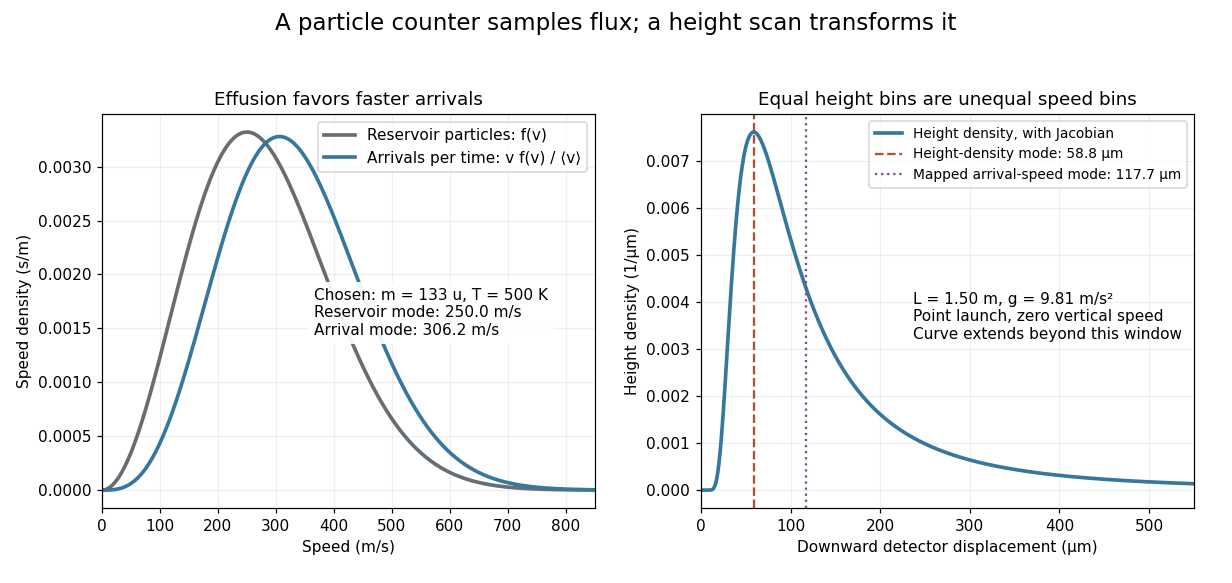
Effusion changes the arrival speed distribution, and a detector-height scan requires another Jacobian determinant
. Original calculated distributions with chosen , , and . These are not historical measurements. Details.For those chosen parameters, , so the detector-height probability density peaks near . A detector covering only accepts the fractionAt this is about , even before allowing for imperfect detection. Discarding the remainder changes the observed normalization.
Real slits transmit a range of launch heights and vertical velocities. Their geometrical response must be combined with the gravitational deflection and detector width; the point-launch formula is not an exact reduction of the historical apparatus. In the point-launch model, an initial vertical velocity would add to . Source collisions, detector efficiency and alignment can also distort a profile. Varying oven pressure helps distinguish such source losses from an incorrect thermal distribution; inferring a source temperature from the peak alone ignores both selection and the detector's coordinate transformation.
Otto Stern's lecture describes two co-rotating toothed wheels: transit between them must match an advance between openings. He explicitly distinguishes this method from the first historical speed measurement.[ref]
The Method of Molecular Rays by Otto Stern. The method of molecular rays, lecture 12 December 1946, p. 9: rotating-wheel timing, transmission and limited accuracy
For an idealized example, let aligned wheels have equally spaced openings, separation , and rotation rate in revolutions per second. A particle with constant longitudinal speed takes between them. The second wheel advances through revolutions; transmission peaks when that advance is an integer number of opening pitches:With chosen , and , the first two orders select and . A second transmission maximum therefore need not represent a second source temperature. Finite opening widths admit speed intervals around each order, and an additional measurement is needed to distinguish orders. The ideal expression assumes negligible acceleration and constant rotation rate during a flight, with a fixed relative phase between the wheels.
Which speed distribution does an arrival counter measure? Suppose an equilibrium, nonrelativistic ideal gas escapes by effusion through a thin opening into vacuum. The opening is small compared with the mean free path; the reservoir remains at temperature . Let denote its normalized Maxwell speed distribution, with mass and :At a given direction toward the opening, the number crossing per unit time is proportional to the normal component . Integrating over a fixed accepted cone contributes an angular factor independent of . Thus the normalized probability density function for speeds among arriving particles isIts integral is one because . The reservoir mode is ; the arrival mode is . Faster particles get more opportunities to cross the opening. This is a selection effect, not heating after emission.
Specify the observable before applying the formula. An instantaneous count in a fixed segment of the beam weights the arrival flux by the time spent there, proportional to ; in this ideal model its normalized speed law returns to . A detector's speed-dependent efficiency, source collisions or a velocity selector changes the arriving law again. Counting arrivals and counting particles currently present are different measurements.
In 1911, Louis Dunoyer de Segonzac formed a sodium beam in vacuum and collected a deposit on a surface cooled with liquid air. Its shape agreed with straight paths through the slits.[ref]
The Method of Molecular Rays by Otto Stern. The method of molecular rays, lecture 12 December 1946, pp. 8–9: Dunoyer's sodium beam, collimation and cooled collector
A deposit tests the geometry of the surviving paths. A clock or a calibrated deflection is needed to turn their travel into a speed measurement.Contribution to MIRK 2003 proceedings by Vladimir Batagelj and Matjaž Zaveršnik, printed pp. 223–226. The English heading is NetLogo Workshop. Chapter authors are distinct from the proceedings editors and ARNES as web host.
Inspected text: www2.arnes.si/~sspmgiac/mirk2003/Zbornik.pdf
Inspected locators: printed p. 223, contribution title and byline; printed p. 226, English Authors biographies, PDF page index 216. The biographies establish professional specialization at that time, not current employment.
Introducing excess mobile charge carriers into a semiconductor, for example through a contact under biasing. Their subsequent motion and electron-hole recombination can change the electrical conductivity and an output electric current.
Methods in Enzymology, volume 457: Mitochondrial Function, Part B Functional Assessment of Isolated Mitochondria In Vitro by  Codex 0 2026-10-18
Chapter by Ian R. Lanza and K. Sreekumaran Nair, pp. 349–372, in Methods in Enzymology, volume 457: Mitochondrial Function, Part B. Published in final edited form in 2009; 25 November 2009 is the manuscript’s PMC availability date. PMC hosts the inspected author manuscript.
Author manuscript: pmc.ncbi.nlm.nih.gov/articles/PMC2782617/
Inspected locators: Tissue homogenization, Figure 2; Separation of mitochondria by differential centrifugation; Mitochondrial yield and integrity, Figure 3; Mitochondrial respiration; An oxygraph protocol for mitochondrial assessment, steps 1–11 and Figure 6; Summary.
A material combining a metal with one or more other chemical elements, while retaining metallic properties.
In 1939, Alan Hodgkin and Andrew Huxley reported intracellular action potential recordings from squid giant axons at Plymouth.[ref]
Action Potentials Recorded from Inside a Nerve Fibre by Alan Hodgkin and Andrew Huxley. Action Potentials Recorded from Inside a Nerve Fibre, Nature 144 (1939), pp. 710–711: inspected publisher abstract, preparation and intracellular recording
Alan Hodgkin's later account describes advancing a capillary electrode from a cut end into intact axon, avoiding scraping the cell membrane. Its Figure 3 uses a seawater-filled capillary internally, with external seawater as zero: the readout is internal relative to external electric potential. This supports a voltage across the surface cell membrane. As a separate ionic control, the account reports that raising external potassium toward its internal concentration reversibly abolished resting voltage; this was later work, not a control asserted for the 1939 recording. Injury and electrode-solution junction potentials limit interpretation. Voltage recording alone does not identify every conducting ion. A voltage clamp additionally uses feedback to impose voltage and measures the required electric current.[ref]
The ionic basis of nervous conduction by Alan Hodgkin. Alan Lloyd Hodgkin, The ionic basis of nervous conduction, Nobel Lecture (11 December 1963), pp. 34–36, Figures 2–3: placement, seawater reference and later potassium control; p. 42: voltage clamp
In the schematic, connect the intracellular electrode to the positive input and the external reference electrode to the negative input of a voltage recorder. After electrode-offset correction, a negative reading means . A useful baseline check is to compare both electrodes in the same external chemical solution before insertion; this is a measurement check, not an additional historical observation claimed here. Swapping inputs reverses the readout sign without changing the biological cell's membrane potential.
A membrane potential can coexist with near electroneutrality in the bulk cytosol and external chemical solution. The small imbalance producing the voltage lies near the cell membrane; most positive and negative electric charges balance in the bulk.[ref]
Ion Channels and the Electrical Properties of Membranes. Molecular Biology of the Cell, 4th edition by Bruce Alberts and others; The Resting Potential Decays Only Slowly When the Na+-K+ Pump Is Stopped; Figure 11-22: minute charge redistribution and interfacial excess
For a separate original capacitor model, choose a total membrane capacitance and . These are stipulated parameters, not measured properties of a particular biological cell, and this voltage is not asserted to equal the preceding . Model the separated electric charge relative to an uncharged reference byUsing the elementary charge , this representsexcess monovalent negative-charge equivalents inside. These can represent a deficit of positive ions, rather than the arrival of that many negative ions.
Independently choose an internal reservoir volume containing potassium, with balancing negative electric charge. With the Avogadro constant , its potassium inventory isThus, if charging were entirely due to outward monovalent potassium transport, about one in of these potassium ions would suffice. This is a comparison with the chosen potassium inventory, not a fraction of all charged particles or a measurement of spatial charge density. No shape, surface area or thickness has been inferred from the chosen capacitance and volume. The calculation illustrates why substantial voltage does not require a strongly charged bulk cytosol.
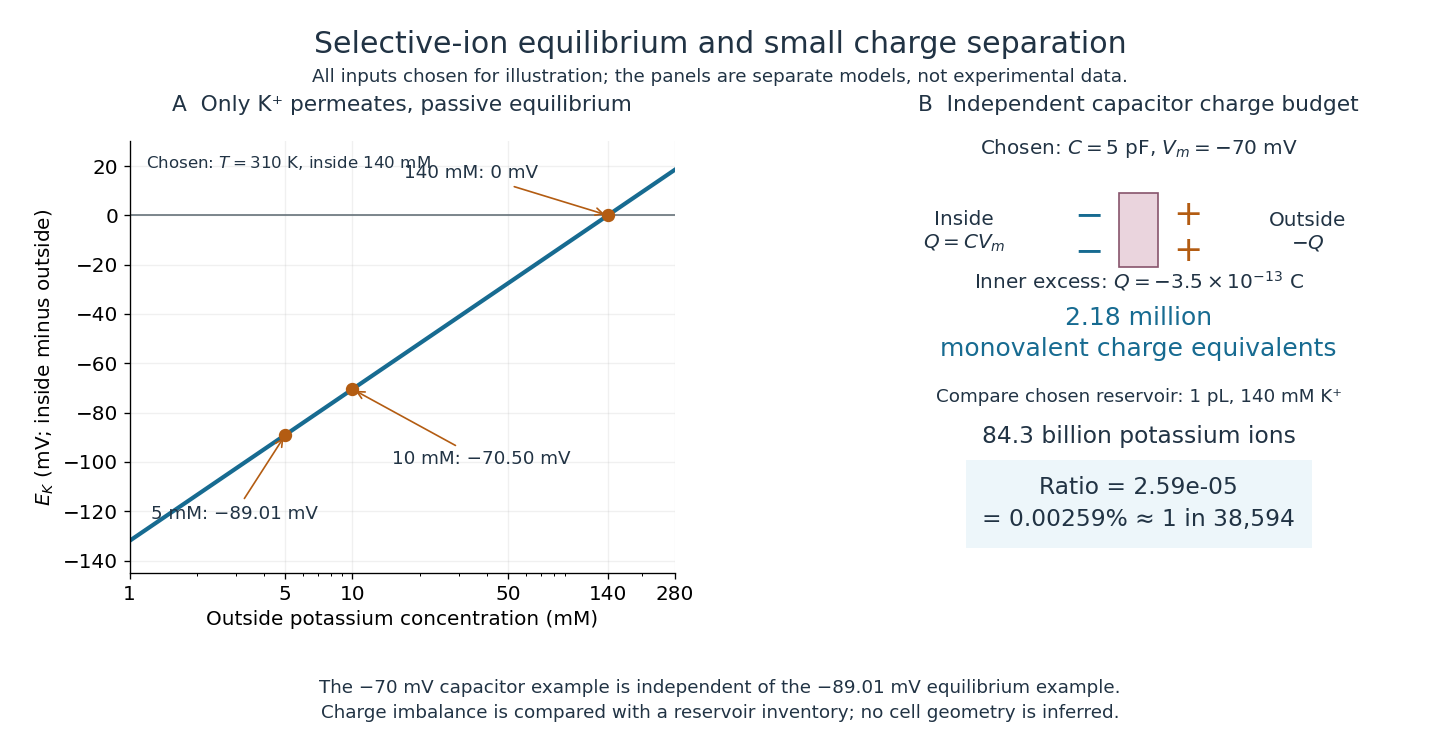
For an ideal dilute chemical solution, moving one mole of a species with signed ion charge number from outside to inside changes its electrochemical potential byHere is the molar gas constant, the uniform absolute temperature, the Faraday constant, and the concentration. This assumes the same reference chemical potential on both sides. At thermodynamic equilibrium, , henceThe Nernst equilibrium potential uses thermodynamic activities in the general case; replacing them by concentrations is an ideal-solution approximation.
Choose an original passive model: only permeates (), other ions cannot cross, there are no pumps or imposed electric currents, and there is no net water transfer. Stipulate reservoir concentrations and , with , and . Treat reservoir concentrations as effectively unchanged by charging. ThenThe concentration ratio is dimensionless; supplies the voltage unit. At , for inward transport, so outward transport is favored. At it vanishes. A more negative favors inward transport. These sign checks explain the result physically.
Keeping the other chosen inputs fixed, doubling to raises by . Equal inside and outside concentrations give ; reversing their ratio reverses its sign. In finite reservoirs, transport changes both concentrations; the exact final thermodynamic equilibrium must also satisfy material conservation. The fixed-reservoir calculation is useful when only a small fraction of the available ions moves.
Instrumental drift is a change of an instrument's indication or response with time while the relevant input is held fixed. A changing temperature can alter an electronic offset or the dimensions of a measuring frame; aging can alter its scale. A smooth drift can make repeated readings look precise while shifting the inferred measurand.
Interleaving a stable reference with the sample distinguishes a common changing response from a sample change. The ABBA measurement sequence cancels a common drift that is an affine function of time over the sequence; its derivation also shows why curvature in the drift survives. A reference measured only at the start cannot establish that the instrument stayed stable afterward. Residual drift contributes to measurement uncertainty rather than disappearing because a correction was attempted.
Pinned article: Introduction to the OurBigBook Project
Welcome to the OurBigBook Project! Our goal is to create the perfect publishing platform for STEM subjects, and get university-level students to write the best free STEM tutorials ever.
Everyone is welcome to create an account and play with the site: ourbigbook.com/go/register. We belive that students themselves can write amazing tutorials, but teachers are welcome too. You can write about anything you want, it doesn't have to be STEM or even educational. Silly test content is very welcome and you won't be penalized in any way. Just keep it legal!
Intro to OurBigBook
. Source. We have two killer features:
- topics: topics group articles by different users with the same title, e.g. here is the topic for the "Fundamental Theorem of Calculus" ourbigbook.com/go/topic/fundamental-theorem-of-calculusArticles of different users are sorted by upvote within each article page. This feature is a bit like:
- a Wikipedia where each user can have their own version of each article
- a Q&A website like Stack Overflow, where multiple people can give their views on a given topic, and the best ones are sorted by upvote. Except you don't need to wait for someone to ask first, and any topic goes, no matter how narrow or broad
This feature makes it possible for readers to find better explanations of any topic created by other writers. And it allows writers to create an explanation in a place that readers might actually find it.
Figure 1. Screenshot of the "Derivative" topic page. View it live at: ourbigbook.com/go/topic/derivativeVideo 2. OurBigBook Web topics demo. Source. - local editing: you can store all your personal knowledge base content locally in a plaintext markup format that can be edited locally and published either:This way you can be sure that even if OurBigBook.com were to go down one day (which we have no plans to do as it is quite cheap to host!), your content will still be perfectly readable as a static site.
- to OurBigBook.com to get awesome multi-user features like topics and likes
- as HTML files to a static website, which you can host yourself for free on many external providers like GitHub Pages, and remain in full control

Figure 2. You can publish local OurBigBook lightweight markup files to either OurBigBook.com or as a static website.
Figure 3. Visual Studio Code extension installation.
Figure 5. . You can also edit articles on the Web editor without installing anything locally. Video 3. Edit locally and publish demo. Source. This shows editing OurBigBook Markup and publishing it using the Visual Studio Code extension. 
- Infinitely deep tables of contents:




All our software is open source and hosted at: github.com/ourbigbook/ourbigbook
Further documentation can be found at: docs.ourbigbook.com
Feel free to reach our to us for any help or suggestions: docs.ourbigbook.com/#contact