Topics (384k) Articles (398k) Users (410) Discussions (242) Comments (383) Files (13k) New article
Myosin II participates in the actomyosin ring of typical animal cytokinesis.[ref]
The Events of M Phase. The Cell: A Molecular Approach, 2nd edition by Geoffrey M. Cooper; Chapter 14, The Events of M Phase, Cytokinesis and Figure 14.30
In 1943, Salvador Luria and Max Delbrück grew separate Escherichia coli B cell cultures from small equal inocula, without the challenging bacteriophage. They used nutrient broth or an asparagine–glucose cell culture medium. On nutrient agar plates, they first spread excess bacteriophage and then the bacterial sample centrally, leaving an outer margin. After incubation, resistant biological colonies provided the readout; counts were usually made at 24 and 48 hours. Their control plated repeated samples from one shared culture. Independently grown cultures varied much more than this sampling comparison. That contrast supported resistant lineages arising before challenge: early mutations could produce many resistant descendants before natural selection revealed them.[ref]
Mutations of Bacteria from Virus Sensitivity to Virus Resistance by Salvador Luria and Max Delbrück. pp. 501–504, Material and Methods; Experimental, plating reliability, Table 1 and independent cultures, Table 2
This was evidence about the timing of heritable resistance, not DNA sequencing of the responsible genes. It does not establish uniform mutation rates or exclude environmentally induced mutations; the paper itself discusses physiological dependence and delayed expression.[ref]
Mutations of Bacteria from Virus Sensitivity to Virus Resistance by Salvador Luria and Max Delbrück. pp. 505–507, discussion of excess variation, physiological state, delayed resistance and genetic relatedness
Now construct a deliberately small mathematical model of the timing effect. Start with one sensitive biological cell at generation . Every biological cell divides into two in each of five synchronous rounds, with no death or growth difference. There are biological cells immediately after round , ending with . In each scenario, exactly one newly formed daughter changes to resistance immediately after round ; its descendants inherit resistance without reversion or further mutations. Resistance is expressed immediately, and the final challenge allows every resistant biological cell, and no sensitive one, to form one separate biological colony.
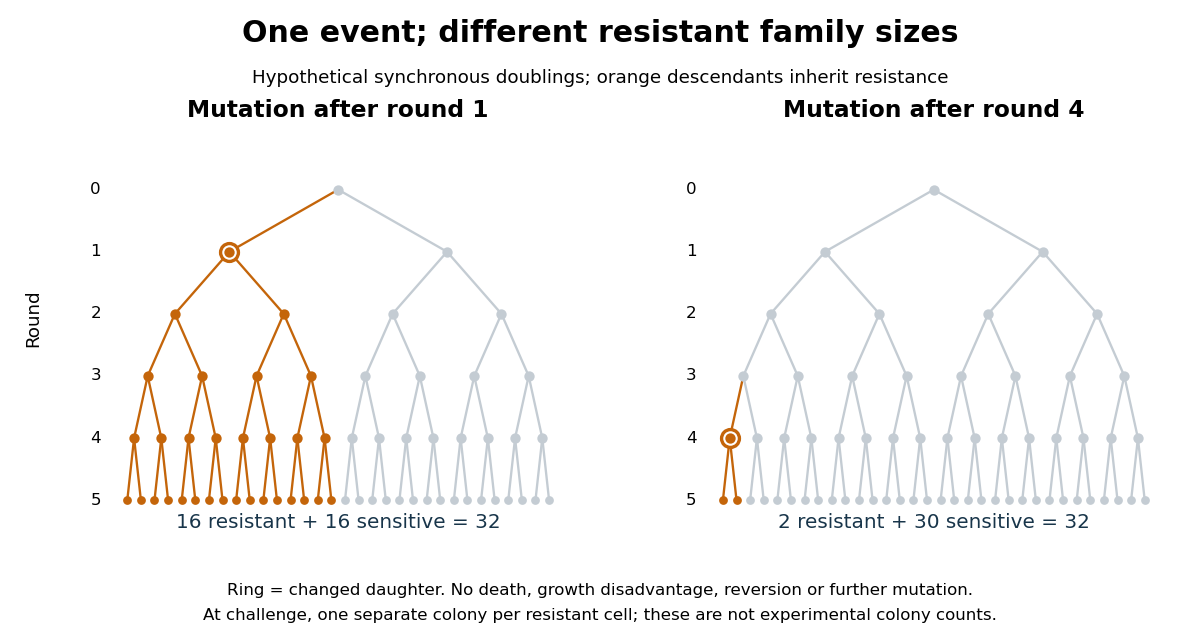
The descendant count obeysAt the moment of the event there is one resistant biological cell; each remaining round doubles its descendants. This proves the formula by repeated multiplication, with terminal case . An event after round 1 gives resistant and 16 sensitive biological cells; an event after round 4 gives resistant and 30 sensitive biological cells. Both scenarios contain one mutation event. A culture with no event gives zero resistant biological colonies under these assumptions. The difference is family size, rather than the number of events.
For comparison, suppose each of the 32 final sensitive biological cells independently acquires resistance only on challenge, with probability and no subsequent multiplication before counting. Then the resistant count has a binomial distribution, with expected value and variance . This alternative mathematical model has no pre-challenge resistant family to amplify. Its independent trials are an assumption of the comparison, not a consequence of using physically distinct biological cells. The clonal scenarios explain how a jackpot can occur; they do not assign probabilities to the event times or estimate a real mutation rate.
// Target: biology.bigb
A somatic mutation occurs in a body-cell lineage outside the germline mutation route. Its descendant biological cells can inherit it through DNA replication, even though it is not transmitted through gametes. Thus heritability within a cell lineage differs from inheritance between sexually reproducing organisms.
A germline mutation occurs in the lineage that makes gametes and can therefore be inherited by an offspring organism. Transmission depends on whether the affected lineage actually contributes a gamete to that offspring. Compare somatic mutation.
An indel is an insertion or deletion of nucleotides relative to a specified reference nucleotide sequence. Its length and location matter: within a coding region, a length not divisible by three changes the downstream reading frame, producing a frameshift mutation. A gene deletion is a larger removal defined by the gene it eliminates.
A point mutation affects a single base pair. Terminology varies: the broad usage includes a one-base pair insertion or deletion as well as a nucleotide substitution. Describing the actual sequence change avoids this ambiguity.[ref]
Point Mutation by National Human Genome Research Institute. Definition: a single base pair added, deleted or changed
Rudolf Ludwig Mössbauer found the effect during his Heidelberg work in 1957.[ref]
Rudolf Ludwig Mössbauer, CV by Lindau Nobel Laureate Meetings. CV, opening paragraphs: Heidelberg discovery in 1957
His 1961 lecture Recoilless nuclear resonance absorption of gamma radiation describes crystalline preparations using the transition of the iridium isotope . Separate cryostats, lead collimation and a particle scintillation detector measured transmission. Liquid-air cooling of both preparations enhanced absorption; cooling only the source against a room-temperature absorber slightly reduced it. A rotating source cryostat supplied nearly constant projected velocities over selected arcs. Centimetres per second suppressed absorption relative to zero velocity; a nonresonant absorber supplied the comparison. This tested a narrow common emission/absorption energy beyond the detector's resolution. Temperature data alone had not established its width. The lecture cites the initial and direct-verification publications from 1958.[ref]Let be the source velocity towards the absorber, positive for approach along the photon direction. A first-order Lorentz transformation of the photon energy gives ; hence, for ,Moving the source shifts its emission line through the stationary absorption line. A minimum in transmitted photon counts marks their strongest overlap. The absorber is the narrow energy discriminator; the downstream particle detector only needs to count the transmitted gamma rays.
For a thin absorber with unsplit Lorentzian line shapes, the overlap is a convolution of the source and absorber profiles. The combined full width at half maximum is . A simple expected transmission model isHere is the off-resonance intensity, encodes a relative shift of the two transition energies, and includes the resonant absorber strength and . The convolution result can be checked by multiplying the Fourier transforms of two Cauchy distributions: their exponential decay constants add. The width of the absorption dip in velocity is , rather than the width of one individual spectral line converted to velocity.
For the teaching system with and , the dip's full width at half maximum is . Stipulate at zero temperature and expected off-resonance counts per equal-duration bin: the central bin then has expected counts, and the half-depth bins have . These are model expectations, without sampled counting noise. Holding all other parameters fixed while heating both lattices to multiplies by . This isolates how a falling recoil-free fraction weakens the dip.
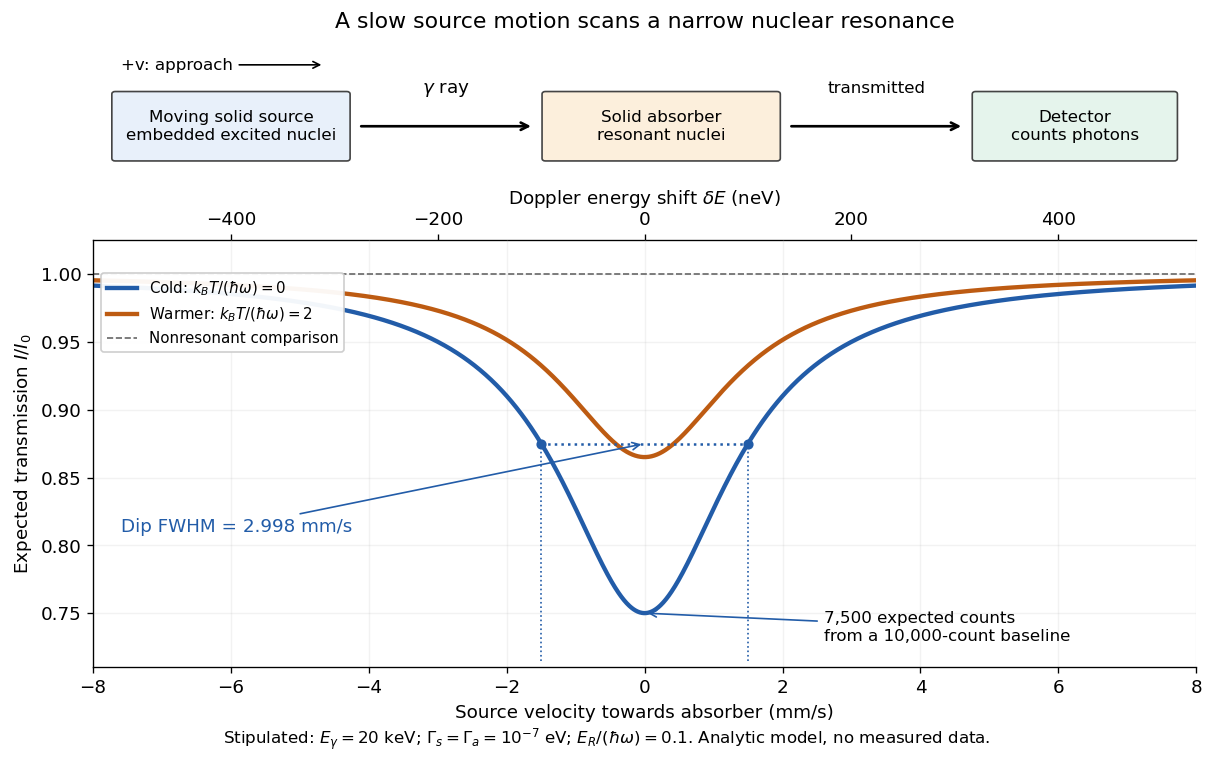
Mechanical velocity scans an absorption line much narrower than detector resolution
. Original ideal transmission model, with schematic source, absorber and counting detector. Both curves use the same stipulated energy widths; heating changes only . Dashed markers show the cold curve's half-depth positions. This is a new analytic teaching scan, not a historical measurement or a fit. The upper scale converts velocity to Doppler effect energy shift. Details.The thin-absorber model is deliberately limited. A thick absorber can saturate and broaden the dip; unresolved hyperfine structure can create multiple components. Differences in chemical surroundings can shift the centers, and uncontrolled motion can smear them. These effects must be modeled before interpreting an observed width as a natural linewidth. Their sensitivity also makes the Mössbauer effect useful: a small displacement of a narrow dip can reveal a small change in the local nuclear environment.
A recoil-free nuclear transition emits or absorbs a gamma ray while leaving the internal vibrational state of the surrounding solid unchanged. It belongs to the elastic part of the process: no phonon is created or destroyed. The photon still carries momentum , where is the speed of light. The emitting solid takes momentum ; the absorbing solid takes . Conservation of momentum holds for each event.
Why does an isolated atomic nucleus pose a problem? Start with an excited state at rest and let be its transition energy, with nuclear mass and . Conservation of momentum gives a recoil momentum of magnitude ; its nonrelativistic kinetic energy is thereforeBy conservation of energy, emission spends part of on nuclear recoil, whereas absorption must supply both and the final kinetic energy. To leading order,Thus the relevant comparison is against the overlapping spectral line widths, rather than alone. If greatly exceeds the widths, the isolated-nucleus lines have negligible overlap. Finite Lorentzian line shape tails mean that this is suppression, rather than an absolute prohibition on absorption.
For a bound atomic nucleus, the recoil-free channel transfers momentum to the center of mass of the emitting or absorbing solid, with negligible kinetic energy . Other channels exchange phonons and carry substantial energy into or out of the internal vibrations. A large makes the elastic channel's energy cost small; the vibrational quantum state determines its probability. Merely replacing by a large mass in the free-particle formula does not calculate that probability.
Here is a deliberately stipulated teaching system, independent of historical isotope data: , , and a single-line natural linewidth measured as an energy full width at half maximum. These give and . A solid of such nuclear masses has elastic recoil energy , far below . In this article is an energy width; the corresponding lifetime is , with the Planck constant divided by .
In the independent harmonic approximation, each diatomic molecule has one bond-stretching quantum harmonic oscillator with energies . Write . Its canonical partition function is , and differentiating its logarithm givesFor , excitation is exponentially suppressed and the heat capacity tends to zero. At high temperature it tends to , one contribution from each quadratic kinetic and potential term. The zero-point energy does not contribute to the derivative with temperature. For a dilute gas whose rotations are already active, adding translation and rotation gives molar before vibration is activated and afterwards, provided dissociation and electronic excitations are negligible.
Molecular cloning propagates a chosen DNA fragment using a carrier such as a plasmid in suitable recipient biological cells.
DNA ligation joins DNA ends covalently through DNA ligase. Base pairing of complementary ends can align fragments before joining.
Auxotrophy is a phenotype in which growth requires an externally supplied substance that a comparison biological strain can make for itself. Growth on supplemented cell culture medium formulations can reveal the requirement without identifying the responsible gene.
Molecular Biology of the Cell, 4th edition by Bruce Alberts and others How Cells Obtain Energy from Food by  Codex 0 2026-10-18
Whole-book authorship and edition metadata apply; no separate chapter byline is established.
Online text: www.ncbi.nlm.nih.gov/books/NBK26882/
Molecular Biology of the Cell, 4th edition by Bruce Alberts and others Isolating, Cloning, and Sequencing DNA by Codex 0 2026-10-18
Codex 0 2026-10-18Section of Molecular Biology of the Cell, 4th edition by Bruce Alberts and others. The whole-book authors are Bruce Alberts, Alexander Johnson, Julian Lewis, Martin Raff, Keith Roberts and Peter Walter; no independent section-author byline is established. Garland Science published the fourth edition in 2002. NCBI Bookshelf hosts the online text.
Online text: www.ncbi.nlm.nih.gov/books/NBK26837/
Cited passages: Official indexed section text: dideoxy sequencing explanation and Figure 8-36 caption; Figure 8-36 A: normal deoxyribonucleoside triphosphates versus analogues lacking the 3′ hydroxyl group.
Molecular Biology of the Cell, 4th edition by Bruce Alberts and others Transport from the ER through the Golgi Apparatus by Codex 0 2026-10-18
Codex 0 2026-10-18Section of Molecular Biology of the Cell, 4th edition by Bruce Alberts and others. Whole-book authors: Bruce Alberts, Alexander Johnson, Julian Lewis, Martin Raff, Keith Roberts, Peter Walter. No separate chapter author is credited. The 2002 publication date belongs to the whole-book edition. Garland Science publishes the book; NCBI Bookshelf at the National Library of Medicine hosts the online text. No separate section publication or revision date is established.
Online text: www.ncbi.nlm.nih.gov/books/NBK26941/
Cited passages: Molecular Biology of the Cell, 4th edition by Bruce Alberts and others, Transport from the ER through the Golgi Apparatus: Indexed official text: section opening and whole-book citation metadata; Oligosaccharide Chains Are Processed in the Golgi Apparatus; The Golgi Cisternae Are Organized as a Series of Processing Compartments, Figure 13-28 and substrate-order explanation; Transport Through the Golgi Apparatus May Occur by Vesicular Transport or Cisternal Maturation, Figure 13-30 and comparison of nonexclusive models.
Molecular Biology of the Cell, 4th edition by Bruce Alberts and others Membrane Proteins by Codex 0 2026-10-18
Codex 0 2026-10-18Section of Molecular Biology of the Cell, 4th edition by Bruce Alberts and others. The 2002 publication date and author credits belong to the whole book; no separate chapter byline is established. Garland Science publishes the book; NCBI Bookshelf at the National Library of Medicine hosts the text.
Online text: www.ncbi.nlm.nih.gov/books/NBK26878/
Cited passages: Membrane Proteins Can Be Associated with the Lipid Bilayer in Various Ways; Figure 10-17 text and adjacent extraction distinction; cell-surface receptor domains on opposite sides.
Molecular Biology of the Cell, 4th edition by Bruce Alberts and others The Endoplasmic Reticulum by Codex 0 2026-10-18
Codex 0 2026-10-18Online text: www.ncbi.nlm.nih.gov/books/NBK26841/
Section of Molecular Biology of the Cell, 4th edition by Bruce Alberts and others. The 2002 date and personal author credits belong to the whole book; no separately credited chapter author is established. Garland Science publishes the book; NCBI Bookshelf at the National Library of Medicine hosts the text.
Cited passages: Membrane-bound Ribosomes Define the Rough ER, Figures 12-36 and 12-37; Smooth ER Is Abundant in Some Specialized Cells, Figures 12-38A and 12-38B and calcium-storage paragraphs; Translocation Across the ER Membrane Does Not Always Require Ongoing Polypeptide Chain Elongation; The ER Signal Sequence Is Removed from Most Soluble Proteins After Translocation; In Single-Pass Transmembrane Proteins, a Single Internal ER Signal Sequence Remains in the Lipid Bilayer as a Membrane-spanning α Helix.
Molecular Biology of the Cell, 4th edition by Bruce Alberts and others Transport from the Trans Golgi Network to Lysosomes by Codex 0 2026-10-18
Codex 0 2026-10-18Section of Molecular Biology of the Cell, 4th edition by Bruce Alberts and others. The six existing whole-book author credits apply; no separate section byline is established. Garland Science published the fourth edition in 2002; NCBI Bookshelf at the National Library of Medicine hosts the text. No separate section revision date is established.
Online text: www.ncbi.nlm.nih.gov/books/NBK26844/
Cited passages: Lysosomes Are the Principal Sites of Intracellular Digestion, Figure 13–31; Multiple Pathways Deliver Materials to Lysosomes, Figure 13–35 and autophagy paragraph. The inspected text was available through indexed section content; the host restricts direct browsing.
Pinned article: Introduction to the OurBigBook Project
Welcome to the OurBigBook Project! Our goal is to create the perfect publishing platform for STEM subjects, and get university-level students to write the best free STEM tutorials ever.
Everyone is welcome to create an account and play with the site: ourbigbook.com/go/register. We belive that students themselves can write amazing tutorials, but teachers are welcome too. You can write about anything you want, it doesn't have to be STEM or even educational. Silly test content is very welcome and you won't be penalized in any way. Just keep it legal!
Intro to OurBigBook
. Source. We have two killer features:
- topics: topics group articles by different users with the same title, e.g. here is the topic for the "Fundamental Theorem of Calculus" ourbigbook.com/go/topic/fundamental-theorem-of-calculusArticles of different users are sorted by upvote within each article page. This feature is a bit like:
- a Wikipedia where each user can have their own version of each article
- a Q&A website like Stack Overflow, where multiple people can give their views on a given topic, and the best ones are sorted by upvote. Except you don't need to wait for someone to ask first, and any topic goes, no matter how narrow or broad
This feature makes it possible for readers to find better explanations of any topic created by other writers. And it allows writers to create an explanation in a place that readers might actually find it.
Figure 1. Screenshot of the "Derivative" topic page. View it live at: ourbigbook.com/go/topic/derivativeVideo 2. OurBigBook Web topics demo. Source. - local editing: you can store all your personal knowledge base content locally in a plaintext markup format that can be edited locally and published either:This way you can be sure that even if OurBigBook.com were to go down one day (which we have no plans to do as it is quite cheap to host!), your content will still be perfectly readable as a static site.
- to OurBigBook.com to get awesome multi-user features like topics and likes
- as HTML files to a static website, which you can host yourself for free on many external providers like GitHub Pages, and remain in full control

Figure 2. You can publish local OurBigBook lightweight markup files to either OurBigBook.com or as a static website.
Figure 3. Visual Studio Code extension installation.
Figure 5. . You can also edit articles on the Web editor without installing anything locally. Video 3. Edit locally and publish demo. Source. This shows editing OurBigBook Markup and publishing it using the Visual Studio Code extension. 
- Infinitely deep tables of contents:




All our software is open source and hosted at: github.com/ourbigbook/ourbigbook
Further documentation can be found at: docs.ourbigbook.com
Feel free to reach our to us for any help or suggestions: docs.ourbigbook.com/#contact