Topics (384k) Articles (398k) Users (410) Discussions (242) Comments (383) Files (13k) New article

Let be positive and a closed smooth hypersurface in a complex torus. The semipositive canonical bundle of a submanifold of a complex torus makes positive. Since , the restriction of the -th ambient twist is when . Apply the Kodaira vanishing theorem on , and use and its long exact sequence to induct from the positive bundle on the torus. No unproved ambient positivity of is needed.
With Hermitian angular-momentum generators , the Killing form is and its inverse contraction is . Equivalently the anti-Hermitian basis has Killing form and gives the same operator. In the complex highest-weight basis, . It acts on spin by , so it differs in normalization from the usual angular-momentum quadratic Casimir operator.
Within the ideal-vapor Clausius-Clapeyron approximation, a local slope of the natural logarithm of saturation pressure against inverse temperature estimates the molar latent heat:In the stipulated vapor-pressure calculation, the slope is , which recovers . For variable , a two-point estimate gives an average weighted by , rather than the latent heat at an arbitrary midpoint. Differentiating noisy pressure measurements amplifies their errors. Outside the ideal-vapor regime, use independently determined molar volumes in ; a straight-looking graph alone cannot establish that the gas is ideal.
Consider an unnamed model substance with molar latent heat and saturation pressure at . Stipulate the ideal-vapor Clausius-Clapeyron approximation throughout , constant , and . These parameters define an illustrative model, not a measured dataset or a fit to water. At ,At the reference state the gas molar volume is , and the local slope is . The tangent estimate is much lower than the integrated result: a local derivative should not be extrapolated over this whole interval. By contrast, over a small temperature increment, the fractional sensitivity is .
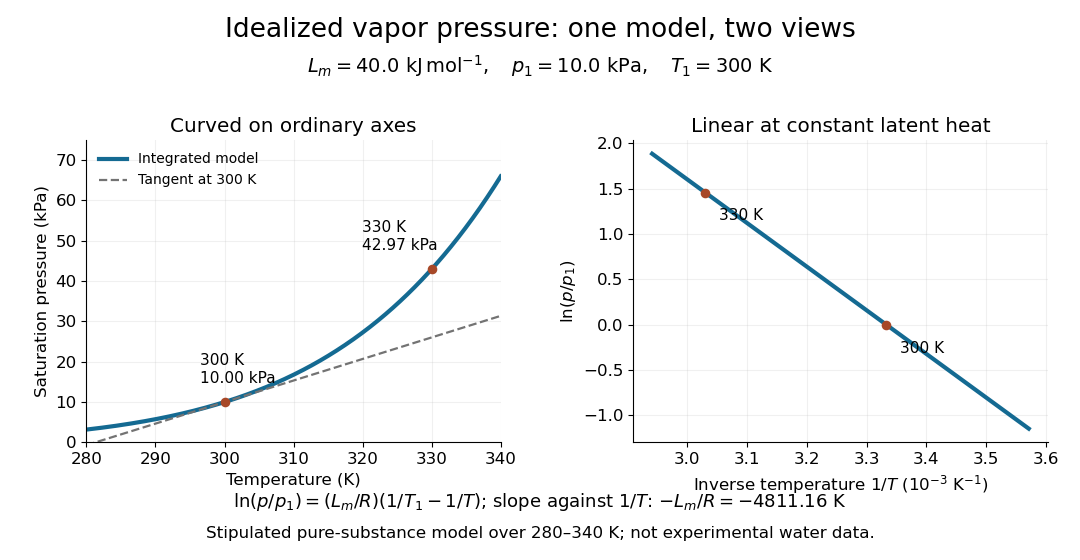
Stipulated saturation pressure versus temperature and its linear logarithm versus inverse temperature
. Details. For a closed holomorphic one-form on a polydisc, the displayed coordinate-path integral is a holomorphic function. Differentiating in gives the endpoint term; for use and integrate that derivative. The resulting sum telescopes to . Thus , giving an explicit degree-one proof of the holomorphic Poincaré lemma.
If and are local meromorphic equations for two divisors on a complex manifold, then defines their sum. With local frames satisfying , the transition functions of a vector bundle for the tensor product are the products of the two ratios, exactly those for . Multiplication of local frames therefore gives the displayed holomorphic line bundle isomorphism.
For reduced local equations with a holomorphic unit, the holomorphic line bundle associated to a divisor has local generators and transition . Differentiation along gives . Sending the restricted local generator to gives the conormal isomorphism. The term disappears only after restricting to .
For a root reflection on the weight lattice, with . A finite anti-invariant element of the group ring of a weight lattice is a sum of terms ; fixed weights have zero coefficient. Each pair is divisible by , because is divisible by in for every integer . Thus the quotient has finite support.
The formal expression is interpreted coefficientwise. Along each coset of , only finitely many coefficients of are nonzero and their total is zero by reflection anti-invariance. Partial coefficient sums therefore vanish before and after that finite interval. The result has finite support, even though the individual summands do not eventually vanish.
// Target: lie-algebra.bigb
A good reduction in characteristic is ordinary when the geometric -torsion has points, equivalently its formal group of an elliptic curve has height one. For a CM elliptic curve, a good prime split in its CM field is ordinary. One of the two roots of is a -adic unit, enabling the bounded ordinary p-adic L-function.
A good reduction in characteristic is supersingular when its geometric -torsion is trivial, equivalently its formal group of an elliptic curve has height two. Good inert primes of a CM elliptic curve are supersingular. The ordinary bounded-measure and torsion-Selmer formulation must then be modified, for instance using signed local conditions in the cyclotomic tower.
An integral Weierstrass equation of an elliptic curve with unit elliptic-curve discriminant defines a smooth proper elliptic curve over the valuation ring. Properness identifies points over the local field with integral sections. The group law, constructed by adding degree-zero divisor classes, is a morphism over the valuation ring, and base change to the residue field preserves it. Hence reducing primitive projective coordinates is a group homomorphism, including exceptional affine addition cases.
Normalize the Fubini-Study form so that a complex projective line has symplectic area . The displayed map takes the unit symplectic ball in diffeomorphically onto the complement of the last-coordinate hyperplane. Its lift to the unit sphere has last coordinate positive real, so that coordinate contributes zero to the pulled-back standard symplectic form. The map is therefore a symplectomorphism.
On a compact Hermitian manifold without boundary, this operator is the inverse of the Dolbeault Laplacian on the orthogonal complement of its harmonic forms and is zero on the harmonic space. Elliptic theory gives , with the harmonic projection, and ensures that sends smooth forms to smooth forms. It commutes with and ; their commutation with the Laplacian and orthogonality to its kernel give this by uniqueness of the inverse. If is -exact, then . On a Kähler manifold, the same operator serves the holomorphic Laplacian because .
In frames with and input-index connection matrices, the Chern connection has . These holomorphic one-forms, interpreted in the beta frame, satisfy the transported Čech cocycle condition because . Local primitives of curvature differ by this cocycle. A holomorphic frame change adds the Čech coboundary of , so the resulting curvature Dolbeault class is intrinsic.
For odd nonzero , the intrinsic bad primes of are exactly the displayed set. If , the change , removes that even valuation from the parameter and gives unit discriminant at odd . If the valuation is odd, after the same removal the discriminant valuation is six. Discriminant valuations of isomorphic Weierstrass models differ by multiples of twelve, so no integral model has unit discriminant. At two the original discriminant valuation is also six. Thus primes dividing a nonminimal displayed discriminant need not be intrinsic bad primes: is isomorphic to and has good reduction at three.
Discriminants of isomorphic Weierstrass equations of an elliptic curve differ by a twelfth power of the scale parameter, so their valuations differ by a multiple of twelve. An integral model with good reduction has discriminant valuation zero. Thus a displayed integral model with discriminant valuation not divisible by twelve proves intrinsic bad reduction. More generally, a displayed discriminant valuation between zero and eleven is already minimal, since any smaller integral-model valuation would be nonnegative and differ by twelve. Positive valuations divisible by twelve alone do not establish bad reduction; rescaling may remove them.
Let Roche-lobe overflow transfer mass conservatively within a circular binary while a separate fast wind escapes with the donor's specific orbital angular momentum. Then and . Differentiating the donor and Roche lobe radii and enforcing contact gives the displayed rate. It is positive and stabilizing when the wind drives overfill and . When the latter inequality is reversed, transfer increases the overfill, producing runaway rather than a steady negative-transfer solution.
A weight basis of a Lie algebra representation is a basis consisting of weight vectors for a chosen Cartan subalgebra. When the Cartan action is diagonalizable, choose a basis separately in every weight space and combine them. This makes weight multiplicities directly visible and gives diagonal matrices for Cartan elements.
Multiply the Weyl character formula by the generating series of the Kostant partition function. In each numerator summand, the coefficient of occurs when . Summing those coefficients with the Weyl group signs proves the displayed weight multiplicity formula. Although need not itself be an integral group weight, is in the root lattice, so each partition-function argument is an integral weight.
The group ring of a weight lattice consists of finite sums with integer coefficients, where . A finite-dimensional Lie algebra representation has formal character in this ring. The Weyl group acts by . The ambient ring need not consist of genuine characters; the representation ring of a semisimple Lie algebra of finite-dimensional modules for a complex semisimple Lie algebra identifies with the invariant subring .
// Target: semisimple-lie-algebra.bigb
Pinned article: Introduction to the OurBigBook Project
Welcome to the OurBigBook Project! Our goal is to create the perfect publishing platform for STEM subjects, and get university-level students to write the best free STEM tutorials ever.
Everyone is welcome to create an account and play with the site: ourbigbook.com/go/register. We belive that students themselves can write amazing tutorials, but teachers are welcome too. You can write about anything you want, it doesn't have to be STEM or even educational. Silly test content is very welcome and you won't be penalized in any way. Just keep it legal!
Intro to OurBigBook
. Source. We have two killer features:
- topics: topics group articles by different users with the same title, e.g. here is the topic for the "Fundamental Theorem of Calculus" ourbigbook.com/go/topic/fundamental-theorem-of-calculusArticles of different users are sorted by upvote within each article page. This feature is a bit like:
- a Wikipedia where each user can have their own version of each article
- a Q&A website like Stack Overflow, where multiple people can give their views on a given topic, and the best ones are sorted by upvote. Except you don't need to wait for someone to ask first, and any topic goes, no matter how narrow or broad
This feature makes it possible for readers to find better explanations of any topic created by other writers. And it allows writers to create an explanation in a place that readers might actually find it.
Figure 1. Screenshot of the "Derivative" topic page. View it live at: ourbigbook.com/go/topic/derivativeVideo 2. OurBigBook Web topics demo. Source. - local editing: you can store all your personal knowledge base content locally in a plaintext markup format that can be edited locally and published either:This way you can be sure that even if OurBigBook.com were to go down one day (which we have no plans to do as it is quite cheap to host!), your content will still be perfectly readable as a static site.
- to OurBigBook.com to get awesome multi-user features like topics and likes
- as HTML files to a static website, which you can host yourself for free on many external providers like GitHub Pages, and remain in full control

Figure 2. You can publish local OurBigBook lightweight markup files to either OurBigBook.com or as a static website.
Figure 3. Visual Studio Code extension installation.
Figure 5. . You can also edit articles on the Web editor without installing anything locally. Video 3. Edit locally and publish demo. Source. This shows editing OurBigBook Markup and publishing it using the Visual Studio Code extension. 
- Infinitely deep tables of contents:



All our software is open source and hosted at: github.com/ourbigbook/ourbigbook
Further documentation can be found at: docs.ourbigbook.com
Feel free to reach our to us for any help or suggestions: docs.ourbigbook.com/#contact