Topics (384k) Articles (398k) Users (410) Discussions (242) Comments (383) Files (13k) New article

A discovery becomes more intelligible when its motivating question, proposed explanation and actual measurement can be followed together. The photoelectric effect connects Albert Einstein's light-quantum reasoning with the Millikan photoelectric experiment. The Schrödinger equation and the Davisson–Germer experiment connect mathematical wave mechanics with a laboratory test of matter waves.
The Nobel Prize in Physics provides one route through these subjects. Following the original papers and the people who built the apparatus also brings collaborators into view: Lester Halbert Germer appears alongside Clinton J. Davisson in the Davisson–Germer experiment. The history belongs in the articles on those people and concepts as well as in award records.
Particle detection infers a particle's passage from a physical change in matter. A cloud chamber makes the spatial pattern of ionization visible; an ionization chamber instead collects electric charge from ionization. Choosing the readout determines what can be inferred from a single event.
The Richter-Ting independent J/psi discovery experiments show how different readouts can establish the same particle resonance: reconstruct daughter invariant masses after a beam hits a stationary target, or tune the initial center-of-mass energy of two colliding beams. Both require an ensemble of events and calibrated particle detectors.
Theoretical physics develops physical models, derives their consequences and identifies observations that can test them. It uses mathematics to connect assumptions with predictions: a Lagrangian can determine equations of motion, while a symmetry can imply a conservation law.
An ideal simple pendulum is a small but complete example. Its assumed constraint and gravitational force determine an equation; the small-angle approximation gives a tractable oscillation period; comparison with larger-amplitude measurements tests that approximation. A successful calculation and a physically adequate model are connected achievements, but one does not automatically establish the other.
A thought experiment explores the consequences of a specified hypothetical setup using physical or logical assumptions.
The many-body problem asks how a system of many interacting constituents behaves, given their dynamics and interactions. A simple Hamiltonian operator for nonrelativistic quantum particles contains one-particle terms and pair interactions,Even a compact expression can be difficult to solve: interactions correlate the constituents, and a tensor product of local state spaces of dimension has dimension before constraints or symmetries are used.
Mean-field theory replaces part of the correlated environment by an effective average, while Hartree-Fock theory uses a restricted fermionic state description. Their usefulness comes with a question: which correlations have been neglected, and do those correlations control the phenomenon of interest? Electron correlation and collective excitations show why knowing each constituent in isolation need not explain the system.
An effective area describing the strength of a specified interaction. With an incident particle flux and independent target particles, the ideal event rate for that channel is .
LIGO measures gravitational wave-induced changes in the relative lengths of widely separated interferometer arms. Laser light travels along perpendicular arms, reflects from suspended mirrors and recombines; a change in relative optical phase alters the detected signal. Arm optical cavities increase the interaction time, while vibration isolation and mirror suspension reduce unwanted motion.[ref]
Advanced LIGO by J. Aasi and others. Abstract and detector configuration: Michelson geometry, arm cavities and noise-control systems
The scientific collaboration associated with the Virgo gravitational-wave detector.
Quantum information science studies the storage, processing and transmission of quantum information, including the physical implementation of the tasks described by quantum information theory.
In photography, photographic processing uses chemical reactions to develop and stabilize an exposed photographic emulsion.
A photographic emulsion is a coating that responds to light to record an image in photography, for example on a photographic plate. Silver halide crystals, commonly silver bromide, are dispersed in gelatin. Exposure leaves a latent image. A developer produces dark silver grains and fixing removes remaining sensitive material. A microscope can reveal a charged particle's path through the coating: the basis of nuclear emulsion particle detection.[ref]
Research Profile: Cecil Powell by Luisa Bonolis. Luisa Bonolis, Research Profile: Cecil Powell, “A new visual method: nuclear emulsions”, paragraphs describing composition, coating, development, fixing and microscope observation
A camera combines an image-forming arrangement with a surface that records the incident light. An optical lens collects many light rays from each object point and directs them toward a corresponding image point; a photographic emulsion or photodetector then records the image. The optical camera is the imaging part of this arrangement.
The simplest demonstration replaces the optical lens with an optical pinhole. In NASA's two-card activity, foil containing a small hole covers a window in one card, and a second white card receives the projected image of the Sun. Increasing the separation enlarges the image; making several holes produces several images. The receiving card is viewed from the side, rather than looking through the hole at the Sun.[ref]
An optical pinhole selects narrow bundles of light rays without refraction. A finite hole also produces geometric blur, and an extremely small hole makes diffraction important. These competing effects explain why reducing the hole indefinitely does not produce unlimited spatial resolution.
Stereoscopy uses images from different viewpoints to convey or recover depth. In scientific photography, identifying the same feature in two calibrated views permits stereoscopic triangulation: intersecting the directions inferred from the two images.[ref]
What Is Stereo Reconstruction? by MathWorks. How Does Stereo Reconstruction Work? and Stereo Camera Calibration
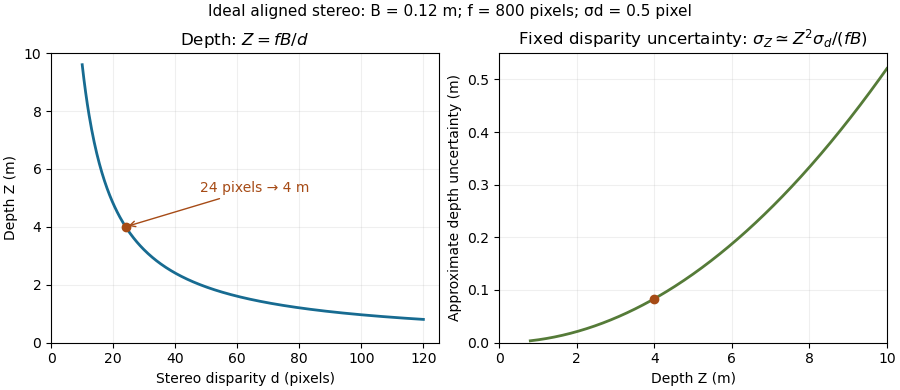
Consider ideal cameras with parallel axes, separated by a baseline . With matching forward-projection coordinates and common focal length in image-coordinate units, a point at projects toSubtracting gives the stereo disparity , hence . If and are measured in pixels, has the same length unit as .
For an original example, , pixels and pixels give . First-order propagation of uncertainty gives . Thus fixed disparity precision produces increasing depth uncertainty for more distant objects. Correctly matching the same feature is also essential; ambiguous or hidden features can defeat the reconstruction even when the geometry is known.
Aerospace engineering concerns aircraft and spacecraft, linking aerodynamics, structures, propulsion, control and thermal design. Aircraft operate through forces exchanged with the atmosphere; spacecraft also require orbital dynamics and operation in vacuum. A low-mass structure can reduce propulsion requirements but may be more flexible, affecting control and vibration. Coupling these subsystems makes performance a system-level property: improving one component's isolated efficiency does not necessarily improve the complete vehicle.
Manufacturing turns a design and raw materials into physical products through controlled processes such as casting, forming, machining and joining. The process changes more than shape: heat treatment and deformation can alter microstructure and residual stress. A component's tolerances, surface finish and defect population therefore depend on the production route. Reproducibility requires measuring variation across parts and relating it to the required function. Material selection and process selection are coupled because a good nominal property is of little use if the required geometry cannot be made consistently.
A lighthouse produces a visible navigational light from a fixed coastal or offshore structure. Its optical system concentrates light into selected directions rather than radiating equal useful intensity everywhere. A Fresnel lens can approximate the focusing action of a thick lens through stepped sections with less material. Rotating or switched beams give characteristic flash patterns that distinguish stations. Visibility depends on intensity, atmospheric scattering and the geometric horizon, so greater source power alone does not remove every range limitation.
Pinned article: Introduction to the OurBigBook Project
Welcome to the OurBigBook Project! Our goal is to create the perfect publishing platform for STEM subjects, and get university-level students to write the best free STEM tutorials ever.
Everyone is welcome to create an account and play with the site: ourbigbook.com/go/register. We belive that students themselves can write amazing tutorials, but teachers are welcome too. You can write about anything you want, it doesn't have to be STEM or even educational. Silly test content is very welcome and you won't be penalized in any way. Just keep it legal!
Intro to OurBigBook
. Source. We have two killer features:
- topics: topics group articles by different users with the same title, e.g. here is the topic for the "Fundamental Theorem of Calculus" ourbigbook.com/go/topic/fundamental-theorem-of-calculusArticles of different users are sorted by upvote within each article page. This feature is a bit like:
- a Wikipedia where each user can have their own version of each article
- a Q&A website like Stack Overflow, where multiple people can give their views on a given topic, and the best ones are sorted by upvote. Except you don't need to wait for someone to ask first, and any topic goes, no matter how narrow or broad
This feature makes it possible for readers to find better explanations of any topic created by other writers. And it allows writers to create an explanation in a place that readers might actually find it.
Figure 1. Screenshot of the "Derivative" topic page. View it live at: ourbigbook.com/go/topic/derivativeVideo 2. OurBigBook Web topics demo. Source. - local editing: you can store all your personal knowledge base content locally in a plaintext markup format that can be edited locally and published either:This way you can be sure that even if OurBigBook.com were to go down one day (which we have no plans to do as it is quite cheap to host!), your content will still be perfectly readable as a static site.
- to OurBigBook.com to get awesome multi-user features like topics and likes
- as HTML files to a static website, which you can host yourself for free on many external providers like GitHub Pages, and remain in full control

Figure 2. You can publish local OurBigBook lightweight markup files to either OurBigBook.com or as a static website.
Figure 3. Visual Studio Code extension installation.
Figure 5. . You can also edit articles on the Web editor without installing anything locally. Video 3. Edit locally and publish demo. Source. This shows editing OurBigBook Markup and publishing it using the Visual Studio Code extension. 
- Infinitely deep tables of contents:



All our software is open source and hosted at: github.com/ourbigbook/ourbigbook
Further documentation can be found at: docs.ourbigbook.com
Feel free to reach our to us for any help or suggestions: docs.ourbigbook.com/#contact