Topics (384k) Articles (398k) Users (410) Discussions (242) Comments (383) Files (13k) New article

Mechanical engineering studies and designs machines and physical systems using mechanics, thermodynamics, fluid flow and materials. A pump, engine or robotic joint links forces and motion to energy conversion and dissipation. Design analysis must distinguish ideal kinematics from the loads and losses required to realize it. For example, a linkage may permit a desired motion while its bearings overheat or its members deflect excessively. Measurement and testing connect such component-level predictions to actual system behaviour.
Materials science relates the preparation and internal structure of materials to their properties and uses. Crystal structure, elasticity and electrical conductivity describe different aspects of that connection.
An engineer develops or evaluates a design against practical requirements using engineering methods. The reasoning includes the intended function, the conditions under which it must work, the approximations in its model and the evidence supplied by tests or measurements. For a small actuator, force capacity, response time, heating and manufacturing tolerances can all matter. Different specializations select different tools, but the common task is to justify how a constructed system will meet its specified function.
Civil engineering concerns designed infrastructure such as buildings, bridges, transport networks and water systems. Its analyses connect mechanics, materials, fluid flow and ground behaviour to service requirements. For a beam, checking that stress stays below an allowable value is only one requirement; deflection, vibration, fatigue and foundation movement can also control a design. Physical scale models, field measurements and construction inspection test assumptions that an ideal structural model cannot establish by itself.
Telecommunication conveys information between separated places by physical signals. Radio communication uses radio waves; telegraphy communicates discrete written symbols. The engineering problem includes choosing a source, a channel and a readable output, then distinguishing that output from noise.
A slotted line samples an electromagnetic field along a guide with a movable probe introduced through a longitudinal slot. Positions of standing wave minima determine the guided wavelength; a detector response need not be a calibrated field amplitude.
Optoelectronics combines electronic devices with generation, detection or control of light. A light-emitting diode converts carrier recombination into photons, while a photodiode converts absorbed photons into an electrical response. Semiconductor band structure determines which photon energies interact efficiently, but device geometry, recombination and transport also control speed and efficiency. Optical communication links, image sensors and photovoltaic devices use different parts of this interaction. Measuring an optical signal therefore often requires understanding both the light field and the electronic readout.
Spintronics uses electron spin and spin-dependent transport in electronic materials and devices. In a magnetic multilayer, the relative magnetization directions can change resistance because electrons of different spin scatter differently. Giant magnetoresistance and tunnel magnetoresistance turn this dependence into electrical readout. Spin accumulation instead describes a nonequilibrium imbalance of spin populations. The field connects quantum angular momentum to transport and information storage; spin polarization need not imply that the entire material is a permanent magnet.[ref]
Nobel Lecture: Origin, development, and future of spintronics by Albert Fert. discussion of spin-dependent conduction and giant magnetoresistance
A coaxial cable has an inner conductor surrounded by a concentric outer conductor, with dielectric between them. In the ideal homogeneous lossless Transverse electromagnetic mode, electric field is radial and magnetic field circles the axis; the return current flows on the outer conductor. For inner radius and inner shield radius , its characteristic impedance isFor air dielectric this is approximately ohms. A cable's characteristic impedance describes travelling waves, not its DC wire resistance. Finite conductivity, imperfect shielding and higher modes limit the ideal description.
An electrical transformer transfers energy between electromagnetic coils through electromagnetic induction. A changing shared magnetic flux produces an electromotive force in each coil. In the ideal model, both coils link the same flux ; for and turns, Faraday's law of induction gives induced voltages proportional to and . Their relative signs depend on the winding orientations.[ref]
For sinusoidal operation, the ideal root mean square voltage magnitudes satisfyThe ideal lossless model also conserves transferred power. With negligible excitation electric current, its electric current magnitudes obey . For a load electrical impedance , combining the voltage and electric current ratios gives the input electrical impedanceThus an electrical transformer changes the voltage-current relationship seen by a source as well as the voltage.[ref]
University Physics Volume 2 by Samuel J. Ling and others. Section 15.6, equations 15.20–15.22; impedance formula derived here
For an ideal 10:1 turns ratio, a 230 V sinusoidal input produces 23 V at the secondary. A 23 ohm resistive load draws 1 A, corresponding to 0.1 A at the primary: both sides transfer 23 W. These are ideal-model calculations. Winding electrical resistance, magnetic hysteresis, eddy currents and incomplete shared flux introduce losses or departures from those ratios in a real electrical transformer. A constant flux produces no sustained induced secondary voltage.
An electric arc is a sustained electrical discharge through an ionized gas, carrying substantial electric current in a conducting plasma channel. Heating and ionization maintain conductivity after the initial breakdown. An arc can join electrodes even though the cold gas between them is normally a poor conductor. In arc welding, the discharge supplies heat to a joint; in a switch, an unintended arc can prolong current after contacts separate. Its current-voltage characteristic can differ strongly from an ordinary resistor, so replacing it by one fixed resistance can miss the discharge dynamics.
A transmission line guides travelling voltage and current waves. Its distributed electrical properties determine its characteristic impedance. A mismatch at a terminal produces reflected waves; available power, delivered power and returned power are distinct quantities.
An analog-to-digital converter produces a discrete numerical code from an input voltage. Its specifications include input range, resolution, conversion rate, input impedance, offset, gain error and nonlinearity. A uniform -bit converter covering voltage span has nominal spacing . The uniform-quantization error bound applies to rounding inside the range, while clipping is a different error. Sampling and quantization are separate operations: neither sufficient sampling rate nor a large bit count alone guarantees accurate reconstruction.
Artificial intelligence studies computational systems that perform tasks involving inference, learning, planning, perception or action under uncertainty. A classifier can learn to map measured features to labels; a planning system can search for a sequence of actions satisfying a goal. The capabilities depend on the model, training information and evaluation setting. Success on one benchmark does not by itself establish general competence or human-like understanding. Machine learning, symbolic reasoning and search algorithms offer different, sometimes combined, ways of building such systems.
Quantum computing processes quantum information through controlled physical transformations and quantum measurements. In the quantum circuit model, an initial quantum state evolves through quantum gates, and the Born rule predicts the final outcome probabilities. Quantum interference makes the relative quantum phases of amplitudes computationally useful. David Deutsch's 1985 paper developed a model of universal quantum computation.[ref]
A one-qubit example shows why amplitudes matter. Starting from , a Hadamard gate gives ; a second Hadamard gate returns . Insert a Pauli Z gate between the two Hadamard gates and the final state is instead : the intermediate relative sign changes how amplitudes combine. Measuring the intermediate state alone would give equal probabilities in both cases. A useful quantum algorithm arranges such transformations to make information about the required answer accessible through the final quantum measurement.
Distillation separates a mixture by producing vapor from a liquid and collecting the condensed liquid, called the distillate. The more volatile component can have a higher mole fraction in the vapor. Simple distillation collects this condensate directly; fractional distillation adds repeated contact in a fractionating column.[ref]
Distillation introduction. Chem2O06 Laboratory Manual by McMaster University; General Principles; A Mixture of Ideal Liquids; Fractional Distillation
Two questions must be kept separate. Vapor-liquid equilibrium describes which compositions can coexist. A distillation material balance accounts for how much of each component leaves in each product. A product can be enriched without containing all the original component, and even a feasible distillation material balance does not establish that an apparatus can make those products.
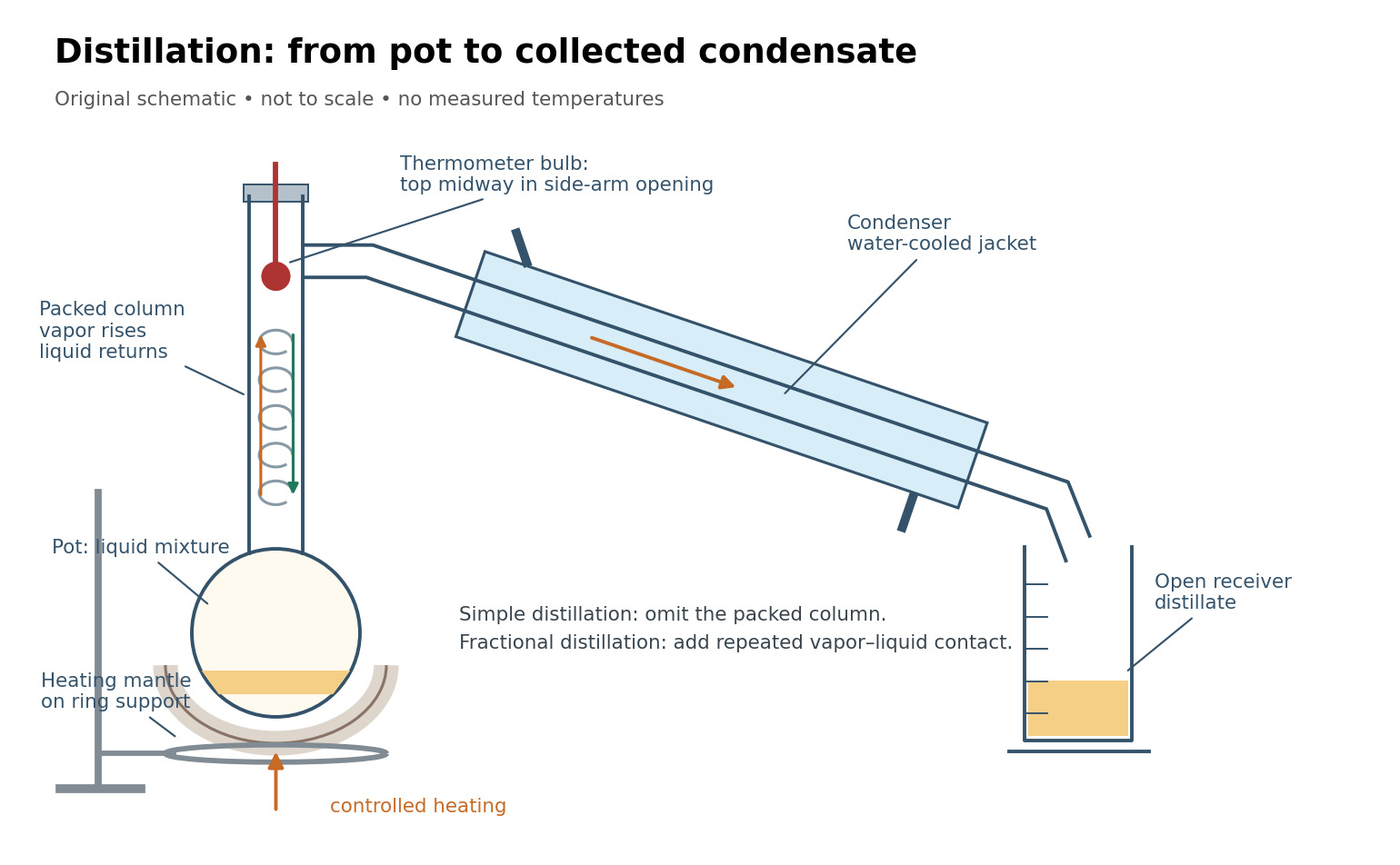
Distillation connects a heated pot, a fractionating column, a thermometer, a laboratory condenser, and a receiver
. Original schematic, not a scale drawing. Bulb position and mantle support follow the paired simple and fractional distillation experiment; blue marks the cooling jacket. Details.A substance that kills susceptible bacteria or inhibits their growth through a biological target such as cell wall synthesis or translation. The effect depends on organism and exposure; growth inhibition, killing and selection of resistant survivors are different experimental outcomes.
Anatomy studies the structure and spatial organization of organisms. It connects the shapes of organs, the arrangement of tissues and the geometry of individual biological cells to the functions studied in physiology. Dissection, imaging and histology reveal complementary scales of organization.
A useful anatomical explanation makes relations explicit: a nerve passes through a canal, a tendon crosses a joint, or a thin epithelium separates two exchanging fluids. These relations explain why the same region can contain structures with different functions and why damage at one location can affect several systems.[ref]
Anatomy and Physiology training modules by the National Cancer Institute. Introductory organization and body-system modules
Microinjection introduces material through a fine needle into a biological cell or one of its compartments.
Pinned article: Introduction to the OurBigBook Project
Welcome to the OurBigBook Project! Our goal is to create the perfect publishing platform for STEM subjects, and get university-level students to write the best free STEM tutorials ever.
Everyone is welcome to create an account and play with the site: ourbigbook.com/go/register. We belive that students themselves can write amazing tutorials, but teachers are welcome too. You can write about anything you want, it doesn't have to be STEM or even educational. Silly test content is very welcome and you won't be penalized in any way. Just keep it legal!
Intro to OurBigBook
. Source. We have two killer features:
- topics: topics group articles by different users with the same title, e.g. here is the topic for the "Fundamental Theorem of Calculus" ourbigbook.com/go/topic/fundamental-theorem-of-calculusArticles of different users are sorted by upvote within each article page. This feature is a bit like:
- a Wikipedia where each user can have their own version of each article
- a Q&A website like Stack Overflow, where multiple people can give their views on a given topic, and the best ones are sorted by upvote. Except you don't need to wait for someone to ask first, and any topic goes, no matter how narrow or broad
This feature makes it possible for readers to find better explanations of any topic created by other writers. And it allows writers to create an explanation in a place that readers might actually find it.
Figure 1. Screenshot of the "Derivative" topic page. View it live at: ourbigbook.com/go/topic/derivativeVideo 2. OurBigBook Web topics demo. Source. - local editing: you can store all your personal knowledge base content locally in a plaintext markup format that can be edited locally and published either:This way you can be sure that even if OurBigBook.com were to go down one day (which we have no plans to do as it is quite cheap to host!), your content will still be perfectly readable as a static site.
- to OurBigBook.com to get awesome multi-user features like topics and likes
- as HTML files to a static website, which you can host yourself for free on many external providers like GitHub Pages, and remain in full control

Figure 2. You can publish local OurBigBook lightweight markup files to either OurBigBook.com or as a static website.
Figure 3. Visual Studio Code extension installation.
Figure 5. . You can also edit articles on the Web editor without installing anything locally. Video 3. Edit locally and publish demo. Source. This shows editing OurBigBook Markup and publishing it using the Visual Studio Code extension. 
- Infinitely deep tables of contents:



All our software is open source and hosted at: github.com/ourbigbook/ourbigbook
Further documentation can be found at: docs.ourbigbook.com
Feel free to reach our to us for any help or suggestions: docs.ourbigbook.com/#contact