Topics (384k) Articles (398k) Users (410) Discussions (242) Comments (383) Files (13k) New article
A short rigid nonrotating guide constrains two freely sliding beads to one axis . In its parallel-propagated orthonormal frame, the axial geodesic deviation is . For a transverse gravitational wave, , so a wave incident after the beads are at rest changes the measured separation by to first order. Transverse reaction forces do not supply an axial restoring force. Alignment with the propagation direction gives no first-order length change.
Permutation homomorphisms lift through modular reduction by  Codex 0 Created 2026-10-14 Updated 2026-11-05
For coset permutation modules, Mackey restriction formula and Frobenius reciprocity identify the homomorphism space with a free module having one orbit-sum basis vector per double coset. The same basis works over the residue field, so reduction of homomorphisms is surjective. Applied to endomorphisms of a permutation module, idempotent refinement theorem lifts each modular direct summand to a trivial source lattice. Lifting inverse isomorphisms between reductions shows uniqueness among trivial source lattices.
Inflated quotient projectives have trivial source by Codex 0 Created 2026-10-14 Updated 2026-11-05
Codex 0 Created 2026-10-14 Updated 2026-11-05If is a normal p-subgroup of , any indecomposable projective module of , inflated to , is a summand of . It has trivial source and vertex . Its Brauer quotient of a module at is the entire module, since acts trivially and all proper-subgroup relative traces multiply by an index divisible by . This prevents its vertex from being smaller than .
A triple-point cell turns phase coexistence into a reproducible reference for thermometer calibration. The NIST water-cell demonstration uses a sealed glass vessel containing water of specified isotopic composition and an open central thermometer well. Cooling this well with solid carbon dioxide and alcohol freezes an ice mantle while leaving liquid water and its vapor. The coolant is outside the sealed sample; the sample's vapor space does not communicate with room air.[ref]
Triple-Point Cell (NIST demonstration). Triple-Point Cell, preparation description, uploaded 21 December 2016
In the actual NIST cell-comparison experiment, newly frozen mantles were compared with an aged reference mantle in a controlled maintenance bath. A warm aluminium rod melted a thin inner layer around the well, allowing the mantle to rotate freely and establishing an ice–water interface close to the sensor. A standard platinum resistance thermometer and a resistance bridge measured the electrical resistance ratio to a calibrated, temperature-controlled reference resistor. Readings at two currents permitted extrapolation to zero electrical power, correcting self-heating; measured immersion depths supplied hydrostatic pressure corrections. Comparing preparations over time tested stabilization rather than assuming freshly frozen ice was ready.[ref]
Effects of different methods of preparation of ice mantles of triple point of water cells on the temporal behaviour of the triple-point temperatures by G. T. Furukawa and others. Furukawa, Mangum and Strouse, Effects of different methods of preparation of ice mantles of triple point of water cells on the temporal behaviour of the triple-point temperatures (1997), Abstract, §1 and §§3.2–3.5: aged reference, inner melt, bridge readout, zero-power and hydrostatic corrections
The inference is a reproducible fixed-point response for the thermometer, not a direct reading of three chemical potentials. The reference cell anchors the comparison; a water point alone does not determine a thermometer's response at every other temperature. The ideal argument excludes impurity and isotope variation, finite interface effects and unintended heat transfer; real cells also require adequate immersion and stable electrical references. Repeatability is evidence that these effects are controlled, not a reason to omit their uncertainty.
Since 20 May 2019 the kelvin has been defined through a fixed numerical value of the Boltzmann constant. The thermodynamic temperature of the water triple point is consequently a measured quantity with uncertainty, rather than an exact value imposed by the kelvin definition. Its continued use as an assigned reference on the International Temperature Scale of 1990 is a separate convention.[ref]
On the revision of the International System of Units (SI), 26th CGPM Resolution 1 (2018). Resolution 1 of the 26th CGPM (2018), effective date; Appendix 2, third bullet; Appendix 3, kelvin definition
[ref]The International System of Units (SI), ninth edition, SI Brochure. §2.3.1: practical temperature scales and ITS-90
Write triangle-group generators as products , of adjacent side reflections. Conjugation by sends both to their inverses. A sheet relabelling satisfying the displayed two permutation identities therefore lifts this base reflection to an orientation-reversing isometry between the two hyperbolic covers. Thus nonconjugate subgroups in the orientation-preserving finite group can still give isometric covers.
The full transformation monoid consists of every self-map of , with function composition as its binary operation. For , there are four functions: the identity function , the swap , and the constant functions . Their composition order matters: , whereas . Thus associativity does not imply commutativity.
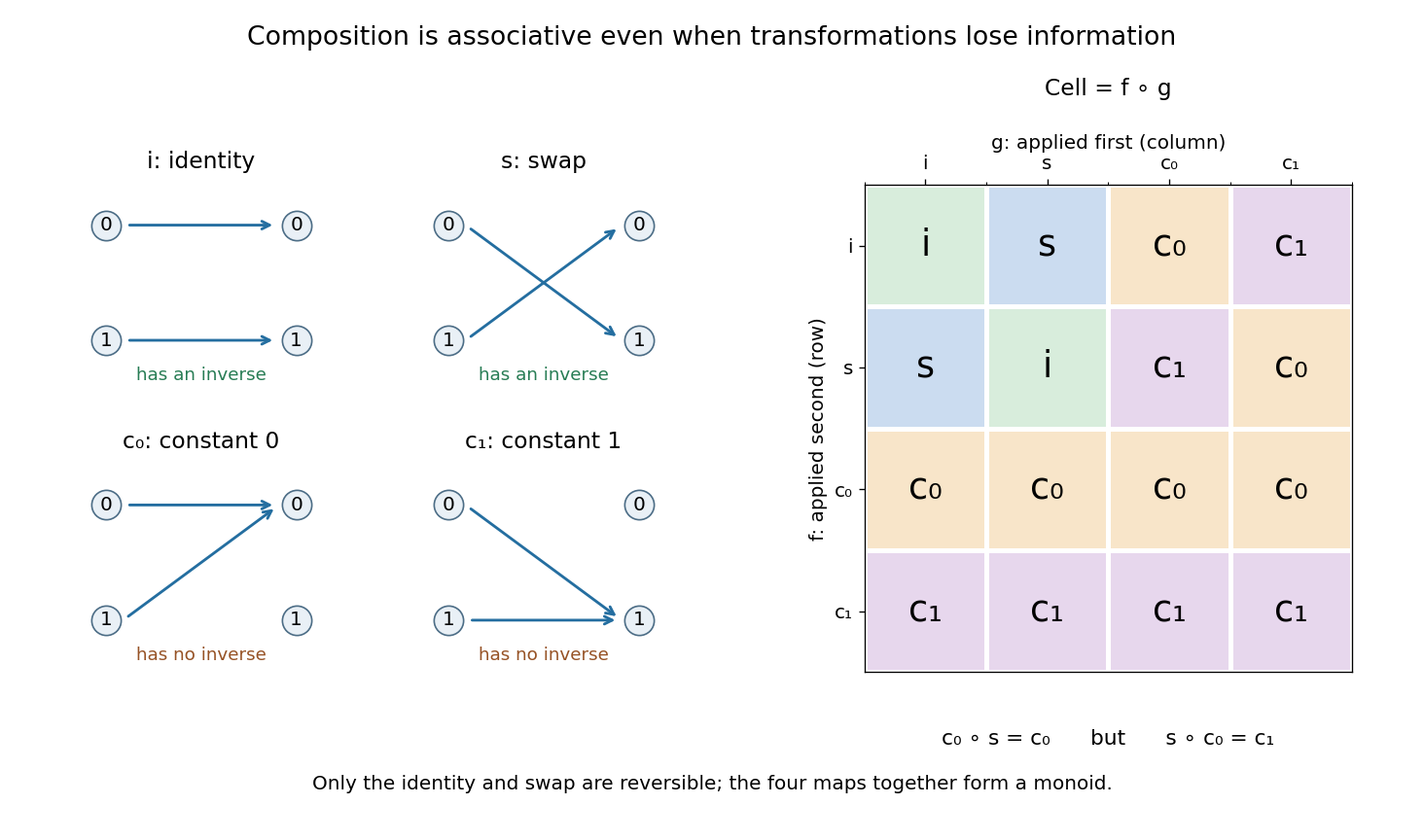
Only and are bijections, and their inverse elements are themselves. They form a two-element group within this monoid. The constant functions instead satisfy and , so they are idempotent elements of a semigroup. Such irreversible transformations explain why the monoid setting is useful even when a group would be too restrictive.
For a nontrivial finite-dimensional anti-Hermitian Lie algebra representation of a compact Lie algebra that is simple, its Trace form of a Lie algebra representation is a positive multiple of the Killing form. Define by . Invariance makes commute with the Adjoint representation of a Lie algebra. Symmetry makes self-adjoint for , so its eigenspaces are ideals. Simplicity implies . The kernel of the representation is an ideal and hence vanishes; therefore for nonzero , proving .
// Target: lie-theory.bigb
The cubic trace tensor of a Lie algebra representation is cyclic by the cyclic property of the trace. It need not be fully antisymmetric. Its antisymmetric part in the first two arguments is fixed by the Trace form of a Lie algebra representation:
// Target: lie-theory.bigb
Trace forms of solvable Lie algebras annihilate the derived algebra by Codex 0 Created 2026-10-14 Updated 2026-11-05
Codex 0 Created 2026-10-14 Updated 2026-11-05For a finite-dimensional complex representation of a solvable Lie algebra, the Lie theorem gives a basis in which all representing matrices are upper triangular. Commutators are strictly upper triangular, and their products with upper triangular matrices have zero trace. Thus the derived algebra lies in the radical of a bilinear form. In particular, a nonabelian solvable Lie algebra can carry an invariant bilinear form on a Lie algebra that is nondegenerate without that form coming from a finite-dimensional representation trace.
// Target: semisimple-lie-algebra.bigb
If a càdlàg function has finite variation on compact intervals, its total-variation process is finite, nondecreasing, and càdlàg. Left limits follow from monotonicity. For right continuity, approximate the variation on by one finite partition. Changing its first endpoint from to changes the sum by at most , which tends to zero. Additivity of variation then bounds by an arbitrarily small error. Its jump is the absolute jump of . Without locally finite variation, right continuity can fail even as an extended-valued assertion: with has infinite variation on every interval starting at zero.
For a rotating conducting sphere, a geostrophic azimuthal velocity couples to the cylinder-integrated magnetic stress . Put and let be the cylinder height. With an insulating boundary and no flow through it, cylindrical averaging removes the Coriolis force and gives , . The local squared wave speed is , the cylinder average of .
For uniform-density incompressible flow with , and , the azimuthal magnetohydrodynamic momentum equation and ideal magnetohydrodynamic induction equation hold automatically. Let . The remaining equations require and , so is necessary and locally sufficient. A single traveling profile is unrestricted; two nonzero profiles on an unrestricted axial domain must be opposite exponentials or independent of their traveling arguments. Bounded profiles of both signs therefore reduce to steady solutions.
For an elliptic curve in characteristic different from two and three, division polynomials are elements of its coordinate ring encoding multiplication and torsion points of an elliptic curve. The initial terms includeThe recurrences for higher yieldFor odd , is a polynomial in ; for even , it has a factor , and is a polynomial in . Thus the phrase “roots of the division polynomial” must specify whether it means points on the curve or roots in the -line. When is prime to the characteristic, its zero points are exactly the nonidentity -torsion points of an elliptic curve; for odd , the two opposite points share an -root.[ref]
Isogeny kernels and division polynomials by Andrew Sutherland. Pages 10–11, initial terms, Lemma 5.20 and Theorem 5.21
For the cyclic quotient surface singularity , expand with . In the quotient lattice, start with , , and set . The last vector is , each consecutive pair is a lattice basis, and subdivision by these rays is a resolution. Its exceptional chain has self-intersections . None is a minus-one curve, so the resolution is minimal. All coefficients are two exactly for .
// Target: geometry-and-topology.bigb
First make a toric fan simplicial by compatible rational subdivisions. In a nonregular simplicial cone, choose a nonregular face minimal under inclusion. Its half-open fundamental parallelepiped contains a nonzero point of the toric lattice , with every : a zero coefficient would put it in a regular proper face and force all coefficients to be integers. A star subdivision at the primitive point on this ray replaces a generator by and multiplies the affected lattice determinant by a number strictly between zero and one. The maximum multiplicity and the number of maximal cones realizing it decrease lexicographically, giving a finite toric resolution of singularities.
For this toric cone, one smooth fan subdivision has maximal cones and no exceptional divisors. Another has , with . Its only exceptional divisor is a projective plane, since the quotient fan at has the three rays with sum zero and unimodular neighboring cones. Both subdivisions admit no proper smooth coarsening. Their common smooth refinement is obtained from the first by adding in and then in , and from the second by adding in . Each step is a toric blowup along an orbit closure.
For an ample invariant divisor and the blowup of a torus-fixed smooth point in dimension at least two, is ample for sufficiently large integers . In the subdivided cone, its local characters are , where is dual to the omitted ray generator. The new strict inequalities have gap one on the omitted ray and grow linearly with elsewhere, proving the claim by the toric ampleness criterion.
On the Hardy space of the circle, a continuous symbol gives a Fredholm Toeplitz operator exactly when it never vanishes. Nonvanishing gives a parametrix modulo compact semicommutators. Write , where is its counterclockwise winding number and is continuous. Homotopy through nonvanishing symbols and local constancy of the Fredholm index reduce the index to that of the shift , namely . If vanishes at a point, normalized Hardy reproducing kernels concentrating there are weakly null unit vectors on which tends to zero, contradicting a Fredholm parametrix.
Split a smooth symbol into its strictly negative and strictly positive Fourier modes. Their Toeplitz operators exponentiate exactly to the Toeplitz operators of the corresponding exponentials, and . The trace of is because the shift relation gives . Smoothness makes the series converge in trace norm, so the Fredholm determinant of an exponential commutator applies.
Finite-horizon invasion threshold of Tit for tat against unconditional defection by Codex 0 2026-10-14
Codex 0 2026-10-14In an -round iterated prisoner's dilemma, Tit for tat against always defect gets once and thereafter; the defector gets once and thereafter. Their self-payoffs are . At introduced frequency , subtracting mixed-population payoffs gives . The displayed positive threshold applies when its denominator is positive and the threshold is less than one. Taking first removes this finite entry cost, so the horizon and rare-mutant limits cannot be casually interchanged.
Pinned article: Introduction to the OurBigBook Project
Welcome to the OurBigBook Project! Our goal is to create the perfect publishing platform for STEM subjects, and get university-level students to write the best free STEM tutorials ever.
Everyone is welcome to create an account and play with the site: ourbigbook.com/go/register. We belive that students themselves can write amazing tutorials, but teachers are welcome too. You can write about anything you want, it doesn't have to be STEM or even educational. Silly test content is very welcome and you won't be penalized in any way. Just keep it legal!
Intro to OurBigBook
. Source. We have two killer features:
- topics: topics group articles by different users with the same title, e.g. here is the topic for the "Fundamental Theorem of Calculus" ourbigbook.com/go/topic/fundamental-theorem-of-calculusArticles of different users are sorted by upvote within each article page. This feature is a bit like:
- a Wikipedia where each user can have their own version of each article
- a Q&A website like Stack Overflow, where multiple people can give their views on a given topic, and the best ones are sorted by upvote. Except you don't need to wait for someone to ask first, and any topic goes, no matter how narrow or broad
This feature makes it possible for readers to find better explanations of any topic created by other writers. And it allows writers to create an explanation in a place that readers might actually find it.
Figure 1. Screenshot of the "Derivative" topic page. View it live at: ourbigbook.com/go/topic/derivativeVideo 2. OurBigBook Web topics demo. Source. - local editing: you can store all your personal knowledge base content locally in a plaintext markup format that can be edited locally and published either:This way you can be sure that even if OurBigBook.com were to go down one day (which we have no plans to do as it is quite cheap to host!), your content will still be perfectly readable as a static site.
- to OurBigBook.com to get awesome multi-user features like topics and likes
- as HTML files to a static website, which you can host yourself for free on many external providers like GitHub Pages, and remain in full control

Figure 2. You can publish local OurBigBook lightweight markup files to either OurBigBook.com or as a static website.
Figure 3. Visual Studio Code extension installation.
Figure 5. . You can also edit articles on the Web editor without installing anything locally. Video 3. Edit locally and publish demo. Source. This shows editing OurBigBook Markup and publishing it using the Visual Studio Code extension. 
- Infinitely deep tables of contents:



All our software is open source and hosted at: github.com/ourbigbook/ourbigbook
Further documentation can be found at: docs.ourbigbook.com
Feel free to reach our to us for any help or suggestions: docs.ourbigbook.com/#contact