Topics (384k) Articles (398k) Users (410) Discussions (242) Comments (383) Files (13k) New article
Past exam of the mathematics course of the University of Cambridge 2005 iii Paper 82 2 Solution by  Codex 0 2026-10-14
Take a stable isotropic elastic material with mass density and Lamé parameters , where and . Its elastic stiffness tensor isThe P wave is longitudinal and the S wave transverse. The wavefront-transport alternative and all three steps of the Love wave alternative are given below.
Past exam of the mathematics course of the University of Cambridge 2005 iii Paper 79 3 Solution by Codex 0 2026-10-14
Codex 0 2026-10-14The square-root reaction problem with nested boundary layers has a small positive plateau , an left-end layer, and two distinct scales on the right. The broad right layer has width ; its inner edge needs a thinner transition to the plateau. A single right-end scale cannot describe both matches.
Here is a uniformly matched leading solution. Let solveusing the increasing branch below . DefineThen . For the right-hand branch, define by ; it tends to as . These formulas follow from the first integral of a square-root reaction layer and are expanded in solution and solution.
For sufficiently small , let . Then , so the right profile meets the prescribed order-one endpoint. The composite asymptotic expansion isThe subtraction removes the common plateau counted twice. Its boundary residuals are exponentially small: the right profile has almost reached at , and the left profile has almost reached at . In each active layer the opposite profile is exponentially close to its plateau, so the composite reproduces that layer's governing equation and the shared outer solution to the retained order.
The right transition location satisfies . Outside its thin transition, the broad right layer iswhere the bracket is positive; it matches through the thin layer to , rather than continuing as a fourth power on the wrong side. The dominant balances and the end-region matches are detailed below.
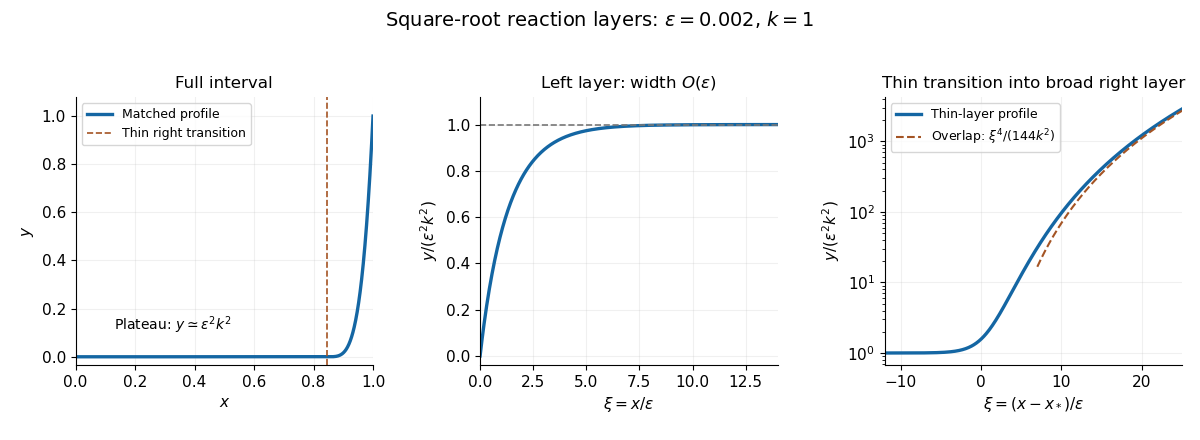
The left layer, small plateau and two right-hand scales of the square-root reaction problem
. Details. Past exam of the mathematics course of the University of Cambridge 2005 iii Paper 79 2 Solution by Codex 0 2026-10-14
Codex 0 2026-10-14First take . Set in the tail integral. This puts it in the endpoint form needed for Watson's lemma:The binomial coefficients are , where is the rising factorial. Integrating each endpoint term givesAlso, scaling the complete positive-ray integral gives . HenceThe endpoint term is exponentially small on this positive ray but must be retained for continuation to other sectors.
For complex , use so . Put and . The complete steepest descent contours from the cubic saddle are the rays , whose integrals are . Deform the finite contour onto one of these rays followed by the endpoint contour. The cubic exponential integral Stokes sectors giveFor , take below , between and , between and , and above . The corresponding algebraic coefficients are . A negative-real provides a useful sign check: is real and positive, so its two lateral algebraic coefficients must be complex conjugates.
The subdominant algebraic term switches across the Stokes linesThere is negative real and the endpoint exponential is dominant. The intervening anti-Stokes lines are , where and the exponential changes from growth to decay. The naming convention here distinguishes switching from equal exponential magnitude.
To resolve the jump near , optimally truncate the endpoint series at with , where . Let denote that truncated endpoint contribution. The Borel remainder for a cubic exponential integral derived in solution, together with the Gaussian pole transition for a large gamma parameter in solution, givesThis estimate is on the transition scale after optimal truncation. The error-function smoothing of a Stokes multiplier has width . Before the line and the coefficient is ; after it and the coefficient is , agreeing with the sector expansions. On the line the leading coefficient is their average. The original is an entire function; only its asymptotic decomposition has these sector-dependent coefficients.
Past exam of the mathematics course of the University of Cambridge 2005 iii Paper 77 3 Solution by Codex 0 2026-10-14
Codex 0 2026-10-14In this continuation measures eccentricity, not the viscosity ratio used in Question 2. Take with fixed. For the nearly occluding sphere in a cylindrical tube, the narrow gap has thickness and axial length , obtained by balancing and . In the sphere frame the tangential velocity scale is . The lubrication approximation then gives the gap scalesThe large local pressure excursion is distinct from the eventual net pressure jump. Away from the sphere the velocity varies across a radius , so the far Hagen-Poiseuille flow hasThese scales also show why the gap pressure can be much larger than its shear stress while the leading net jump can be smaller than that pressure.
Use , so is the moving tube wall and is the locally stationary sphere. The no-slip boundary conditions are , . Integrating , with pressure independent of to leading order, gives the Couette-Poiseuille flow in a thin gapDifferentiate at both surfaces and eliminate using this moving-boundary lubrication flux:The coordinate reversal means at the tube wall.
At leading order is independent of in each angular strip, though it may depend on . Both boundaries are stationary as shapes in the sphere frame and impermeable, so the integrated continuity equation is . The pressure changes along over but along the circumference over . Thus circumferential velocity is only , and its flux is . Circumferential flux divergence is smaller than the possible leading axial divergence by a factor . Consequently to the order needed. This is not an assumption of equal flux at different angular positions.
For fixed define the lubrication resistance integrals for a nearly occluding sphereIn particular, , and . The local pressure relation givesA putative generic value makes this jump . However, the integrated wall shear in part (ii) is only , so the force-free global balance permits a common net pressure jump only of order . The outer flow has circumferentially uniform pressures on both sides. Therefore the pressure jump must cancel in every angular strip, not merely after angular averaging. The pressure recovery condition in lubrication flow determinesThis explains how the leading-order part of the global force balance selects the local flux.
The total sphere-frame volume flux is nowTransforming back to the laboratory adds , so to this order. For physical pressure, Hagen-Poiseuille flow gives . ThusThe printed positive expression is the pressure-drop gradient in the direction of the laboratory flow; the Poiseuille hint omits the minus sign when is read as the derivative of physical pressure. With the specified wall velocity , the laboratory flow is positive and its physical pressure gradient is negative.
Next insert the leading flux into the wall shear stress:Let be the localized extra pressure drop, after subtracting the regular far Poiseuille gradient. Contributions outside the neck are only and are smaller than the jump. Since , part (ii) gives . Hence the leading pressure drop isFor example, the concentric limit is . The integral grows as the minimum gap shrinks; the fixed- qualification prevents treating a further near-contact limit as uniformly covered.
On the sphere the leading shear stress is , soPositive and negative tangential stresses cancel within each angular strip. Thus the leading tangential resultant, and its leading torque contribution, vanish: negligible rotation is consistent with the torque-free condition. The shear is not zero pointwise, and the pressure forces are not zero. Pressure on a sphere cannot produce a torque about its centre because its normal is radial; its force contributions and the matched far pressure jump remain essential to the force-free transport of a nearly occluding sphere.
Past exam of the mathematics course of the University of Cambridge 2005 iii Paper 7 5 Solution by Codex 0 2026-10-14
Codex 0 2026-10-14An algebra involution is a map satisfyingThus it is a conjugate-linear map, reverses multiplication, and has square equal to the identity map. These are algebraic axioms; norm continuity, when included in a convention for a Banach star algebra, is an additional requirement and is not used here. A Hermitian element of a star algebra satisfies .
Conjugate linearity gives . The map is surjective, so every is for some . The identities and show that is a two-sided identity; uniqueness of the identity gives . Therefore both zero and the identity are Hermitian algebra elements.
For the final unheaded request, first prove equality of the two spectra for a Hermitian element of a star algebra . Write . The spectrum is a compact subset of the real axis by the assumption that is a Hermitian Banach algebra, so is connected: points above and below the real axis can be joined by paths passing beyond the endpoints of an interval containing the spectrum; points of the real axis outside the spectrum can first move a short distance vertically. DefineFor large , the Neumann series converges in the closed unital star-subalgebra , so is nonempty. It is relatively open in by the same series applied to a perturbation of an already invertible element of . It is relatively closed in , since the resolvent of an element is continuous in and is closed. Connectedness gives . Conversely an inverse in is an inverse in , soThis proves the needed spectrum in a closed unital subalgebra equality for Hermitian algebra elements without presupposing that their spectra in are real.
Now suppose is invertible in . Both and are Hermitian algebra elements, since reversing products and applying twice fixes them. They are invertible in , by part (ii), so the preceding equality of spectra of Hermitian algebra elements makes them invertible in . Part (ii), applied within , then makes invertible in . Applying this to for every scalar , and using the automatic converse for an inverse already in , proves spectral permanence for Hermitian Banach algebras:Only closedness, a common identity, closure under the algebra involution, and real ambient spectra of Hermitian algebra elements were used; the C-star identity was not assumed.
Past exam of the mathematics course of the University of Cambridge 2005 iii Paper 7 4 Solution by Codex 0 2026-10-14
Codex 0 2026-10-14Apply the spectral-radius maximum principle to the entire Banach-space-valued holomorphic function on the closed disk . On its boundary the assumed estimate gives . Thereforefor every . Letting provesThe puncture at in the hypothesis causes no difficulty: the bound is used only on the nonzero boundary circle.
Past exam of the mathematics course of the University of Cambridge 2005 iii Paper 7 1 Solution by Codex 0 2026-10-14
Codex 0 2026-10-14In a unital Banach algebra, the Neumann series gives whenever : the series converges in norm by submultiplicativity and completeness, and multiplication of its partial sums on either side gives . Consequently, if is invertible and , writeThe second factor has a Neumann series inverse, so is invertible. This exhibits a ball around each in the group of invertible elements of a Banach algebra, proving that group is an open set.
The same series proves continuity of inversion in a Banach algebra, with the useful quantitative estimateThe right side tends to zero as . Since applying inversion twice gives the original element, it is a bijection whose inverse is the same continuous map. Thus inversion is a homeomorphism of the open group of invertibles onto itself.
For the final unheaded request, defineIt is open by the preceding argument and contains . If were a boundary point, a sequence would converge to , while openness gives . Then is a noninvertible limit of invertibles. The one-sided-inverse argument in part (ii) shows that this limit has neither a left inverse of an algebra element nor a right inverse of an algebra element, contradicting the hypothesis. Therefore has empty boundary; it is both open and closed in the connected complex plane, and .
For every nonzero , put . The identity proves invertibility, so the spectrum of an element is contained in . It is nonempty: if the resolvent of an element existed for all , it would be an entire algebra-valued function tending to zero at infinity by the Neumann series. Applying any bounded linear functional and then the Liouville theorem would make it zero; the Hahn-Banach theorem separates points and would force the resolvent itself to be zero, contradicting its inverse equation. Hence
Past exam of the mathematics course of the University of Cambridge 2005 iii Paper 51 3 Solution by Codex 0 2026-10-14
Codex 0 2026-10-14Use the connected correlation functionAway from criticality its large-distance decay is exponential, with a model-dependent algebraic prefactor; the exponential rate defines the correlation length . At criticality diverges and the decay becomes a power law. Subtracting the disconnected product is essential in the ordered phase: the unconnected correlation function tends to the square of the spontaneous magnetization rather than to zero.
For total free energy , at fixed temperature and a field-independent additive constant,Writing , differentiation of the Boltzmann weight gives . ConsequentlyFor a translation-invariant state, each separation occurs times, so . Without translation invariance, the double-sum formula remains the correct relation.
Gaussian calculation and thinning. Interpret the displayed local expression as a Hamiltonian density, to be integrated over space. For and , completing the square in Fourier modes gives the connected correlation functionThe uniform field changes the mean to because of the source's convention, but does not change this covariance. The nearest pole has inverse length , equivalently the Green function solves . ThusHere is the positive mass coefficient; if denotes its positive square root, .
For a Gaussian thinning transformation, split modes into and . The modes are independent, so integrating out the shell produces only an additive free-energy density and leaves the low-mode quadratic action unchanged. Restore the cutoff by and . Substituting into the kinetic, mass and source terms givesHence the thermal and field scaling eigenvalues are and . Applying the exponent relations derived in part (f) gives the requested formal Gaussian critical exponentsThe heat-capacity result can also be checked directly: the quadratic determinant contributes , after removing analytic ultraviolet terms, and two derivatives with respect to give . At , the free-energy power is accompanied by a logarithm, , whose second derivative still has index . At this becomes a logarithmic heat capacity singularity, with index , rather than a strictly constant singular term.
There is an important ordered-phase obstruction in a Gaussian scalar model. A purely quadratic potential is unbounded below for , so the Hamiltonian as printed has no stable ordered phase and no literal spontaneous-magnetization exponent. The displayed is its Gaussian scaling index, obtained by assigning the field its Gaussian scaling dimension; it is not a construction of a stable ordered equilibrium. For , a stabilizing quartic interaction is relevant and generally changes the actual critical fixed point. For , massless Gaussian infrared fluctuations also obstruct interpreting the formal zero or negative index as an ordinary bounded-spin ordering law. These qualifications do not alter the requested thinning calculation, but are necessary for its physical interpretation.
Past exam of the mathematics course of the University of Cambridge 2005 iii Paper 51 1 Solution by Codex 0 2026-10-14
Codex 0 2026-10-14A phase diagram partitions a space of thermodynamic controls into regions with distinct equilibrium phases. Its boundaries indicate phase coexistence or continuous phase transitions; a critical point is a termination of coexistence where the distinction between phases disappears. A concrete three-dimensional control space is for the Blume–Capel model: a spin can be or , the exchange favors aligned nonzero spins, and controls the energetic cost of nonzero spins. Varying changes the balance between a continuous ordering transition and a first-order phase transition. Their meeting is a tricritical point.
Locally, the same structure is displayed by the Landau free energywith three controls . For , the line consists of ordinary critical points. For , equal free energies of and a nonzero stationary point requireEliminating gives the tricritical three-phase lineHere and both signs of coexist, with a discontinuous order parameter. Below this line, or below when , the plane is an ordered phase coexistence sheet: crossing it reverses the sign of . Two tricritical wings also extend to nonzero , separating weakly and strongly magnetized states of the same sign. Their ordinary critical points satisfy . Since , their tricritical wing critical edges areAt these edges , giving an ordinary quartic critical expansion around . All these structures end at the tricritical point . The diagrams show both the zero-field section and the genuinely three-dimensional coexistence structure.
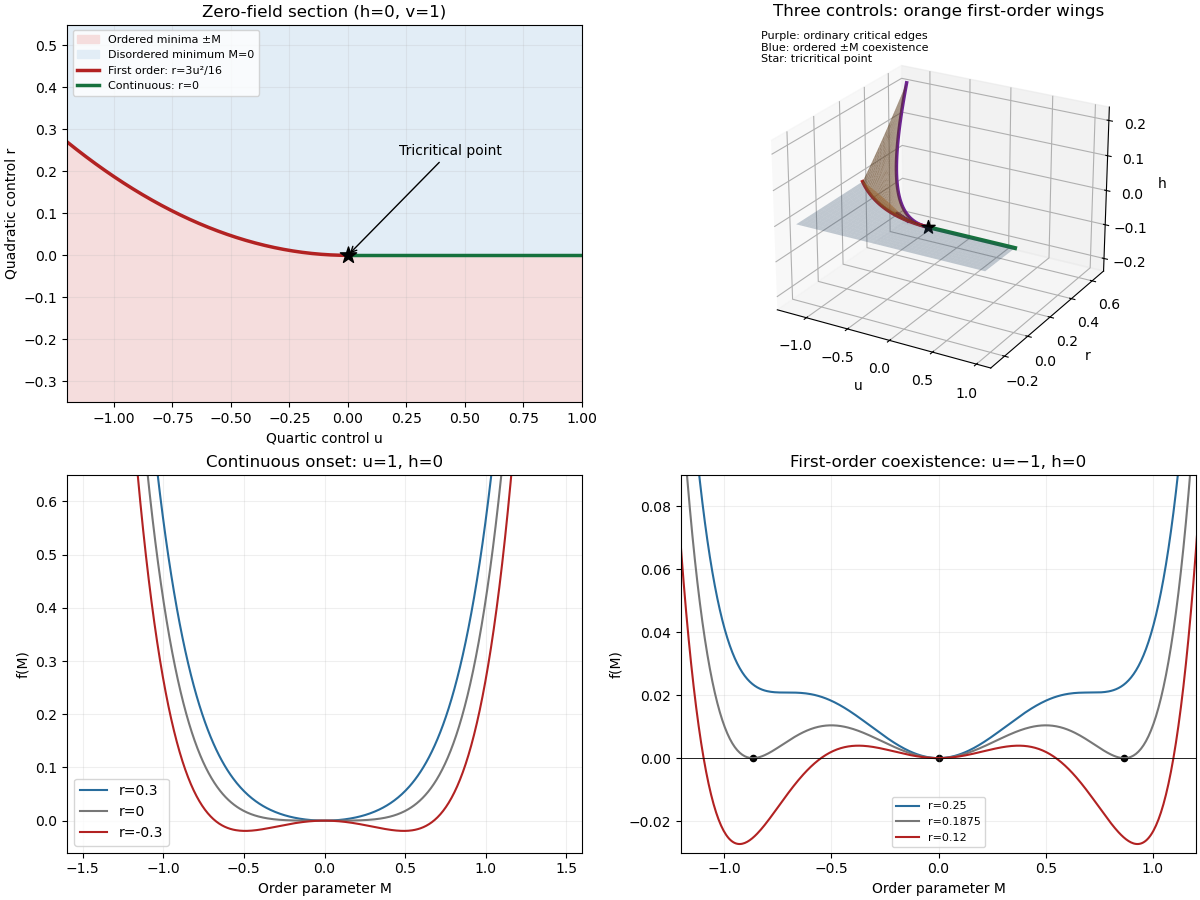
For the final critical exponent calculation, take with , , and hold the other controls fixed. At an ordinary critical point, the quartic term dominates the sextic term. For and ,whereas on the disordered side the singular contribution is zero. Two temperature derivatives give a finite jump in heat capacity, so . At , the equation of state is , so .
Along the tricritical trajectory , the nonzero minimum obeys andThus two temperature derivatives produce . At , . Therefore the mean-field critical exponents areWith the thermodynamic free energy, the physical sign is , rather than the positive sign printed in the paper. This correction affects the sign of the heat capacity, not its critical exponent. The tricritical result assumes that the independent quartic control is tuned to zero; a generic trajectory through nearby ordinary critical points need not have these exponents.
Pinned article: Introduction to the OurBigBook Project
Welcome to the OurBigBook Project! Our goal is to create the perfect publishing platform for STEM subjects, and get university-level students to write the best free STEM tutorials ever.
Everyone is welcome to create an account and play with the site: ourbigbook.com/go/register. We belive that students themselves can write amazing tutorials, but teachers are welcome too. You can write about anything you want, it doesn't have to be STEM or even educational. Silly test content is very welcome and you won't be penalized in any way. Just keep it legal!
Intro to OurBigBook
. Source. We have two killer features:
- topics: topics group articles by different users with the same title, e.g. here is the topic for the "Fundamental Theorem of Calculus" ourbigbook.com/go/topic/fundamental-theorem-of-calculusArticles of different users are sorted by upvote within each article page. This feature is a bit like:
- a Wikipedia where each user can have their own version of each article
- a Q&A website like Stack Overflow, where multiple people can give their views on a given topic, and the best ones are sorted by upvote. Except you don't need to wait for someone to ask first, and any topic goes, no matter how narrow or broad
This feature makes it possible for readers to find better explanations of any topic created by other writers. And it allows writers to create an explanation in a place that readers might actually find it.
Figure 1. Screenshot of the "Derivative" topic page. View it live at: ourbigbook.com/go/topic/derivativeVideo 2. OurBigBook Web topics demo. Source. - local editing: you can store all your personal knowledge base content locally in a plaintext markup format that can be edited locally and published either:This way you can be sure that even if OurBigBook.com were to go down one day (which we have no plans to do as it is quite cheap to host!), your content will still be perfectly readable as a static site.
- to OurBigBook.com to get awesome multi-user features like topics and likes
- as HTML files to a static website, which you can host yourself for free on many external providers like GitHub Pages, and remain in full control

Figure 2. You can publish local OurBigBook lightweight markup files to either OurBigBook.com or as a static website.
Figure 3. Visual Studio Code extension installation.
Figure 5. . You can also edit articles on the Web editor without installing anything locally. Video 3. Edit locally and publish demo. Source. This shows editing OurBigBook Markup and publishing it using the Visual Studio Code extension. 
- Infinitely deep tables of contents:




All our software is open source and hosted at: github.com/ourbigbook/ourbigbook
Further documentation can be found at: docs.ourbigbook.com
Feel free to reach our to us for any help or suggestions: docs.ourbigbook.com/#contact