Topics (384k) Articles (398k) Users (410) Discussions (242) Comments (383) Files (13k) New article

Let , and . The synchronous-to-Newtonian transformation with positive spatial perturbations gives . Since , the displayed identity follows by integration. The emission endpoint combines intrinsic and velocity shifts into the ordinary Sachs-Wolfe effect; the local observer endpoint is a monopole plus a dipole. Without anisotropic stress the remaining integral is the Integrated Sachs-Wolfe effect, . The angular term in the synchronous contraction is positive for this metric convention.
Facing a companion and facing the source of light are different relations. The Moon keeps its near side of the Moon approximately toward Earth, while the direction to the distant Sun is nearly fixed during the idealized orbit shown below. A fixed surface patch therefore turns toward, across and away from sunlight. The far side of the Moon has day and night too; its name does not mean permanent darkness. [ref]
https://science.nasa.gov/moon/facts/. NASA: changing lunar illumination
.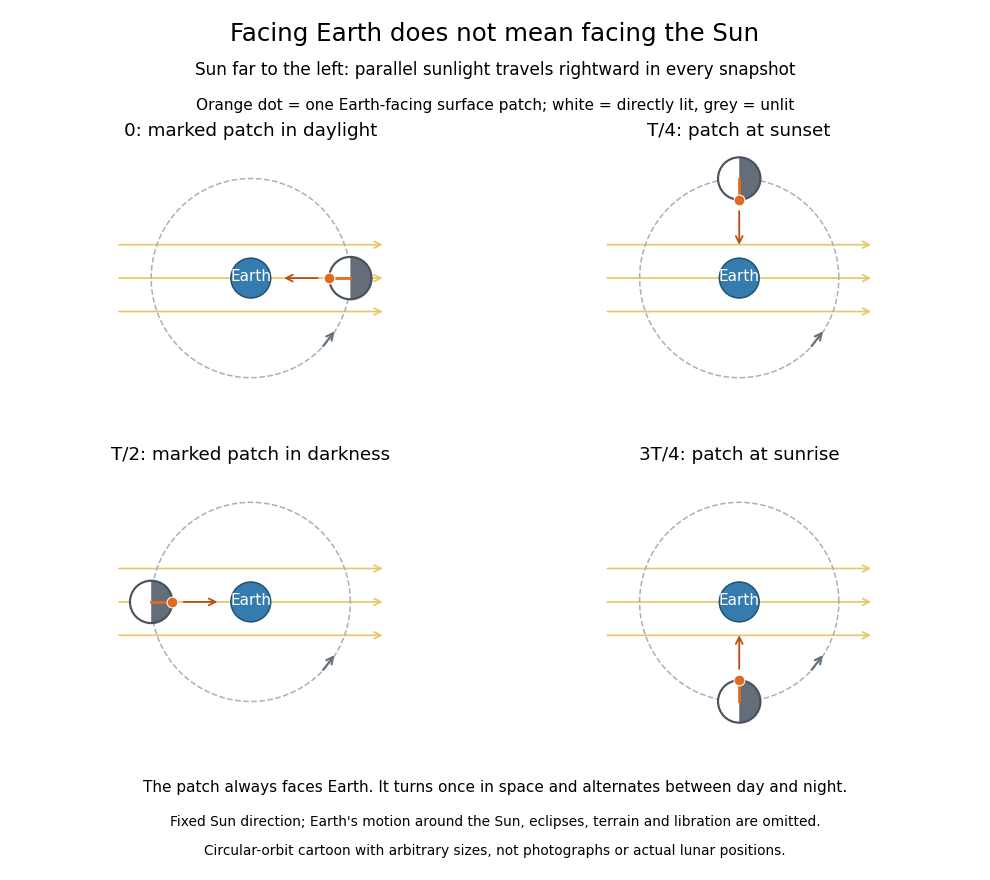
If the Sun direction has fixed angle and the marked surface patch has outward normal vector at angle , its direct illumination is proportional to . With synchronous rotation, , so the patch goes through day and night even though it always faces Earth. In reality the Earth-Moon system advances around the Sun: the lunar spin and orbital cycle relative to distant stars is about Earth days, while the lunar phase cycle has a synodic period of about Earth days. These numbers describe the actual system, not the fixed-sunlight cartoon. [ref]
https://starchild.gsfc.nasa.gov/docs/StarChild/questions/question32.html. NASA StarChild: sidereal and synodic lunar periods
.For a synchronously rotating exoplanet whose orbital companion is itself the illuminating star, the direction to the star turns with the orbit. On an ideal circular orbit, with perpendicular spin axis and no additional oscillations, this direction is fixed relative to the surface, giving persistent day and night hemispheres. Day-night heat redistribution then helps determine the nightside temperature; permanent lack of direct starlight does not imply zero temperature. Orbital eccentricity and departures from this ideal spin geometry modify that simple picture.
View a circular orbit along its perpendicular spin axis. Let be the orbital angle measured from a fixed direction, choosing an arbitrary zero for the circular limit of true anomaly, and let be the direction of an outward arrow painted on the body, measured from the same fixed direction. The direction from the body to its companion is . Thus an inward-facing arrow satisfiesMore generally synchronous rotation keeps constant; its particular value selects which surface direction faces the companion. Over one orbital period , both and the unwrapped increase by . This is the short geometric explanation for one turn per orbit. For a nonspinning body, instead, and the companion direction sweeps through all surface longitudes. On an eccentric orbit, mean spin does not force to stay exactly constant: true anomaly advances nonuniformly, producing the longitudinal component of libration.
This group consists of time-one maps of Hamiltonian isotopies whose flows are defined throughout the specified time interval. With , composition of isotopies generated by has generator , where is the first isotopy. The inverse path has generator . These formulas prove closure under composition and inversion. On a closed symplectic manifold, every smooth time-dependent Hamiltonian has a complete flow over a bounded time interval.
A subspace of a symplectic vector space is symplectic if the restricted symplectic form is nondegenerate. It has a symplectic orthogonal complement and the ambient space is the direct sum of those two subspaces.
A linear map is symplectic when it pulls back the target symplectic form to the source form. Nondegenerate bilinear form makes such a map injective. In equal finite dimensions it is an isomorphism. The automorphisms form the symplectic group and preserve the symplectic orientation on the ambient space and on every symplectic subspace.
A rank- vector subbundle of a rank- symplectic vector bundle is Lagrangian when each fibre is a Lagrangian subspace. If it exists, a compatible almost complex structure supplies a complementary Lagrangian subbundle by applying . Existence is a global condition: the area-oriented tangent bundle of the two-sphere has no real line subbundle, by triviality of real line bundles over the sphere and the Hairy ball theorem.
For and , the oscillator flow is a free circle action on the sphere of radius . Its quotient is Complex projective space. For two modes, the reduced form in is , of total area . Reduction at zero energy is singular instead of a smooth quotient of the asserted dimension.
For a planar cotangent bundle, rotation has moment map . At its level is regular and the circle action is free. Polar canonical coordinates give . Fixing and quotienting leaves with the displayed form. The unit-mass free Hamiltonian becomes .
At a regular free circle group level of a moment map, the inverse image of a Lagrangian submanifold of the reduced space is a Lagrangian submanifold of the original space. Its restricted symplectic form is the pullback of the reduced form and hence vanishes. Its dimension is one more than that of the reduced Lagrangian, exactly half the ambient dimension. It is a circle bundle over the original Lagrangian.
For a line , complete to a symplectic basis with complementary symplectic space . The unipotent radical has elements sending to , to and to . Its multiplication is , giving order . Its commutator is central with parameter . It is Heisenberg-type in odd characteristic and abelian in characteristic two. The full stabilizer also scales inversely and acts symplectically on .
With a Lagrangian subspace first in a paired symplectic basis, its stabilizer consists of with symmetric. The additive symmetric-matrix unipotent radical has order ; the Levi subgroup is , acting by . Its index in is , the number of Lagrangian subspaces.
This map preserves the alternating form and has inverse . Transvections along a fixed line form an abelian normal subgroup of its stabilizer. They generate the symplectic group by aligning successive symplectic basis pairs.
For , embedded perfect groups contain every symplectic transvection. For , four coefficient-one transvections on the lines of an isotropic plane multiply to the identity; their abelianized class is annihilated by 3 and 4. For , seven transvections on an isotropic three-space multiply to the identity; their class is annihilated by 2 and 7. Thus all nonexceptional cases are perfect.
Let be even and let be the vector subspace of even-weight vectors. Its dot product is an alternating bilinear form, since on . The orthogonal complement of in is spanned by the all-one vector , which lies in . Consequently the radical of a bilinear form on is , andis a nondegenerate symplectic vector space of dimension . The symmetric group acts by coordinate permutations, preserving this alternating bilinear form.
At , this group action is faithful. A weight-two vector and its complement have weights two and four, so a permutation fixing its quotient class must fix that two-element subset itself. Fixing every two-element subset forces the identity. The resulting embedding is an isomorphism, because the symplectic group over a finite field order formula gives .
The standard symplectic cylinder restricts one conjugate coordinate pair to a disk and leaves the remaining symplectic coordinates unrestricted. Its normalized symplectic capacity is , despite its infinite symplectic volume when .
For with real orthogonal skew-symmetric , the dual transforms as . Hence is constant on the reachable unitary orbit of a density operator. Different values can obstruct density operator controllability even when the ordinary spectra agree. For a four-dimensional pairing indices and , the two diagonal arrangements and have invariants and .
For a closed -dimensional symplectic manifold, a symplectic blowup of size removes the symplectic volume of the radius- ball. Its exceptional divisor has lower dimension and contributes no ambient volume. The displayed volume loss shows that different size choices can give forms that are not related by a symplectomorphism.
For a symplectic blowup of a -dimensional symplectic manifold, the displayed formula gives its First Chern class. The exceptional divisor has normal bundle ; the discrepancy coefficient is . In dimension four it is one.
Pinned article: Introduction to the OurBigBook Project
Welcome to the OurBigBook Project! Our goal is to create the perfect publishing platform for STEM subjects, and get university-level students to write the best free STEM tutorials ever.
Everyone is welcome to create an account and play with the site: ourbigbook.com/go/register. We belive that students themselves can write amazing tutorials, but teachers are welcome too. You can write about anything you want, it doesn't have to be STEM or even educational. Silly test content is very welcome and you won't be penalized in any way. Just keep it legal!
Intro to OurBigBook
. Source. We have two killer features:
- topics: topics group articles by different users with the same title, e.g. here is the topic for the "Fundamental Theorem of Calculus" ourbigbook.com/go/topic/fundamental-theorem-of-calculusArticles of different users are sorted by upvote within each article page. This feature is a bit like:
- a Wikipedia where each user can have their own version of each article
- a Q&A website like Stack Overflow, where multiple people can give their views on a given topic, and the best ones are sorted by upvote. Except you don't need to wait for someone to ask first, and any topic goes, no matter how narrow or broad
This feature makes it possible for readers to find better explanations of any topic created by other writers. And it allows writers to create an explanation in a place that readers might actually find it.
Figure 1. Screenshot of the "Derivative" topic page. View it live at: ourbigbook.com/go/topic/derivativeVideo 2. OurBigBook Web topics demo. Source. - local editing: you can store all your personal knowledge base content locally in a plaintext markup format that can be edited locally and published either:This way you can be sure that even if OurBigBook.com were to go down one day (which we have no plans to do as it is quite cheap to host!), your content will still be perfectly readable as a static site.
- to OurBigBook.com to get awesome multi-user features like topics and likes
- as HTML files to a static website, which you can host yourself for free on many external providers like GitHub Pages, and remain in full control

Figure 2. You can publish local OurBigBook lightweight markup files to either OurBigBook.com or as a static website.
Figure 3. Visual Studio Code extension installation.
Figure 5. . You can also edit articles on the Web editor without installing anything locally. Video 3. Edit locally and publish demo. Source. This shows editing OurBigBook Markup and publishing it using the Visual Studio Code extension. 
- Infinitely deep tables of contents:



All our software is open source and hosted at: github.com/ourbigbook/ourbigbook
Further documentation can be found at: docs.ourbigbook.com
Feel free to reach our to us for any help or suggestions: docs.ourbigbook.com/#contact