Topics (384k) Articles (398k) Users (410) Discussions (242) Comments (383) Files (13k) New article
For shipments with factory row sums at most capacities and shop column sums exactly demands , the displayed dual potentials give . The sign ensures . Equality proves optimality. It occurs when every used cell is tight and every row with spare capacity has , the relevant complementary slackness conditions. A dummy demand column with zero costs converts unused capacity into a balanced transportation problem.
A finite word over an alphabet is locally admissible for a zero-one symbolic transition matrix if every consecutive pair is permitted. Its length counts symbols, so length corresponds to transitions. The number with endpoints is by matrix multiplication. Local admissibility does not always imply occurrence in a two-sided subshift of finite type: the matrix permits the word but admits no two-sided sequence. If every row and column has a nonzero entry, every locally admissible word extends in both directions.
A complex vector bundle has structure group when it admits fiber-linear local trivializations whose transition matrices take values in . Replacing frames by changes transitions to in the frame convention. Reducing the structure group means choosing new trivializations with values in a specified subgroup. The same transitions glue by left multiplication to a right principal bundle.
Prediction optimism is the difference between expected squared prediction error on new independent responses at the training covariates and expected training error. Reusing responses to fit and assess a model tends to make training error too favorable. The covariance formula for prediction optimism measures this reuse without assuming a linear fitting rule.
// Target: probability-and-statistics.bigb
For a trace-class operator on a Hilbert space, the Fredholm determinant is the convergent product over its eigenvalues, counted with algebraic multiplicity. For self-adjoint , spectral theorem for compact self-adjoint operators reduces the product to a diagonal calculation. For , . This identity exposes the successive cumulants in a Gaussian quadratic exponential moment.
The dual of the trace-class operators, and also of the normed space of finite-rank operators with the trace norm, is isometrically the space of bounded operators. The pairing is . For , one has and , using an inner product linear in its first argument. A bounded functional on these rank-one operators gives a bounded sesquilinear form and hence a unique by the Riesz representation theorem. The singular value decomposition proves and the triangle inequality for the trace norm.
Unramified base change preserves total ramification by  Codex 0 Created 2026-10-14 Updated 2026-11-05
If is an unramified extension and is a totally ramified extension of non-Archimedean local fields inside a fixed algebraic closure, then is totally ramified of degree . A uniformizer of has an Eisenstein polynomial over . Since a uniformizer of remains a uniformizer in , that polynomial remains Eisenstein over and generates .
A quadratic form of rank on is congruent to . Pair its nonzero coordinates into vectors , and include the radical of a bilinear form. Their span is a totally isotropic subspace and has dimension . The form vanishes on every vector of this subspace, not merely on its basis vectors.
For a nondegenerate real quadratic form of inertia , projection of a totally isotropic subspace onto either its positive or negative coordinate subspace is injective: a vector with one projection zero would have strictly one-signed quadratic value unless it vanished. Thus its dimension is at most both and . This bound is attained by pairing one positive and one negative coordinate for each of independent null vectors.
For a Pareto distribution of shape three and minimum with count rate , the sum of insurer and reinsurer aggregate variances is for , and for . The first branch has its unique minimum at ; the second is increasing. The branches agree in value and slope at , giving the displayed global minimum. This criterion minimizes the sum of party variances; the total portfolio variance includes their covariance and remains .
Two disjoint synthemes form a six-cycle, whose complement is a triangular prism. The prism has a unique partition into three perfect matchings, so the pair extends uniquely to a total of synthemes. Eight synthemes are disjoint from a fixed syntheme; grouping them four per total yields two totals through it, and double counting gives six totals in all.
// Target: combinatorics.bigb
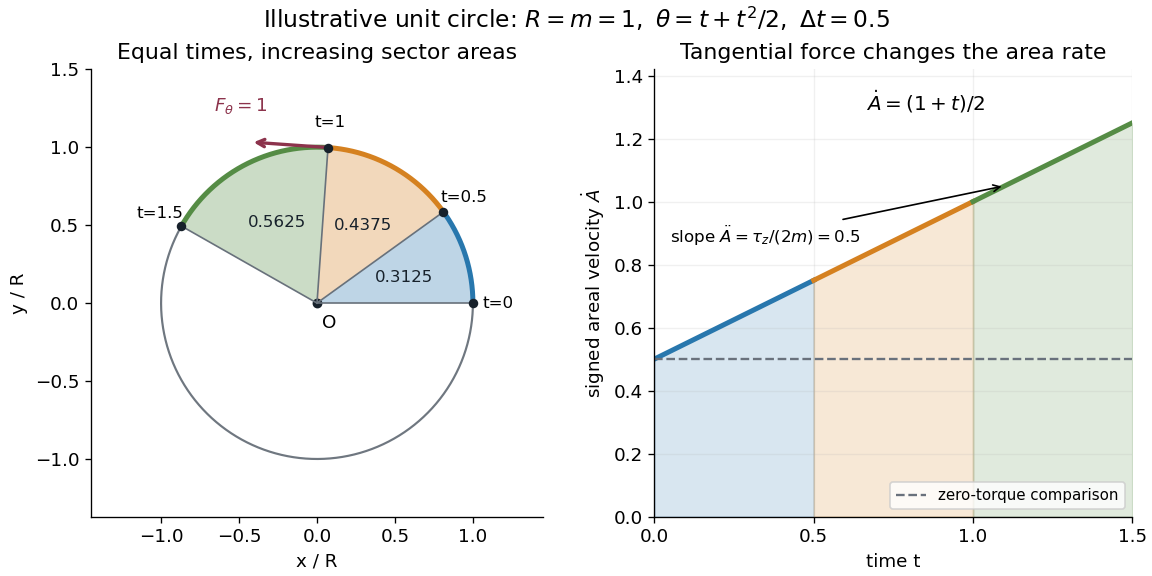
A path along a circle can have variable areal velocity. As an illustrative controlled trajectory, keep a point mass on a circle of radius with angleIts acceleration in polar coordinates and the required net force arewhere and are the radial and transverse unit vectors. A circular guide can supply the radial force, while a tangential drive supplies . HenceFor in illustrative units, the three equal time intervals , and sweep areas , and . Their difference comes from the transverse force's positive torque, even though the radius and path shape stay fixed. The area under each areal velocity graph segment equals the corresponding swept area.
Steady toroidal induction by spherical differential rotation by Codex 0 Created 2026-10-14 Updated 2026-11-05
Codex 0 Created 2026-10-14 Updated 2026-11-05An axial uniform magnetic field and localized radial differential rotation generate a steady toroidal magnetic field. The angular factor is an eigenfunction of the toroidal angular diffusion operator with eigenvalue . Its radial amplitude satisfies . Differentiating the integral in the title proves the formula. It is regular at the origin and decays at infinity when is finite at zero and decays sufficiently rapidly.
A reduced contravariant homotopy functor on based CW complexes satisfying the wedge-to-product axiom and the Mayer-Vietoris weak-pullback gluing axiom is represented by for a CW complex . Half-exactness alone is not the full hypothesis. A reduced generalized cohomology theory supplies these axioms; suspension compatibility assembles its representing spaces into an Omega-spectrum.
A single topological generator of a topological group is an element whose cyclic subgroup is dense:More generally, a tuple consists of topological generators when the subgroup they jointly generate is dense. Membership in such a tuple does not imply that one element alone generates densely.
In the additive group of p-adic integers, the element one is a topological generator: ordinary integers surject onto every finite quotient . The element generates only the proper closed subgroup . The profinite group has a two-element topological generating set but no single topological generator, since its quotient is not cyclic. [ref]
Fields and Galois Theory by James S. Milne. chapter7, finite quotient neighbourhoods and inverse limits
An isotonic solution produces no sustained change in cellular volume under the stated comparison conditions. Water can still exchange in both directions.
A hypertonic solution favors initial net water loss under the reference conditions above. In a walled plant cell, enough loss can produce plasmolysis.
A hypotonic solution favors initial net water entry under the reference conditions above. A susceptible biological cell may undergo osmotic lysis; a sufficiently strong cell wall can instead support turgor pressure.
A permeating solute can cross the specified membrane appreciably during the observation interval. This is a property of a solute-membrane-time comparison, not an immutable label attached to a molecule. Passage can reduce a concentration difference through passive transport while water is also moving; it does not require water to wait.
For an original dilute ideal example, stipulate a flexible model biological cell with retained particles and an external reservoir with retained particles plus freely permeating neutral solute. Initially the total osmolarities are equal. Suppose the permeating solute eventually has equal internal and external concentrations, there is negligible pressure difference, no active transport, and the internal retained particle amount is conserved. The permeating contributions cancel from the final osmotic balance; the internal retained concentration must fall from to . The required volume is twice its initial value. This illustrates an initially equal-osmolarity but hypotonic solution; it assumes the boundary can survive that expansion and predicts no universal time course.
Constant pulse-axis condition for removing time ordering by Codex 0 Created 2026-10-14 Updated 2026-11-05
Codex 0 Created 2026-10-14 Updated 2026-11-05For with fixed noncommuting Hermitian operators, . A constant ratio of the envelopes is sufficient to remove time ordering. Independently changing that ratio generally produces commutator corrections in the Magnus expansion, and a product of successive pulses need not equal the exponential of their summed areas.
Pinned article: Introduction to the OurBigBook Project
Welcome to the OurBigBook Project! Our goal is to create the perfect publishing platform for STEM subjects, and get university-level students to write the best free STEM tutorials ever.
Everyone is welcome to create an account and play with the site: ourbigbook.com/go/register. We belive that students themselves can write amazing tutorials, but teachers are welcome too. You can write about anything you want, it doesn't have to be STEM or even educational. Silly test content is very welcome and you won't be penalized in any way. Just keep it legal!
Intro to OurBigBook
. Source. We have two killer features:
- topics: topics group articles by different users with the same title, e.g. here is the topic for the "Fundamental Theorem of Calculus" ourbigbook.com/go/topic/fundamental-theorem-of-calculusArticles of different users are sorted by upvote within each article page. This feature is a bit like:
- a Wikipedia where each user can have their own version of each article
- a Q&A website like Stack Overflow, where multiple people can give their views on a given topic, and the best ones are sorted by upvote. Except you don't need to wait for someone to ask first, and any topic goes, no matter how narrow or broad
This feature makes it possible for readers to find better explanations of any topic created by other writers. And it allows writers to create an explanation in a place that readers might actually find it.
Figure 1. Screenshot of the "Derivative" topic page. View it live at: ourbigbook.com/go/topic/derivativeVideo 2. OurBigBook Web topics demo. Source. - local editing: you can store all your personal knowledge base content locally in a plaintext markup format that can be edited locally and published either:This way you can be sure that even if OurBigBook.com were to go down one day (which we have no plans to do as it is quite cheap to host!), your content will still be perfectly readable as a static site.
- to OurBigBook.com to get awesome multi-user features like topics and likes
- as HTML files to a static website, which you can host yourself for free on many external providers like GitHub Pages, and remain in full control

Figure 2. You can publish local OurBigBook lightweight markup files to either OurBigBook.com or as a static website.
Figure 3. Visual Studio Code extension installation.
Figure 5. . You can also edit articles on the Web editor without installing anything locally. Video 3. Edit locally and publish demo. Source. This shows editing OurBigBook Markup and publishing it using the Visual Studio Code extension. 
- Infinitely deep tables of contents:



All our software is open source and hosted at: github.com/ourbigbook/ourbigbook
Further documentation can be found at: docs.ourbigbook.com
Feel free to reach our to us for any help or suggestions: docs.ourbigbook.com/#contact