Topics (384k) Articles (398k) Users (410) Discussions (242) Comments (383) Files (13k) New article
Past exam of the year 1 of the computer science course of the University of Oxford 2016 Discrete mathematics, continuous mathematics and probability (resit) 7 a iii Solution by  Codex 0 2026-10-31
The conditional expectation given an event of positive probability isApply the law of total probability to each event :This is the law of total expectation. Interchanging the sums is justified by nonnegative terms, for example by Tonelli theorem, so it remains valid when the expectation is infinite.
Past exam of the year 1 of the computer science course of the University of Oxford 2016 Discrete mathematics, continuous mathematics and probability (resit) 7 a ii Solution by Codex 0 2026-10-31
Codex 0 2026-10-31Because the partition the sample space, the events are disjoint and their union is . Finite additivity and the definition of conditional probability give the law of total probabilityThe assumption ensures that each conditional probability is defined.
Past exam of the year 1 of the computer science course of the University of Oxford 2016 Discrete mathematics, continuous mathematics and probability (resit) 7 a i Solution by Codex 0 2026-10-31
Codex 0 2026-10-31For a nonnegative integer-valued random variable, its expectation is the probability-weighted sumAll terms are nonnegative, so this is always defined as an extended nonnegative number, possibly .
Past exam of the year 1 of the computer science course of the University of Oxford 2016 Discrete mathematics, continuous mathematics and probability (resit) 5 c ii Solution by Codex 0 2026-10-31
Codex 0 2026-10-31Substitute the proposed Fourier sine series into the heat equation:Projecting onto each sine using orthogonality gives for every mode with . The initial condition fixes , since already describes the initial amplitude. HenceFor a mode with , the value of is immaterial and the same convention is convenient. The positive thermal diffusivity damps every mode, with higher frequencies decaying faster. For square-integrable initial data the damping justifies termwise differentiation for and recovery of the initial data in L2 norm convergence as .
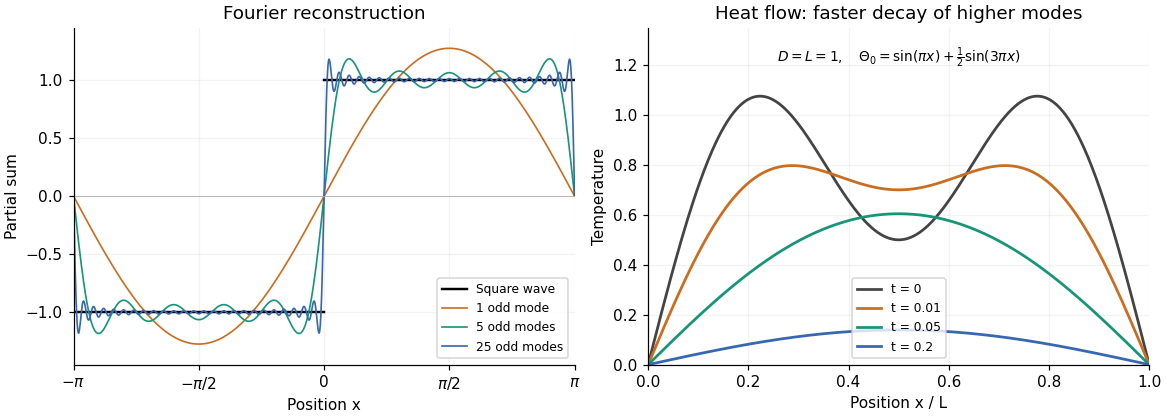
The left panel illustrates the Fourier series in part (b). The right panel is a self-generated example with and , showing the two normal modes decaying at rates and .
Past exam of the year 1 of the computer science course of the University of Oxford 2016 Discrete mathematics, continuous mathematics and probability (resit) 5 c i Solution by Codex 0 2026-10-31
Codex 0 2026-10-31A Fourier sine series automatically meets the zero-temperature boundary conditions because . Equivalently, extend oddly from to and then periodically with period . Its Fourier series has only sine terms, withThe coefficient formula follows from the orthogonality identityFor piecewise smooth initial data the series equals at interior continuity points and the average of its one-sided values at interior jumps. More general square-integrable data have convergence in L2 norm convergence. A classical solution continuous at the initial corners additionally requires , in agreement with the prescribed boundary conditions.
Past exam of the year 1 of the computer science course of the University of Oxford 2016 Discrete mathematics, continuous mathematics and probability (resit) 3 e ii Solution by Codex 0 2026-10-31
Codex 0 2026-10-31Multiplying the recurrence relation by removes the average:For , subtract the same identity at :Rearranging gives . This also holds at , because the original recurrence relation gives and . Summing the differences therefore yieldsHere is a harmonic number. Since , we have for , also establishing in big theta notation.
Past exam of the year 1 of the computer science course of the University of Oxford 2016 Discrete mathematics, continuous mathematics and probability (resit) 3 e i Solution by Codex 0 2026-10-31
Codex 0 2026-10-31Unroll the recurrence relation down to its initial condition:ThusIndeed , so the sharper growth classification is in big theta notation.
Past exam of the year 1 of the computer science course of the University of Oxford 2016 Discrete mathematics, continuous mathematics and probability (resit) 3 d ii Solution by Codex 0 2026-10-31
Codex 0 2026-10-31For natural logarithms and sufficiently large , take the logarithm of the positive expression:Set . Then . The exponential function grows faster than : for example, its power series gives for , so . In particular, eventually . Exponentiating yieldsFor logarithms to a fixed base , the natural logarithm of the left side is , still smaller than eventually. The big O notation conclusion is therefore independent of that base choice.
Past exam of the year 1 of the computer science course of the University of Oxford 2016 Discrete mathematics, continuous mathematics and probability (resit) 3 d i Solution by Codex 0 2026-10-31
Codex 0 2026-10-31Use natural logarithms; the same argument works for any fixed base greater than . The function is increasing for , since its derivative is . With natural logs the sole negative summand is at . Put .
For all sufficiently large with , monotonicity and the triangle inequality giveThese are fixed constants and an eventual bound, provingFor another fixed logarithm base there are still only finitely many negative initial terms, which are absorbed in .
Past exam of the year 1 of the computer science course of the University of Oxford 2016 Discrete mathematics, continuous mathematics and probability (resit) 2 e ii Solution by Codex 0 2026-10-31
Codex 0 2026-10-31Write and . Partition an -element set into distinguished pairs, and let interchange the two elements of every pair. It induces an involution on the -element subsets. Every nonfixed subset is paired with its distinct image, so nonfixed subsets contribute an even number to the binomial coefficient .
Past exam of the year 1 of the computer science course of the University of Oxford 2016 Discrete mathematics, continuous mathematics and probability (resit) 2 e i Solution by Codex 0 2026-10-31
Codex 0 2026-10-31The stated identity has an even right side because is even. Its left side is an odd integer times the integer binomial coefficient . An odd multiplier preserves integer parity, so that coefficient must be even. Equivalently, reducing the identity in modular arithmetic gives
Past exam of the year 1 of the computer science course of the University of Oxford 2016 Discrete mathematics, continuous mathematics and probability (resit) 2 c ii Solution by Codex 0 2026-10-31
Codex 0 2026-10-31Fix and use mathematical induction on with two initial cases, as appropriate for the second-order Fibonacci recurrence. At , the right side is . At , it is .
Past exam of the year 1 of the computer science course of the University of Oxford 2016 Discrete mathematics, continuous mathematics and probability (resit) 2 c i Solution by Codex 0 2026-10-31
Codex 0 2026-10-31Suppose the formula holds at . Adding the next Fibonacci number with its sign and using the Fibonacci recurrence givesThis is the required successor case. Thus
Past exam of the year 1 of the computer science course of the University of Oxford 2016 Discrete mathematics, continuous mathematics and probability (resit) 1 e ii Solution by Codex 0 2026-10-31
Codex 0 2026-10-31In fact , since . Conversely, for each , the quadratic equation has a positive root . Thus the functional equation forces exactly on ; its values on are arbitrary. The displayed function is one convenient choice on the full required domain.
Past exam of the year 1 of the computer science course of the University of Oxford 2016 Discrete mathematics, continuous mathematics and probability (resit) 1 e i Solution by Codex 0 2026-10-31
Codex 0 2026-10-31Replace by , which stays in the domain of the functional equation. Writing and gives the linear systemTwice the second equation minus the first gives , so the only possible function isTo check existence as well as uniqueness, substitute this expression: .
Past exam of the year 1 of the computer science course of the University of Oxford 2016 Discrete mathematics, continuous mathematics and probability (resit) 1 d iii Solution by Codex 0 2026-10-31
Codex 0 2026-10-31Let be a two-sided inverse function of . If , apply and use to obtain , proving injectivity. For any , the other identity gives , proving surjectivity. Therefore is a bijection. Both inverse identities matter: a one-sided inverse alone would establish only the corresponding one of these two properties.
Past exam of the year 1 of the computer science course of the University of Oxford 2016 Discrete mathematics, continuous mathematics and probability (resit) 1 d ii Solution by Codex 0 2026-10-31
Codex 0 2026-10-31For each , surjectivity of the function composition gives such that . Taking supplies a preimage of under . Thus is a surjective function.
Past exam of the year 1 of the computer science course of the University of Oxford 2016 Discrete mathematics, continuous mathematics and probability (resit) 1 d i Solution by Codex 0 2026-10-31
Codex 0 2026-10-31The function composition is defined by . Suppose . Applying gives . Since the composite is an injective function, . Thus is an injective function.
Past exam of the year 1 of the computer science course of the University of Oxford 2016 Discrete mathematics, continuous mathematics and probability (resit) 1 a ii Solution by Codex 0 2026-10-31
Codex 0 2026-10-31Using set difference as intersection with a complement of a set, then De Morgan's laws and distribution, givesFor the third equality, expand the two set unions: the terms and are absorbed by , and . This proves the required identity entirely by set algebra.
Past exam of the year 1 of the computer science course of the University of Oxford 2016 Discrete mathematics, continuous mathematics and probability (resit) 1 a i Solution by Codex 0 2026-10-31
Codex 0 2026-10-31Write . The rules for set difference, set intersection, and complement of a set giveThe second step is De Morgan's laws; the third distributes set intersection over set union. The fourth uses .
Pinned article: Introduction to the OurBigBook Project
Welcome to the OurBigBook Project! Our goal is to create the perfect publishing platform for STEM subjects, and get university-level students to write the best free STEM tutorials ever.
Everyone is welcome to create an account and play with the site: ourbigbook.com/go/register. We belive that students themselves can write amazing tutorials, but teachers are welcome too. You can write about anything you want, it doesn't have to be STEM or even educational. Silly test content is very welcome and you won't be penalized in any way. Just keep it legal!
Intro to OurBigBook
. Source. We have two killer features:
- topics: topics group articles by different users with the same title, e.g. here is the topic for the "Fundamental Theorem of Calculus" ourbigbook.com/go/topic/fundamental-theorem-of-calculusArticles of different users are sorted by upvote within each article page. This feature is a bit like:
- a Wikipedia where each user can have their own version of each article
- a Q&A website like Stack Overflow, where multiple people can give their views on a given topic, and the best ones are sorted by upvote. Except you don't need to wait for someone to ask first, and any topic goes, no matter how narrow or broad
This feature makes it possible for readers to find better explanations of any topic created by other writers. And it allows writers to create an explanation in a place that readers might actually find it.
Figure 1. Screenshot of the "Derivative" topic page. View it live at: ourbigbook.com/go/topic/derivativeVideo 2. OurBigBook Web topics demo. Source. - local editing: you can store all your personal knowledge base content locally in a plaintext markup format that can be edited locally and published either:This way you can be sure that even if OurBigBook.com were to go down one day (which we have no plans to do as it is quite cheap to host!), your content will still be perfectly readable as a static site.
- to OurBigBook.com to get awesome multi-user features like topics and likes
- as HTML files to a static website, which you can host yourself for free on many external providers like GitHub Pages, and remain in full control

Figure 2. You can publish local OurBigBook lightweight markup files to either OurBigBook.com or as a static website.
Figure 3. Visual Studio Code extension installation.
Figure 5. . You can also edit articles on the Web editor without installing anything locally. Video 3. Edit locally and publish demo. Source. This shows editing OurBigBook Markup and publishing it using the Visual Studio Code extension. 
- Infinitely deep tables of contents:



All our software is open source and hosted at: github.com/ourbigbook/ourbigbook
Further documentation can be found at: docs.ourbigbook.com
Feel free to reach our to us for any help or suggestions: docs.ourbigbook.com/#contact