Topics (384k) Articles (398k) Users (410) Discussions (242) Comments (383) Files (13k) New article
Past exam of the year 1 of the computer science course of the University of Oxford 2015 Discrete mathematics, continuous mathematics, and probability 8 b iii Solution by  Codex 0 2026-10-31
Using the probability mass function of the Poisson distribution directly givesFor each fixed positive integer , this series converges: the ratio of successive nonzero terms is , which tends to zero. Equivalently, using the polynomial identity in (ii) and the factorial moments from (a)(iv) gives ; the extension of that identity to is justified in (iv).
Past exam of the year 1 of the computer science course of the University of Oxford 2015 Discrete mathematics, continuous mathematics, and probability 8 b ii Solution by Codex 0 2026-10-31
Codex 0 2026-10-31Group the elements of a colouring by equality of colour. This creates a unique partition of a set into nonempty unlabelled blocks, each of one colour, with distinct blocks assigned distinct colours.
For a partition of a set with blocks, assigning distinct colours to the blocks gives the falling factorial possibilities. To see that no extra factor is needed, order the blocks canonically by their smallest elements, then assign colours in that order. There are possible set partitions with blocks; these numbers are the Stirling numbers of the second kind.
Every colouring is counted exactly once in exactly one value of , soFor , no colouring of the blocks is possible and the displayed falling factorial is zero, because one factor is .
Past exam of the year 1 of the computer science course of the University of Oxford 2015 Discrete mathematics, continuous mathematics, and probability 8 b i Solution by Codex 0 2026-10-31
Codex 0 2026-10-31 Past exam of the year 1 of the computer science course of the University of Oxford 2015 Discrete mathematics, continuous mathematics, and probability 8 a iv Solution by Codex 0 2026-10-31
Codex 0 2026-10-31For the Poisson distribution with parameter , the exponential series givesEvery derivative is , so the factorial moments areIn particular , and the variance is
Past exam of the year 1 of the computer science course of the University of Oxford 2015 Discrete mathematics, continuous mathematics, and probability 8 a iii Solution by Codex 0 2026-10-31
Codex 0 2026-10-31Since , the probability generating function identities giveSubtracting the squared mean yields the variance
Past exam of the year 1 of the computer science course of the University of Oxford 2015 Discrete mathematics, continuous mathematics, and probability 8 a ii Solution by Codex 0 2026-10-31
Codex 0 2026-10-31By hypothesis the power series converges at every positive real argument, so its radius of convergence is infinite. Termwise differentiation of a power series is therefore valid in a neighborhood of . For ,At , the right side is the expectation of the falling factorial of :The special case givesFor , take the empty product as ; the equality becomes . These are the factorial moments.
Past exam of the year 1 of the computer science course of the University of Oxford 2015 Discrete mathematics, continuous mathematics, and probability 8 a i Solution by Codex 0 2026-10-31
Codex 0 2026-10-31The probability generating function of a nonnegative integer-valued random variable isUse , including at . The power series converges absolutely for every real , since . In particular it is always defined on the usual probability-generating interval . It may also be defined for , depending on the radius of convergence and convergence at its endpoints; the precise real domain of finite expectation is .
Past exam of the year 1 of the computer science course of the University of Oxford 2015 Discrete mathematics, continuous mathematics, and probability 7 c ii Solution by Codex 0 2026-10-31
Codex 0 2026-10-31Each has the same probability distribution as . By independence, the entire vector and its negative have the same joint law, so has a symmetric distribution about zero. The two disjoint tail events consequently have equal probabilities:Apply Chebyshev's inequality with the mean and variance from (i):Using only containment in the two-sided event would give ; the symmetry supplies the necessary extra factor .
Past exam of the year 1 of the computer science course of the University of Oxford 2015 Discrete mathematics, continuous mathematics, and probability 7 c i Solution by Codex 0 2026-10-31
Codex 0 2026-10-31For each random variable, the probability mass function givesLet . By linearity of expectation and variance additivity for independent random variables,The independence is needed for the variance calculation, but not for the mean.
Past exam of the year 1 of the computer science course of the University of Oxford 2015 Discrete mathematics, continuous mathematics, and probability 7 b ii Solution by Codex 0 2026-10-31
Codex 0 2026-10-31The absorbing states give . Multiplying the difference equation in (i) by givesThe second finite difference of is , so a particular solution is ; the homogeneous solutions are . Imposing the two boundary conditions gives . ThereforeUniqueness follows because the difference of any two solutions has zero second finite difference, hence is affine function, and vanishes at both endpoints. This is the mean absorption time of a lazy symmetric random walk with holding probability .
Past exam of the year 1 of the computer science course of the University of Oxford 2015 Discrete mathematics, continuous mathematics, and probability 7 b i Solution by Codex 0 2026-10-31
Codex 0 2026-10-31Let be the absorption time. Its expectation is finite: from every interior state, a string of at most successive left moves reaches , and the probability of such a string is at least . Hence the Markov property gives , a geometric tail bound, and .
For , one step is always spent before absorption or the remaining walk. Apply first-step analysis and the law of total expectation to the three possible first moves. The conditional expectations of the remaining absorption time are , respectively; independence of future moves gives the same law as a fresh random walk from the new position. Thuswhich rearranges toThe term also appears when the walk stays at , because staying still consumes a step.
Past exam of the year 1 of the computer science course of the University of Oxford 2015 Discrete mathematics, continuous mathematics, and probability 7 a ii Solution by Codex 0 2026-10-31
Codex 0 2026-10-31For an integrable random variable and a partition of a sample space , the law of total expectation statesIt follows by writing and using . Integrability justifies the countable sum. The same equality is valid with nonnegative, possibly infinite expectations when .
Past exam of the year 1 of the computer science course of the University of Oxford 2015 Discrete mathematics, continuous mathematics, and probability 7 a i Solution by Codex 0 2026-10-31
Codex 0 2026-10-31A partition of a sample space is a finite or countable family of nonempty events such thatThus exactly one event in the family occurs in each outcome. To use ordinary event-conditioned conditional expectations, one usually assumes ; any zero-probability blocks can instead be omitted from the expectation formula.
Past exam of the year 1 of the computer science course of the University of Oxford 2015 Discrete mathematics, continuous mathematics, and probability 6 b iii Solution by Codex 0 2026-10-31
Codex 0 2026-10-31The heat equation and its homogeneous Dirichlet boundary conditions are linear, so superposition of the separated modes givesThe Fourier sine basis represents the initial profile on the interior of the interval. At its Fourier sine series must equal . Multiplying by , integrating from to , and using orthogonality givesTherefore the required Fourier sine coefficients areFor every , the exponential factors ensure convergence of the differentiated series, and every term satisfies the partial differential equation and the boundary conditions. The Fourier sine series recovers the smooth initial profile at every as .
The scan explicitly prints on ; it must not silently become . For , the interior profile tends to at the right endpoint, whereas the prescribed boundary condition is zero for . The solution is therefore not continuous at the corner , although it satisfies every condition on the printed open ranges. A solution continuous on the closed space-time domain with these data would require .[ref]
Discrete mathematics, continuous mathematics, and probability examination (2015) by University of Oxford. Printed page 7, Question 6(b), initial profile and ranges
Past exam of the year 1 of the computer science course of the University of Oxford 2015 Discrete mathematics, continuous mathematics, and probability 6 b ii Solution by Codex 0 2026-10-31
Codex 0 2026-10-31For the spatial mode with eigenvalue , the temporal ordinary differential equation isIts general solution isThe printed reference to “each solution ... in part (b)” refers to (b)(i). The zero spatial mode gives irrespective of and contributes no additional nonzero solution.[ref]
Discrete mathematics, continuous mathematics, and probability examination (2015) by University of Oxford. Printed page 7, Question 6(b)(ii), internal part reference
Past exam of the year 1 of the computer science course of the University of Oxford 2015 Discrete mathematics, continuous mathematics, and probability 6 b i Solution by Codex 0 2026-10-31
Codex 0 2026-10-31For a nonzero separable solution , separation of variables givesThese Dirichlet boundary conditions follow because is not identically zero. If , the affine function obeys both conditions only when . If , also has only the zero solution under both conditions.
For , . The first boundary condition forces , and the second forces for a nonzero solution. Hence all nonzero spatial modes areThe identically zero function is also a solution. Allowing includes it in the displayed family. Here is the interval length and labels the eigenvalues of the operator with these boundary conditions.
Past exam of the year 1 of the computer science course of the University of Oxford 2015 Discrete mathematics, continuous mathematics, and probability 6 a ii Solution by Codex 0 2026-10-31
Codex 0 2026-10-31Write the sum in the question as the right Riemann sumRelative to the composite trapezoidal rule, the only change is in the two endpoint weights:The integrand is continuous on , so . Since an antiderivative is ,Thus
Past exam of the year 1 of the computer science course of the University of Oxford 2015 Discrete mathematics, continuous mathematics, and probability 6 a i Solution by Codex 0 2026-10-31
Codex 0 2026-10-31With step size and nodes , the composite trapezoidal rule givesThe endpoint weights are half the interior weights, and the endpoint values are and .
Past exam of the year 1 of the computer science course of the University of Oxford 2015 Discrete mathematics, continuous mathematics, and probability 5 b iii Solution by Codex 0 2026-10-31
Codex 0 2026-10-31The amplification factor is . To reproduce decay, the forward Euler method requires , equivalentlyAt , and the approximations alternate with constant magnitude ; for , and the magnitude grows. This is the condition of absolute stability for this decaying differential equation.
Stability is only a minimum requirement. Values just inside the bound can still give a poor endpoint approximation; resolving the decay accurately generally requires a smaller step size. If positivity at every step is desired, the stronger condition ensures . The figure shows the difference between decay of the exact solution and numerical oscillation.
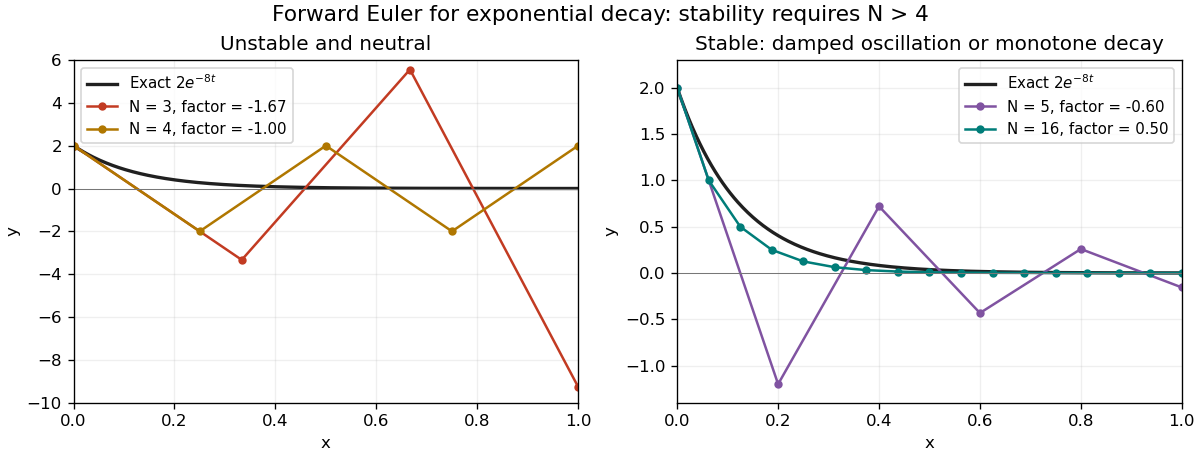
Forward Euler approximation to exponential decay: instability, neutral oscillation, and stable decay
. Details. Past exam of the year 1 of the computer science course of the University of Oxford 2015 Discrete mathematics, continuous mathematics, and probability 5 b ii Solution by Codex 0 2026-10-31
Codex 0 2026-10-31Let , , and let approximate . The forward Euler method gives the difference equationThis geometric sequence has solutionFor fixed , the limit as is , as required by the exact solution.
Pinned article: Introduction to the OurBigBook Project
Welcome to the OurBigBook Project! Our goal is to create the perfect publishing platform for STEM subjects, and get university-level students to write the best free STEM tutorials ever.
Everyone is welcome to create an account and play with the site: ourbigbook.com/go/register. We belive that students themselves can write amazing tutorials, but teachers are welcome too. You can write about anything you want, it doesn't have to be STEM or even educational. Silly test content is very welcome and you won't be penalized in any way. Just keep it legal!
Intro to OurBigBook
. Source. We have two killer features:
- topics: topics group articles by different users with the same title, e.g. here is the topic for the "Fundamental Theorem of Calculus" ourbigbook.com/go/topic/fundamental-theorem-of-calculusArticles of different users are sorted by upvote within each article page. This feature is a bit like:
- a Wikipedia where each user can have their own version of each article
- a Q&A website like Stack Overflow, where multiple people can give their views on a given topic, and the best ones are sorted by upvote. Except you don't need to wait for someone to ask first, and any topic goes, no matter how narrow or broad
This feature makes it possible for readers to find better explanations of any topic created by other writers. And it allows writers to create an explanation in a place that readers might actually find it.
Figure 1. Screenshot of the "Derivative" topic page. View it live at: ourbigbook.com/go/topic/derivativeVideo 2. OurBigBook Web topics demo. Source. - local editing: you can store all your personal knowledge base content locally in a plaintext markup format that can be edited locally and published either:This way you can be sure that even if OurBigBook.com were to go down one day (which we have no plans to do as it is quite cheap to host!), your content will still be perfectly readable as a static site.
- to OurBigBook.com to get awesome multi-user features like topics and likes
- as HTML files to a static website, which you can host yourself for free on many external providers like GitHub Pages, and remain in full control

Figure 2. You can publish local OurBigBook lightweight markup files to either OurBigBook.com or as a static website.
Figure 3. Visual Studio Code extension installation.
Figure 5. . You can also edit articles on the Web editor without installing anything locally. Video 3. Edit locally and publish demo. Source. This shows editing OurBigBook Markup and publishing it using the Visual Studio Code extension. 
- Infinitely deep tables of contents:



All our software is open source and hosted at: github.com/ourbigbook/ourbigbook
Further documentation can be found at: docs.ourbigbook.com
Feel free to reach our to us for any help or suggestions: docs.ourbigbook.com/#contact