Topics (384k) Articles (398k) Users (410) Discussions (242) Comments (383) Files (13k) New article

On the side where V is positive, set . Its radial Euclidean metric becomes the displayed plane in polar coordinates. The would-be singularity is conical unless the angular variable has period exactly . This fixes ; a nontrivial integer multiple still has a cone excess at the tip.
The Euclidean unit ball is the closed unit ball of the Euclidean norm, centered at zero. Its radial function is identically , making it a natural reference body for John ellipsoids and volume ratios.
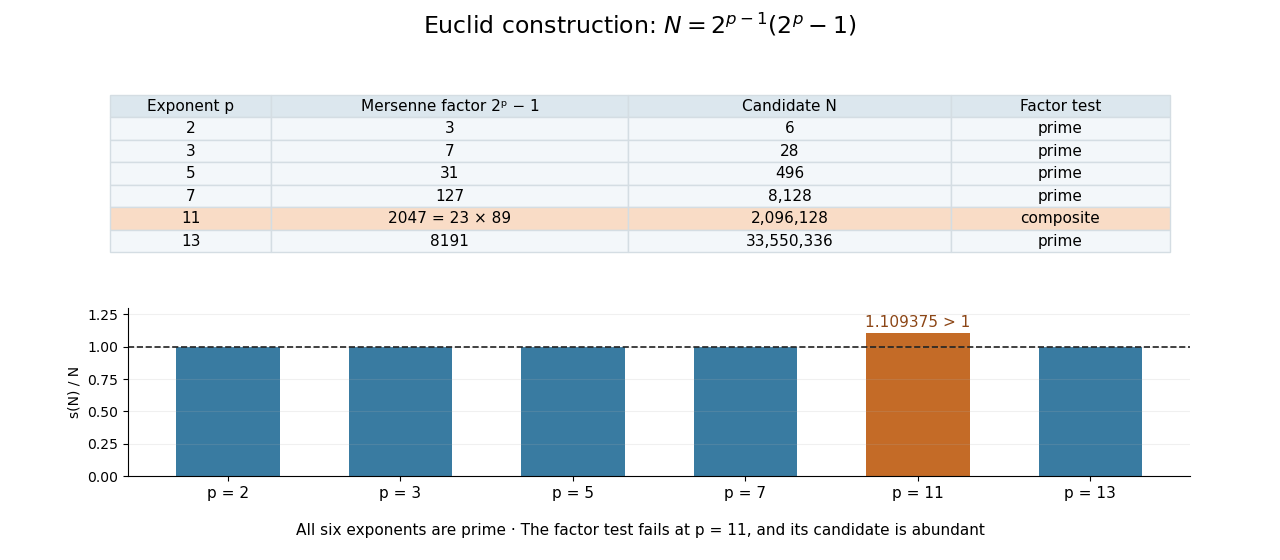
The prime exponents give Mersenne primes and therefore perfect numbers. But gives . The resulting candidate hasso . It is an abundant number, not a perfect number. Checking only that the exponent is prime would miss this obstruction.
Let be a closed operator and let be compact when the domain carries its graph norm. If is closed on the same domain, compact perturbation invariance of Fredholm operators applied to the maps proves invariance of the Fredholm essential spectrum. For self-adjoint operators this is also the essential spectrum obtained by deleting isolated finite-multiplicity eigenvalues. A bounded potential tending to zero at spatial infinity is relatively compact with respect to a second-order constant-coefficient operator: local Rellich-Kondrachov compactness theorem gives compactness on bounded intervals and the small tails give compactness globally.
For a bounded linear operator on an infinite-dimensional complex Hilbert space, define the essential spectrum by failure of the Fredholm property for . The Atkinson theorem identifies it with the spectrum in the Calkin algebra, hence it is compact and nonempty. On a finite-dimensional Hilbert space it is empty. For a bounded real diagonal operator on a separable infinite-dimensional space it equals the subsequential cluster set of the diagonal entries, including values of infinite multiplicity.
For errors at distinct nonzero locations , the evaluator associated with syndromes is . Its degree is smaller than the number of errors. Together with the error locator polynomial it gives the Reed-Solomon key equation and the Forney algorithm for error magnitudes.
A Chien search finds error positions by evaluating an error locator polynomial at every possible inverse location value . A zero identifies coordinate . Using the recurrence between successive powers of avoids recomputing all monomials from scratch.
For the upper-pole integral , let and . Scaling gives at leading order. At its indentation is . Differentiation with respect to gives , so integration gives the displayed error function. This is an optimal truncation transition; the underlying analytic integral has no literal discontinuity. The general mechanism is discussed in the DLMF account of Stokes smoothing.
Substitution of into gives the displayed real amplitude equation and conserved imaginary-part flux. Conversely these equations produce an exact complex solution wherever . The WKB approximation is obtained by expanding this exact system where stays positive.
For , Cauchy-Schwarz inequality applied to and gives the upper bound. Equal absolute coordinate values attain its factor . Expanding gives the lower bound, and a vector with only one nonzero coordinate attains its factor one. Thus both constants are optimal. These Lp norms define the same finite-dimensional topology despite having different unit balls.
An equivalence class representative is any set element belonging to that equivalence class. In the finite modulo-three example, either , or represents . Changing the equivalence class representative changes its name but preserves the equivalence class itself. Choosing gives one representative of an equivalence class from each class; the quotient set consists of the three whole sets.
For inter-renewal times with an Erlang distribution of integer shape and rate , the mean is and survival function is . The equilibrium first-delay density is survival divided by the mean,This is the equal mixture of Erlang distributions of shapes . It can be constructed by observing a Poisson clock with uniformly randomized phase modulo , whose every th event is a renewal.
A dissociation constant is an equilibrium constant for a reaction in which a combined species separates into components. For , a concentration convention writesIt has units of concentration. The dimensionless thermodynamic form instead uses thermodynamic activities, . For ideal concentration activities, , with specified standard concentration . The choice of quantity and reference is therefore part of quoting the constant.[ref]
IUPAC Compendium of Chemical Terminology, fifth edition (Gold Book) by International Union of Pure and Applied Chemistry. Entry E02177, equilibrium constant: activity and concentration conventions
In the simple dilute model with free held fixed, the fraction of B present as AB is . A smaller therefore means more association at the same free concentration. The inverse association constant describes the reversed reaction only when conventions, solvent conditions and temperature match. A dissociation rate is a kinetic quantity and is not specified by this equilibrium ratio alone.
Interval discrepancy measures the difference between empirical counts and the expected count for normalized Lebesgue measure. Convolving an enlarged interval indicator function with a narrow unit-integral indicator function gives a continuous majorant. Its Fourier coefficients decay as , converting the count into a constant term, finite exponential sums and a controlled absolute tail.
The sequence is equidistributed in precisely when for every nonzero integer pair . Equivalently are rationally independent. Under that condition, nonconstant character averages tend to zero by the geometric-series formula. Uniform approximation by trigonometric polynomials gives convergence for continuous functions, and continuous upper and lower bounds give convergence for rectangles. If a character is resonant, the orbit lies in its proper closed kernel and misses a positive-area rectangle, so equidistribution fails.
For independent -dimensional random vectors with densities and finite differential entropies, the entropy power inequality statesThe sum's differential entropy is required to be defined; a value makes the inequality immediate. Equality for finite nondegenerate densities occurs for Gaussian distributions with proportional covariance matrices.
// Target: probability-and-statistics.bigb
A probability measure with a Dirichlet form satisfies a logarithmic Sobolev inequality with constant iffor every in the domain of the Dirichlet form. The entropy functional measures how far is from a constant, while the Dirichlet form measures its spatial variation. For a symmetric Markov semigroup with generator , the convention is when this expression is defined.
For standard Gaussian measure, and Gaussian integration by parts gives . The Gaussian logarithmic Sobolev inequality has optimal constant two in this convention. Rescaling the Dirichlet form rescales the constant inversely, so a numerical constant needs its energy convention. The logarithmic Sobolev inequality implies hypercontractivity and also supports concentration inequalities through the Herbst argument.[ref]
// Target: analysis.bigb
The displayed supremum norm is finite on every entire function, positive on every nonzero one by the identity theorem, and submultiplicative under pointwise multiplication. It is not complete: partial geometric sums are Cauchy on the disk but their limit there extends meromorphically with a pole at two. More generally, no complete algebra norm exists on all entire functions because the coordinate function has algebraic spectrum of an element equal to the whole complex plane.
For a bipartite pure state, the squared Schmidt coefficients are the nonzero eigenvalues of either reduced density matrix. Their sum except the largest defines . The largest eigenvalue is a convex function, since ; consequently is concave. If Alice measures locally and records outcome , Bob's conditional reductions satisfy . Concavity gives . For Bob's measurements use Alice's unchanged average reduction instead. Iteration proves average monotonicity under LOCC. For Schmidt rank at most two, is the smaller squared Schmidt coefficient. A conversion succeeding with probability therefore obeys , since failure branches contribute nonnegative amounts.
The relative entropy of entanglement is the smallest quantum relative entropy from a density operator to a separable quantum state, with the separable set specified for the relevant division into parties. Nonnegativity of quantum relative entropy implies . For a separable quantum state, choosing gives . For finite-dimensional bipartite states, compactness of the separable set and lower semicontinuity of the relative entropy give the converse. The support convention is unless .
Pinned article: Introduction to the OurBigBook Project
Welcome to the OurBigBook Project! Our goal is to create the perfect publishing platform for STEM subjects, and get university-level students to write the best free STEM tutorials ever.
Everyone is welcome to create an account and play with the site: ourbigbook.com/go/register. We belive that students themselves can write amazing tutorials, but teachers are welcome too. You can write about anything you want, it doesn't have to be STEM or even educational. Silly test content is very welcome and you won't be penalized in any way. Just keep it legal!
Intro to OurBigBook
. Source. We have two killer features:
- topics: topics group articles by different users with the same title, e.g. here is the topic for the "Fundamental Theorem of Calculus" ourbigbook.com/go/topic/fundamental-theorem-of-calculusArticles of different users are sorted by upvote within each article page. This feature is a bit like:
- a Wikipedia where each user can have their own version of each article
- a Q&A website like Stack Overflow, where multiple people can give their views on a given topic, and the best ones are sorted by upvote. Except you don't need to wait for someone to ask first, and any topic goes, no matter how narrow or broad
This feature makes it possible for readers to find better explanations of any topic created by other writers. And it allows writers to create an explanation in a place that readers might actually find it.
Figure 1. Screenshot of the "Derivative" topic page. View it live at: ourbigbook.com/go/topic/derivativeVideo 2. OurBigBook Web topics demo. Source. - local editing: you can store all your personal knowledge base content locally in a plaintext markup format that can be edited locally and published either:This way you can be sure that even if OurBigBook.com were to go down one day (which we have no plans to do as it is quite cheap to host!), your content will still be perfectly readable as a static site.
- to OurBigBook.com to get awesome multi-user features like topics and likes
- as HTML files to a static website, which you can host yourself for free on many external providers like GitHub Pages, and remain in full control

Figure 2. You can publish local OurBigBook lightweight markup files to either OurBigBook.com or as a static website.
Figure 3. Visual Studio Code extension installation.
Figure 5. . You can also edit articles on the Web editor without installing anything locally. Video 3. Edit locally and publish demo. Source. This shows editing OurBigBook Markup and publishing it using the Visual Studio Code extension. 
- Infinitely deep tables of contents:



All our software is open source and hosted at: github.com/ourbigbook/ourbigbook
Further documentation can be found at: docs.ourbigbook.com
Feel free to reach our to us for any help or suggestions: docs.ourbigbook.com/#contact