Topics (384k) Articles (398k) Users (410) Discussions (242) Comments (383) Files (13k) New article
A zero mode is a nonzero eigenvector of an operator with eigenvalue zero. For a differential fluctuation operator it must also satisfy the specified boundary conditions. A zero mode prevents ordinary inversion of the operator and makes its unmodified functional determinant vanish. Gauge directions can produce zero modes of a kinetic operator, while stationary-path focusing can produce them in a semiclassical boundary-value problem. Removing, separately integrating or otherwise treating these directions is necessary before using a Gaussian determinant formula.
For a linear operator on a finite-dimensional complex vector space with , every even power is and every odd power is . Separating the absolutely convergent matrix exponential series into those powers proves the displayed identity without a Hermiticity assumption. If is also a Hermitian operator, the exponential is a unitary operator.
The vector space of functions satisfying for a specified Laplace-Beltrami operator. On a closed manifold its dimension is finite and is the spectral multiplicity of . A finite isometric group action preserves this space; invariant elements are the Laplacian eigenfunctions on the corresponding smooth quotient.
Real square roots of operators with simple real spectrum by  Codex 0 Created 2026-10-14 Updated 2026-11-05
If a real linear operator on an -dimensional vector space has distinct real eigenvalues, any real square root commutes with and preserves each one-dimensional eigenspace. There is multiplication by a real , hence . Conversely, if all the eigenvalues are nonnegative, choosing on an eigenbasis supplies a real square root. Without simple spectrum the necessity fails: a real quarter-turn squares to .
An eigenline is a one-dimensional vector subspace spanned by an eigenvector. If with , then for every scalar , so the line is an invariant subspace. It can be contained in an eigenspace of larger dimension; an eigenline need not be the whole eigenspace.
A Dirichlet eigenfunction is an eigenfunction of a differential operator satisfying a homogeneous Dirichlet boundary condition. The term applies to more general boundary-value operators as well as the Dirichlet Laplacian.
A nodeless real eigenfunction has no zero in the interior of the domain. For a one-dimensional confining Schrödinger operator, the nodeless theorem for a one-dimensional ground state identifies the ground state as the eigenfunction that can be chosen strictly positive. Normalizable excited states have nodes.
At small areal number density , identical aligned cracks contribute independently the fixed-throughflow dissipation reduction of a conductive crack. Equating the mean dissipation density to gives the displayed first-order enhancement. Writing is an algebraic noninteraction estimate, not a claim of accuracy at higher density. The enhancement saturates as crack conductance becomes large compared with transport through the surrounding porous matrix.
Consider planar horizontal layers with positive scalar intrinsic intrinsic permeabilities , thicknesses , and fractions . Assume each layer is uniform and isotropic, fully saturated by the same Newtonian fluid of constant mass density and dynamic viscosity, with perfect hydraulic contact and steady incompressible flow. Use boundaries that impose pure flow normal to the layers or a common gradient of hydraulic head along them; additional interface resistance and finite-edge effects are excluded.
For vertical flow normal to the layers, every layer carries the same normal Darcy flux by mass conservation. The hydraulic head drops add. Writing and taking positive as the drop along the flow direction givesThis is the thickness-weighted harmonic mean. It is hydraulic head, rather than fluid pressure alone, that accounts correctly for gravity in the vertical calculation. A thin layer of very small permeability of a porous medium can control the whole discharge because all flow must pass through it.
For horizontal flow parallel to the layers, each layer experiences the same gradient of hydraulic head. For width , each area is , and the individual volume fluxes add:This is the thickness-weighted arithmetic mean. A highly permeable layer can carry most of the horizontal flow because it supplies a continuous route from inlet to outlet. Woessner and Poeter derive both cases for hydraulic conductivity; identical fluid properties allow the common factor to cancel.[ref]
For two equally thick layers, take and , where . The values 1 and 9 are therefore permeabilities in units of , rather than dimensionless intrinsic intrinsic permeabilities. ThenAcross the layers, the less permeable half takes of the total hydraulic head drop and the more permeable half only . Along the layers, the more permeable half carries of the total volume flux. At the same magnitude of imposed gradient of hydraulic head, horizontal Darcy flux is times the vertical Darcy flux.
The arrangement thus creates physical anisotropy from locally isotropic ingredients. In coordinates with along the layers and normal to them, the effective permeability of a porous medium tensor is . A driving gradient of hydraulic head with both horizontal and vertical components generally produces a discharge in a different direction. This distinction matters when deciding whether a geological bed conducts aquifer flow along itself or acts as a barrier to flow across it.
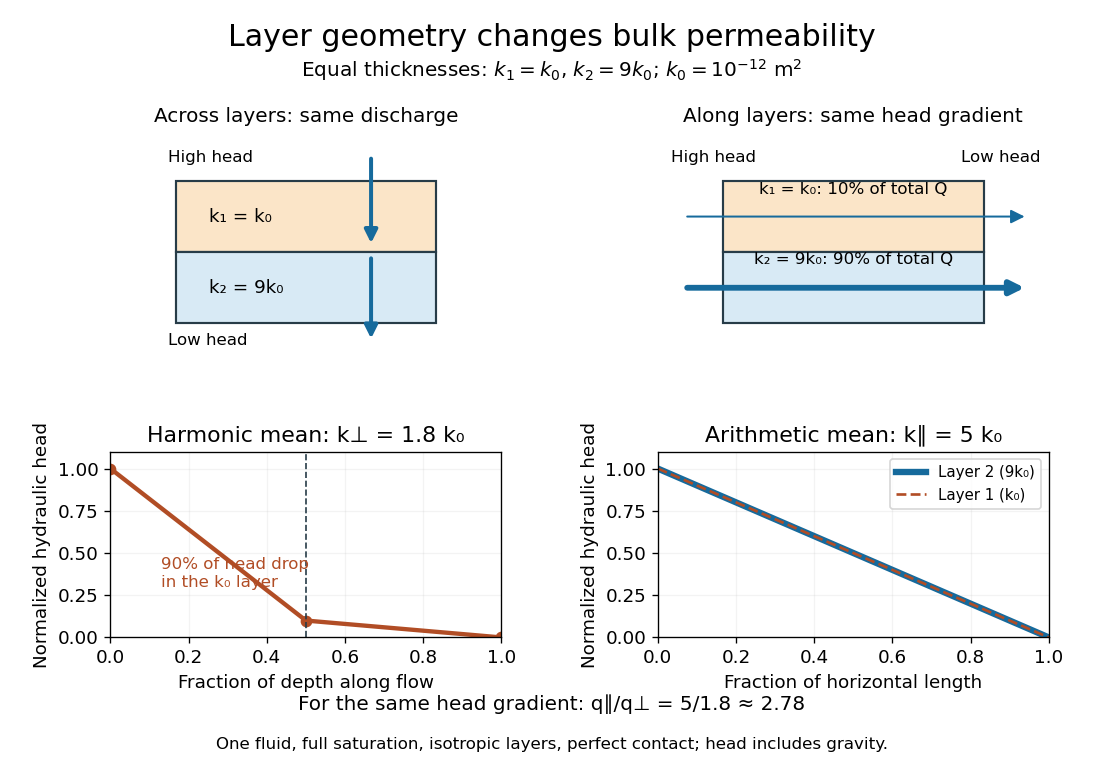
Regenerate the diagram by running
python ../layered-porous-permeability.py from _media; it writes its PNG into the current directory.For in the finite moment-generating function domain and integrable , Jensen inequality gives the lower bound and almost surely gives the upper bound. The Holder inequality makes convex with . Thus for , and the effective bandwidth is nondecreasing. It need not be strictly increasing: deterministic traffic gives a constant bandwidth. Infinite peaks or exponential moments require extended-value conventions.
For a nondecreasing process with stationary increments and independent increments, suppose . If , then is a nonnegative supermartingale. Applying the maximal inequality for a nonnegative supermartingale up to time and then letting givesThe stationary workload of a stable queue fed by has this supremum distribution, using the past input and stationary increments and independent increments. For independent flows, the constraint is , where is the long-time effective bandwidth. The result bounds a continuous-time supremum directly; a one-time Chernoff bound by itself does not do that.
Let a slotted queue have stationary input, constant service , and finite stationary queue workload . Write for its past cumulative arrivals. The union bound and Chernoff bound give the displayed inequality for . It requires no temporal independence. If each is finite and , the series is finite: its tail is bounded by a geometric series. Consequently for . The condition is that the asymptotic effective bandwidth be less than service capacity.
Independent slots carry either zero work or units, the latter with probability . Their effective bandwidth is the displayed expression, with small-parameter limit and large-parameter limit when . For , the positive root of determines the optimized exponential overflow bound. In the special case , the stationary queue workload is geometric with ratio , and the root is , giving exactly for integers .
For independent Poisson arrival counts of mean per slot, with one unit of work per arrival, the cumulant-generating function is . Its effective bandwidth is the displayed expression. If , the equation has a unique positive root: strict convexity, negative initial derivative after subtracting , and divergence to infinity prove existence and uniqueness. Independent Poisson streams combine by replacing with the sum of their intensities.
Let count -cliques in a binomial random graph on vertices and count distinct ordered pairs sharing an edge. The clique conflict graph gives : order its vertices randomly and keep each one preceding all its neighbours, then apply the Cauchy-Schwarz inequality. Another application gives . If and is no larger, then . Changing one edge changes by at most one, so the Azuma-Hoeffding inequality for an edge-exposure martingale yields the displayed exponential absence bound. This supports a union bound over exponentially many adaptive candidate subsets.
For the upper plane-wave branch of the quintic real Ginzburg-Landau equation, put . A modulation of wavenumber has growth rates . Long-wave phase diffusion is positive when , giving the displayed stability boundary. At equality the leading phase growth is , so the boundary is marginal in the diffusion coefficient but damped at the next spatial order. In the plane the boundary is .
For a real Ginzburg–Landau equation plane wave with amplitude squared , perturbing its amplitude and phase couples Fourier modes on either side of its carrier wavenumber. The displayed eigenvalues follow from the real-linear two-component perturbation equation. Their small- phase branch is , so the robust infinite-domain stable band is . On a finite periodic envelope domain only discrete are allowed; an instability requires an allowed with . Uniform amplitude perturbations alone cannot determine this Eckhaus instability.
With uniform thermal wind above a plane boundary, write the zero-interior-potential vorticity response as , where and . Boundary vertical velocity gives and natural angular frequency . An initially zero response has . Its continuous resonant limit is : forcing in phase with the boundary mode supplies energy every cycle, and linear undamped theory predicts secular growth.
Start at one and apply updates, each multiplying the current value by . The final value is : one update gives , two give , ten give approximately , and one hundred give approximately . Increasing the number of steps, while reducing each increment proportionally, approaches Euler's number rather than producing unbounded accumulation.
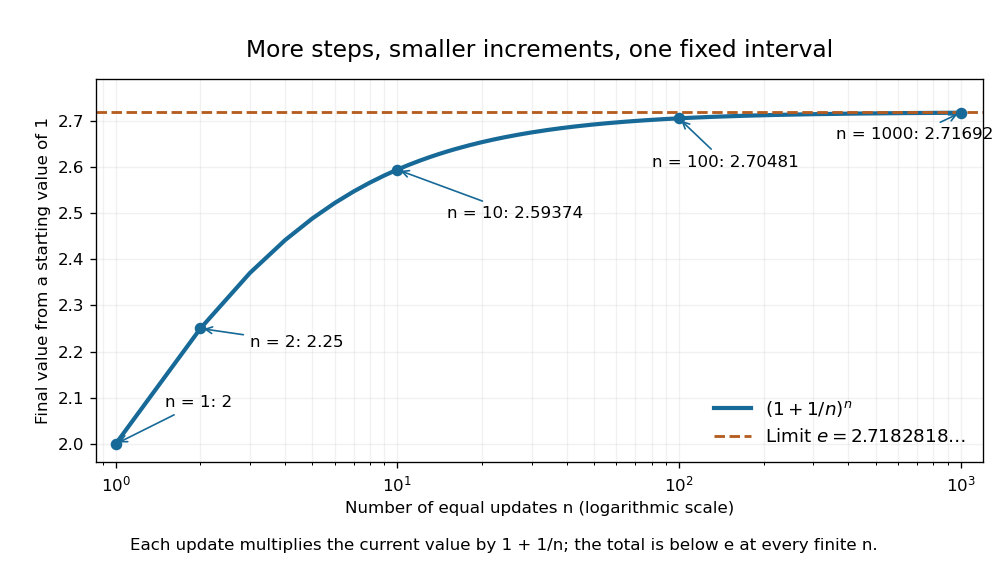
The natural logarithm makes the limit transparent. For , its integral definition gives , by bounding on . With ,The squeeze theorem gives a logarithmic limit of one; continuity of the exponential function gives . This links a discrete multiplicative rule with continuous exponential growth, without assuming that a finite number of steps equals the limiting value.
Magnetic concentration by an incompressible stagnation flow by Codex 0 Created 2026-10-14 Updated 2026-11-05
Codex 0 Created 2026-10-14 Updated 2026-11-05The linear incompressible flow compresses the transverse plane and stretches the axial direction. An axial magnetic field obeys . In ideal magnetohydrodynamics, its amplitude grows as while its transverse width decreases as . Thus its magnetic energy per unit axial length grows as , even when opposite-polarity angular sectors give zero signed magnetic flux. Finite magnetic diffusivity limits the amplification of localized finite-flux Gaussian fields.
Pinned article: Introduction to the OurBigBook Project
Welcome to the OurBigBook Project! Our goal is to create the perfect publishing platform for STEM subjects, and get university-level students to write the best free STEM tutorials ever.
Everyone is welcome to create an account and play with the site: ourbigbook.com/go/register. We belive that students themselves can write amazing tutorials, but teachers are welcome too. You can write about anything you want, it doesn't have to be STEM or even educational. Silly test content is very welcome and you won't be penalized in any way. Just keep it legal!
Intro to OurBigBook
. Source. We have two killer features:
- topics: topics group articles by different users with the same title, e.g. here is the topic for the "Fundamental Theorem of Calculus" ourbigbook.com/go/topic/fundamental-theorem-of-calculusArticles of different users are sorted by upvote within each article page. This feature is a bit like:
- a Wikipedia where each user can have their own version of each article
- a Q&A website like Stack Overflow, where multiple people can give their views on a given topic, and the best ones are sorted by upvote. Except you don't need to wait for someone to ask first, and any topic goes, no matter how narrow or broad
This feature makes it possible for readers to find better explanations of any topic created by other writers. And it allows writers to create an explanation in a place that readers might actually find it.
Figure 1. Screenshot of the "Derivative" topic page. View it live at: ourbigbook.com/go/topic/derivativeVideo 2. OurBigBook Web topics demo. Source. - local editing: you can store all your personal knowledge base content locally in a plaintext markup format that can be edited locally and published either:This way you can be sure that even if OurBigBook.com were to go down one day (which we have no plans to do as it is quite cheap to host!), your content will still be perfectly readable as a static site.
- to OurBigBook.com to get awesome multi-user features like topics and likes
- as HTML files to a static website, which you can host yourself for free on many external providers like GitHub Pages, and remain in full control

Figure 2. You can publish local OurBigBook lightweight markup files to either OurBigBook.com or as a static website.
Figure 3. Visual Studio Code extension installation.
Figure 5. . You can also edit articles on the Web editor without installing anything locally. Video 3. Edit locally and publish demo. Source. This shows editing OurBigBook Markup and publishing it using the Visual Studio Code extension. 
- Infinitely deep tables of contents:




All our software is open source and hosted at: github.com/ourbigbook/ourbigbook
Further documentation can be found at: docs.ourbigbook.com
Feel free to reach our to us for any help or suggestions: docs.ourbigbook.com/#contact