Topics (384k) Articles (398k) Users (410) Discussions (242) Comments (383) Files (13k) New article
Every finite-sums set generated by an infinite sequence of positive integers contains another finite-sums set generated by a strictly increasing sequence satisfying . Consequently the divisibility requirement can be added to the conclusion of Hindman theorem.
Choose each as a sum over a finite block of indices of the original sequence, with these index blocks disjoint and successive. Given , take two fresh groups of terms. In either group the partial sums, including , give two equal congruence classes modulo by the pigeonhole principle. Their difference is a nonempty consecutive sum divisible by , and hence at least . Add the two such sums to obtain divisible by . Its index block is the union of the two selected subblocks. Discard the rest of these groups and continue after them. Because the blocks are disjoint, every finite sum of the is a finite sum of distinct original terms. This proves both the finite-sums set containment and the strictly increasing divisibility chain.
The Minkowski sausage replaces a segment by eight directed unit segments whose endpoint displacement is four units. A middle straight run of length two represents two collinear unit segments. After normalizing the displacement to one, the eight contracting Euclidean similarities all have ratio . The open diamond is an open set condition witness: its eight image diamonds have disjoint interiors and lie within it. Hence , giving Hausdorff dimension . Treating the middle run as a single similarity of ratio instead defines a different iterated scheme.
The finite satisfiability problem is undecidable, and the set of first-order sentences valid in every finite structure is not computably enumerable. A halting computation can be encoded as a finite ordered tableau satisfying finitely many local first-order constraints; the resulting sentence has a finite model exactly when the computation halts.
Finite residual contains surjective endomorphism kernels by  Codex 0 Created 2026-10-14 Updated 2026-11-05
Let be a finitely generated group and a surjective endomorphism. Pullback by permutes the finite set of normal subgroups of any prescribed finite index. For each such , some iterate satisfies , so . Intersecting proves the inclusion. Consequently every finitely generated residually finite group is a Hopfian group.
A connected quiver has finite representation type exactly when its underlying unoriented graph is a Dynkin diagram of type , , or . In that case, dimension vectors give a bijection from indecomposable representations to positive roots.
Parameter family for an elementary abelian p-group by Codex 0 Created 2026-10-14 Updated 2026-11-05
Codex 0 Created 2026-10-14 Updated 2026-11-05For , put , . On a basis , prescribe , , , . These are valid modules because every product of two radical operators is zero. Each is indecomposable, and an isomorphism preserves the equality , hence preserves . An infinite field therefore gives infinitely many isomorphism classes.
For equal exterior potential energies and constant mass, the exact transmission probability isBelow the barrier, the hyperbolic sine is positive for , so . At , the interior wavefunction is linear in ; either neighbouring formula has the displayed finite limit, since and tend to one. Above the barrier, the interior wavefunction oscillates: the quantum reflection probability generally remains nonzero, but for a positive integer gives perfect transmission probability through constructive wave interference. These are scattering resonances, not below-barrier quantum tunnelling.
At half height, , we have and , consistent with finite square barrier transmission at half barrier height after replacing this width by that example's width . In the illustration, the width is four times and , giving . The plotted wavefunction comes from solving the four interface equations; the transmission probability curve uses the closed formula.
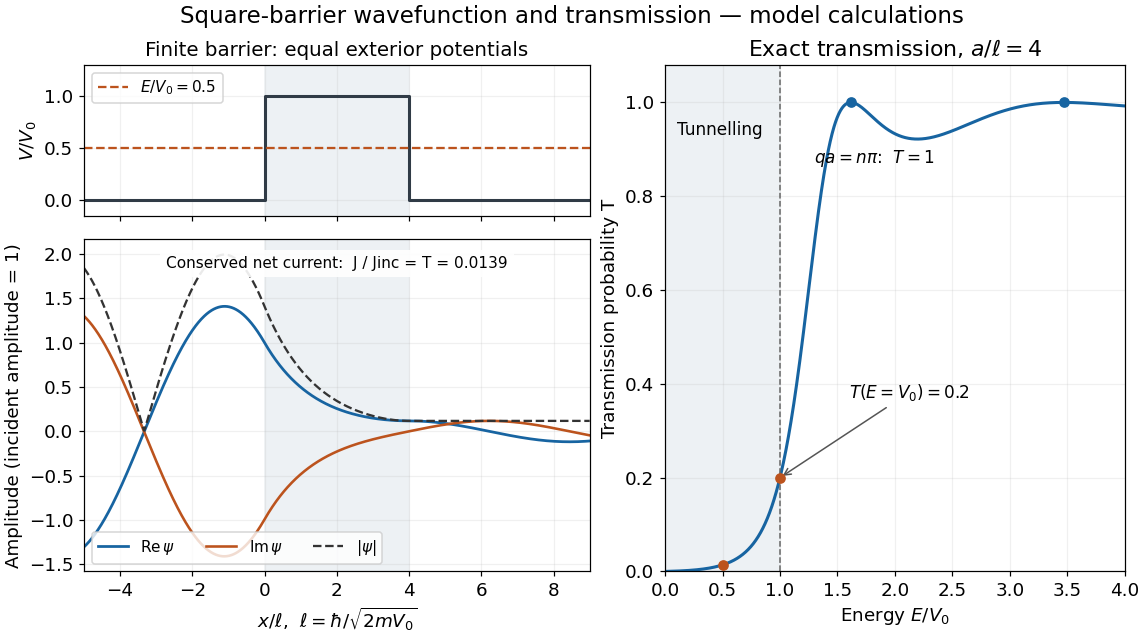
Matched square-barrier wavefunction and transmission below and above the barrier
. Original model calculations with equal exterior potential energies, constant mass and incident probability amplitude one. The real part and imaginary part of the wavefunction, its modulus and the exact transmission probability are shown; these curves are not measurements. The conserved net probability current is small but nonzero throughout the barrier. Details.The tunnelling decay constant is the inverse length controlling the exponential decay of an evanescent wave in a constant potential barrier with . The wavefunction amplitude decay length is ; the squared-amplitude decay length is .
For positive integers , the Ramsey number is the least integer such that every red-blue edge coloring of the complete graph contains either a red clique on vertices or a blue clique on vertices. The complete graph has all unordered pairs as edges; every edge gets exactly one color, with no requirement that incident edges have different colors. The definition and its graph interpretation appear in D. Yogeshwaran's Discrete Mathematics notes, section 5.3.
For example, asks how many vertices force a monochromatic triangle in a graph. Swapping colors gives . Also : either a red edge exists, or all edges are blue. On vertices, an all-blue coloring avoids both a red edge and a blue -clique. Under the convention that a one-vertex clique qualifies in either color, .
For , splitting the neighbors of one vertex by the colors of their incident edges givesIndeed, in a complete graph of the order on the right, at least neighbors are joined to that vertex by red edges, or at least are joined by blue edges. In the red case, the defining property of the smaller Ramsey number supplies either a blue -clique among the neighbors or a red -clique that extends by the chosen vertex; the blue case is symmetric. Starting from the one-vertex base cases, this recursively proves finite existence. The binomial upper bound for a Ramsey number packages the resulting estimate. [ref]
https://www.its.caltech.edu/~dconlon/RamseyLecture1.pdf. David Conlon's Graph Ramsey Theory notes, Lecture 1
present the neighbor argument and the sharp Ramsey number for triangles.Equivalently, every graph on at least vertices has an -clique or a -element independent set: color its edges red and the edges of its complement graph blue. This is the Ramsey theorem in graph theory. Larger monochromatic patterns have their own thresholds, such as a graph Ramsey number, matching Ramsey number or triangle-packing Ramsey number; these ask different questions from finding one clique.
The weak Huygens principle is the domain-of-dependence statement that initial data outside a backward light cone cannot influence its tip. It permits an interior tail and is weaker than the Strong Huygens principle. For with , integrating the local energy over shrinking balls proves this statement: the boundary contribution is .
For whole-line Cauchy data with support contained in , the displayed inclusion holds at . A short check uses D'Alembert's formula: if , both sampled endpoints and the whole interval of integration lie to the right of , so all contributions vanish; the argument for is identical. The inclusion can be strict, and a nonzero response at the first permitted arrival is not guaranteed.
For , the backward causal cone at isIts boundaries are characteristic lines for the one-dimensional wave equation; its base on is the initial-data domain of dependence. The forward cone from is , . Here the cone is set by the model's wave speed, which may be acoustic or a string wave speed; it does not assert propagation at the speed of light.
A finite p-group is powerful if for odd , or for . Here powers denote generated subgroups. The same definition applies to pro-p groups using closed power and commutator subgroups. Its Frattini subgroup is . For odd , successive power layers admit linear correction of roots, which makes every element of an actual th power.
The displayed descending filtration combines powers and group commutators. In a pro-p group, take the closure of the generated product at each step. For a powerful p-group these layers are , with iterated closed power subgroups in the infinite case. The successive quotients are elementary abelian p-groups.
A p-subgroup is a subgroup which is a finite p-group, for a specified prime . Every p-subgroup lies in a Sylow subgroup.
A Frobenius group has a nontrivial proper subgroup satisfying for every , with . Such is a Frobenius complement. The Frobenius kernel theorem turns the identity together with elements outside all conjugates of into a normal subgroup , giving .
A finite group is monomial if every irreducible character is a monomial character. Finite metabelian groups have this property.
A finite group is ambivalent when every element is conjugate to its inverse. Since every complex character satisfies , an ambivalent group has real values for every irreducible character. Conversely, if every irreducible value is real, irreducible characters separate conjugacy classes and force every to be conjugate to .
In finite-group character theory, an elementary group is a group that is p-elementary group for some prime . Such groups are solvable and provide the subgroup tests in Brauer's characterization of characters. This does not mean elementary abelian group.
For a set of primes, a pi-group is a finite group whose order has no prime divisors outside . The trivial group qualifies for every .
Pinned article: Introduction to the OurBigBook Project
Welcome to the OurBigBook Project! Our goal is to create the perfect publishing platform for STEM subjects, and get university-level students to write the best free STEM tutorials ever.
Everyone is welcome to create an account and play with the site: ourbigbook.com/go/register. We belive that students themselves can write amazing tutorials, but teachers are welcome too. You can write about anything you want, it doesn't have to be STEM or even educational. Silly test content is very welcome and you won't be penalized in any way. Just keep it legal!
Intro to OurBigBook
. Source. We have two killer features:
- topics: topics group articles by different users with the same title, e.g. here is the topic for the "Fundamental Theorem of Calculus" ourbigbook.com/go/topic/fundamental-theorem-of-calculusArticles of different users are sorted by upvote within each article page. This feature is a bit like:
- a Wikipedia where each user can have their own version of each article
- a Q&A website like Stack Overflow, where multiple people can give their views on a given topic, and the best ones are sorted by upvote. Except you don't need to wait for someone to ask first, and any topic goes, no matter how narrow or broad
This feature makes it possible for readers to find better explanations of any topic created by other writers. And it allows writers to create an explanation in a place that readers might actually find it.
Figure 1. Screenshot of the "Derivative" topic page. View it live at: ourbigbook.com/go/topic/derivativeVideo 2. OurBigBook Web topics demo. Source. - local editing: you can store all your personal knowledge base content locally in a plaintext markup format that can be edited locally and published either:This way you can be sure that even if OurBigBook.com were to go down one day (which we have no plans to do as it is quite cheap to host!), your content will still be perfectly readable as a static site.
- to OurBigBook.com to get awesome multi-user features like topics and likes
- as HTML files to a static website, which you can host yourself for free on many external providers like GitHub Pages, and remain in full control

Figure 2. You can publish local OurBigBook lightweight markup files to either OurBigBook.com or as a static website.
Figure 3. Visual Studio Code extension installation.
Figure 5. . You can also edit articles on the Web editor without installing anything locally. Video 3. Edit locally and publish demo. Source. This shows editing OurBigBook Markup and publishing it using the Visual Studio Code extension. 
- Infinitely deep tables of contents:



All our software is open source and hosted at: github.com/ourbigbook/ourbigbook
Further documentation can be found at: docs.ourbigbook.com
Feel free to reach our to us for any help or suggestions: docs.ourbigbook.com/#contact