Topics (384k) Articles (398k) Users (410) Discussions (242) Comments (383) Files (13k) New article
For a strongly continuous unitary representation, integration against defines an operator satisfying . Fubini's theorem gives , and the group-algebra involution gives . On an Abelian group, the operator-norm closure is a commutative C-star algebra. Its algebra characters produce continuous unitary group characters, allowing the Commutative Gelfand--Naimark theorem and Riesz-Markov-Kakutani representation theorem to turn a positive vector functional into a finite spectral measure.
Triviality of finite-dimensional unitary representations of SL2R by  Codex 0 Created 2026-10-14 Updated 2026-11-05
The diagonal element conjugates to . In a finite-dimensional unitary representation, conjugacy therefore makes its eigenvalue multiset invariant under every square power. Square-power rigidity of a finite nonzero spectrum makes the image of every upper unipotent the identity. Its kernel is a normal subgroup; elementary unipotent generators of SL2R then force the entire group representation to be trivial. This algebraic argument does not require continuity.
A local unit has valuation zero in the local field, or equivalently is an invertible element of its valuation ring. A principal unit additionally reduces to one in the residue field. The distinction between local units and principal units retains the prime-to-p residue roots of unity in a cyclotomic p-adic field.
Sensitivity analysis for unit and item nonresponse by Codex 0 Created 2026-10-14 Updated 2026-11-05
Codex 0 Created 2026-10-14 Updated 2026-11-05Vary the unobserved outcome probabilities for item and unit nonresponders, and any unknown auxiliary-variable mixture, over scientifically plausible ranges. Recompute the population estimate and identify values at which substantive conclusions change. This probes untestable transport or missing at random assumptions; it is distinct from sampling uncertainty represented by a confidence interval. Letting each missing-outcome probability vary from zero to one gives worst-case identification bounds.
For a uniform random permutation of objects, let count its fixed points. Write . Each indicator random variable has expected value , so linearity of expectation gives for every . This average does not require independence: for , fixing two specified objects has probability , greater than the product of their individual probabilities.
For four objects, exact enumeration gives counts for fixed points among the equally likely permutations. Their weighted arithmetic mean is . Exactly three fixed points are impossible: the last object must then also be fixed.
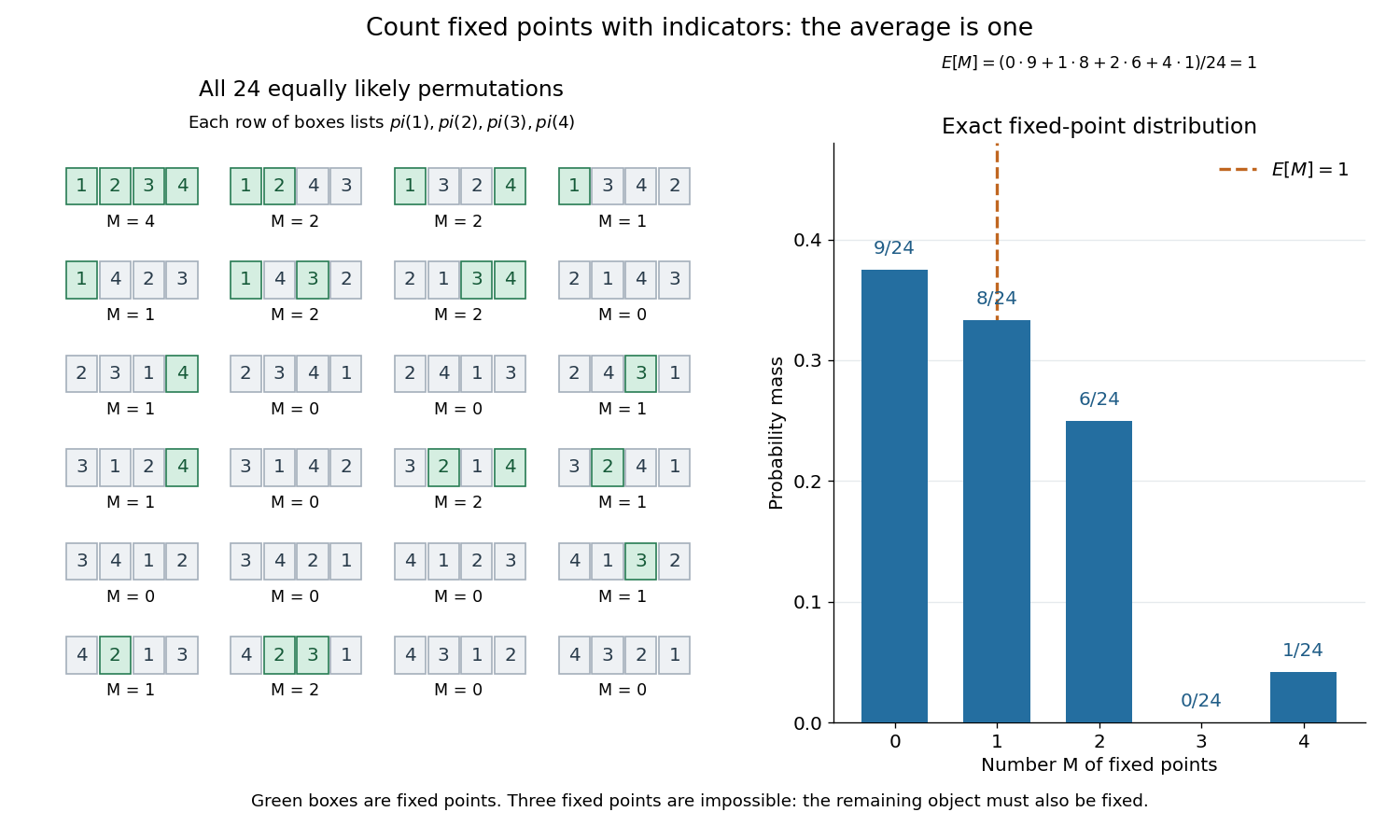
The fixed point count of a uniform random permutation averaged over all permutations of four objects
. Each card lists . Green entries equal their positions and therefore mark fixed points. The probability mass function on the right counts those cards; its expected value is one. Details.Choose the fixed objects and derange the remaining . Their count is among equally likely permutations. The inclusion-exclusion principle for proves the displayed law, valid for and zero otherwise. With , it includes the all-fixed case and the impossibility of exactly fixed objects. For fixed , the law tends to , the Poisson distribution of mean one.
Independent relative ranks of a uniform random permutation by Codex 0 Created 2026-10-14 Updated 2026-10-31
Codex 0 Created 2026-10-14 Updated 2026-10-31For a uniform random permutation , define as the rank of among , with rank one assigned to the smallest value. Each sequence corresponds to exactly one permutation: insert index in position of the current increasing-value list, then assign the final list the values . The equally likely permutations therefore correspond to the equally likely rank sequences. Consequently the are independent random variables, each with the displayed uniform distribution.
Gaussian independence of linear and quadratic statistics by Codex 0 Created 2026-10-14 Updated 2026-11-05
Codex 0 Created 2026-10-14 Updated 2026-11-05When has full column rank, its Gram matrix is positive-definite and . The stacked normal vector therefore has zero cross covariance, so its blocks are independent. Since , the linear and quadratic statistics are independent. This is the projection argument behind independence of regression coefficient and variance estimators in a normal linear model.
For , the forward average is and the backward average is , both with positive interval length in the denominator. They are linear operators. Their absolute values are bounded by the uncentered maximal function: enlarge the interval to put in its interior and pass to the limit. The same boundary-enlargement argument works regardless of the value of the chosen representative at .
For normalized linearly independent pure states, their Gram matrix is positive definite. The displayed reciprocal vectors satisfy . The operator has nonzero eigenvalues equal to those of : use the polar factorization of the matrix whose columns are . Choosing gives the POVM effects and . Each conclusive outcome has probability on its own state and zero on every other input. The inconclusive effect preserves positivity, so the construction is a physical measurement in quantum mechanics.
Countable saturation of an ultraproduct over omega by Codex 0 Created 2026-10-14 Updated 2026-10-31
Codex 0 Created 2026-10-14 Updated 2026-10-31An ultraproduct over a nonprincipal ultrafilter on realizes each countable finitely satisfiable type. For the first formulas, their coordinate simultaneous-witness set belongs to the ultrafilter by the Łoś theorem. Replace it by and choose at coordinate a witness to as many initial formulas as that coordinate permits. This finite number tends to infinity modulo the ultrafilter, so the resulting product class realizes every formula. More generally countably incomplete ultrafilters admit the same descending-set diagonalization. This statement does not assert saturation at every larger cardinal.
A phosphotyrosine residue is a tyrosine residue modified by phosphorylation. Its location and surrounding protein primary structure help determine which SH2 domains can recognize it.
The complex scalar combines the IIB axion and dilaton. Its imaginary part is for a constant background. S-duality acts by fractional linear transformations, corresponding to changes of torus basis in the M-theory torus duality.
A (p,q) string carries units of fundamental string charge and units of D1-brane charge. Coprime integers label an elementary primitive charge vector; nonprimitive vectors describe multiple units. The displayed tension uses the string metric and vanishing axion. In the M-theory torus duality, it comes from an M2-brane wrapped on the corresponding primitive one-cycle.
The IIB five-brane doublet combines NS5-brane and Ramond–Ramond five-brane charges. Its toroidal M-description involves wrapped M5-branes or Kaluza-Klein monopoles, depending on whether the IIB circle lies along or transverse to the five-brane. Electric–magnetic charge bases fix the order and signs of the integer labels.
The NS-NS fields are a graviton, Kalb–Ramond field and dilaton, with physical polarizations. The RR fields are , with polarizations; the five-form field strength of is self-dual. Two same-chirality Majorana-Weyl gravitini contribute polarizations, and two Majorana-Weyl dilatini of the opposite chirality contribute . Potential components, dual potentials and physical polarizations are different counts.
Massive type IIA supergravity is a deformation of type IIA supergravity with a nonzero zero-form Ramond–Ramond sector field strength, the Romans mass . The parameter modifies field strengths, gauge transformations and scalar interactions; it is not a statement that every field, including the graviton, has acquired an ordinary particle mass.
In the presence of a D8-brane, the value of can differ on the two sides of the brane. This links the deformation to charged domain-wall solutions and distinguishes it from the simplest circle reduction of eleven-dimensional supergravity. The limit recovers the ordinary massless theory, but a nonzero flux must be retained consistently in both field equations and source matching.[ref]
Non-BPS D8-branes and Dynamic Domain Walls in Massive IIA Supergravities by A. Chamblin and others. abstract and introduction: D8-branes, Romans bulk theory and domain-wall matching
At generic fixed , the factor has simple poles at the displayed nonnegative values of . Its denominator is finite there. The factors do not generically cancel those poles under . Factorization identifies massless and massive intermediate states at those masses. The factor has no negative-mass-squared poles; special polarization or momentum choices can suppress individual residues and cannot establish the degeneracy of an entire level.
The superconducting mixed state is the equilibrium vortex regime of a type-II superconductor, between its lower critical magnetic field and upper critical magnetic field in the ideal bulk description. Magnetic flux enters through Abrikosov vortices, while the surrounding material retains a nonzero superconducting order parameter.
Each vortex has a suppressed-order core and circulating electric currents; in the appropriate bulk limit, a singly wound vortex carries one superconducting flux quantum. Their mutual interactions can produce an Abrikosov vortex lattice. Increasing the field increases the vortex density until superconductivity is destroyed at the upper critical field. Defects can immobilize vortices through flux pinning, so a prepared sample's magnetization need not coincide with the equilibrium curve. Spatial coexistence here means vortex cores within superconducting matter, rather than arbitrary macroscopic patches of two phases.[ref]
Nobel Lecture: Type-II superconductors and the vortex lattice by Alexei Alexeyevich Abrikosov. discussion of the vortex solution and triangular lattice
A Hubble diagram plots a distance indicator, such as standardized supernova apparent magnitude or distance modulus, against redshift. The low-redshift relation sets a distance-scale intercept, while curvature of the relation at larger redshift tests the expansion history through luminosity distance. A common unknown absolute magnitude remains degenerate with the Hubble constant; the diagram's redshift-dependent shape can still constrain other cosmological parameters.
A permissive gate allows conduction when it is open. Suppose an ion channel conducts only when all gates are open, where is a positive integer. If the gate-open events are mutually independent events and each has the same open probability at the time considered, thenThis follows from the multiplication rule for independent events. Identical transition rates alone do not guarantee independence: the initial gate states must also be independently prepared, and the model must not couple their transitions. Gates sharing a fluctuating membrane potential can be correlated; the simple product requires an appropriate independence assumption, for example independent gates at an externally fixed voltage.
At , channels requiring permissive gates have open probabilities , and . For four independent gates there are possible open/closed configurations, equally probable at ; only the all-open configuration conducts. Thus is the gate-open probability, while is the whole-channel open probability. Neither is a fractional state of one observed channel. Among independently prepared identical four-gate channels, the expected value of the open count is , although an actual count fluctuates.
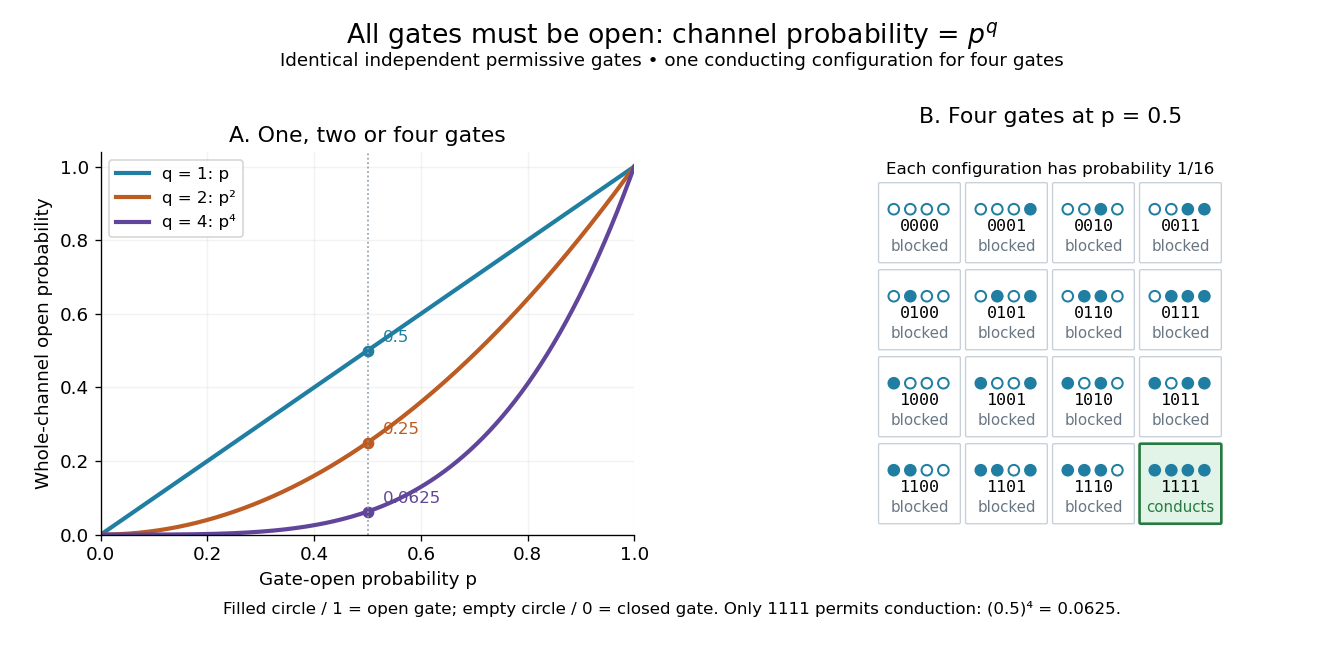
Independent permissive gates in an ion channel: an all-open requirement
. Left: whole-channel open probability for one, two and four identical independent permissive gates. Right: all sixteen configurations of four gates at , each with probability ; filled circles are open gates and empty circles closed gates. Only the highlighted all-open configuration permits conduction. This is an illustrative model, not a molecular structure or an ionic electric current measurement. Details.For unequal independent gate-open probabilities , use rather than . This is the distinction behind the Hodgkin-Huxley model's : and are different activation and inactivation-availability variables, rather than one common . Its uses four identical activation factors. Independence and the all-open requirement are model assumptions; correlated gates or alternative conducting configurations require a different calculation. The simple product is useful because a modest gate-open probability can produce sharply suppressed whole-channel availability without any additional gate interaction.
Pinned article: Introduction to the OurBigBook Project
Welcome to the OurBigBook Project! Our goal is to create the perfect publishing platform for STEM subjects, and get university-level students to write the best free STEM tutorials ever.
Everyone is welcome to create an account and play with the site: ourbigbook.com/go/register. We belive that students themselves can write amazing tutorials, but teachers are welcome too. You can write about anything you want, it doesn't have to be STEM or even educational. Silly test content is very welcome and you won't be penalized in any way. Just keep it legal!
Intro to OurBigBook
. Source. We have two killer features:
- topics: topics group articles by different users with the same title, e.g. here is the topic for the "Fundamental Theorem of Calculus" ourbigbook.com/go/topic/fundamental-theorem-of-calculusArticles of different users are sorted by upvote within each article page. This feature is a bit like:
- a Wikipedia where each user can have their own version of each article
- a Q&A website like Stack Overflow, where multiple people can give their views on a given topic, and the best ones are sorted by upvote. Except you don't need to wait for someone to ask first, and any topic goes, no matter how narrow or broad
This feature makes it possible for readers to find better explanations of any topic created by other writers. And it allows writers to create an explanation in a place that readers might actually find it.
Figure 1. Screenshot of the "Derivative" topic page. View it live at: ourbigbook.com/go/topic/derivativeVideo 2. OurBigBook Web topics demo. Source. - local editing: you can store all your personal knowledge base content locally in a plaintext markup format that can be edited locally and published either:This way you can be sure that even if OurBigBook.com were to go down one day (which we have no plans to do as it is quite cheap to host!), your content will still be perfectly readable as a static site.
- to OurBigBook.com to get awesome multi-user features like topics and likes
- as HTML files to a static website, which you can host yourself for free on many external providers like GitHub Pages, and remain in full control

Figure 2. You can publish local OurBigBook lightweight markup files to either OurBigBook.com or as a static website.
Figure 3. Visual Studio Code extension installation.
Figure 5. . You can also edit articles on the Web editor without installing anything locally. Video 3. Edit locally and publish demo. Source. This shows editing OurBigBook Markup and publishing it using the Visual Studio Code extension. 
- Infinitely deep tables of contents:




All our software is open source and hosted at: github.com/ourbigbook/ourbigbook
Further documentation can be found at: docs.ourbigbook.com
Feel free to reach our to us for any help or suggestions: docs.ourbigbook.com/#contact