Topics (384k) Articles (398k) Users (410) Discussions (242) Comments (383) Files (13k) New article

The punctured torus retracts onto two circles, so its flat gauge-orbit space is under simultaneous conjugation. Write unit quaternions as and . Complete orbit invariants are with . Adding to the third coordinate identifies this space with the compact convex set of positive-semidefinite real correlation matrices, a closed three-ball. The dense open subset is a closed disk times an open interval; its complement is two disjoint intervals.
// Destination: geometry-and-topology.bigb
The nonzero even theta constants and the Jacobi abstruse identity give and . It is invariant under the principal congruence subgroup of level two. This parameter puts the associated complex elliptic curve in Legendre form ; its Klein j-invariant is .
The congruence class of modulo a positive integer is . Two integers have the same class exactly when their difference is divisible by . Addition and multiplication of representatives descend to well-defined operations on , because replacing a representative by a multiple-of- translate changes the result by a multiple of .
For an integer , Wilson's theorem characterizes prime numbers by a factorial:The right side is an integer congruence, so the least nonnegative remainder is . For example, certifies that five is a prime number, whereas rules out six. [ref]
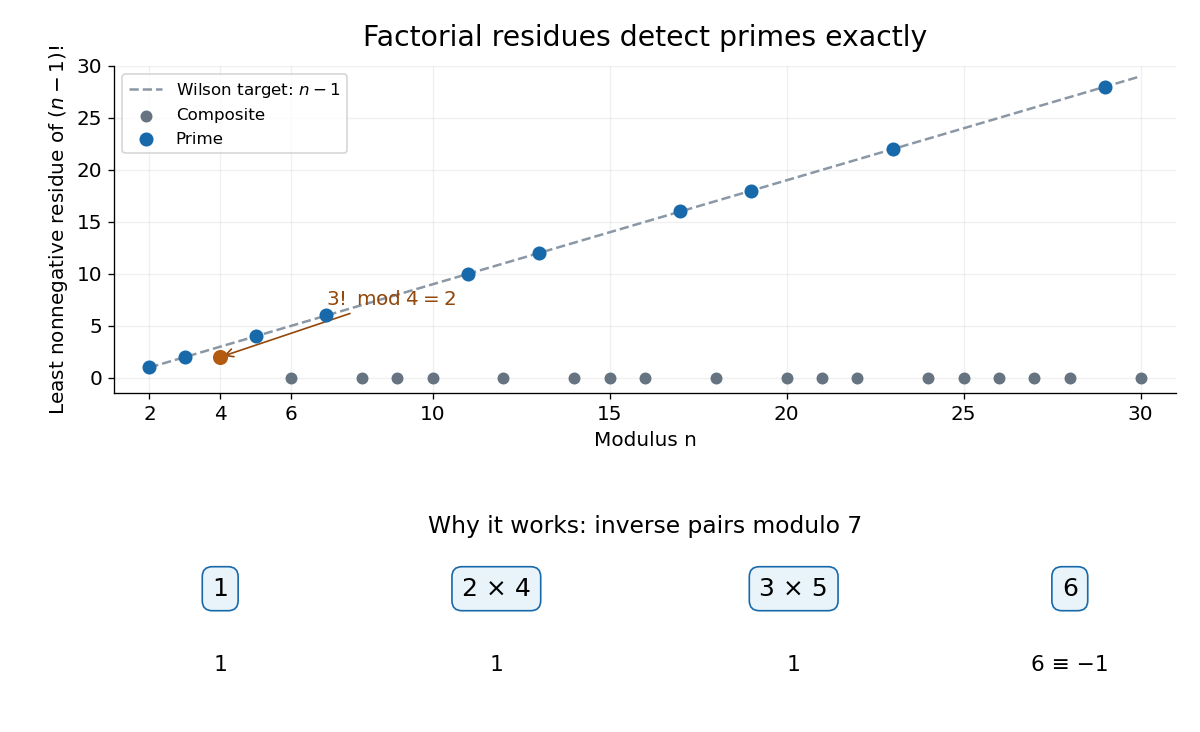
For an odd prime number , each nonzero congruence class has a unique modular multiplicative inverse. Pair each class with its inverse: each distinct pair contributes one. A class is its own inverse exactly when ; since , Euclid's lemma leaves only . Their product is . The prime number two needs a separate check: . Conversely, a proper divisor divides both and , so the displayed integer congruence would force , a contradiction. [ref]
The composite numbers have an even sharper pattern: for every composite number , but . To check the zero claim, write with . If , both occur as different factors in the factorial. If , the different factors and both occur since , and their product is divisible by . The only excluded case is . Thus four is an exception to the zero pattern, but still fails Wilson's theorem: its required remainder would be three.
This is an exact primality testing criterion, but direct evaluation is expensive: even reducing modulo after every multiplication still takes a number of multiplications proportional to , which grows exponentially with the number of binary digits of . The problem is not merely storing a huge factorial. The more useful role of Wilson's theorem is simplifying factorial expressions in modular arithmetic. For instance, if is a prime number, then gives by a modular multiplicative inverse.
For a positive modulus , integers are congruent when their difference is divisible by . This is an equivalence relation: zero is divisible by , changing sign preserves divisibility, and adding two divisible differences proves transitivity. Addition and multiplication respect it, because and . Its equivalence classes are the residue classes used in modular arithmetic.
The least nonnegative residue of an integer modulo a positive integer modulus is the unique representative of its congruence class in . Euclidean division gives . For example, , so ; the integer congruence does not assert equality of those two integers.
The positive integer in is the modulus. It specifies which differences are ignored: exactly the integer multiples of . It is distinct from the modulus of a complex number, which measures magnitude.
The diagram of is the set of atomic and negated atomic sentences true in the expansion by constants naming every element of . Its elementary diagram contains every sentence true in that expansion. Models of these diagrams correspond respectively to embeddings and elementary embeddings of .
Finite model theory studies first-order structures restricted to finite domains, and asks which properties can be expressed in specified formal languages. The restriction changes the available tools: ordinary first-order compactness does not hold when only finite models are admitted.
For example, the sentences saying there are at least distinct elements, one for every positive integer , have a finite model for each finite subset but no common finite model. This is a direct failure of finite compactness. Logical games, locality, and bounded-variable fragments then compare the expressive power of formulas on finite databases and graphs, linking definability with computational complexity theory.
Item nonresponse leaves a particular measurement unobserved while retaining other measurements on that individual. Unit nonresponse leaves all survey measurements unavailable. Adjusting for an observed auxiliary variable can address item nonresponse under missing at random, but does not identify the auxiliary-variable distribution among unit nonresponders. Extrapolation to them needs further assumptions or external information.
The right Rindler wedge is the open region of Minkowski spacetime. Coordinates , , , give metric . The wedge extends into Minkowski spacetime and is geodesically incomplete, while its constant- slices are Cauchy surfaces for the wedge itself.
Allow the four affine Minkowski coordinates to take independent complex values, obtaining with the holomorphic extension of the flat conformal metric. In two-spinor coordinates , the metric is proportional to . The twistor incidence relation associates a complex projective line to each affine point; compactification adds the points at conformal infinity.
For positive lapse , this time reparametrization gives a local Minkowski metric. If the new time coordinate ranges over the entire real line, it is a global isometry to Minkowski space. In particular gives and complete nonperiodic timelike geodesics. A lapse depending on the spatial coordinate instead can describe a different curved geometry; exchanging the arguments is not a harmless relabeling of the same metric.
With hypercharge normalized by , the renormalizable R-parity-conserving MSSM superpotential is , with . Additional renormalizable R-parity violation allows . The two antisymmetries are and . The first, second and fourth additional terms violate lepton number; the third violates baryon number.
A microkernel using security capabilities to control access to operating-system kernel objects, including IPC endpoints and software threads. An IPC endpoint connects cooperating user-space services; its security capabilities are distinct from the service-defined handle
9 in the microkernel file-read example. [ref]Capabilities tutorial by seL4 Project. Capabilities tutorial, Background: What is a capability?
For the microkernel file-read example, distinguish system call entry/exit, security capability lookup, payload transfer, process scheduling and context switches from the service's actual file lookup and read work. Entering a privileged processor privilege level and switching to a different address space are different events. A change of address space can affect the translation lookaside buffer; running different code and touching different computer memory can cause cache misses. Neither event implies that every translation lookaside buffer entry or cache line must be discarded.
A larger copied payload requires more transfer work; sharing memory pages can avoid copying that bulk data but introduces mapping and synchronization work. A service that requests another service adds another IPC exchange. If the cached file data were absent, communication with a device driver and the input-output wait would also matter. Blocking behind other requests affects observed response time even when the individual IPC operations are cheap.
These are cost sources, not timings or a universal ranking against a monolithic kernel. Implementation and CPU details matter: the construction analysis separates protected entry costs, address space switching, translation lookaside buffer effects and memory cache effects. [ref]
On micro-kernel construction by Jochen Liedtke. Liedtke, On micro-kernel construction, section 4.1, pp. 241–244: kernel-user switches, address-space switches, and discussion of hardware-dependent cache and TLB effects
Suppose the user-space service stops after receiving request
7, before replying. Assume that its private memory pages are not writable mappings of the client's or an unrelated service's computer memory, and that it lacks security capabilities to change their software threads. A failed store in the service cannot directly overwrite that private state through ordinary CPU address translation. Those assumptions establish a particular isolation boundary, not a successful read.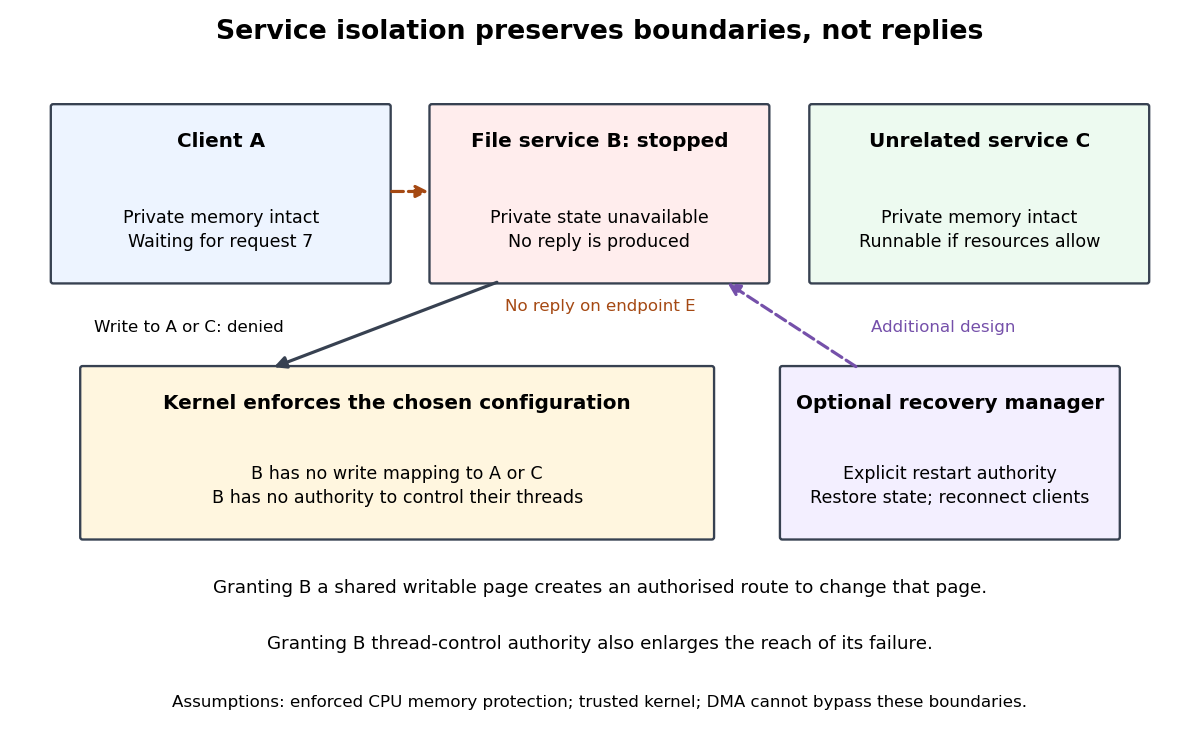
Memory protection and security capabilities limit a stopped service's reach; recovery needs an additional design
. Details. The client can remain blocked waiting for request
7. An unrelated runnable service may continue if process scheduling and resources permit, but clients that depend on the stopped service still lose access to its service. A separately authorized recovery manager would need to detect the failure, rebuild the service's state and arrange communication with its replacement. The microkernel architecture by itself supplies none of those application-specific recovery decisions.A missing reply also does not reveal whether a service crashed, is delayed by process scheduling, or entered an infinite computation. For a read, retrying after recovery may be straightforward; for a modifying operation, absence of a reply does not prove that the modification never happened. Recovery must account for ambiguous completed operations and any required file-system crash consistency.
The boundary changes with authority. A deliberately shared writable memory page allows the service to change its shared contents; a security capability controlling another software thread permits the corresponding control operations. A device driver with uncontrolled DMA can bypass ordinary CPU memory protection. Thus service placement and actual permissions must be considered together. [ref]
What the Proofs Assume by seL4 Project. What the Proofs Assume, The Assumptions: DMA and memory-mapped device registers
Consider an original toy file system service in address space B and a client in address space A, on one CPU. The service holds a five-byte cached file containing
LIME followed by a newline. The client already has service handle 9, permission to read that file, and a security capability to send requests to IPC endpoint E. Handle 9 is interpreted by the service; it is neither a virtual address nor an operating-system kernel object identifier. All relevant memory pages are resident, and this read needs no device driver.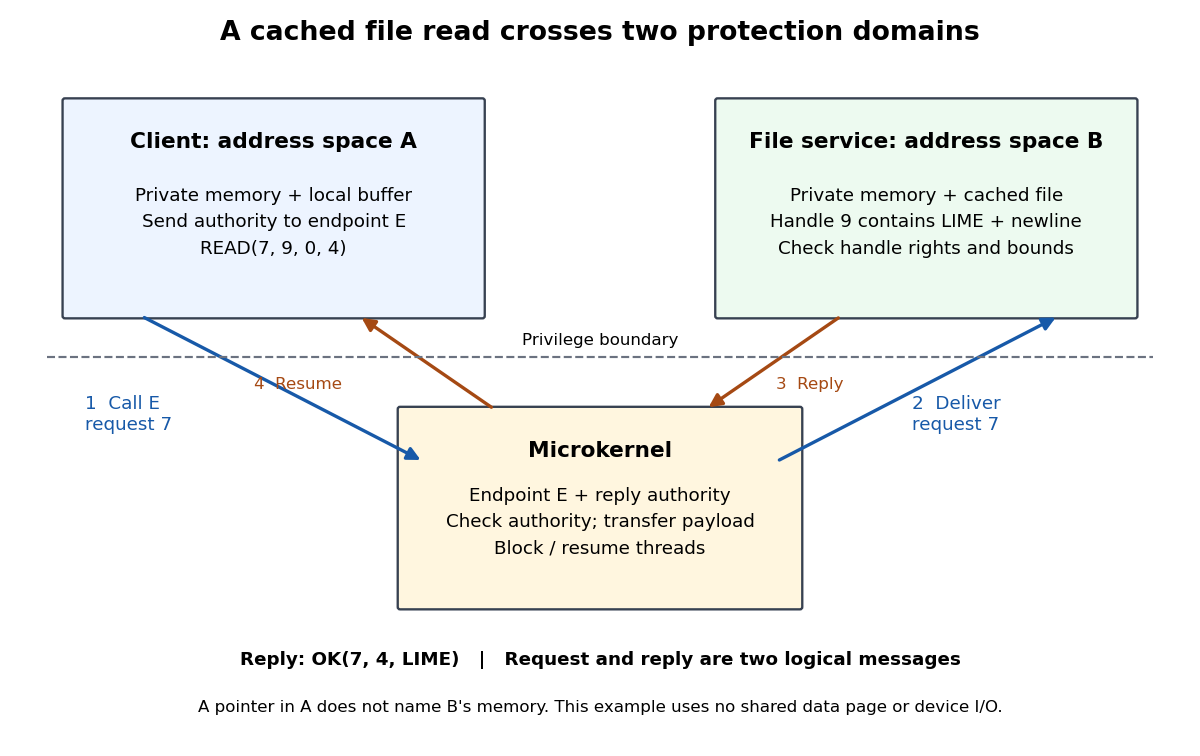
A cached file read uses IPC between separate address spaces, with authority checked by the microkernel
. Details. - The client submits
READ(7, 9, 0, 4): request identifier7, handle9, byte offset0, and requested length4. A system call enters the microkernel; the security capability is checked before delivery on IPC endpoint E. The client waits for a reply. - A waiting service software thread receives the request. The service checks the handle's read permission and the requested range, then obtains the first four bytes from its cached file. The microkernel transports the request; the service supplies its file system meaning.
- The service uses reply capability authority to return
OK(7, 4, LIME). The client resumes, checks the request identifier and returned length, and copies those four bytes into its own local buffer. There were two logical IPC messages: request and reply. The four arrows show delivery stages, not four separate requests.
This protocol is an illustrative design, not an actual seL4 file system interface. Its call/reply structure follows seL4's documented IPC:
seL4_Call waits using reply authority, and small payloads can travel in processor registers. [ref]An ordinary pointer in A refers to A's address space. Sending its numeric value does not make B's private computer memory appear there. This example explicitly transfers bytes. Sharing a mapped memory page instead would require intentional memory protection permissions and a protocol for ownership and synchronization; passing a pointer alone establishes neither.
The same IPC mechanism could carry
WRITE, but this client could still be refused by the service's read-only handle policy. Conversely, possession of an IPC endpoint security capability permits communication without automatically granting access to every file the service manages. The separation of mechanism and policy appears twice: endpoint authority gates delivery, and the service's handle policy gates the requested operation.Differentiating and multiplying by the inverse gives the displayed variation. It is the matrix inverse derivative, expressed with the covariant and contravariant components of a metric tensor.
For a nondegenerate metric tensor whose signature is fixed during the variation, the Jacobi formula gives . Differentiating the square root of the absolute determinant proves the displayed identity. Expressed through the variation of inverse metric, the formula is . Absolute values accommodate either Riemannian or Lorentzian signature.
Pinned article: Introduction to the OurBigBook Project
Welcome to the OurBigBook Project! Our goal is to create the perfect publishing platform for STEM subjects, and get university-level students to write the best free STEM tutorials ever.
Everyone is welcome to create an account and play with the site: ourbigbook.com/go/register. We belive that students themselves can write amazing tutorials, but teachers are welcome too. You can write about anything you want, it doesn't have to be STEM or even educational. Silly test content is very welcome and you won't be penalized in any way. Just keep it legal!
Intro to OurBigBook
. Source. We have two killer features:
- topics: topics group articles by different users with the same title, e.g. here is the topic for the "Fundamental Theorem of Calculus" ourbigbook.com/go/topic/fundamental-theorem-of-calculusArticles of different users are sorted by upvote within each article page. This feature is a bit like:
- a Wikipedia where each user can have their own version of each article
- a Q&A website like Stack Overflow, where multiple people can give their views on a given topic, and the best ones are sorted by upvote. Except you don't need to wait for someone to ask first, and any topic goes, no matter how narrow or broad
This feature makes it possible for readers to find better explanations of any topic created by other writers. And it allows writers to create an explanation in a place that readers might actually find it.
Figure 1. Screenshot of the "Derivative" topic page. View it live at: ourbigbook.com/go/topic/derivativeVideo 2. OurBigBook Web topics demo. Source. - local editing: you can store all your personal knowledge base content locally in a plaintext markup format that can be edited locally and published either:This way you can be sure that even if OurBigBook.com were to go down one day (which we have no plans to do as it is quite cheap to host!), your content will still be perfectly readable as a static site.
- to OurBigBook.com to get awesome multi-user features like topics and likes
- as HTML files to a static website, which you can host yourself for free on many external providers like GitHub Pages, and remain in full control

Figure 2. You can publish local OurBigBook lightweight markup files to either OurBigBook.com or as a static website.
Figure 3. Visual Studio Code extension installation.
Figure 5. . You can also edit articles on the Web editor without installing anything locally. Video 3. Edit locally and publish demo. Source. This shows editing OurBigBook Markup and publishing it using the Visual Studio Code extension. 
- Infinitely deep tables of contents:




All our software is open source and hosted at: github.com/ourbigbook/ourbigbook
Further documentation can be found at: docs.ourbigbook.com
Feel free to reach our to us for any help or suggestions: docs.ourbigbook.com/#contact