Topics (384k) Articles (398k) Users (410) Discussions (242) Comments (383) Files (13k) New article

Exocytosis releases the contents of a membrane-bounded compartment to the extracellular space by fusion with the cell membrane. Synaptic vesicle fusion is an example. Its contents are released, while its membrane becomes connected to the cell membrane; see synaptic vesicle for recovery and reuse.
Active transport moves a substance uphill in its electrochemical gradient by coupling the transfer to a downhill process. Some carrier proteins use ATP hydrolysis; others couple uphill transfer of one solute to downhill transfer of another solute, often an ion. The latter mechanism uses a stored electrochemical gradient and need not consume ATP directly at that carrier protein. Maintaining the driving electrochemical gradient still requires a source of energy. See Alberts et al.: carrier proteins and active membrane transport.
For the neutral 8:2 example, B-to-A transfer costs per mole. As an explicitly assumed bookkeeping example, suppose a tightly coupled cycle supplies a downhill free energy change of per mole of transferred solute. The total is then . This makes forward cycling energetically possible under those assumptions; it specifies neither a molecular mechanism nor a rate. Merely adding a carrier protein cannot supply the missing free energy. Conversely, as the transported concentration ratio rises, the required uphill cost rises, so a fixed driving process has a finite thermodynamic limit.
Passive transport is net movement down the transported substance's electrochemical gradient without coupling that movement to another source of free energy. Facilitated diffusion is passive transport through an ion channel or a passive carrier protein. Providing such a route can speed passage, but does not turn an uphill transfer into a downhill one. For an uncharged solute under the ideal conditions above, net passive transport runs from higher to lower concentration; for an ion, the membrane potential also matters. See Cooper, The Cell: transport of small molecules.
In the figure, stipulate eight neutral solute tracers in A and two in B, with equal fixed volumes, identical surroundings, and no imposed electric potential difference. The concentration ratio is , so A-to-B transfer has , or at the assumed temperature . If this solute can cross, thermodynamic equilibrium has equal expected concentrations: five tracers per side on average. Individual crossings occur in both directions; an observed ten-particle snapshot need not contain exactly five on each side. These stipulated counts illustrate a driving force, not a measured flow rate or a prediction of the time to equilibrate.
For a separate illustrative ion calculation, keep , but assign and at . Using and , B-to-A transfer gives . Thus an appropriate open ion channel can permit passive transport toward the higher concentration: the electrical contribution outweighs the opposing chemical potential contribution. This stipulated membrane potential is not inferred from the tracer counts.
A membrane transport protein enables selected substances to cross a cell membrane. A membrane channel forms a permeation pathway, whereas a carrier binds its cargo and changes conformation. Transport can follow an electrochemical gradient or be coupled to an energy source to move material against it. For example, GLUT4 supports facilitated glucose transport, whereas the sodium-potassium ATPase couples transport to ATP hydrolysis. Selectivity and transport mechanism are separate properties. [ref]
An Errors-in-variables model distinguishes a latent true predictor from its noisy measurement and models both the measurement and the response. For example, and , with a population distribution for , propagate predictor uncertainty into inference on . Treating as exact can create attenuation bias from classical measurement error. Identifiability requires appropriate information about the measurement process or latent predictor distribution.
Measurement noise is a fluctuating contribution to measurement error. An additive model for a measured output is , where is the actual plant output. A controller using feedback control can react to as though it were a change in the plant output. This effect is absent from the ideal noiseless examples under control theory; an errors-in-variables model represents a related distinction between latent quantities and their noisy observations.
Faraday's law of induction relates a changing magnetic field to circulation of the electric field. For a fixed oriented surface with boundary , choose the positive direction around by the right-hand rule: the fingers follow while the thumb follows the chosen unit normal. The fixed-loop electromagnetic electromotive force isThe final derivative of magnetic flux is an ordinary time derivative, with the surface held fixed. Reversing both the unit normal and the boundary direction reverses both signs. The loop may be an imagined path: the field law does not require a wire or an electric current. [ref]
https://www.feynmanlectures.caltech.edu/II_17.html#Ch17-S1. Feynman lectures, II.17.1: electric-field circulation and induction
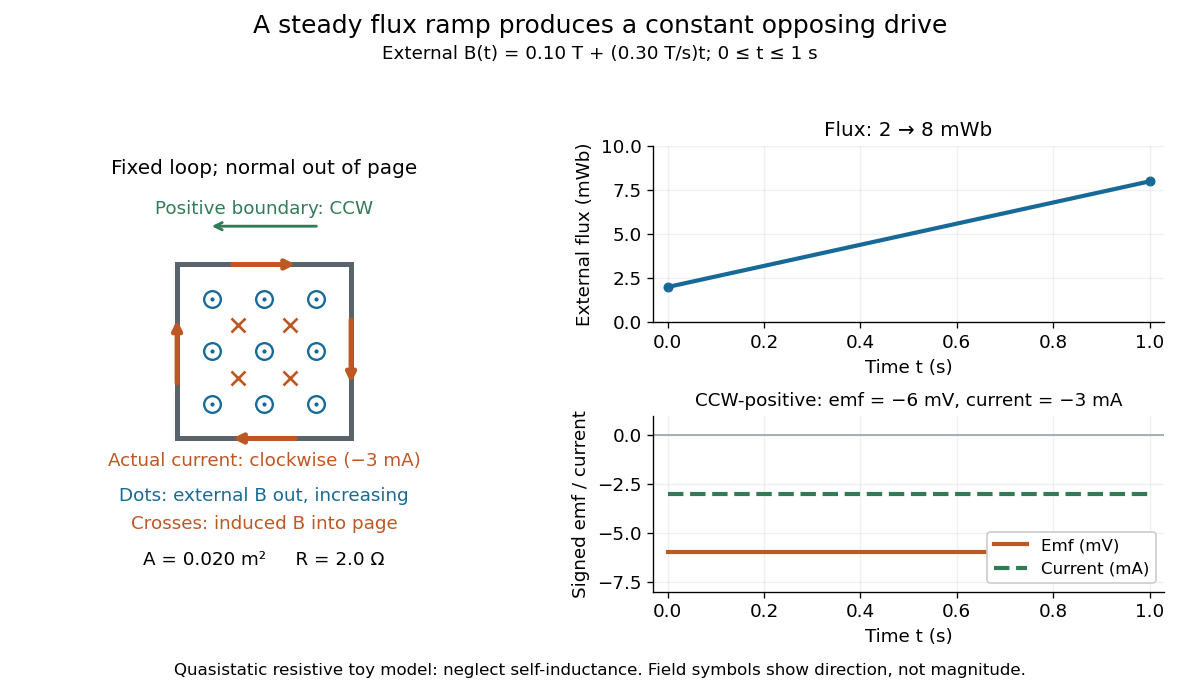
.For a computed example, a fixed single-turn loop has area and out-of-page unit normal. Prescribe an external uniform magnetic field in that direction with for . ThenIn a quasistatic resistive model with electrical resistance , neglect the loop's self-inductance and its own contribution to changing magnetic flux. Ohm's law givesThe magnetic flux rises from to while the induced electromotive force stays constant: it measures the rate of change, rather than the amount of magnetic flux. The negative sign means clockwise electric current; its magnetic field through the loop points into the page, as explained by Lenz's law. The toy model describes the interval of steady ramping, excluding switching transients at its ends.
For a moving conducting loop , the electromagnetic electromotive force instead includes the Lorentz force contribution from the local velocity of each conductor segment:This form assumes a thin-wire model with a well-defined closed contour and spanning oriented surface that move compatibly, a magnetic field satisfying Gauss's law for magnetism, and conductor speeds small compared with the speed of light. Ideal sliding contacts such as those in motional electromotive force can be treated piecewise. Arbitrary changes of electrical connections require checking the actual contour and conductor velocities; differentiating the flux through an arbitrary chosen moving path is insufficient. The velocity here describes conductor motion, not the charge carriers' drift along the wire. [ref]
https://www.feynmanlectures.caltech.edu/II_17.html#Ch17-S2. Feynman lectures, II.17.2: limits of the flux rule
.A short derivation of the fixed-loop integral statement applies Stokes theorem to the local curl equation and differentiates under the fixed surface integral. For the moving loop, the magnetic flux transport for a moving circuit adds the swept-area term to . Combining these two identities gives the moving-loop statement. This derives the integral forms from the local field law; it is not a proof of that empirical law from mathematics alone.
The useful unity is geometric: changing the magnetic field, the enclosed area, or the orientation can change magnetic flux and hence produce an electromotive force. A coil's multiple turns are accounted for by magnetic flux linkage, rather than by multiplying a single-turn flux without checking which flux each turn receives. [ref]
https://openstax.org/books/university-physics-volume-2/pages/13-1-faradays-law. OpenStax University Physics 2, §13.1: flux changes and coils
.Faraday's report read on 24 November 1831 describes opposite momentary responses when a neighboring circuit is connected and disconnected, with no continuing response while its steady electric current is maintained. These are concrete experimental roots of the changing-flux idea. The report predates the modern Maxwell equations notation used above. [ref]
Experimental Researches in Electricity, Volume 1 by Michael Faraday. Faraday, Experimental Researches in Electricity, First Series (1831), §§10–11, reprinted in volume I
.The magnetic nonrelativistic limit neglects displacement current and uses , , . Under a Galilean transformation , , its consistent field transformations are , and . Indeed and , giving covariance of the induction equation. The full charge-current transformation has ; neglecting its convective correction belongs to the magnetic quasineutral approximation, not exact relativistic electrodynamics. With , the combination is invariant. Vanishing electric field in the fluid rest frame therefore gives the ideal magnetohydrodynamic induction equation.
Use the negative curvature convention defined in curvature-sign convention in Killing derivative identities, and . Covariant derivatives of a vector obey . Hence the flat-space equivalent expressions and acquire a difference under the comma-to-semicolon prescription. Covariantizing and its Maxwell equations gives . This form respects gauge invariance. Dropping the Ricci term is generally not gauge invariant. The two expressions coincide in a Ricci-flat vacuum spacetime; vanishing matter alone with nonzero cosmological constant does not imply Ricci flatness.
Vacuum Maxwell equations without sources are invariant under , . At this is , . Electric-conductor boundary conditions are not invariant under arbitrary duality rotations; the transformed fields must be tested separately against the wall conditions.
A reductio rejects an assumption by deriving an absurd or contradictory consequence from it. In a classical mathematical proof of , assume its negation and derive a contradiction. Constructively the same argument yields the double negation of ; removing it requires an additional logical principle. This differs from proving a negation directly by deriving a contradiction from the positive assumption.
A structure consists of a domain together with interpretations of the symbols of a formal language. In the usual finitary setting it interprets constant, function, and relation symbols of their declared arities. A first-order structure is such an interpretation for first-order logic.
Overspill is the principle that an internal subset of a nonstandard extension containing every standard natural number must contain some nonstandard natural number. The overspill lemma is its definable-set instance in nonstandard arithmetic.
Craig's theorem says that a theory with a computably enumerable axiomatization has an equivalent decidable axiomatization. The Craig trick gives a constructive proof by encoding an enumeration index in repeated conjunctions of the enumerated axiom.
A theory is a set of sentences in a formal language, sometimes understood to be closed under deduction. A first-order theory uses a first-order language; consistency and completeness are separate properties of a theory.
A sentence is a closed formula, with no free variable occurrences. Its truth does not depend on a variable assignment. A first-order sentence uses a first-order formal language.
A variable occurrence is bound when it falls within the scope of a binding operation that binds that occurrence; otherwise it is free. Quantifiers and lambda abstractions are common binders. In first-order formulas, a free variable occurrence is outside the scope of a corresponding quantifier.
A proof system is sound with respect to its semantics when every derivable conclusion is true in every interpretation satisfying its premises. Both soundness theorem for propositional logic and soundness theorem for first-order logic establish this property for particular languages and semantics.
A theory has the disjunction property when provability of a closed disjunction implies provability of one disjunct. It has the existence property when a provable existential sentence has a witness whose substitution is provably valid. These are distinct constructive properties; disjunction property of intuitionistic propositional logic is one instance of the former.
Kripke semantics interprets logical formulas at worlds related by an accessibility relation or an information order. Modal logics use accessibility to interpret modal operators; intuitionistic logics use persistent valuations and quantify over stronger worlds for implication.
Pinned article: Introduction to the OurBigBook Project
Welcome to the OurBigBook Project! Our goal is to create the perfect publishing platform for STEM subjects, and get university-level students to write the best free STEM tutorials ever.
Everyone is welcome to create an account and play with the site: ourbigbook.com/go/register. We belive that students themselves can write amazing tutorials, but teachers are welcome too. You can write about anything you want, it doesn't have to be STEM or even educational. Silly test content is very welcome and you won't be penalized in any way. Just keep it legal!
Intro to OurBigBook
. Source. We have two killer features:
- topics: topics group articles by different users with the same title, e.g. here is the topic for the "Fundamental Theorem of Calculus" ourbigbook.com/go/topic/fundamental-theorem-of-calculusArticles of different users are sorted by upvote within each article page. This feature is a bit like:
- a Wikipedia where each user can have their own version of each article
- a Q&A website like Stack Overflow, where multiple people can give their views on a given topic, and the best ones are sorted by upvote. Except you don't need to wait for someone to ask first, and any topic goes, no matter how narrow or broad
This feature makes it possible for readers to find better explanations of any topic created by other writers. And it allows writers to create an explanation in a place that readers might actually find it.
Figure 1. Screenshot of the "Derivative" topic page. View it live at: ourbigbook.com/go/topic/derivativeVideo 2. OurBigBook Web topics demo. Source. - local editing: you can store all your personal knowledge base content locally in a plaintext markup format that can be edited locally and published either:This way you can be sure that even if OurBigBook.com were to go down one day (which we have no plans to do as it is quite cheap to host!), your content will still be perfectly readable as a static site.
- to OurBigBook.com to get awesome multi-user features like topics and likes
- as HTML files to a static website, which you can host yourself for free on many external providers like GitHub Pages, and remain in full control

Figure 2. You can publish local OurBigBook lightweight markup files to either OurBigBook.com or as a static website.
Figure 3. Visual Studio Code extension installation.
Figure 5. . You can also edit articles on the Web editor without installing anything locally. Video 3. Edit locally and publish demo. Source. This shows editing OurBigBook Markup and publishing it using the Visual Studio Code extension. 
- Infinitely deep tables of contents:



All our software is open source and hosted at: github.com/ourbigbook/ourbigbook
Further documentation can be found at: docs.ourbigbook.com
Feel free to reach our to us for any help or suggestions: docs.ourbigbook.com/#contact