Topics (384k) Articles (398k) Users (410) Discussions (242) Comments (383) Files (13k) New article

A researcher and teacher in fluid mechanics whose cylinder-flow experiment connects surface-pressure measurements with aerodynamic drag. The apparatus places a cylinder in a wind tunnel, uses a Pitot-static tube to characterize the incoming flow, and connects surface pressure tappings to pressure-measuring instruments. Comparing measured pressures around the cylinder with ideal-flow predictions exposes the importance of the boundary layer and separated wake. The exercise links instrument readings to the failure of an otherwise elegant flow model.[ref]
Hugo Touchette develops connections between the large deviation principle and statistical mechanics. Rare fluctuations often have probabilities that decrease exponentially with system size or observation time; their rate function captures information beyond a local Gaussian approximation. His treatment uses this structure to derive variational descriptions of equilibrium and nonequilibrium states. Nonconcave entropies expose limits of ordinary Legendre transforms and help explain why different statistical ensembles need not be equivalent.[ref]
The large deviation approach to statistical mechanics by Hugo Touchette. Physics Reports 478, 1–69 (2009), abstract and equilibrium/nonequilibrium variational formulations

Portrait of Hugo Touchette
. External portrait hosted by Stellenbosch University. Source.A researcher in quantum optics who coauthored the 2016 analysis of two-source optical resolution with Mankei Tsang and Ranjith Nair. Their analysis connects measurement design to the precision of separation estimates, explaining why overlapping images need not imply indistinguishable source positions.[ref]

Portrait of Xiao-Ming Lu
. Source. A researcher in quantum optics, and coauthor with Mankei Tsang and Xiao-Ming Lu of a 2016 theory of resolving two incoherent light sources. Their result concerns estimating a separation even when the intensity images overlap: changing the optical measurement can preserve precision that ordinary imaging loses. Possible applications include distinguishing nearby stars.[ref]
Quantum Theory of Superresolution for Two Incoherent Optical Point Sources by Mankei Tsang and others. Abstract: simultaneously emitting sources, far-field estimation and astronomical application
A physicist working on quantum optics and the limits of optical resolution. With Ranjith Nair and Xiao-Ming Lu, he showed that the difficulty of estimating the separation of two nearby, mutually incoherent sources depends on the measurement: suitable linear optics and photon counting retain information lost by ordinary imaging. This makes the Rayleigh criterion a limitation of a particular imaging method rather than a universal precision bound.[ref]
Quantum Theory of Superresolution for Two Incoherent Optical Point Sources by Mankei Tsang and others. Abstract: separation estimation using linear optics and photon counting
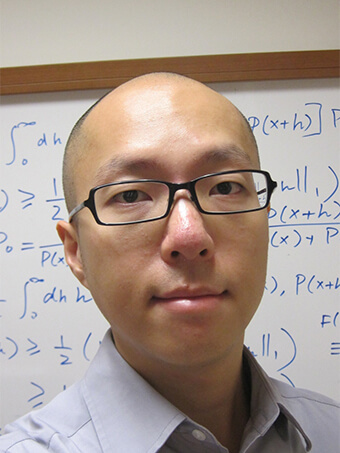
Portrait of Mankei Tsang
. Source. A researcher and microscopy educator whose tutorials explain how optical design limits the detail visible in a microscope. His account of numerical aperture connects the light-collection cone and the immersion medium’s refractive index with the objective’s ability to capture diffracted light. This makes clear why greater magnification alone need not reveal more structure: an objective must collect the angular components carrying that structure before a larger image can show it.[ref]
Numerical Aperture by Michael W. Davidson. Formula 1 and accompanying light-cone discussion: refractive index, angular aperture and resolution
A researcher whose joint microscopy work investigated recovering the optical point spread function from images of finite fluorescent beads. The study evaluates deconvolution as a correction for bead size, while also testing a deliberately modified response with nearby peaks. The calibration object and the optical model must therefore be analyzed together.[ref]
Measurement of point-spread function (PSF) for confocal fluorescence microscopy by InCheon Song and others. Abstract and results: deconvolution, finite-particle errors and phase-modulated two-peak response
A researcher whose team examined the use of fluorescent microspheres as optical calibration objects. Their confocal-microscopy study shows how the marker’s finite size changes the measured point spread function, linking the physical test object with the apparent resolving performance of the instrument.[ref]
Measurement of point-spread function (PSF) for confocal fluorescence microscopy by InCheon Song and others. Author list and abstract: fluorescent-particle size, measured response and experimental validation
A researcher whose joint work tests point spread function measurements using fluorescent beads. A bead image represents the convolution of the object with the microscope response. Comparing different bead sizes helps determine when the particle is small enough to serve as a useful approximation to a point source.[ref]
Measurement of point-spread function (PSF) for confocal fluorescence microscopy by InCheon Song and others. Abstract and §3.2: finite-size effects and bead comparisons
A researcher whose team investigated how fluorescent microsphere size affects measurements of a confocal point spread function. A finite bead is an extended object, so its image includes both optical blur and its own dimensions. The study combines numerical calculations with measurements to assess that calibration bias.[ref]
Measurement of point-spread function (PSF) for confocal fluorescence microscopy by InCheon Song and others. Abstract and §§2–3: bead-size effects, numerical predictions and experimental comparison
A physics researcher whose joint demonstration used a Stirling engine with a copper-wool regenerator. Gas passing between hot and cold regions temporarily transfers heat to this material and retrieves it on the return passage. The apparatus gives a concrete illustration of internal heat recovery during a thermodynamic cycle.[ref]
Demonstration experiments with a Stirling engine by Christopher G Deacon and others. p. 180 and Fig. 1: central regenerator and alternating heat exchange
A contributor to experiments that use a Stirling engine to demonstrate both a heat engine and refrigeration. Driving the apparatus mechanically reverses its function: instead of extracting work from a temperature difference, it moves heat between regions. The same machine therefore connects two thermodynamic operating modes.[ref]
Demonstration experiments with a Stirling engine by Christopher G Deacon and others. pp. 180–183: engine operation and refrigerator/heat-pump demonstrations
A researcher whose joint teaching experiment displayed the pressure-volume cycle of a Stirling engine. Heating one part of the cylinder and water-cooling another drives repeated expansion and compression. The resulting diagram lets students distinguish a complete engine cycle from a single gas-expansion process.[ref]
Demonstration experiments with a Stirling engine by Christopher G Deacon and others. pp. 180–181: heated and cooled regions and pressure-volume demonstration
A physics educator whose joint work turned a Stirling engine into a quantitative thermodynamics demonstration. A moving mirror and laser spot trace changes in pressure and volume. The enclosed loop makes pressure-volume work visible, connecting the engine’s moving pistons with an energy balance.[ref]
Manfred Bayer coauthored the 2014 observation of Rydberg excitons in cuprous oxide. The electron-hole bound states reached principal quantum numbers up to 25, with spatial extents measured on micrometre scales. Their large size strengthens interactions between excitations, and the experiment found evidence that one excitation suppresses creation of another nearby. The result brings highly excited atomic-like states and collective optical effects into a solid.[ref]
Giant Rydberg Excitons in Cuprous Oxide by Tomasz Kazimierczuk and others. Nature Materials 13 (2014), abstract: high principal quantum numbers, size and blockade

Portrait of Manfred Bayer
. Benito Barajas / TU Dortmund. External portrait hosted by TU Dortmund University. Source.A researcher whose team studied large excitons in cuprous oxide. The 2014 result showed that electron–electron hole bound states can have spatial extents thousands of times larger than a typical ground-state exciton, opening an experimental route to strongly interacting optical excitations within a solid.[ref]
A researcher in quantum optics whose joint work on Rydberg excitons connects highly excited atomic states with optical excitations in semiconductors. The 2014 study found evidence of Rydberg blockade: the presence of one large exciton suppresses the creation of another nearby.[ref]
Giant Rydberg Excitons in Cuprous Oxide by Tomasz Kazimierczuk and others. Abstract: dipole interactions and suppression of nearby excitation
A researcher who contributed to the 2014 observation of Rydberg excitons in a semiconductor. Their large spatial extent strengthens interactions between excitations, making these states useful for studying collective optical behavior in a crystal rather than only the properties of isolated electron–electron hole pairs.[ref]
Giant Rydberg Excitons in Cuprous Oxide by Tomasz Kazimierczuk and others. Abstract: large exciton size, interactions and possible ordered phases
Pinned article: Introduction to the OurBigBook Project
Welcome to the OurBigBook Project! Our goal is to create the perfect publishing platform for STEM subjects, and get university-level students to write the best free STEM tutorials ever.
Everyone is welcome to create an account and play with the site: ourbigbook.com/go/register. We belive that students themselves can write amazing tutorials, but teachers are welcome too. You can write about anything you want, it doesn't have to be STEM or even educational. Silly test content is very welcome and you won't be penalized in any way. Just keep it legal!
Intro to OurBigBook
. Source. We have two killer features:
- topics: topics group articles by different users with the same title, e.g. here is the topic for the "Fundamental Theorem of Calculus" ourbigbook.com/go/topic/fundamental-theorem-of-calculusArticles of different users are sorted by upvote within each article page. This feature is a bit like:
- a Wikipedia where each user can have their own version of each article
- a Q&A website like Stack Overflow, where multiple people can give their views on a given topic, and the best ones are sorted by upvote. Except you don't need to wait for someone to ask first, and any topic goes, no matter how narrow or broad
This feature makes it possible for readers to find better explanations of any topic created by other writers. And it allows writers to create an explanation in a place that readers might actually find it.
Figure 1. Screenshot of the "Derivative" topic page. View it live at: ourbigbook.com/go/topic/derivativeVideo 2. OurBigBook Web topics demo. Source. - local editing: you can store all your personal knowledge base content locally in a plaintext markup format that can be edited locally and published either:This way you can be sure that even if OurBigBook.com were to go down one day (which we have no plans to do as it is quite cheap to host!), your content will still be perfectly readable as a static site.
- to OurBigBook.com to get awesome multi-user features like topics and likes
- as HTML files to a static website, which you can host yourself for free on many external providers like GitHub Pages, and remain in full control

Figure 2. You can publish local OurBigBook lightweight markup files to either OurBigBook.com or as a static website.
Figure 3. Visual Studio Code extension installation.
Figure 5. . You can also edit articles on the Web editor without installing anything locally. Video 3. Edit locally and publish demo. Source. This shows editing OurBigBook Markup and publishing it using the Visual Studio Code extension. 
- Infinitely deep tables of contents:


All our software is open source and hosted at: github.com/ourbigbook/ourbigbook
Further documentation can be found at: docs.ourbigbook.com
Feel free to reach our to us for any help or suggestions: docs.ourbigbook.com/#contact