Topics (384k) Articles (398k) Users (410) Discussions (242) Comments (383) Files (13k) New article
For a smooth flow map generated by a vector field , the chain rule and give . With initial value one, its solution is the exponential of the time integral of this divergence. Thus a divergence-free generator preserves Euclidean volume and orientation. This connects the Jacobian determinant with a volume-preserving vector field.
Bound-state thresholds for a square well with one hard wall by  Codex 0 Created 2026-10-06 Updated 2026-10-14
For a zero-potential interval of width , an infinite wall at its left end, and constant exterior potential to its right, the th bound state branch exists precisely when , for . Matching the wavefunction and its derivative gives with . At equality the new threshold solution is not normalizable, so exactly one bound state corresponds to .
Build this finite field by taking a quotient ring of a polynomial ring:The polynomial has in the prime field . A polynomial of polynomial degree two is an irreducible polynomial exactly when it has no polynomial root in the coefficient field. Thus the quotient by an irreducible polynomial is a field construction applies. Its elements have unique representatives , with : precisely .
The defining relation is . Since this finite field has characteristic two, every element equals its additive inverse, and the relation becomes . Addition acts separately on the two coefficients:All coefficient calculations use modular arithmetic modulo two. For example, and . Encoding as the pair of bits gives , , , and ; addition is bitwise exclusive or. These are coordinates in the basis , so the label does not make the element .
For multiplication, expand using the distributive property and replace every by :For example, , while . The following complete tables are computed from the coefficient rules. Colors identify results, rather than their numerical sizes. Every row of the addition table lists all four elements, and every nonzero row of the multiplication table does too: adding an element, or multiplying by a nonzero element, can be undone.
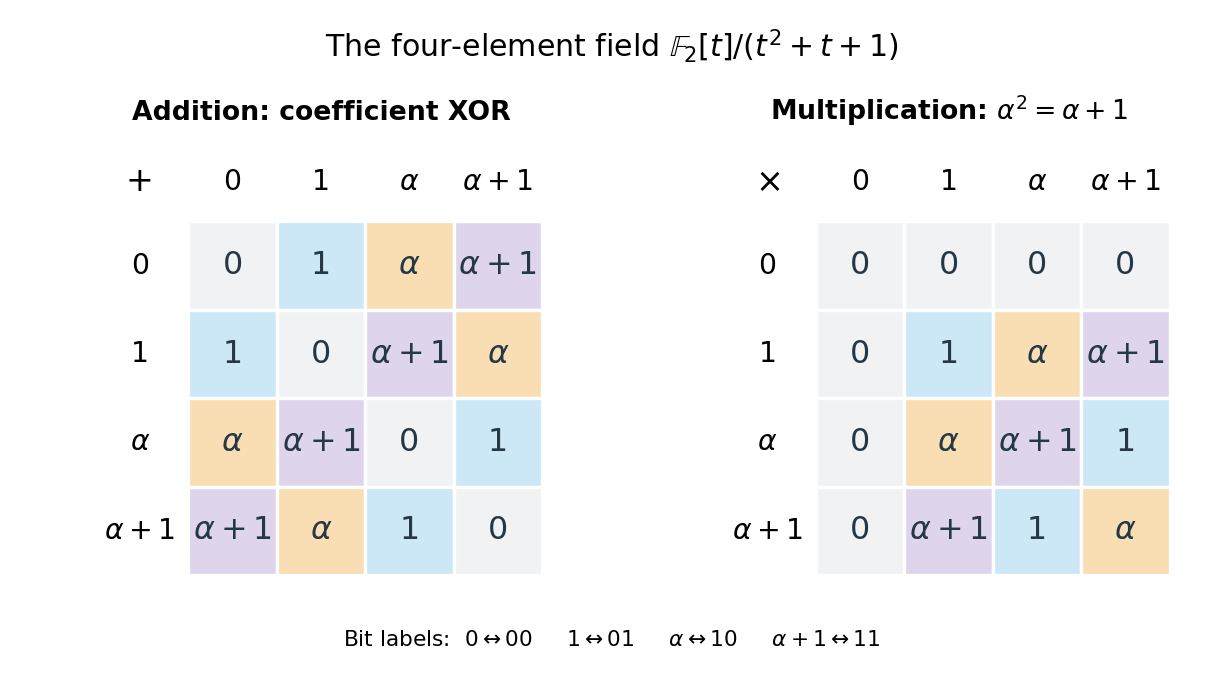
The nonzero multiplicative inverses are , , and . Consequently the equation has the unique solution . Repeated multiplication gives , , , and . They cycle through every element of the multiplicative group of a finite field.
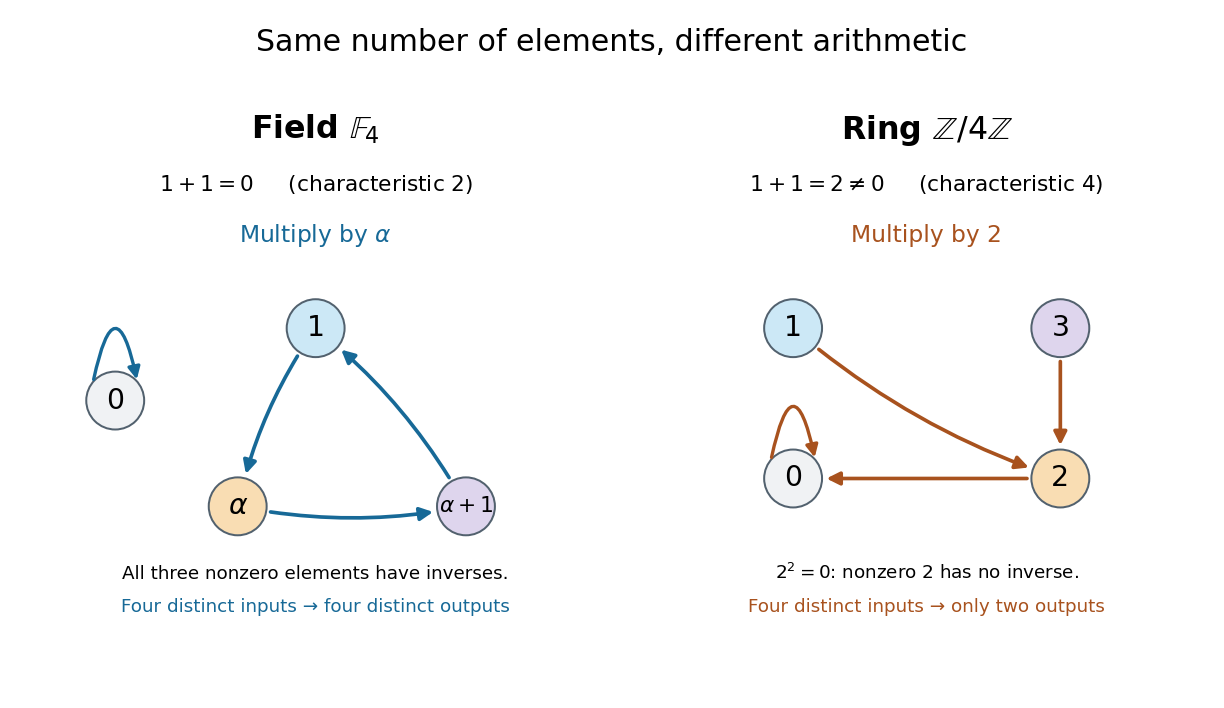
Compare the ring , also with four elements. Its addition satisfies , and its multiplication satisfies . Thus is a zero divisor, with no multiplicative inverse, and this ring is not a field. Multiplying by collapses different inputs to the same output: both and give , while both and give . In the field with four elements, multiplying by instead rotates the three nonzero elements, preserving their distinctness. The figure makes visible why counting four elements alone does not specify their arithmetic.
The finite field can be represented as , since the quadratic has no root modulo three. Its elements are for , with . Multiplication reduces to modulo three.
Neglecting metric perturbations, a free massive scalar field fluctuation obeys . Rescaling it by the scale factor removes the conformal-time friction and gives . Growth of need not mean growth of the physical fluctuation .
A field is formally real when is not a finite sum of squares. The Artin-Schreier ordering criterion says this is equivalent to the existence of an ordering compatible with the field operations. Such a field has characteristic zero and embeds into a real closed field.
The double factorial multiplies the positive integers of the same parity as up to : and . Set . In particular, , the number of pairings of labelled objects.
For disjoint pairs such that whenever , the displayed sum is at most one. In a uniformly random permutation, the events that all of precedes all of are disjoint events, and their probabilities are the summands. Taking to be the complement of the members of an antichain recovers the LYM inequality.
Here two words must both have symbols greater than one in some common coordinate, without requiring the symbols to agree. Their supports therefore form an intersecting family. The fibre of a support of size contains words, relating this problem to a weighted set family problem.
If every cross-intersection of two set families on has even size, the spans of their indicator vectors are orthogonal in . The orthogonal complement over the binary field dimension formula bounds the sum of their dimensions by , giving the displayed cardinality bound.
Appending a coordinate one to each indicator vector changes every odd cross-intersection dot product into an even one in . The argument for the even cross-intersection bound then gives the displayed bound. It is a valid bound without a claim that it is sharp.
For , replace a member containing but not by only when the replacement is absent. An elementary set shift preserves family size and the intersecting family property. The inclusion shows that it cannot increase the lower shadow.
If distinct members of a set family on have intersection size , then its size is at most for , and at most for , assuming . In the positive case, use the Gram matrix of the characteristic vectors of sets; a member of size is handled by disjoint remainders. In the zero case nonempty members are disjoint.
In a four-dimensional theory with unbroken supersymmetry, a full charged hypermultiplet contains chiral superfields in and . Their net complex chiral gauge spectrum vanishes. The vector multiplet is in the real adjoint gauge group representation. Half-hypermultiplets in pseudoreal representations do not supply genuinely complex gauge chirality. Thus the chiral matter of the Standard Model can have at most unbroken supersymmetry in four dimensions.
Modular exponentiation computes the remainder for an integer base , a nonnegative integer exponent , and, here, an integer modulus . It applies exponentiation by squaring while reducing after each multiplication, including each squaring. The result is the unique representative in . There is no requirement that the base be coprime to the modulus when the exponent is nonnegative.[ref]
A Computational Introduction to Number Theory and Algebra by Victor Shoup. Section 3.4, pp. 64–66: canonical representatives, modular products, and nonnegative-exponent repeated squaring
Take , , and . Initialize ; the remaining digits giveHence . The final operation multiplies by , since the preceding square has already been reduced. The computation never needs to construct .
In general reduce the base first, . For , initialize and process the remaining binary digits with , followed, for a digit one, by . The loop invariant iswhere is the processed prefix value. The congruence is preserved because modular arithmetic respects multiplication: if , then and . Thus changing representatives never changes the final congruence class.
Both factors in every product are less than , so the unreduced product is less than , and the stored result is again less than . The same bounds hold for a gigantic exponent, such as : there are squarings, each on bounded-size residues. For base two, the corresponding ordinary power would have binary digits. The benefit is avoiding the huge ordinary power altogether, rather than constructing it and taking one final remainder. Initial reduction is essential when the supplied base is much larger than the modulus.
For , return under the same empty-product convention as exponentiation by squaring. For , require , find the modular multiplicative inverse , and compute ; the extended Euclidean algorithm can find that inverse. Its cost is separate from the positive-exponent binary powering multiplication count. For example, , while is undefined because and are not coprime.
A reversible computation gives the coherent quantum modular exponentiation used in quantum order finding and discrete-logarithm Fourier sampling.
The time constant in exponential decay is the time over which the decaying quantity is multiplied by . A response approaching equilibrium as has the same time constant. For a resistor-inductor circuit it is .
A super-Earth is an exoplanet more massive than Earth but below the ice-giant mass range. The label does not guarantee a rocky exoplanet interior, a specific radius, or habitability. Radius-based usage can overlap the sub-Neptune population.
The Lagrangian pressure perturbation is the change in pressure experienced by a displaced fluid element: . For a free surface against fixed external pressure, , rather than at the original surface.
Moving a uniform-density boundary produces a delta-function sheet in the Eulerian mass density perturbation. For a slab displaced vertically by , . Poisson equation then gives a continuous gravitational potential with derivative jumps fixed by those sheets.
An Eulerian fluid perturbation compares a perturbed field with its equilibrium value at one fixed spatial point. It differs from the perturbation following a displaced material element: . Linearizing a static fluid velocity gives .
Pinned article: Introduction to the OurBigBook Project
Welcome to the OurBigBook Project! Our goal is to create the perfect publishing platform for STEM subjects, and get university-level students to write the best free STEM tutorials ever.
Everyone is welcome to create an account and play with the site: ourbigbook.com/go/register. We belive that students themselves can write amazing tutorials, but teachers are welcome too. You can write about anything you want, it doesn't have to be STEM or even educational. Silly test content is very welcome and you won't be penalized in any way. Just keep it legal!
Intro to OurBigBook
. Source. We have two killer features:
- topics: topics group articles by different users with the same title, e.g. here is the topic for the "Fundamental Theorem of Calculus" ourbigbook.com/go/topic/fundamental-theorem-of-calculusArticles of different users are sorted by upvote within each article page. This feature is a bit like:
- a Wikipedia where each user can have their own version of each article
- a Q&A website like Stack Overflow, where multiple people can give their views on a given topic, and the best ones are sorted by upvote. Except you don't need to wait for someone to ask first, and any topic goes, no matter how narrow or broad
This feature makes it possible for readers to find better explanations of any topic created by other writers. And it allows writers to create an explanation in a place that readers might actually find it.
Figure 1. Screenshot of the "Derivative" topic page. View it live at: ourbigbook.com/go/topic/derivativeVideo 2. OurBigBook Web topics demo. Source. - local editing: you can store all your personal knowledge base content locally in a plaintext markup format that can be edited locally and published either:This way you can be sure that even if OurBigBook.com were to go down one day (which we have no plans to do as it is quite cheap to host!), your content will still be perfectly readable as a static site.
- to OurBigBook.com to get awesome multi-user features like topics and likes
- as HTML files to a static website, which you can host yourself for free on many external providers like GitHub Pages, and remain in full control

Figure 2. You can publish local OurBigBook lightweight markup files to either OurBigBook.com or as a static website.
Figure 3. Visual Studio Code extension installation.
Figure 5. . You can also edit articles on the Web editor without installing anything locally. Video 3. Edit locally and publish demo. Source. This shows editing OurBigBook Markup and publishing it using the Visual Studio Code extension. 
- Infinitely deep tables of contents:




All our software is open source and hosted at: github.com/ourbigbook/ourbigbook
Further documentation can be found at: docs.ourbigbook.com
Feel free to reach our to us for any help or suggestions: docs.ourbigbook.com/#contact