Topics (384k) Articles (398k) Users (410) Discussions (242) Comments (383) Files (13k) New article

On Euclidean space, every Killing vector field is a constant translation generator plus a constant infinitesimal rotation generator:Here is a constant vector and is an antisymmetric matrix. The second covariant derivative of a Killing vector vanishes for the Euclidean metric, so the components are affine functions of Cartesian coordinates; the Killing equation makes the linear coefficient antisymmetric.
In the Euclidean plane with metric tensor , two useful examples areThe notation denotes a coordinate basis vector; denotes a differential one-form. The corresponding flow of a vector field maps areFor translation, all arrows have the same direction and length. For rotation, arrows are tangent to circles, have length , and vanish at the origin. The rotation flow keeps fixed, and its nonstationary integral curves of a vector field are circles. Both flows preserve the Euclidean metric. See Carroll's original notes, section 5, equations (5.45)-(5.46).
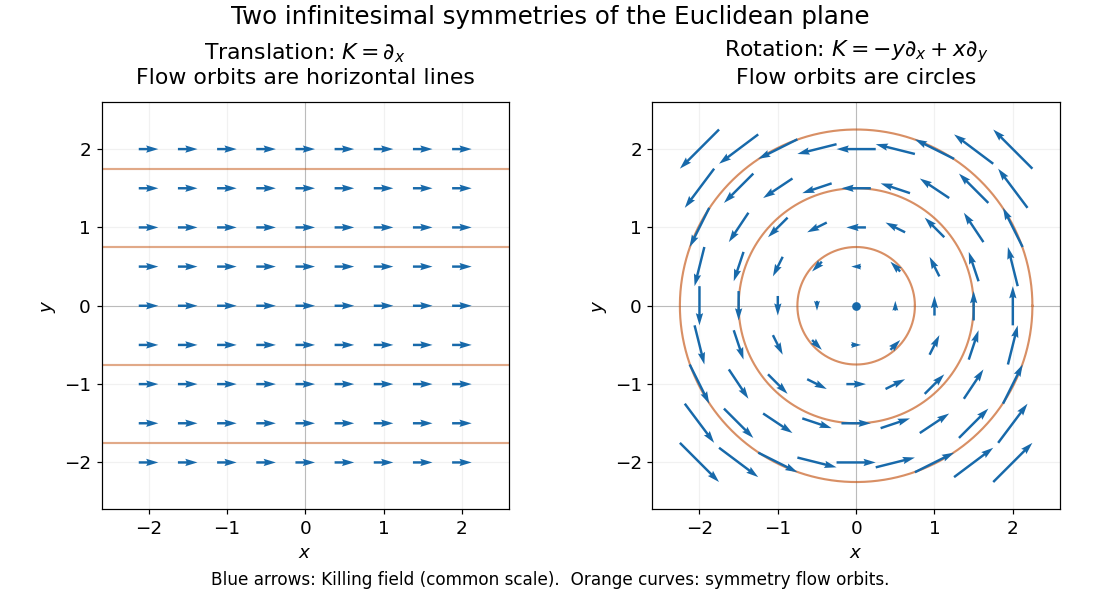
Euclidean Killing vector fields: translation arrows and straight flow orbits, rotation arrows and circular flow orbits
. Details. The circular integral curves of a vector field are symmetry orbits, whereas geodesics of the Euclidean plane are straight lines. A Killing vector field does not require its own orbits to be geodesics. The geodesic conserved quantity from a Killing vector pairs the field with the velocity of a separate geodesic; it does not require the velocity to equal the Killing vector field.
The residual is the difference between predicted and observed data. Its norm measures data misfit and can determine an iteration stopping rule for regularization of an inverse problem.
A finite integer interval is a set with integers . Its cardinality is , including both endpoints. For example, contains five integers, although the real interval from to has length four.
Infinite integer intervals allow one or both endpoints to be unbounded. Statements about bounded gaps in words quantify over finite integer intervals; their endpoints are indices, rather than arbitrary real positions.
For the two-dimensional streamfunction convention , , the advective derivative of is . This antisymmetric Jacobian determinant bracket organizes nonlinear interactions in convection and vorticity equations.
A surface with a complete Riemannian metric of constant Gaussian curvature . Its local model is the Poincaré half-plane model; the orientable case is a quotient by a free properly discontinuous group action of orientation-preserving isometries.
Waves travelling in opposite directions relative to their local background currents can share a laboratory phase velocity. Their interaction can then lock their phases and extract energy from the mean shear, producing growing disturbances. In a layered flow, the coupling is often exponentially weak when the interface separation exceeds the waves' decay length. A dispersion relation for two density interfaces in uniform shear gives a simple explicit example.
The Orr-Sommerfeld equation governs the wall-normal velocity of normal mode disturbances to an incompressible viscous parallel shear flow. Here , , and is the Reynolds number. It follows by eliminating pressure from the linearized Navier-Stokes equations. At a rigid no-slip wall, . In the inviscid limit it reduces to the Rayleigh equation for inviscid shear flow.
If the eigenvalues of are with , exact quantum phase estimation on uses controlled powers . Their Hamiltonian simulation times reach . Counting each supplied controlled power as one oracle query is valid in that oracle model, but does not prove a polynomial time implementation from generic sparse-matrix access. In the ordinary HHL algorithm, one instead chooses finite precision appropriate to the output error and the condition number, or exploits additional structure giving efficient access to the needed powers.
On a positive eigenvalue label and a clean quantum ancilla, the HHL algorithm applies a quantum variable rotation with angle , where :Uncomputation of the eigenvalue register followed by conditioning on flag one multiplies each input eigenvector amplitude by . If is normalized, the success probability is . Choosing from a valid condition number bound gives success probability at least .
Let , where a reversible circuit computes into a clean register. Then applying as a phase on that register and performing uncomputation implements on the data register. For , a Boolean output qubit suffices: acts as when that qubit starts in . This exact construction avoids a Lie-Trotter product formula because the eigenvalue is computed directly.
Phase space coordinates are canonical when their Poisson brackets have the form , with the position-position and momentum-momentum brackets zero.
A phase-space action treats canonical variables as independent fields. Varying them gives Hamilton's equations; Lagrange multipliers can impose constraints.
For the grid graph, if is an integer, , and , the minimum edge boundary of an -vertex set is . A corner square with a nonempty partial adjacent column attains it. The lower bound counts occupied rows and columns; full rows or columns are treated separately because they contribute no boundary in their own direction.
In the radiation zone, the time-averaged energy flux of a weak wave in transverse-traceless gauge isCombining this with the far-zone quadrupole field and integrating over directions gives the quadrupole formula.
The trace-free mass quadrupole moment of a mass distribution isIt is the leading time-dependent mass multipole that can radiate in general relativity: mass conservation removes monopole radiation, while momentum conservation removes mass-dipole radiation.
A vertex cover chooses vertices that collectively touch every edge of a graph. Think of placing monitors at junctions: if a monitor watches every connection incident to its junction, a vertex cover watches all connections. The minimum vertex cover asks how few monitors suffice. This is a model of covering connections through their endpoints, rather than of monitoring distances in the drawing.
For a finite simple graph , a vertex cover is a subset satisfyingBoth endpoints may be selected; the condition requires at least one. An isolated vertex covers no edge, so a minimum vertex cover never needs it.[ref]
Graph Theory by Reinhard Diestel. Diestel, Graph Theory, fourth electronic edition, Section 2.1, definition of vertex cover
Take the cycle graph with vertices and edges . The set is a vertex cover: vertex covers and , vertex covers and , and vertex covers as well as . In particular, the closing edge is covered even though vertex is unselected.
The unselected vertices form an independent set. This is the key connection: an edge missed by would have both endpoints in , precisely what an independent set forbids. For every subset ,Here is the complement of a set within ; the graph itself keeps all its edges. The complement graph is a different construction.[ref]
https://introtcs.org/public/lec_12_NP.html. Barak, Introduction to Theoretical Computer Science, Chapter 14, vertex-cover exercise
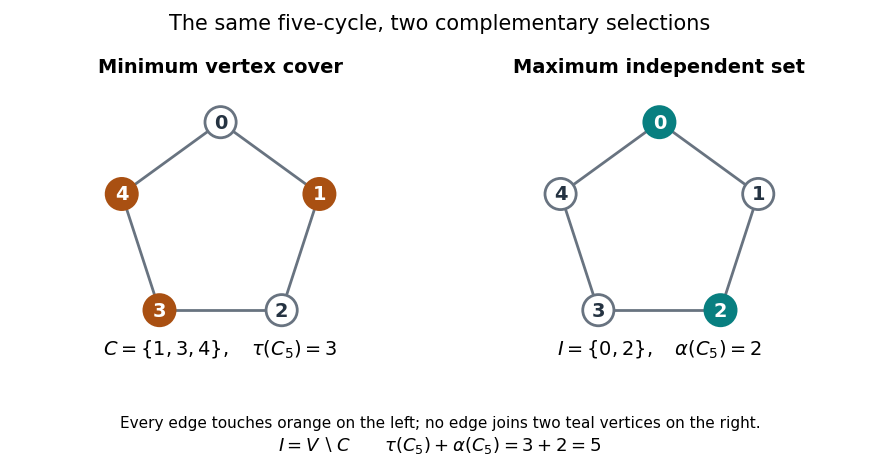
A minimum vertex cover and its maximum independent complement on the same five-cycle
. Details. The endpoints of any maximal matching form a vertex cover: an edge avoiding all endpoints would enlarge that matching in a graph. Consequently a graph with no matching in a graph of size has a vertex cover of size at most . This supplies a convenient vertex cover, but it need not be a minimum vertex cover.
A graph minor compresses connected regions of a graph into single vertices while retaining selected connections between them. For finite simple graphs, means that some sequence of deleting vertices, deleting edges, and performing edge contractions produces up to graph isomorphism. Deleting a vertex also deletes all its incident edges; deleting an edge leaves its endpoints. The edge contraction convention here removes resulting self-loops and duplicate edges.[ref]
For an exact small example, let be the cycle graph with vertices and edges . Contract to a new vertex . The surviving edges are , giving the complete graph . Thus , although has no triangle in a graph as a subgraph. The branch sets of a graph minor are , with the original edges witnessing all three required adjacencies. The first panel of the edge contraction diagram shows this operation.
A subgraph uses existing vertices and edges; a topological minor permits a graph subdivision of the target as a subgraph, so target edges become graph paths with mutually disjoint interiors and no target vertex in an interior. An ordinary graph minor permits whole connected branch sets of a graph minor in place of target vertices. Every topological minor is a graph minor, by contracting the replacement graph paths.[ref]
The converse fails. Take the tree with edges . Contracting gives the star graph . Yet the original tree has maximum degree three, whereas every graph subdivision of retains a centre of degree of a vertex four. Hence is a graph minor but not a topological minor of this tree. The difference is that a connected branch set of a graph minor may gather connections incident to several original vertices.
The counts of vertices and edges never increase under these operations. However, the example shows that being a bipartite graph is not preserved: its graph minor contains an odd cycle. Its chromatic number also increases from two to three. A connected graph stays connected under an edge contraction, because the image of each graph path still connects its endpoints, but deletion can disconnect it. Thus one must check the particular graph property before treating it as preserved by taking graph minors.
Being a planar graph is preserved: in a crossing-free drawing, shrink a contracted edge and bring its incident edges into the merged vertex; deletion merely removes parts of the drawing. This makes a nonplanar graph minor a certificate that the original graph is nonplanar. More strongly, for a finite simple graph, being a planar graph is equivalent to having neither the complete graph nor the complete bipartite graph as a graph minor. Finding the corresponding branch sets of a graph minor settles nonplanarity even when no literal or subgraph is present. The converse is a substantial theorem, rather than a consequence of preservation alone.[ref]
An undirected graph has edges that are unordered pairs of vertices. In a simple undirected graph there are no loops or multiple edges. The skeleton of a directed graph forgets the directions of its edges and is an undirected graph.
The formal gradient flow of this energy is , with a Neumann boundary condition for no flux. The radial Hessian eigenvalues of the gradient integrand are and . Their signs distinguish convex forward diffusion from formal backward diffusion. The heat equation uses , whereas total variation flow uses with a subgradient interpretation at zero.
Ice ablation removes glacier or ice-sheet material by melting, sublimation, or mechanical loss. A negative net ice accumulation rate removes ice only where ice is present; an initially bare region cannot acquire negative thickness.
Pinned article: Introduction to the OurBigBook Project
Welcome to the OurBigBook Project! Our goal is to create the perfect publishing platform for STEM subjects, and get university-level students to write the best free STEM tutorials ever.
Everyone is welcome to create an account and play with the site: ourbigbook.com/go/register. We belive that students themselves can write amazing tutorials, but teachers are welcome too. You can write about anything you want, it doesn't have to be STEM or even educational. Silly test content is very welcome and you won't be penalized in any way. Just keep it legal!
Intro to OurBigBook
. Source. We have two killer features:
- topics: topics group articles by different users with the same title, e.g. here is the topic for the "Fundamental Theorem of Calculus" ourbigbook.com/go/topic/fundamental-theorem-of-calculusArticles of different users are sorted by upvote within each article page. This feature is a bit like:
- a Wikipedia where each user can have their own version of each article
- a Q&A website like Stack Overflow, where multiple people can give their views on a given topic, and the best ones are sorted by upvote. Except you don't need to wait for someone to ask first, and any topic goes, no matter how narrow or broad
This feature makes it possible for readers to find better explanations of any topic created by other writers. And it allows writers to create an explanation in a place that readers might actually find it.
Figure 1. Screenshot of the "Derivative" topic page. View it live at: ourbigbook.com/go/topic/derivativeVideo 2. OurBigBook Web topics demo. Source. - local editing: you can store all your personal knowledge base content locally in a plaintext markup format that can be edited locally and published either:This way you can be sure that even if OurBigBook.com were to go down one day (which we have no plans to do as it is quite cheap to host!), your content will still be perfectly readable as a static site.
- to OurBigBook.com to get awesome multi-user features like topics and likes
- as HTML files to a static website, which you can host yourself for free on many external providers like GitHub Pages, and remain in full control

Figure 2. You can publish local OurBigBook lightweight markup files to either OurBigBook.com or as a static website.
Figure 3. Visual Studio Code extension installation.
Figure 5. . You can also edit articles on the Web editor without installing anything locally. Video 3. Edit locally and publish demo. Source. This shows editing OurBigBook Markup and publishing it using the Visual Studio Code extension. 
- Infinitely deep tables of contents:




All our software is open source and hosted at: github.com/ourbigbook/ourbigbook
Further documentation can be found at: docs.ourbigbook.com
Feel free to reach our to us for any help or suggestions: docs.ourbigbook.com/#contact