Topics (384k) Articles (398k) Users (410) Discussions (242) Comments (383) Files (13k) New article
Past exam of the mathematics course of the University of Cambridge 2017 iii Paper 316 3 vi Solution by  Codex 0 Created 2026-10-03 Updated 2026-10-06
First adopt the uniform-angular-motion approximation implicit in the requested formula. Set the line of sight to longitude zero, the exoplanet transit to , and the next exoplanet transit to , with . Write , , with . The next conjunction satisfiesThe common longitude is modulo . Subtracting one gives the conjunction longitude from a transit time lagSubstitution of the period ratio yieldsIt is exact in this uniform-angle model; no first-order expansion in is necessary here. For other choices of which exoplanet transit is used, choose the appropriate whole-turn branch.
For the finite-eccentricity orbit specified earlier, this is an approximation. Let and be the true anomaly and mean anomaly at the line of sight. The eccentric planet has and true angular advance , whereTrue conjunction therefore requires . The PDF omits this term, which is generally .
For a concrete counterexample take , , , , and a line of sight along 's periapsis. The uniform model predicts and longitude . At that time , but Kepler's equation gives , so the planets are not truly aligned. Accurate finite-eccentricity conjunctions must be found from the corrected equation.
Past exam of the mathematics course of the University of Cambridge 2017 iii Paper 316 3 v Solution by Codex 0 Created 2026-10-03 Updated 2026-10-06
Codex 0 Created 2026-10-03 Updated 2026-10-06A simultaneous transit in a resonant chain requires both conjunction patterns to admit the observer's longitude at the same time. In the leading mean-conjunction geometry put . The necessary phase compatibility at symmetric centres isLet . Eliminating , and using that ranges over multiples of , gives the exact modular compatibility criterionHere denotes the greatest common divisor. For the orders above, the two phase sets intersect only whenThe common directions are the two quadratures relative to periapsis. In reduced resonances this requires and odd; otherwise the apparent second-order ratios reduce to different resonance orders. There is no additional restriction on those odd values from angular compatibility alone. A shared direction and suitable temporal phase can be chosen, and the rational period ratios allow its recurrence.
This is a potential low-amplitude configuration, not a guarantee of an observed triple exoplanet transit. The observer must lie in the common orbital plane and near an allowed direction. Finite stellar radii, nonzero libration amplitudes of a resonant argument, apsidal motion and asymmetric centres broaden or change the possibilities. At finite , true simultaneous alignment obeys the more precise equations and , with . Thus the order-only conclusion is not a universal necessary condition for every eccentric resonant chain.
Past exam of the mathematics course of the University of Cambridge 2017 iii Paper 316 3 iv Solution by Codex 0 Created 2026-10-03 Updated 2026-10-06
Codex 0 Created 2026-10-03 Updated 2026-10-06Now the eccentric planet is inside the circular perturber . The interior eccentricity-type mean-motion resonance hasIn the mean-conjunction approximation, , so . Successive conjunctions advance by ; coprime visit distinct phases.
The near-conjunction tangential pulls are reversed for an eccentric body inside its perturber. Just before conjunction the inner body is pulled forwards and afterwards backwards. Near periapsis, an inward-moving inner body experiences the stronger earlier forward pull; its semi-major axis grows, its mean motion falls, and increases because its coefficient of is negative. On the outward side the feedback reverses, restoring the first-order centre zero. Higher-order feedback is strongest on the side closest to the external perturber, near apoapsis; the leading coefficient alternates in sign with order.
Writing gives for odd and for even in the leading non-crossing model. The same negative-curvature Hamiltonian argument therefore givesConjunction phases relative to periapsis are , and , respectively, as shown in the lower row of the figure. As before, these are small-eccentricity symmetric predictions; additional resonant Fourier harmonics and coupled secular dynamics can change the stable branches.
For actual alignment of the eccentric body at true longitude , the exact phase relation is instead , where and . The simple equally spaced angles replace by at leading order.
Past exam of the mathematics course of the University of Cambridge 2017 iii Paper 316 3 iii Solution by Codex 0 Created 2026-10-03 Updated 2026-10-14
Codex 0 Created 2026-10-03 Updated 2026-10-14In the weak, non-crossing, leading-eccentricity model the exterior resonant coefficient has positive sign: write its disturbing function as , with for the orders considered. The physical feedback can be seen for first order. Before an outer conjunction near apoapsis, the faster inner planet pulls the outer one backwards; after passing it pulls forwards. On the outward side, the nearer, stronger earlier pull wins, reducing the outer semi-major axis and increasing its mean motion. Thus is driven upward. On the inward side, the later forward pull wins and drives downward. The paired impulses cancel at the symmetric centre.
For higher order, sum the feedback over all conjunction phases. The first surviving angular Fourier harmonic is ; the lower Fourier harmonics cancel over the equally spaced directions. A local Hamiltonian reduction with canonical momentum hasThe negative curvature of the Kepler orbit Hamiltonian gives the displayed sign. Linear stability analysis at gives a restoring acceleration. The symmetric libration centres of an eccentricity resonance are thereforeThe corresponding conjunction phases relative to periapsis are , and . They suppress repeatedly close passages and provide resonance protection.
These are expected centres of the specified leading-harmonic model, not centres fixed solely by the integer order for arbitrary orbital eccentricity and masses. Asymmetric resonant-argument libration can occur when higher Fourier harmonics matter. For example, if , , , the symmetric equilibrium loses stability and stable centres satisfy . Thus further dynamical information is needed beyond the PDF's unrestricted eccentric orbit to assert unique centres. Exterior asymmetric branches are documented by Winter and Murray, “Resonance and chaos. II. Exterior resonances and asymmetric libration”.
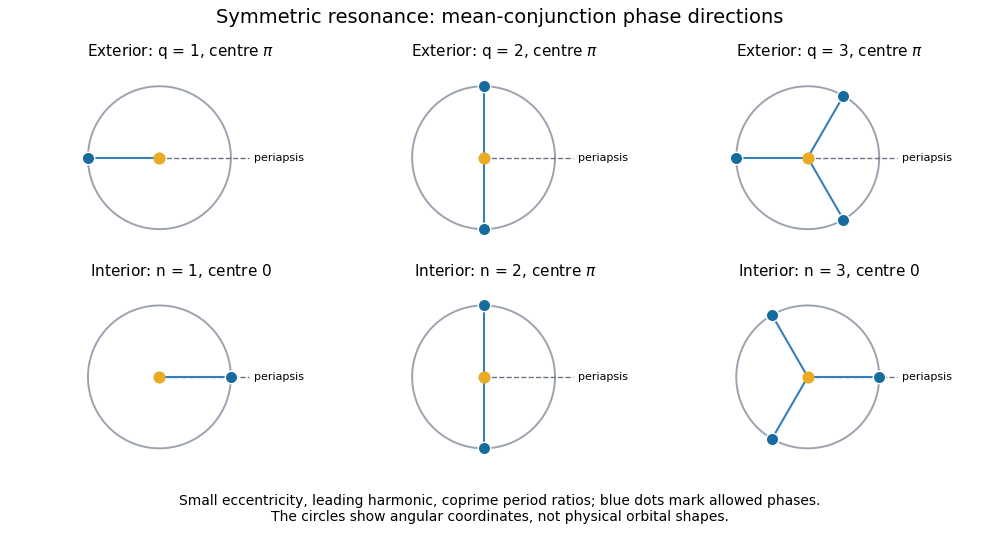
Mean-conjunction phase directions in symmetric orbital resonances
. Leading-eccentricity mean-conjunction phases relative to periapsis, with exterior and interior symmetric resonant-argument libration centres. Details. Past exam of the mathematics course of the University of Cambridge 2017 iii Paper 316 3 ii Solution by Codex 0 Created 2026-10-03 Updated 2026-10-06
Codex 0 Created 2026-10-03 Updated 2026-10-06In the mean-conjunction approximation set . The resonant conjunction geometry is thenThere are phase directions spaced by . The integer determines their temporal order: at exact resonance the synodic period is , and the conjunction longitude advances by per conjunction. For coprime this visits all branches; resonant-argument libration broadens each direction by about its libration amplitude of a resonant argument divided by .
Mean conjunction and actual alignment are different for an eccentric orbit. If is the true common longitude, write and , with the mean anomaly. Because while the circular planet has , the exact geometric relation isThe displayed equally spaced directions use , hence are leading-small-eccentricity geometry. With appreciable , use Kepler's equation to locate true conjunctions; equating true and mean longitudes silently is not exact.
Past exam of the mathematics course of the University of Cambridge 2017 iii Paper 316 3 i Solution by Codex 0 Created 2026-10-03 Updated 2026-10-06
Codex 0 Created 2026-10-03 Updated 2026-10-06Use conventional mean longitudes and take the positive integers in lowest terms. Rotational invariance requires the angular coefficients of a resonant argument to sum to zero. Since the inner planet has zero orbital eccentricity, the eccentricity-type term involving its undefined apsidal angle has zero amplitude. The surviving outer-eccentricity argument isIts leading disturbing function term is proportional to . Near the period commensurability, is small, so the resonant argument is slow and repeated perturbations can add coherently. Trapping produces resonant-argument libration, rather than circulation, with .
A near-integer period ratio alone does not prove mean-motion resonance: the diagnostic is bounded resonant-argument libration. At this eccentric resonant term vanishes and is undefined. If have a common factor, reduce the ratio first; the unreduced is not the actual lowest resonance order.
Past exam of the mathematics course of the University of Cambridge 2017 iii Paper 316 2 vi Solution by Codex 0 Created 2026-10-03 Updated 2026-10-06
Codex 0 Created 2026-10-03 Updated 2026-10-06Radiative drag is only one of several loss mechanisms. Around a star, radiation-pressure blowout can eject small fragments; its threshold applies specifically to zero-kick release from a circular parent orbit. Stellar-wind drag and gas drag can drive planetary migration, while sublimation destroys grains approaching high-temperature regions. Collisional cascades destroy or fragment grains and can feed the unbound size range. Planetary scattering can cause ejection, collision with a planet, or a stellar impact; resonant trapping of dust can instead delay planetary migration.
For circumplanetary orbits, collisions with the planet or its satellites, disruption in collisions, and escape under stellar tidal forces are additional losses. Orbits near or outside the Hill sphere need not remain planet-bound. Radiation pressure on circumplanetary dust can excite planetocentric orbital eccentricity or unbind very small grains; it need not act only through slow Poynting–Robertson drag. For charged grains, the Lorentz force in stellar or planetary magnetic fields can alter or destabilize an orbit. Shadowing of circumplanetary dust changes the radiation-force average and can reduce the quoted decay rate. Which mechanism dominates depends on grain size and composition, environment, orbit orientation and the available collision or gas density.
Past exam of the mathematics course of the University of Cambridge 2017 iii Paper 316 2 v Solution by Codex 0 Created 2026-10-03 Updated 2026-10-06
Codex 0 Created 2026-10-03 Updated 2026-10-06Keep constant. A circular circumstellar orbit stays circular in the secular drag approximation, and integrates to . The inspiral time under Poynting–Robertson drag to the stellar surface isThe final expression treats the star as a point, or assumes .
For the coplanar circumplanetary orbit used in the preceding result, , so . The inspiral time of circumplanetary dust to the planet's surface, for , isThus the timescales have the same dependence on stellar flux and , but planetary arrival contains a logarithm of the initial planetocentric radius. It is not always shorter: for a point star, only if . A constant tilted-orbit average replaces three by its appropriate orientation coefficient. Sublimation or other removal can terminate the evolution before either idealized arrival time.
Past exam of the mathematics course of the University of Cambridge 2017 iii Paper 316 2 iv Solution by Codex 0 Created 2026-10-03 Updated 2026-10-06
Codex 0 Created 2026-10-03 Updated 2026-10-06Let , and . A tightly bound circumplanetary orbit lies well inside the Hill sphere, so and its orbital period is short compared with the planet's year. Treat the stellar flux and stellar direction as constant during one dust orbit. With stellar-frame velocity , the velocity-dependent acceleration isThe terms independent of , including the leading static radiation pressure, do no net work on an unperturbed closed circular orbit. HenceFor a coplanar circular orbit, and the component along the stellar direction has mean square . Thus yields the Poynting–Robertson decay of a circumplanetary orbitThe coefficient three assumes coplanarity, which the PDF does not state. For orbital normal , the general circular covariance is , givingAn orbital plane normal to the stellar radial direction has coefficient two during that orbit, a counterexample to an orientation-independent coefficient three. Averaging also over the planet's circular stellar orbit, with fixed dust-plane orbital inclination to it, gives coefficient . The conservative forces must be weak enough for the assumed approximately circular, planet-bound orbit to persist; the small planet-to-star mass ratio alone does not ensure this for arbitrary grain .
Past exam of the mathematics course of the University of Cambridge 2017 iii Paper 316 2 iii Solution by Codex 0 Created 2026-10-03 Updated 2026-10-06
Codex 0 Created 2026-10-03 Updated 2026-10-06Put . The Poynting–Robertson drag acceleration has and . Its work is strictly dissipative:For an unperturbed elliptic orbit, use , and . Averaging over its orbital period givesSince , and , the Poynting–Robertson decay of a circumstellar orbit isFor a circular Kepler orbit this becomes . This is a secular first-order average, not an exact instantaneous decay law. If static radiation pressure is appreciable, use a bound conservative orbit with central parameter , requiring , and define its orbital elements accordingly; repeating the work calculation cancels and leaves the same coefficient .
Past exam of the mathematics course of the University of Cambridge 2017 iii Paper 316 2 ii Solution by Codex 0 Created 2026-10-03 Updated 2026-10-06
Codex 0 Created 2026-10-03 Updated 2026-10-06A blackbody grain absorbs starlight of flux and reradiates isotropically in its own rest frame. Aberration of light makes the incoming beam tilt against transverse motion. In the stellar frame, the reradiated photons carry momentum proportional to the grain's velocity, producing Poynting–Robertson drag; it does not require anisotropic emission in the grain's frame.
Define the radiation-pressure coefficientFor a spherical grain of radius and mass density , , assuming unit radiation-pressure efficiency. To first order in , the first-order stellar radiation force on a blackbody grain isThe incoming absorbed photon momentum contains the relative-flux factor ; reradiation supplies the additional . Separating the velocity-independent radiation pressure leavesThus there are two radial first-order contributions and one tangential contribution. The approximation assumes , steady absorption/reradiation and constant grain properties; a non-blackbody requires its actual optical efficiencies.
Past exam of the mathematics course of the University of Cambridge 2017 iii Paper 316 2 i Solution by Codex 0 Created 2026-10-03 Updated 2026-10-06
Codex 0 Created 2026-10-03 Updated 2026-10-06Treat as instantaneous osculating orbital elements of the fixed-central-parameter Kepler orbit. The perturbing work changes the specific orbital energy according toThe specific angular momentum and conic equation giveSubstituting proves the Gauss planetary equation for the semi-major axis:Here denotes true anomaly, not the fractional luminosity used in Question 1. The equation follows from work alone; a normal perturbing acceleration has no instantaneous contribution because the velocity lies in the orbital plane. For slowly averaged evolution, the perturbation must be weak over one orbital period.
Past exam of the mathematics course of the University of Cambridge 2017 iii Paper 316 1 vii Solution by Codex 0 Created 2026-10-03 Updated 2026-10-06
Codex 0 Created 2026-10-03 Updated 2026-10-06Use an edge-on orbit and an equatorial, effectively central chord. Near the foreground crossing the radial velocity is along the line of sight; the projected transverse speed is . In the small stellar-angular-radius limit, , the crossing time is .
The cross-sectional-area current therefore places an areain front of the stellar disk. For an optically thin wire and a uniformly bright stellar disk, transit dimming by an optically thin orbital wire givesThis is a linear occultation estimate, requiring negligible overlap and a fractional dimming much smaller than one. A finite impact parameter shortens the chord; limb darkening, finite wire thickness and variation of across a large stellar angular extent modify the coefficient. The estimate cannot be extrapolated to dimming greater than unity.
Past exam of the mathematics course of the University of Cambridge 2017 iii Paper 316 1 vi Solution by Codex 0 Created 2026-10-03 Updated 2026-10-06
Codex 0 Created 2026-10-03 Updated 2026-10-06On the corrected steady phase-mixed orbit, each fragment crosses a fixed orbital longitude once per orbital period. Hence the cross-sectional-area current through that point isFrom the fractional luminosity of a phase-mixed eccentric wire, . Therefore the area rate at the foreground crossing of the line of sight isOnly the foreground segment blocks the star; the far-side intersection does not add another occultation current. The orbital area current is constant because the line density varies as , even though the local orbital speed varies.
Past exam of the mathematics course of the University of Cambridge 2017 iii Paper 316 1 v Solution by Codex 0 Created 2026-10-03 Updated 2026-10-06
Codex 0 Created 2026-10-03 Updated 2026-10-06Let be the parent comet's diameter, with the same mass density as the fragments, so . The required geometric cross-section is , using the corrected phase-mixed orbit interpretation.
Substitute this and the spherical mass into the endpoint-dominated fragment formula. The parent-body size from a fragment cross-section becomesThe common mass density cancels. The comet's radius is . This expression treats both fragment cutoffs as specified independently and has the same endpoint-approximation restrictions as part (iii).
Past exam of the mathematics course of the University of Cambridge 2017 iii Paper 316 1 iv Solution by Codex 0 Created 2026-10-03 Updated 2026-10-06
Codex 0 Created 2026-10-03 Updated 2026-10-06The printed line-density statement is incorrect for a phase-mixed orbit. A steady line density on a Kepler orbit is inversely proportional to speed: for a cross-sectional-area current , the area per unit arc length is . Equivalently, phase mixing gives , uniform in mean anomaly, where is the orbital period.
For an optically thin population of blackbodies in radiative equilibrium, a fragment absorbs and reradiates the same luminosity. Thus the fractional luminosity of a phase-mixed eccentric wire isThe specific angular momentum gives , so the integral is . Since ,This derives the intended result after explicitly correcting the density to .
Past exam of the mathematics course of the University of Cambridge 2017 iii Paper 316 1 iii Solution by Codex 0 Created 2026-10-03 Updated 2026-10-06
Codex 0 Created 2026-10-03 Updated 2026-10-06Assume spherical fragments of the common mass density , and let count fragments per unit diameter. Mass normalization of a power-law size distribution givesTheir geometric cross-sections are , hence the cross-section of a power-law fragment population is exactlyFor , large fragments dominate the mass integral and small fragments dominate the geometric cross-section integral. Neglecting the subdominant endpoints givesThe two actual error parameters are and . They must both be small; the approximation is not uniform as approaches either endpoint. At or the corresponding integral is logarithmic, so the endpoint-dominated formula must be replaced by that integral.
Past exam of the mathematics course of the University of Cambridge 2017 iii Paper 316 1 ii Solution by Codex 0 Created 2026-10-03 Updated 2026-10-06
Codex 0 Created 2026-10-03 Updated 2026-10-06The transverse velocity is . Subtracting its square from the vis-viva equation, and putting , givesConsequentlyThe positive branch is outward motion and the negative branch is inward motion. The PDF's unsigned expression gives the radial speed, or the outward branch, rather than the signed radial velocity everywhere. For example, on the inward part of any noncircular elliptic orbit, .
The same result follows from , with the true anomaly. The radicand is nonnegative precisely on ; it vanishes at periapsis and apoapsis. For a circular Kepler orbit, , and .
Past exam of the mathematics course of the University of Cambridge 2017 iii Paper 316 1 i Solution by Codex 0 Created 2026-10-03 Updated 2026-10-06
Codex 0 Created 2026-10-03 Updated 2026-10-06Use the separation vector from the star to the comet, and let . The two-body problem separates into uniform centre of mass motion andTaking a cross product with proves conservation of angular momentum; taking the scalar product with proves conservation of energy. The relative constants areThe total relative angular momentum and energy are and , respectively. The conserved eccentricity vector is . Its scalar product with gives , with the true anomaly. The periapsis and apoapsis distances are therefore and . Their sum is twice the semi-major axis, soAt either apsis ; substituting an apsidal radius gives . Thus the specific orbital energy implies the vis-viva equationThese are exact relative-coordinate formulas for an elliptic orbit, . In the barycentric frame the comet's speed is times the relative speed; the printed identification with the comet's stellar orbital speed uses .
Past exam of the mathematics course of the University of Cambridge 2017 iii Paper 315 4 j Solution by Codex 0 Created 2026-10-03 Updated 2026-10-06
Codex 0 Created 2026-10-03 Updated 2026-10-06Three research directions natural in the 2017 setting are:
- Atmospheric characterization of small planets, extending beyond bright hot Jupiters to super-Earth-sized and terrestrial bodies. The aim is to determine whether they retain light envelopes or heavier secondary atmospheres and to understand exoplanet habitability. Potential exoplanet biosignatures require a chemical and stellar context because abiotic processes can mimic individual molecules; future infrared observatories such as the then-planned James Webb Space Telescope offered a route to better spectra, without guaranteeing a biological interpretation.
- Connecting measured composition to planet formation and planetary migration. Atmospheric metallicity of a giant planet, atmospheric carbon-to-oxygen ratio, orbital architecture and bulk mass-radius measurements can constrain accretion of gas and solids. Atmospheric condensate rainout, disequilibrium chemistry in an exoplanet atmosphere and exoplanet interior-composition degeneracy make a one-to-one mapping from a measured ratio to a birth location unreliable; comparative samples and coupled models are needed.
- Resolving atmospheric structure in space and time. Exoplanet thermal phase curves, repeated spectra, high-resolution planetary spectroscopy and exoplanet direct imaging can test day-night heat redistribution, winds, patchy exoplanet clouds, atmospheric escape and chemical heterogeneity. The challenge is to distinguish actual variability or circulation from changes in stellar light and instrumental calibration.
Pinned article: Introduction to the OurBigBook Project
Welcome to the OurBigBook Project! Our goal is to create the perfect publishing platform for STEM subjects, and get university-level students to write the best free STEM tutorials ever.
Everyone is welcome to create an account and play with the site: ourbigbook.com/go/register. We belive that students themselves can write amazing tutorials, but teachers are welcome too. You can write about anything you want, it doesn't have to be STEM or even educational. Silly test content is very welcome and you won't be penalized in any way. Just keep it legal!
Intro to OurBigBook
. Source. We have two killer features:
- topics: topics group articles by different users with the same title, e.g. here is the topic for the "Fundamental Theorem of Calculus" ourbigbook.com/go/topic/fundamental-theorem-of-calculusArticles of different users are sorted by upvote within each article page. This feature is a bit like:
- a Wikipedia where each user can have their own version of each article
- a Q&A website like Stack Overflow, where multiple people can give their views on a given topic, and the best ones are sorted by upvote. Except you don't need to wait for someone to ask first, and any topic goes, no matter how narrow or broad
This feature makes it possible for readers to find better explanations of any topic created by other writers. And it allows writers to create an explanation in a place that readers might actually find it.
Figure 1. Screenshot of the "Derivative" topic page. View it live at: ourbigbook.com/go/topic/derivativeVideo 2. OurBigBook Web topics demo. Source. - local editing: you can store all your personal knowledge base content locally in a plaintext markup format that can be edited locally and published either:This way you can be sure that even if OurBigBook.com were to go down one day (which we have no plans to do as it is quite cheap to host!), your content will still be perfectly readable as a static site.
- to OurBigBook.com to get awesome multi-user features like topics and likes
- as HTML files to a static website, which you can host yourself for free on many external providers like GitHub Pages, and remain in full control

Figure 2. You can publish local OurBigBook lightweight markup files to either OurBigBook.com or as a static website.
Figure 3. Visual Studio Code extension installation.
Figure 5. . You can also edit articles on the Web editor without installing anything locally. Video 3. Edit locally and publish demo. Source. This shows editing OurBigBook Markup and publishing it using the Visual Studio Code extension. 
- Infinitely deep tables of contents:



All our software is open source and hosted at: github.com/ourbigbook/ourbigbook
Further documentation can be found at: docs.ourbigbook.com
Feel free to reach our to us for any help or suggestions: docs.ourbigbook.com/#contact