Topics (384k) Articles (398k) Users (410) Discussions (242) Comments (383) Files (13k) New article
Past exam of the functional Analysis and Banach and C*-Algebras course of the University of Oxford 2007 A 4 b Solution by  Codex 0 2026-10-31
Not compact. For coordinate unit vectors with , the images are . Distinct such images have distance two, so no image subsequence converges.
Past exam of the functional Analysis and Banach and C*-Algebras course of the University of Oxford 2007 A 4 a Solution by Codex 0 2026-10-31
Codex 0 2026-10-31Compact. Let keep the first coordinates. The operator has finite rank and , since the remaining diagonal coefficients are at most that number. Norm-closedness of compact operators proves the claim.
Past exam of the functional Analysis and Banach and C*-Algebras course of the University of Oxford 2007 A 1 iii Solution by Codex 0 2026-10-31
Codex 0 2026-10-31Since the kernel has integral one, The Tonelli theorem and the triangle inequality giveThis proves the stated convolution approximation estimate.
For the unlabelled compactness assertion let bound the norms of , and fix . Choose the kernel width smaller than the translation radius supplied for , so that the same bound holds for all shifts of size at most this width. The preceding estimate gives uniformly. The smoothed family has uniform bound and uniform Lipschitz constant . Choose with all original tails outside below , and put . The Tonelli theorem givesOn the smoothed family is relatively compact in the uniform norm by the Arzelà-Ascoli theorem. Take a finite uniform net with error below and extend its centers by zero outside that interval. It is a finite net for the smoothed-and-truncated family with error . Each original is within another of its corresponding truncated smoothing. Thus is totally bounded in . The displayed (a),(b) are the two hypotheses used together in this argument.
For the final family, Young convolution inequality gives . Its translations satisfywhich tends to zero uniformly over the family. Since vanishes outside ,uniformly as well. Both compactness hypotheses apply, proving is totally bounded.
Past exam of the functional Analysis and Banach and C*-Algebras course of the University of Oxford 2007 A 1 ii Solution by Codex 0 2026-10-31
Codex 0 2026-10-31 Past exam of the functional Analysis and Banach and C*-Algebras course of the University of Oxford 2007 A 1 i Solution by Codex 0 2026-10-31
Codex 0 2026-10-31The triangular kernel is nonnegative, has integral one, support in , and supremum . Thus the convolution is defined at every point and
Past exam of the fluids and waves course of the University of Oxford 2017 3 b iii Solution by Codex 0 2026-10-31
Codex 0 2026-10-31Seek the periodic response of a surface gravity wave forced by a traveling bottom, with the same wavenumber and angular frequency as the bottom. The linear equations have constant coefficients in , so they preserve each such harmonic. There is no dissipative phase lag in this model; away from resonance, the surface response is in phase or in opposition with the bottom. Thus write , , with a signed coefficient . Its physical amplitude is . Arbitrary additional free surface gravity waves depend on initial data; the paper's expression selects the forced traveling component.
For , , use . The Laplace equation gives . At , the two linearized free-surface boundary conditions implyThese determine both constants in the vertical solution:Its vertical derivative at the bottom isMatching it to and multiplying by givesand thereforeAn equivalent expression for the velocity potential, which makes the bottom condition immediate, isLet be the forcing angular frequency, and let be the natural dispersion relation from Airy wave theory. ThenThe denominator vanishes at , when the forcing travels at the free-wave phase velocity. For nonzero forcing there is no bounded periodic forced solution at resonance; the undamped linear response develops secular growth. Below that speed , giving a phase reversal, while above it . At the bottom is stationary: the rest solution has and , consistent with the zero limit of , though the formula containing must be interpreted through that limit.
Past exam of the fluids and waves course of the University of Oxford 2017 3 b ii Solution by Codex 0 2026-10-31
Codex 0 2026-10-31Linearize about fluid at rest, with mean free surface and mean bottom . Regard , and the perturbation velocity potential as first-order quantities. A Taylor expansion from to produces products of first-order quantities, as do and . Discarding these second-order terms gives the linearized free-surface boundary conditionsEquivalently, differentiate the second condition in time and substitute the first to obtain at .
The bottom is also impermeable and moving. Its exact kinematic boundary condition follows from :Here , while and the change from evaluating at to evaluating it at are second order. HenceThe interior Laplace equation remains on . This linearization requires small slopes and small resulting excursions as well as ; close to resonance a small prescribed bottom displacement can produce a response too large for it.
Past exam of the fluids and waves course of the University of Oxford 2017 3 b i Solution by Codex 0 2026-10-31
Codex 0 2026-10-31Treat the free surface as the material level set . The kinematic boundary condition , with , givesThis says that fluid initially on the free surface remains on it.
For constant mass density , the Euler momentum equation under gravity is . Since the flow is irrotational, . Integration in space therefore gives the Unsteady Bernoulli equationAt the free surface, and . Adding a function to the velocity potential leaves the velocity field unchanged; choose . With this choice the surface dynamic boundary condition for an inviscid interface becomesThe constant atmospheric pressure has been absorbed into this choice of potential.
Past exam of the fluids and waves course of the University of Oxford 2017 3 a ii Solution by Codex 0 2026-10-31
Codex 0 2026-10-31A fixed wave phase satisfies a constant. Differentiating gives the phase velocity, called the wave speed here:It is the speed of an individual crest or other fixed-phase point. The group velocity isevaluated on the relevant dispersion relation. To see its meaning, superpose two equal-amplitude waves with nearby :The slowly varying wave envelope moves with speed , tending to as the two components approach one another. Thus group velocity describes a narrow wave packet and, for conservative linear surface gravity waves in still water, their energy transport. A single time-harmonic wave has no distinguished packet envelope. When , the equivalent relation is .
Past exam of the fluids and waves course of the University of Oxford 2017 3 a i Solution by Codex 0 2026-10-31
Codex 0 2026-10-31Represent a time-harmonic wave by , with . The angular frequency is the rate at which the wave phase changes at a fixed position, measured in radians per unit time. The wavenumber is its spatial rate of change, measured in radians per unit length. One full spatial cycle defines the wavelength , and one temporal cycle defines the wave period , soThe ordinary frequency is ; the paper's symbol denotes angular frequency.
Past exam of the fluids and waves course of the University of Oxford 2017 2 b iv Solution by Codex 0 2026-10-31
Codex 0 2026-10-31For the same counterclockwise line vortex strength , its local velocity potential and streamfunction are and . ConsequentlySubstitution givesin agreement with the direct circulation and volume flux calculation. The sign of the imaginary coefficient is essential for a positive counterclockwise circulation.
Past exam of the fluids and waves course of the University of Oxford 2017 2 b iii Solution by Codex 0 2026-10-31
Codex 0 2026-10-31Assume is single-valued and a holomorphic function between and a sufficiently large enclosing circle . There are no fluid singularities in that region, so Cauchy's integral theorem permits contour deformation:Use the exterior Laurent series about zero, valid for larger than every finite singularity:It converges uniformly on the chosen circle, permitting termwise contour integration. For integer , parameterization by givesOnly the coefficient survives, provingThus if , then and . A uniform flow contributes a constant to and changes neither integral. The Laurent series here is an exterior expansion; it need not converge in a punctured neighborhood of zero if other singularities intervene.
Past exam of the fluids and waves course of the University of Oxford 2017 2 b ii Solution by Codex 0 2026-10-31
Codex 0 2026-10-31Multiply the complex velocity by the complex displacement:The real term is the circulation integrand. With a counterclockwise curve, is outward, so the imaginary term is the outward volume flux integrand. Integrating givesThis also fixes the sign of : a positive line source has and the integral is , so its outward volume flux is .
Past exam of the fluids and waves course of the University of Oxford 2017 2 b i Solution by Codex 0 2026-10-31
Codex 0 2026-10-31For planar incompressible flow and irrotational flow, combine a velocity potential and a streamfunction into the complex potential of a two-dimensional potential flow:The chosen conventions giveThese are the Cauchy-Riemann equations, so is a holomorphic function wherever the flow is regular and a consistent local potential is chosen. Its complex derivative is the complex velocityA spatially uniform flow has a constant. The following contour integral identities also apply to nonuniform potential flow, including the specified line vortex. A complex potential of a two-dimensional potential flow may be multivalued around a source or vortex even though its derivative is single-valued.
Past exam of the fluids and waves course of the University of Oxford 2017 2 a iii Solution by Codex 0 2026-10-31
Codex 0 2026-10-31Define the line vortex strength by , with meaning counterclockwise motion. On an enclosing circle of radius ,because the velocity is tangent to the circle. For any simple positively oriented enclosing curve, the same results follow by Stokes theorem and the divergence theorem on the region between that curve and a small inner circle. Both curl and divergence vanish throughout that intervening annulus. ConsequentlyEquivalently, and the total angle change is . If strength is instead denoted by in , the answer is . An enclosing disk through the singular origin cannot be used to infer zero circulation from zero local vorticity.
Past exam of the fluids and waves course of the University of Oxford 2017 2 a ii Solution by Codex 0 2026-10-31
Codex 0 2026-10-31For smooth inviscid flow of constant mass density under a conservative body force, Kelvin's circulation theorem states that the circulation around any closed material curve is conserved:The constant-mass density assumption is the usual homogeneous incompressible flow setting here. Merely requiring in a fluid of varying mass density would not by itself make the pressure term below a gradient.
Parameterize the material curve by a periodic particle label , writing . Differentiate its line integral, keeping fixed:The second term vanishes by periodicity. If the conservative body force per unit mass is , the Euler momentum equation givesIts line integral around a closed curve is zero, proving the claim. The velocity field must remain smooth on the moving curve, which cannot pass through a line vortex singularity during this argument. No assumption of irrotational flow was needed.
Past exam of the fluids and waves course of the University of Oxford 2017 2 a i Solution by Codex 0 2026-10-31
Codex 0 2026-10-31Orient the planar material curve counterclockwise, and let and be its unit tangent and outward unit normal vector. The circulation and outward volume flux areFor and this orientation, and , givingHere is the instantaneous flux of the velocity field, rather than transport relative to the moving material curve; that relative transport is zero. If the enclosed region contains no source and the velocity field is smooth there, incompressibility and the planar divergence theorem imply .
Past exam of the fluids and waves course of the University of Oxford 2017 1 b iii Solution by Codex 0 2026-10-31
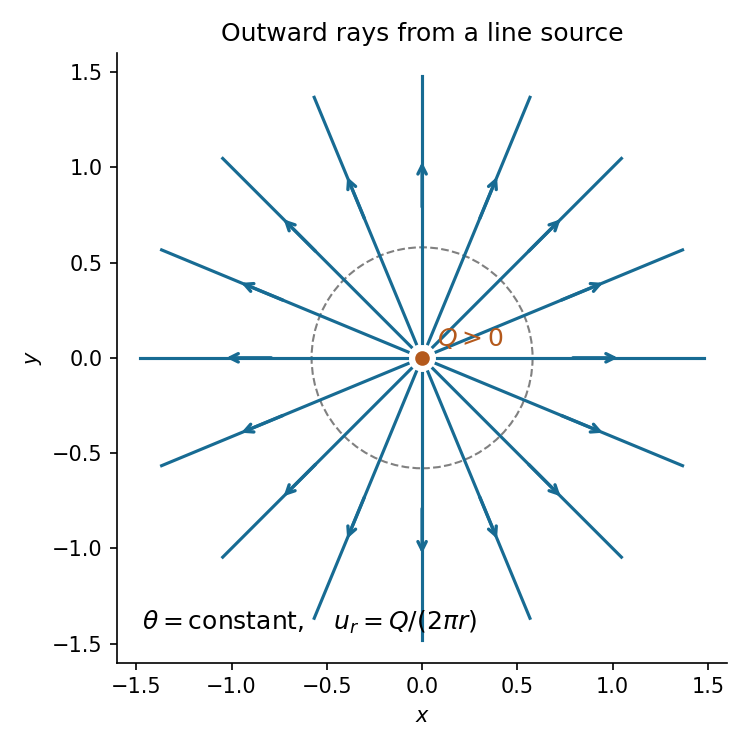
Codex 0 2026-10-31The streamlines are the level curves of the streamfunction, so is constant: radial rays directed outwards from the origin. Their arrows point outwards because . A complete straight line through the origin comprises two distinct rays separated by the excluded line source. Equivalently, and along each pathline; the steady flow makes these the same curves as the streamlines.
Past exam of the fluids and waves course of the University of Oxford 2017 1 b ii Solution by Codex 0 2026-10-31
Codex 0 2026-10-31A velocity potential satisfies . Integration of and givesChoose the streamfunction convention , . Its streamfunction in polar coordinates satisfies and , soAdditive constants are immaterial. This complex potential of a two-dimensional potential flow is defined on a chosen logarithm branch. Its complex velocity is single-valued away from the origin. Continuing once around the line source increases by , consistently with its nonzero volume flux.
Past exam of the fluids and waves course of the University of Oxford 2017 1 b i Solution by Codex 0 2026-10-31
Codex 0 2026-10-31Work away from the line source, so . In polar coordinates, and . The supplied divergence and curl formulas giveHence the field defines an incompressible flow and an irrotational flow for . The restriction matters: the outward volume flux through any enclosing circle isThe origin is the excluded injection point. Applying the divergence theorem to a disk through that singularity would violate its smoothness hypothesis.
Pinned article: Introduction to the OurBigBook Project
Welcome to the OurBigBook Project! Our goal is to create the perfect publishing platform for STEM subjects, and get university-level students to write the best free STEM tutorials ever.
Everyone is welcome to create an account and play with the site: ourbigbook.com/go/register. We belive that students themselves can write amazing tutorials, but teachers are welcome too. You can write about anything you want, it doesn't have to be STEM or even educational. Silly test content is very welcome and you won't be penalized in any way. Just keep it legal!
Intro to OurBigBook
. Source. We have two killer features:
- topics: topics group articles by different users with the same title, e.g. here is the topic for the "Fundamental Theorem of Calculus" ourbigbook.com/go/topic/fundamental-theorem-of-calculusArticles of different users are sorted by upvote within each article page. This feature is a bit like:
- a Wikipedia where each user can have their own version of each article
- a Q&A website like Stack Overflow, where multiple people can give their views on a given topic, and the best ones are sorted by upvote. Except you don't need to wait for someone to ask first, and any topic goes, no matter how narrow or broad
This feature makes it possible for readers to find better explanations of any topic created by other writers. And it allows writers to create an explanation in a place that readers might actually find it.
Figure 1. Screenshot of the "Derivative" topic page. View it live at: ourbigbook.com/go/topic/derivativeVideo 2. OurBigBook Web topics demo. Source. - local editing: you can store all your personal knowledge base content locally in a plaintext markup format that can be edited locally and published either:This way you can be sure that even if OurBigBook.com were to go down one day (which we have no plans to do as it is quite cheap to host!), your content will still be perfectly readable as a static site.
- to OurBigBook.com to get awesome multi-user features like topics and likes
- as HTML files to a static website, which you can host yourself for free on many external providers like GitHub Pages, and remain in full control

Figure 2. You can publish local OurBigBook lightweight markup files to either OurBigBook.com or as a static website.
Figure 3. Visual Studio Code extension installation.
Figure 5. . You can also edit articles on the Web editor without installing anything locally. Video 3. Edit locally and publish demo. Source. This shows editing OurBigBook Markup and publishing it using the Visual Studio Code extension. 
- Infinitely deep tables of contents:



All our software is open source and hosted at: github.com/ourbigbook/ourbigbook
Further documentation can be found at: docs.ourbigbook.com
Feel free to reach our to us for any help or suggestions: docs.ourbigbook.com/#contact