Topics (384k) Articles (398k) Users (410) Discussions (242) Comments (383) Files (13k) New article

For a prime , one normalization of the weight- Hecke operator at level one isIf , thenwhere unless divides .
The Fricke matrix normalizes and under the appropriate determinant-normalized slash action. It exchanges the cusps zero and infinity.
This is the complete first-order theory of real closed fields.
The theory of real closed fields is complete and model-complete. In the language of ordered rings it eliminates quantifiers; in the pure language of rings its definable order prevents quantifier elimination.
The canonical commutation relation fixes the antisymmetric product of a mode function and its canonical-momentum mode . In the convention , one commonly has .
A compact metric space is a metric space that is compact. Equivalently, it is complete and totally bounded.
For and any points in a Hilbert space, there is a linear map into Euclidean dimension that multiplies every pairwise distance by a factor between and .
The striking feature is that the target dimension depends on the number of points and the allowed error, independently of the ambient dimension. Fix a finite set , with , and . An equivalent sufficient statement uses squared Euclidean distances: a linear map exists, with , such thatThe finite-set theorem cited here supplies an explicit sufficient target dimension for this squared-distance formulation. [ref]
An elementary proof of a theorem of Johnson and Lindenstrauss by Sanjoy Dasgupta and Anupam Gupta. An elementary proof of a theorem of Johnson and Lindenstrauss, Theorem 2.1, p. 61: bounds for squared distances
Taking square roots gives distance factors and , which lie inside . Conversely, bounds on distances only give squared-distance bounds ; the same numerical tolerance should not be silently used for both. Under the squared-distance bounds, the bi-Lipschitz distortion is at most .
The Johnson–Lindenstrauss lemma preserves this fixed finite set, rather than every vector in the ambient Euclidean space. A linear map with has a nonzero kernel by the rank-nullity theorem, so some nonzero vectors collapse completely. For finitely many points in a real Hilbert space, apply the finite-dimensional argument on their linear span and extend by orthogonal projection onto that linear span. If the sufficient target dimension exceeds the ambient dimension, the identity map already preserves every Euclidean distance exactly, with zero padding if a larger target is requested.
Every metric space with points admits an embedding into a Hilbert space with distortion . The usual random-subset construction gives an embedding into Euclidean dimension .
A Banach space is finitely representable in when, for every finite-dimensional subspace and every , there are a subspace and an isomorphism with .
Use the convention for the Hamming cube . Its elements are length- binary strings, and their Hamming distance counts the differing coordinates:Send each binary string to the vector with the same coordinates, by . Every differing coordinate contributes both to the sum of absolute differences and to the sum of squared differences. Therefore the L1 norm and L2 norm give, respectively,This short coordinate calculation proves that the L1 norm gives an isometric embedding, while Euclidean distance grows like the square root of the number of changed binary digits. For example, and differ twice: their Hamming distance and Manhattan distance are , but their Euclidean distance is . Comparing binary strings in these two geometric representations answers different questions even though the points have the same coordinates.
For distinct pairs ranges over every integer from to . The metric embedding into the L2 norm thus has sharp ratiosNeighbors attain and opposite corners attain . This computes the bi-Lipschitz distortion of this coordinate map; it does not prove that every metric embedding into an L2 space has at least this bi-Lipschitz distortion. Uniformly multiplying the output coordinates changes and together and leaves unchanged.
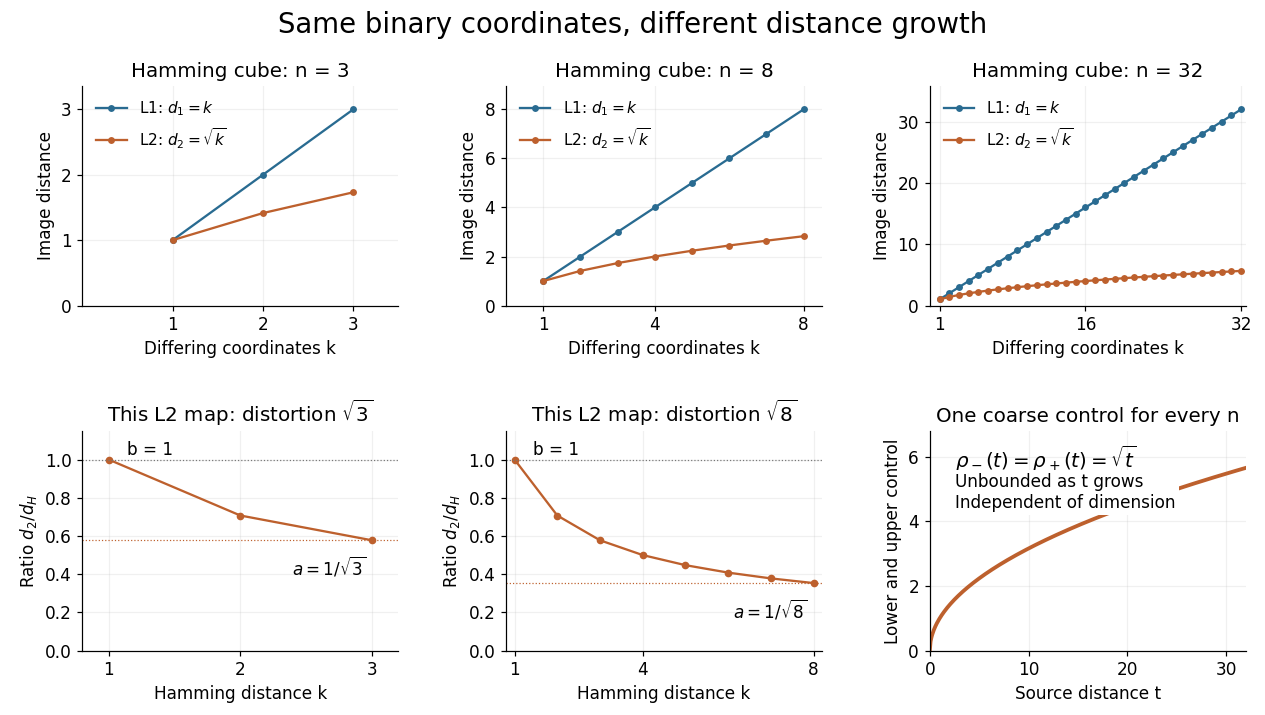
The important family distinction is that these coordinate maps have no dimension-independent bound on their bi-Lipschitz distortion into the L2 norm, yet they do give a uniform coarse embedding of a family of metric spaces. Pad each output vector with zero coordinates to view all maps in the single l2 sequence space, an L2 space for counting measure. Then the same functionswork for every , and . Similarly, padding into the l1 sequence space gives common controls and exact preservation of Hamming distance. These claims use unnormalized Hamming distance; replacing it by normalized Hamming distance changes the family of source metrics.
The geometry has a practical origin: Hamming's 1950 paper uses the number of differing positions between binary strings to study error-correcting codes. Changing one binary digit moves to a neighboring corner, so a question about corrupted messages becomes a question about separation in the Hamming cube. [ref]
https://ineffectivetheory.com/edu/papers/hamming-codes-1950.pdf. R. W. Hamming, Error Detecting and Error Correcting Codes, 1950, Section 5
A map between metric spaces is a coarse embedding when nondecreasing control functions satisfyThe last condition means that distances tending to infinity in the source must also tend to infinity in the target. The upper control prevents bounded source distances from having unbounded image distances. Unlike a metric embedding as defined here, a coarse embedding need not be injective: its lower control may vanish at small distances. Finite bi-Lipschitz distortion implies a coarse embedding by taking and , but nonlinear controls such as allow much more compression.
For an injective function between metric spaces with at least two source points, consider all distance ratiosIf constants satisfythen is a bi-Lipschitz map: both and its inverse on are Lipschitz maps. The bound compares the most expanded pair with the most contracted pair. To define the bi-Lipschitz distortion of this particular metric embedding, use the sharp bounds and :Here the Lipschitz constant of is . If no positive finite bounds exist, the bi-Lipschitz distortion is infinite. For a finite source, every injective function has finite bi-Lipschitz distortion, but its size can depend on the source. Matoušek gives the equivalent definition using one scale factor and a multiplicative error bound. [ref]
Lecture notes on metric embeddings by Jiří Matoušek. Matoušek, Section 1.1: distortion and Lipschitz maps
Changing units is harmless: replacing by , with , multiplies both and by and leaves unchanged. In a normed vector space this can be achieved by multiplying every output vector by . Thus bi-Lipschitz distortion one means that all distances change by the same factor; an isometric embedding additionally requires that factor to be one. A stretch factor with a specified normalization is a related quantity; when comparing sources, check which overall scale has been fixed.
Take the four corners , , , of a square, with Euclidean distance in both source and target. For the linear map , the six unordered pairs exhaust the possibilities: the two vertical sides have ratio , the two horizontal sides have ratio , and the two diagonals have ratio . Consequently , , and . In contrast, , three times the identity function, gives ratio for every pair and has bi-Lipschitz distortion .
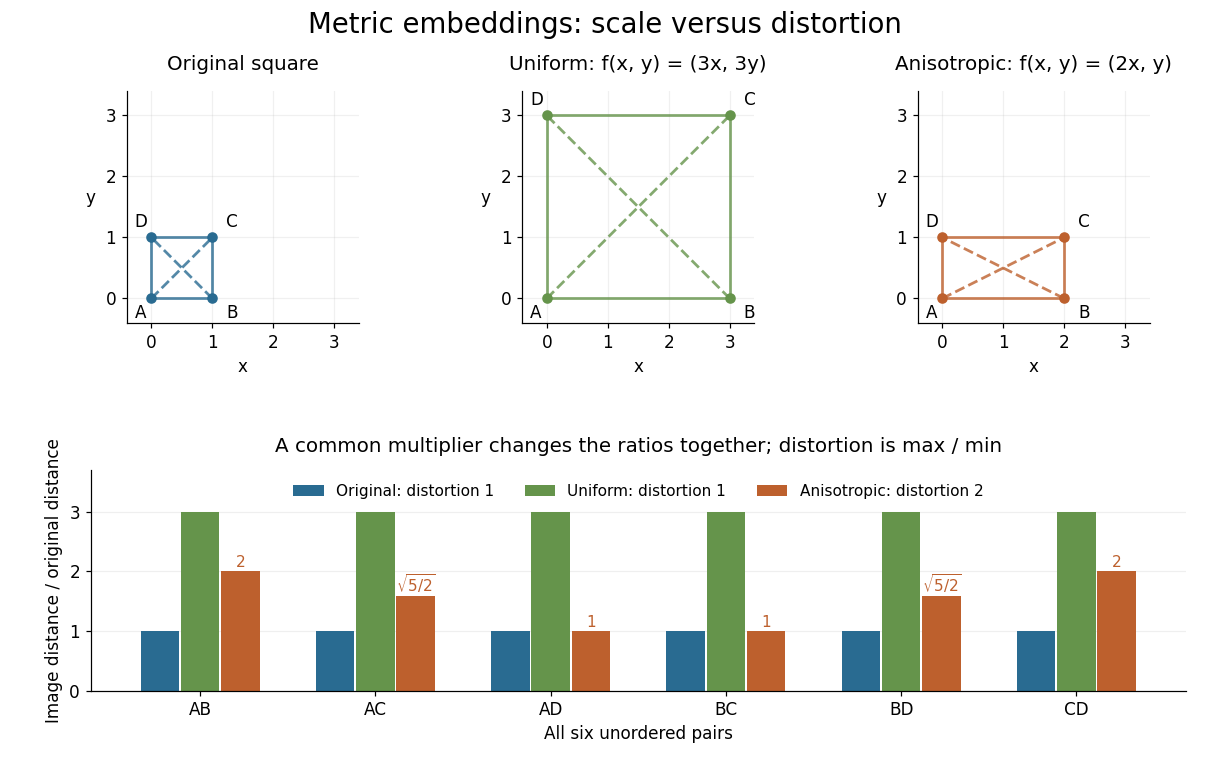
Uniform scaling keeps distortion one; unequal coordinate scaling gives distortion two
. Details. The ratio chart makes the reason visible: a common multiplier moves every ratio together, while unequal coordinate scaling spreads the ratios apart. More generally, in a normed vector space, the ratio bounds giveThis normalization gives Lipschitz constant one and inverse Lipschitz constant . It is only a change of scale, so it cannot improve the bi-Lipschitz distortion.
The best possible bi-Lipschitz distortion of a source into a specified target is a separate quantity:The infimum runs over all injective functions, and need not be attained. The notation means the analogous infimum over metric embeddings into an Lp space. A calculation for one chosen gives an upper bound for ; proving optimality also requires a lower bound for every possible .
On a real interval, a step function is constant on the open cells of a finite partition of an interval, with endpoint values specified separately. Equivalently, up to those finitely many point values it is a finite linear combination of interval indicator functions. For example, a function equal to two on , one on and zero on is a step function. Its integral is the sum of rectangle heights times widths.
A simple function is more general in measure theory: its finitely many value sets can be arbitrary measurable sets. The Dirichlet function on is simple but is not an interval step function, because every nonempty interval contains both rational and irrational points. Merely being constant on a finite or countable measurable partition therefore does not characterize the usual interval-based step functions.
Countably many jumps can be considered under explicitly stated extensions of the term. The finite-partition convention is the one used for elementary Riemann approximations; the measurable finite-range convention belongs to simple functions in Lebesgue integration.
A semiring of sets contains the empty set, is closed under intersections, and has the property that the difference of two members is a finite disjoint union of members. Predictable rectangles form a semiring generating the predictable sigma-algebra.
A neutron interferometer coherently splits and recombines a neutron matter wave, converting a difference of quantum phase between paths into an output intensity change. A sample in one path can therefore be studied through its phase shift, even when its effect on transmitted intensity is small.
A perfect-crystal implementation uses several diffracting silicon blades machined from one crystal with a common base. Bragg diffraction splits the incident wave into paths, redirects them and recombines them in a geometry analogous to a Mach-Zehnder interferometer. The common base helps preserve relative alignment; thermal and vibration isolation protect phase stability. The institutional apparatus description includes the blade geometry and explains the importance of environmental isolation.[ref]
Neutron Interferometry and Optics Facilities by NIST. overview, Fig. 2 and NIOF description: monolithic silicon blades, common base, and thermal/acoustic/vibration isolation
Recombination measures a relative phase rather than an individual particle trajectory. Electric, magnetic, gravitational or material interactions can all contribute, so a quantitative result requires controls separating the desired phase from drifts and other path differences. The Colella–Overhauser–Werner experiment is a gravitational example.
The de Broglie wavelength is the distance over which a matter wave accumulates one full spatial quantum phase cycle in its propagation direction:Here is the Planck constant, is the momentum, and is the angular wavevector. The scalar in means the positive momentum magnitude, not a signed component. Reversing a momentum reverses the wavevector without making the wavelength negative. At zero momentum there is no finite spatial phase period: the limiting wavelength diverges.
This relation makes microscopic diffraction accessible with particles: increasing the momentum shortens the wavelength until it is comparable with the spacings in a crystal scattering problem. The electron accelerating-voltage wavelength gives a practical way to tune this scale, while the Davisson–Germer experiment tests it by comparing electron diffraction directions with independently known crystal geometry. The same relation applies to neutral particles in a neutron interferometer; electric charge is not a requirement for a matter wave.
The wavelength belongs to the wavefunction, not to a sinusoidal path of a particle. A free-particle momentum convention makes the distinction especially clear: a plane wave has a rotating complex quantum phase but a constant probability density. A localized wave packet contains a range of momenta and therefore generally has a range of wavelengths, rather than one exact spatial period.
Matter-wave interference occurs when coherent spatial branches of a particle's wavefunction recombine and their relative quantum phase changes the detection probabilities.
For an MPS tensor , the transfer map is the completely positive map . Its fixed points control normalization and local expectation values, while its subleading eigenvalues control correlation lengths.
Pinned article: Introduction to the OurBigBook Project
Welcome to the OurBigBook Project! Our goal is to create the perfect publishing platform for STEM subjects, and get university-level students to write the best free STEM tutorials ever.
Everyone is welcome to create an account and play with the site: ourbigbook.com/go/register. We belive that students themselves can write amazing tutorials, but teachers are welcome too. You can write about anything you want, it doesn't have to be STEM or even educational. Silly test content is very welcome and you won't be penalized in any way. Just keep it legal!
Intro to OurBigBook
. Source. We have two killer features:
- topics: topics group articles by different users with the same title, e.g. here is the topic for the "Fundamental Theorem of Calculus" ourbigbook.com/go/topic/fundamental-theorem-of-calculusArticles of different users are sorted by upvote within each article page. This feature is a bit like:
- a Wikipedia where each user can have their own version of each article
- a Q&A website like Stack Overflow, where multiple people can give their views on a given topic, and the best ones are sorted by upvote. Except you don't need to wait for someone to ask first, and any topic goes, no matter how narrow or broad
This feature makes it possible for readers to find better explanations of any topic created by other writers. And it allows writers to create an explanation in a place that readers might actually find it.
Figure 1. Screenshot of the "Derivative" topic page. View it live at: ourbigbook.com/go/topic/derivativeVideo 2. OurBigBook Web topics demo. Source. - local editing: you can store all your personal knowledge base content locally in a plaintext markup format that can be edited locally and published either:This way you can be sure that even if OurBigBook.com were to go down one day (which we have no plans to do as it is quite cheap to host!), your content will still be perfectly readable as a static site.
- to OurBigBook.com to get awesome multi-user features like topics and likes
- as HTML files to a static website, which you can host yourself for free on many external providers like GitHub Pages, and remain in full control

Figure 2. You can publish local OurBigBook lightweight markup files to either OurBigBook.com or as a static website.
Figure 3. Visual Studio Code extension installation.
Figure 5. . You can also edit articles on the Web editor without installing anything locally. Video 3. Edit locally and publish demo. Source. This shows editing OurBigBook Markup and publishing it using the Visual Studio Code extension. 
- Infinitely deep tables of contents:




All our software is open source and hosted at: github.com/ourbigbook/ourbigbook
Further documentation can be found at: docs.ourbigbook.com
Feel free to reach our to us for any help or suggestions: docs.ourbigbook.com/#contact