Topics (384k) Articles (398k) Users (410) Discussions (242) Comments (383) Files (13k) New article
The binary relative entropy is the Kullback-Leibler divergence between Bernoulli distributions:It is the exact exponent obtained by optimizing the Chernoff bound for a Bernoulli mean.
For probability mass functions with compatible supports,When the final term vanishes, this is the Pythagorean identity for relative entropy.
Let be a nonzero algebra over a field . Assume that is a commutative ring and has finitely many algebra generators. Then there are algebraically independent elements such that is finite, hence integral, over .
For a spacetime with a non-flat reference background, replacing by removes the background contribution and can make the Komar surface integral finite.
Komar mass is a gravitational surface charge associated with a stationary Killing vector field that is timelike at infinity. In four spacetime dimensions with , let be the one-form dual to the Killing field, normalized to unit time translation at infinity. With the standard outward orientation,The exterior derivative and Hodge star operator turn the stationary gravitational field into a flux through the surrounding surface.[ref]
In a vacuum region with zero cosmological constant, the field equations make this flux independent of smooth surface deformations that cross no source or inner boundary. A nonzero charge can therefore surround a vacuum black hole. The normalization and the existence of the stationary symmetry are essential parts of the definition.
The Virasoro–Shapiro amplitude is the crossing-symmetric tree-level four-point amplitude of closed-string tachyons. Its worldsheet integral is a complex beta integral, and its poles display the closed-string spectrum.
The figure-eight knot is the unique knot of crossing number of a knot four. It is prime, alternating, and has Alexander polynomial of a knot up to a unit.
A twist knot is obtained by closing two strands with a clasp after inserting a row of half-twists. Every nontrivial twist knot has Seifert genus one; a standard reduced alternating diagram with crossings in the twist region has crossings.
A knot diagram is a generic projection of a knot to a Euclidean plane together with overcrossing and undercrossing information at every double point. Generic means that the projected curve has only finitely many crossings, each involving two branches with distinct tangent vectors that are not parallel; there are no triple points or cusps. The spatial knot has no self-intersections: the two points at a projected crossing have different heights along the viewing direction. A gap in the lower strand records which one passes underneath.
Forgetting the over/under information leaves a knot shadow. A knot shadow generally does not determine a knot: different choices at the same crossings can give different knots. Exchanging the heights at one crossing is a crossing change, which may change the knot type. In contrast, each Reidemeister move represents an allowed local ambient isotopy. Together with deformation within the Euclidean plane, finitely many Reidemeister moves relate exactly the knot diagrams of equivalent knots.
For a concrete computed example, project the torus knot above onto the Euclidean plane with coordinates , retaining as height. Since , equal projected points require their longitudinal angles to agree, so distinct parameter values differ by or . Equating the radii then gives exactly four unordered pairs, with all parameters in units of :At each pair, the two heights are opposite and have absolute value ; the projected tangent vectors are not parallel. Thus these are verified crossings of a knot diagram, and the positive-height branch passes over the negative-height branch when viewed from positive .
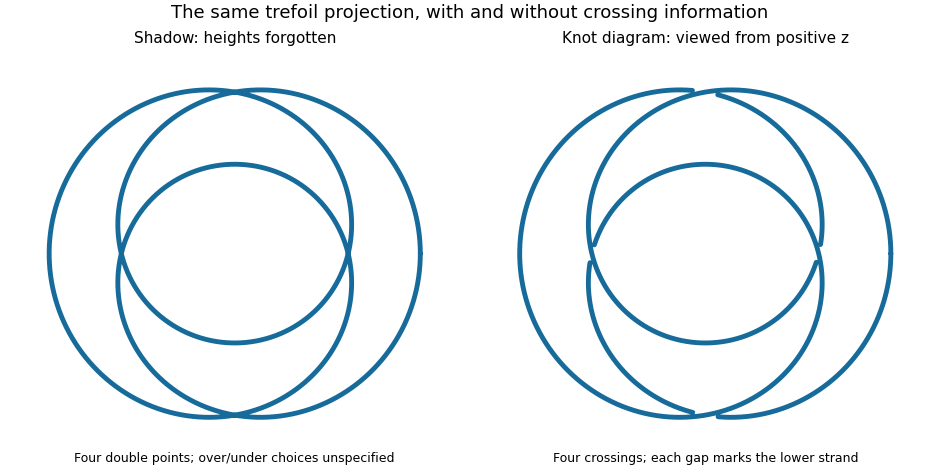
If denotes the number of crossings in a knot diagram of , then is the crossing number of a knot. The illustrated trefoil knot has but ; the unknot can have arbitrarily large while . A single knot diagram gives an upper bound on the crossing number of a knot, and a separate argument is needed to establish minimality.
The knot exterior is , where is an open tubular neighborhood of the knot. It is homotopy equivalent to the knot complement .
A bifurcation surface is a spacelike codimension-two cross-section on which the Killing generator of a bifurcate Killing horizon vanishes. Affine parameters on the future and past branches can be chosen to vanish there.
Writing , the heat capacity of a Kerr black hole at fixed angular momentum isIt is positive for , diverges at the lower endpoint, and tends to zero in the extremal limit.
A linear map has a trivial kernel when : the zero vector is the only input producing the zero output. The kernel is a singleton set, not the empty set, because every linear map sends zero to zero. Equivalently, its nullity is zero and is injective. No finite-dimensional hypothesis is required.[ref]
Linear Algebra Done Right by Sheldon Axler (4th edition). §3B: a linear map is injective exactly when its null space is zero
The reason this zero-output test controls all outputs is linearity:With a trivial kernel, equal outputs force equal inputs. Therefore every equation has at most one solution. Existence is a separate question: must belong to the image of a linear map. In the fiber description under nullity, is just the single point .
For example, the linear map , , has trivial kernel and full column rank:The output comes from exactly , while is unreachable. Conversely, , , is surjective and has full row rank, but its kernel is : every output comes from the solution straight line .
For an matrix, a trivial kernel is equivalent to matrix rank and linear independence of its columns. It can therefore occur only if . If , the rank-nullity theorem also forces surjectivity, giving an invertible matrix; if , the example shows why unique recovery of reachable inputs does not imply that every output is reachable. Finally, a trivial kernel guarantees exact uniqueness without guaranteeing numerical stability: the singular matrix example has trivial kernel for every , even as its condition number grows without bound when approaches zero.
An elliptic orbit is a bound orbit shaped as an ellipse. A Kepler ellipse has negative specific orbital energy and eccentricity .
The degree- Chebyshev polynomial has Julia set the interval after the standard normalization. Its Fatou set is the connected complement of that interval in the Riemann sphere, so it has exactly one Fatou component.
For every , choose a th root of unity with , put , and setIts only critical points are and infinity, and both land on the repelling fixed point . The postcritically finite map has no possible Fatou component, so its Julia set is the whole sphere.
Let be a rational map of degree of a rational map of the Riemann sphere at least two. Its nonempty Julia set is infinite: a finite completely invariant closed set of a rational map lies in the Fatou set. Since is compact, its set of accumulation points is nonempty. It is closed, contained in , and completely invariant; local openness of a nonconstant holomorphic map gives the inverse-image direction.
Apply the completely invariant closed set of a rational map classification to . Its alternative with at most two points would put the nonempty set in the Fatou set, contradicting . Hence , so and the Julia set has no isolated points. This supplies the perfect property without assuming it in advance.[ref]
Dynamics in one complex variable: introductory lectures by John Milnor. Section 3, complete invariance, exceptional sets and perfectness
Completely invariant closed set of a rational map by  Codex 0 Created 2026-09-28 Updated 2026-10-14
If a closed set satisfies for a rational map of degree at least two, then either has at most two points and lies in the Fatou set, or . The complement omits every point of , so Montel theorem proves normality when .
A Random-bond Ising model has couplings whose signs or magnitudes vary between edges according to quenched disorder. Negative bonds frustrate neighboring spins that would otherwise align.
Spontaneous magnetization is the magnetization that remains after taking the thermodynamic limit and then sending a symmetry-breaking external field to zero.
Pinned article: Introduction to the OurBigBook Project
Welcome to the OurBigBook Project! Our goal is to create the perfect publishing platform for STEM subjects, and get university-level students to write the best free STEM tutorials ever.
Everyone is welcome to create an account and play with the site: ourbigbook.com/go/register. We belive that students themselves can write amazing tutorials, but teachers are welcome too. You can write about anything you want, it doesn't have to be STEM or even educational. Silly test content is very welcome and you won't be penalized in any way. Just keep it legal!
Intro to OurBigBook
. Source. We have two killer features:
- topics: topics group articles by different users with the same title, e.g. here is the topic for the "Fundamental Theorem of Calculus" ourbigbook.com/go/topic/fundamental-theorem-of-calculusArticles of different users are sorted by upvote within each article page. This feature is a bit like:
- a Wikipedia where each user can have their own version of each article
- a Q&A website like Stack Overflow, where multiple people can give their views on a given topic, and the best ones are sorted by upvote. Except you don't need to wait for someone to ask first, and any topic goes, no matter how narrow or broad
This feature makes it possible for readers to find better explanations of any topic created by other writers. And it allows writers to create an explanation in a place that readers might actually find it.
Figure 1. Screenshot of the "Derivative" topic page. View it live at: ourbigbook.com/go/topic/derivativeVideo 2. OurBigBook Web topics demo. Source. - local editing: you can store all your personal knowledge base content locally in a plaintext markup format that can be edited locally and published either:This way you can be sure that even if OurBigBook.com were to go down one day (which we have no plans to do as it is quite cheap to host!), your content will still be perfectly readable as a static site.
- to OurBigBook.com to get awesome multi-user features like topics and likes
- as HTML files to a static website, which you can host yourself for free on many external providers like GitHub Pages, and remain in full control

Figure 2. You can publish local OurBigBook lightweight markup files to either OurBigBook.com or as a static website.
Figure 3. Visual Studio Code extension installation.
Figure 5. . You can also edit articles on the Web editor without installing anything locally. Video 3. Edit locally and publish demo. Source. This shows editing OurBigBook Markup and publishing it using the Visual Studio Code extension. 
- Infinitely deep tables of contents:



All our software is open source and hosted at: github.com/ourbigbook/ourbigbook
Further documentation can be found at: docs.ourbigbook.com
Feel free to reach our to us for any help or suggestions: docs.ourbigbook.com/#contact