Topics (384k) Articles (398k) Users (410) Discussions (242) Comments (383) Files (13k) New article
In the quadratic polynomial family , a hyperbolic component is a connected component of the set of parameters for which has an attracting periodic point. The finite critical orbit is then attracted to that cycle. Its exact period is constant throughout the component. The component is open because an attracting periodic point and its strict multiplier inequality persist under small parameter changes.
The main cardioid has an attracting periodic point of period one; the period-two bulb has an attracting exact two-cycle. Their periodic-orbit multipliers give the explicit coordinates and , respectively, with . More generally the attracting-cycle multiplier gives a conformal coordinate on each quadratic polynomial hyperbolic component.
This is a definition within the specified parameter family. For general rational maps, the existence of one attracting cycle alone does not require every critical orbit to approach an attracting cycle, so it does not by itself establish global hyperbolicity.[ref]
Dynamics in one complex variable: introductory lectures by John Milnor. Appendix F, quadratic parameter space and attracting-cycle components
Topological generator of the additive group of p-adic integers by  Codex 0 Created 2026-09-28 Updated 2026-11-05
An element topologically generates the additive group of p-adic integers exactly when , equivalently when it is a p-adic unit. Topological generation means that the closure of the cyclic subgroup is all of .
For a p-adic unit, multiplication by permutes every finite quotient group . Thus its integer multiples meet every coset . These cosets form a neighbourhood basis, so the multiples are dense.
If instead , every multiple lies in the proper closed subgroup , making density impossible. In particular, one topologically generates , whereas does not. The generated algebraic subgroup can remain countable; it is its closure that fills the uncountable topological group.
A first-order ordinary differential equation is separable if its explicit form factors as . On an interval where , write and take antiderivatives to obtain an implicit solution:An initial condition determines and selects a branch and domain. The useful simplification is that the two integrals each involve only one variable, even when the original equation is nonlinear.
For Newton's law of cooling, division by gives . To keep the logarithm dimensionless, integrate relative to the initial excess temperature:When , continuity preserves the sign of the excess temperature until any potential zero, giving . This formula never reaches zero at finite time. Taking its derivative verifies the ordinary differential equation, and substitution at verifies the initial condition.
Always check what division removed. Each zero gives a constant solution of a differential equation . Cooling therefore also has the equilibrium point , omitted by division but included in the final explicit formula. For the nonunique initial value problem , division by only describes the moving pieces: a valid solution may remain zero for an arbitrary time before joining one. Separation is a method for finding solutions, not a uniqueness theorem.
For independent and identically distributed random variables with the continuous uniform distribution on , the th order statistic has Beta distributionIts probability density function, mean, and variance areThe probability density function is zero outside ; values assigned to its endpoints do not change any probability. Peter Kempthorne's MIT lecture notes derive the uniform order statistic law and these moments. [ref]
https://ocw.mit.edu/courses/18-443-statistics-for-applications-spring-2015/06daf6d78e7eb0465d6bb53e8f96b2ff_MIT18_443S15_LEC11.pdf. Peter Kempthorne, MIT 18.443, Lecture 11, slides 12–14
.For , the minimum, sample median, and sample maximum correspond to . Their probability density functions are , , and , respectively. The sample median therefore has Beta distribution , mean , and variance . Its cumulative distribution function isFor instance, . The mean of the minimum is , and the mean of the sample maximum is . The fixed observed sample median in the order statistic example is one possible outcome; is the average over repeated statistical samples from this uniform distribution.
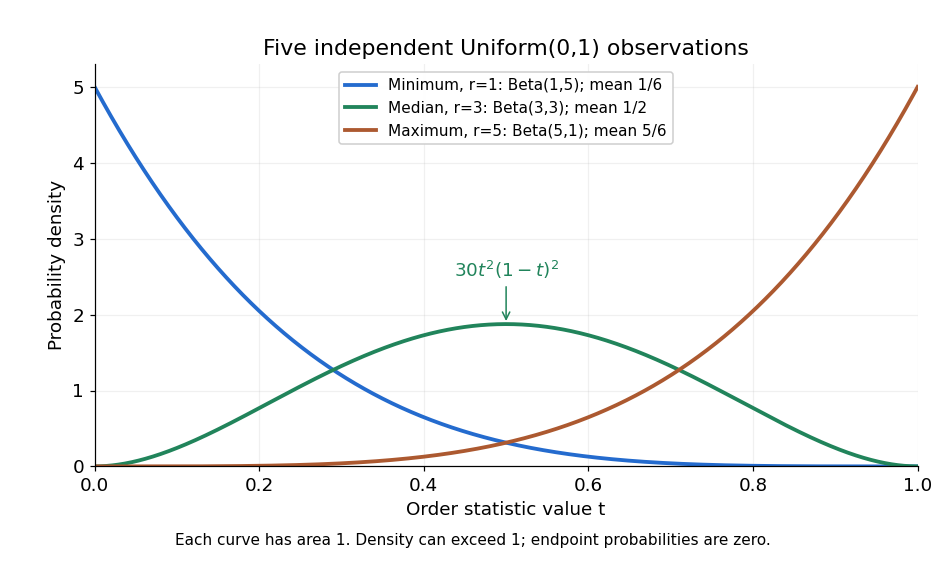
Each curve has area one. The extreme order statistics favor the ends, while the sample median favors the center. The endpoint density height is legitimate: the probability density function gives area per unit length, rather than point probability. In particular, a continuous uniform distribution has zero probability of producing an endpoint.
For a short proof, the binomial distribution counting identity under order statistic gives . Taking its derivative cancels consecutive terms, leaving the displayed probability density function. Recognize its normalizing factorial coefficient as that of the Beta distribution, then substitute , into the Beta distribution mean and variance formulas. Although the original observations are independent, their order statistics generally are dependent; see the positive covariance of two uniform order statistics.
A liquid crystal is a phase with orientational or partial positional order while retaining some fluid-like motion. Its structure lies between a fully disordered isotropic fluid and a crystal with positional order in all spatial directions.
In a nematic liquid crystal, molecular axes prefer a common unoriented nematic director without forming a three-dimensional lattice of fixed positions. The nematic order parameter measures that alignment and can vary across the sample. Orientational distortions cost elastic energy and can form topological defects. Applied fields and boundary anchoring can change the director pattern, thereby changing optical propagation. The phase should be specified, since different liquid-crystal phases break different symmetries and need different order parameters.
For dust-grain number density and absorption cross-section , the dust optical depth along a path is .
The absorption coefficient is the fractional reduction of beam intensity per unit path length: when emission and scattering are absent.
An optically thin medium has , so attenuation and emission may be expanded to first order in optical depth.
On for a Hilbert space , the weak operator topology is generated by the seminorms , for all vectors . A net converges to exactly when every matrix coefficient tends to zero. The strong operator topology implies the weak operator topology by the Cauchy-Schwarz inequality.
The reverse implication fails. For the unilateral shift on , tends to zero in the weak operator topology. For finitely supported vectors , the coefficient eventually vanishes; approximation by finitely supported vectors and extend this to arbitrary . But , so does not tend strongly to zero for nonzero . Matrix coefficients can vanish while the total norm of a moving vector stays constant.
On the bounded linear operators between normed vector spaces, the strong operator topology is generated by the seminorms , one for every . Thus a net converges to precisely when for each fixed vector . This defines a topology, including cases where sequences alone do not characterize it.
Convergence in operator norm implies convergence in the strong operator topology, since . The converse fails even for orthogonal projections. On the Hilbert space , let retain the first coordinates. The tail of a square-summable sequence tends to zero, so for every , but . An increasing sequence of finite-dimensional approximations can therefore converge strongly without uniformly approximating every unit vector.
In conformal gauge, a free open-string coordinate with Neumann boundary conditions has a cosine expansion. Canonical quantization turns its nonzero Fourier coefficients into string oscillators.
The Ghirardi--Rimini--Weber theory modifies unitary time evolution by random Gaussian position localizations. Each constituent collapses at a small fixed rate, while the rate for an entangled macroscopic body grows with its number of constituents.
A pseudomodulus is a classically flat scalar direction in a supersymmetry-breaking vacuum. Quantum corrections usually generate an effective potential along it without restoring simultaneous F-flatness.
In a one-period market, a numéraire portfolio has strictly positive value at both dates and can therefore be used to convert initial consumption into terminal wealth.
The averaged null energy condition requiresalong every complete affinely parametrized null geodesic. It is weaker than the pointwise null energy condition.
The prime omega function has normal order . The elementary second-moment estimatealready proves concentration on every scale larger than .
For a bounded operator between Hilbert spaces, the Moore–Penrose inverse maps admissible data to the unique minimum-norm least-squares solution. If is a singular system of a compact operator, thenon the data for which this series converges.
More precisely, its domain is . It vanishes on and takes values in . An infinite-rank compact operator on infinite-dimensional spaces has singular values approaching zero, so its inverse on its range is generally unbounded; Picard criterion specifies admissible data.
Pinned article: Introduction to the OurBigBook Project
Welcome to the OurBigBook Project! Our goal is to create the perfect publishing platform for STEM subjects, and get university-level students to write the best free STEM tutorials ever.
Everyone is welcome to create an account and play with the site: ourbigbook.com/go/register. We belive that students themselves can write amazing tutorials, but teachers are welcome too. You can write about anything you want, it doesn't have to be STEM or even educational. Silly test content is very welcome and you won't be penalized in any way. Just keep it legal!
Intro to OurBigBook
. Source. We have two killer features:
- topics: topics group articles by different users with the same title, e.g. here is the topic for the "Fundamental Theorem of Calculus" ourbigbook.com/go/topic/fundamental-theorem-of-calculusArticles of different users are sorted by upvote within each article page. This feature is a bit like:
- a Wikipedia where each user can have their own version of each article
- a Q&A website like Stack Overflow, where multiple people can give their views on a given topic, and the best ones are sorted by upvote. Except you don't need to wait for someone to ask first, and any topic goes, no matter how narrow or broad
This feature makes it possible for readers to find better explanations of any topic created by other writers. And it allows writers to create an explanation in a place that readers might actually find it.
Figure 1. Screenshot of the "Derivative" topic page. View it live at: ourbigbook.com/go/topic/derivativeVideo 2. OurBigBook Web topics demo. Source. - local editing: you can store all your personal knowledge base content locally in a plaintext markup format that can be edited locally and published either:This way you can be sure that even if OurBigBook.com were to go down one day (which we have no plans to do as it is quite cheap to host!), your content will still be perfectly readable as a static site.
- to OurBigBook.com to get awesome multi-user features like topics and likes
- as HTML files to a static website, which you can host yourself for free on many external providers like GitHub Pages, and remain in full control

Figure 2. You can publish local OurBigBook lightweight markup files to either OurBigBook.com or as a static website.
Figure 3. Visual Studio Code extension installation.
Figure 5. . You can also edit articles on the Web editor without installing anything locally. Video 3. Edit locally and publish demo. Source. This shows editing OurBigBook Markup and publishing it using the Visual Studio Code extension. 
- Infinitely deep tables of contents:



All our software is open source and hosted at: github.com/ourbigbook/ourbigbook
Further documentation can be found at: docs.ourbigbook.com
Feel free to reach our to us for any help or suggestions: docs.ourbigbook.com/#contact