Topics (384k) Articles (398k) Users (410) Discussions (242) Comments (383) Files (13k) New article
The nonlinear sigma model has an -component field constrained to a sphere, commonly or . An auxiliary Lagrange-multiplier field turns the constraint into a self-consistent mass gap in the Large-N expansion.
For , the trapped focusing cubic ground-state equation in two dimensions isA nonzero positive solution follows from minimizing the harmonic-oscillator quadratic form subject to a fixed norm and then rescaling by the positive Lagrange multiplier.
Every bounded sequence in has, after passage to a subsequence, a decompositionwhere for , the and gradient norms decouple asymptotically, andfor every , where for and for .
For a sufficiently regular solution of the mass-critical focusing nonlinear Schrödinger equation with finite variance, the variance and its first derivative areA second differentiation and integration by parts give the virial identityThese constants use Laplacian coefficient one in the evolution equation. Energy conservation makes the second derivative constant. If the energy is negative, the resulting quadratic expression for eventually becomes negative, contradicting its definition as a nonnegative integral; this proves negative-energy blowup for the mass-critical focusing nonlinear Schrödinger equation under the finite-variance hypotheses.
The mass-critical focusing nonlinear Schrödinger equation on isIts scaling preserves the Lebesgue space norm , which is the conserved mass.
An ideal of a Noetherian local ring is an ideal of definition when has Krull dimension zero. Equivalently, is -primary, so and for some positive integer .
The dilatation current associated with scale transformations is up to improvement terms. Its divergence is the trace of the stress-energy tensor, so classical scale invariance requires a traceless improved tensor on shell.
A Noether charge is the spatial integral of a Noether current. It is time-independent when the current has vanishing flux through the spatial boundary, and in a Hamiltonian formulation it generates the associated continuous symmetry.
A conserved current has components satisfying the continuity equation . It relates local accumulation of a quantity to its transport.
For a fixed volume , the divergence theorem givesThus the integrated charge density, not an arbitrary spatial integral of every current component, is constant when boundary flux vanishes. Electric charge provides one example; a continuous field symmetry can provide a Noether current for another. A measured local density can change while the global charge remains conserved, because current redistributes it across the sample.
A quantum instrument associates each classical outcome with a completely positive trace-nonincreasing map; summing the outcome maps gives a quantum channel. It specifies both outcome probabilities and conditional output states.
The Cavendish experiment makes the attraction predicted by Newton's law of universal gravitation measurable between laboratory masses. Two small test masses hang at the ends of a horizontal rod in a Cavendish torsion balance; nearby larger source masses exert a tiny torque. A thin suspension fiber supplies an opposing torque as it twists. Measuring its twist and calibrating its torsion constant lets an experimenter infer the gravitational force and, in a modern analysis, the gravitational constant. [ref]
https://www.phys.uconn.edu/~hamilton/phys258/N/cav.pdf. University of Connecticut, Physics 258/259, The Cavendish Experiment: apparatus and equations of motion, pp. 1–3
The beautiful feature is that the two horizontal forces can cancel as vectors while their torques add. The instrument converts weak attraction into a rotation, with sensitivity set by the fiber's torsion constant. Earth's much larger downward gravitational weight is supported by the suspension rather than supplying the intended torque about its vertical axis. A laboratory measurement can therefore probe the same Newtonian gravitational field that governs the two-body problem.
Henry Cavendish's original paper was Experiments to determine the Density of the Earth, published in Philosophical Transactions, volume 88 (1798), pp. 469–526, and read on 21 June 1798. On p. 469 he credits John Michell with the apparatus idea and explains that Michell died before using it; the instrument reached Cavendish through Francis John Hyde Wollaston. Cavendish's stated aim was Earth's mean mass density. Calling the experiment a determination of the gravitational constant is a modern interpretation, not Cavendish's own formulation of his result. [ref]
https://www.famaf.unc.edu.ar/~wolf/FisicaI/Phil.%20Trans.%20R.%20Soc.%20Lond.-1798-Cavendish-rstl.1798.0022.pdf. Cavendish (1798), original paper, opening p. 469; DOI 10.1098/rstl.1798.0022
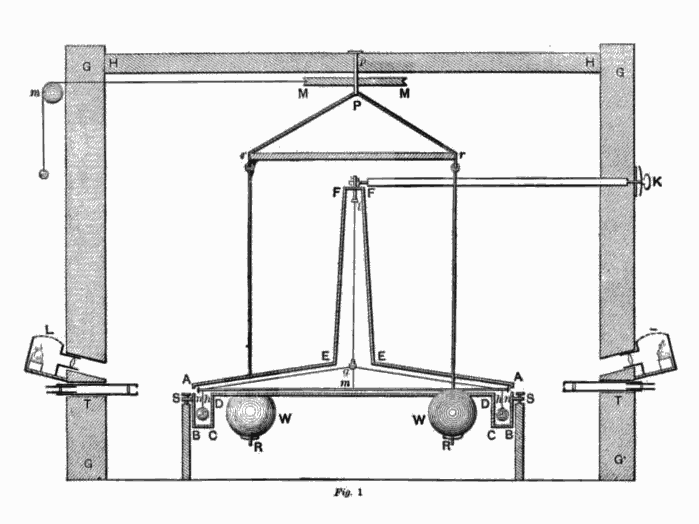
Cavendish's published apparatus cross-section, including its enclosing building
. Figure 1 from Henry Cavendish's 1798 paper, reproduced in The Laws of Gravitation (1900), p. 62. The building and external operation complement the simplified Cavendish torsion balance diagram. Scan prepared by Wikimedia contributor Chetvorno in 2007. Public domain; Public Domain Mark 1.0. Source.The connection between Earth's mean mass density and the gravitational constant follows in a spherical, nonrotating model of Earth. With Earth mass , radius , and surface gravitational acceleration , the spherical shell theorem and Newton's law of universal gravitation giveThus a local comparison of gravitational attractions, together with knowledge of Earth's size and surface gravitational acceleration, reaches a property of the entire planet. These are modern equations explaining the connection, not equations quoted from Cavendish's paper.
For a worked example, use an explicitly simplified two-near-pair model. Each test point mass is , each source point mass is , and each lever arm is , so the rod's full length is . Neglect the rod's mass. At zero twist put the test masses at and , and the sources at and . Here is the near-pair center separation. Ignore each source's attraction on the test mass at the opposite end. Evaluate the two near-pair forces at zero twist and treat their torque as constant for a small twist, requiring . This is a teaching model, not a precision model of Cavendish's actual apparatus.
By Newton's law of universal gravitation, each retained force has magnitude . The left force points down and the right force points up. Using torque about the suspension axis, both contributions are counterclockwise when viewed from above:The net retained horizontal force is zero, yet the net torque is positive. Moving the sources to and reverses both forces and hence the torque. In a real apparatus, the opposite source also attracts each test mass; that correction is explicitly included in the university derivation. [ref]
https://www.phys.uconn.edu/~hamilton/phys258/N/cav.pdf. University of Connecticut, The Cavendish Experiment, p. 2, equation (1): opposite-source correction
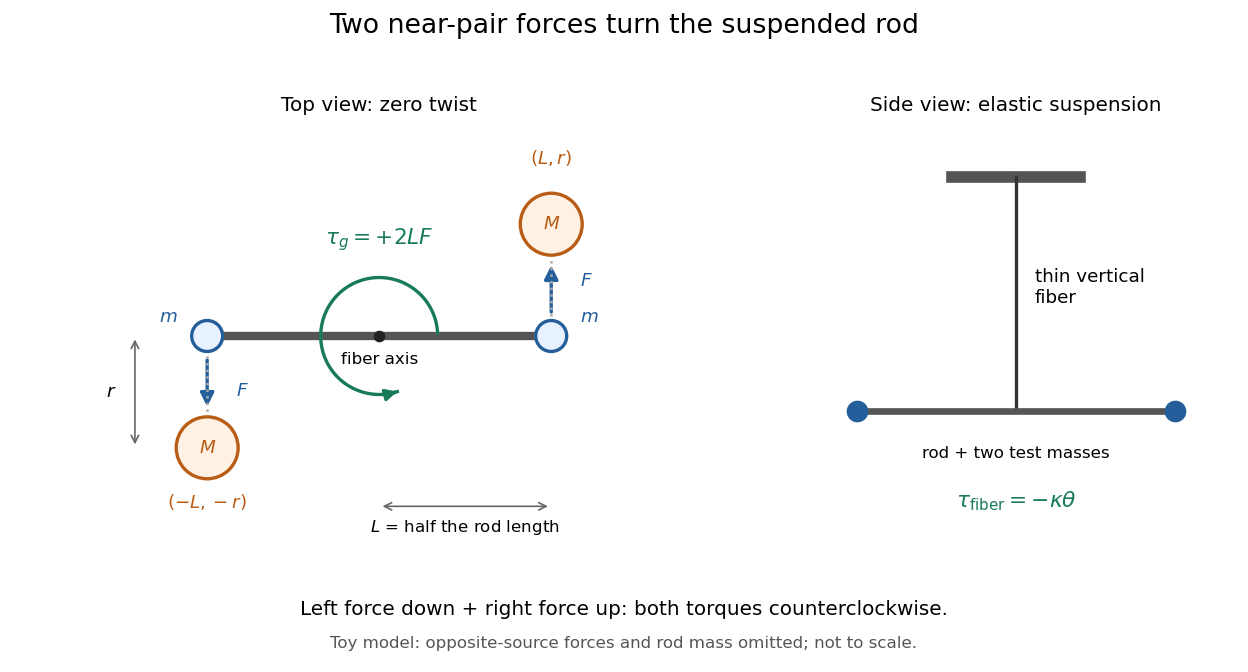
For illustrative parameters, take , , , , and torsion constant . Use , the central value in NIST's 2022 CODATA table; that table gives standard uncertainty . This is an input for the example, not a measurement made with these assumed parameters. [ref]This sub-nanonewton force produces a measurable twist in the Cavendish torsion balance. The displayed digits make the toy calculation reproducible; they do not describe experimental precision.
The gravitational constant sets the strength of Newton's law of universal gravitation. Two point masses and a center-to-center distance apart attract with force magnitudeFor fixed masses and separation, doubling would double the force. For bodies with spherical symmetry, the same exterior formula follows from the spherical shell theorem; for arbitrary extended bodies, add the attractions of their mass density elements instead. The gravitational constant connects a laboratory attraction to the Newtonian gravitational field controlling a Kepler orbit.
The gravitational constant and local gravitational acceleration are different quantities. Applying Newton's second law to a test particle gives for one spherical source. The source's mass and the observer's position change ; remains the same parameter of the law. A local falling-body experiment therefore measures a field, not alone. On rotating Earth, an instrument fixed to the surface also responds to centrifugal acceleration, while surrounding mass density and altitude change the gravitational contribution.
Dimensional analysis explains the units. Denote the base physical dimensions of length, mass and time by . Since force has dimension ,By contrast, and the standard gravitational parameter has dimension . A small numerical value of a dimensional constant depends on the units chosen: it is the resulting force for specified physical masses and separation that conveys the laboratory scale.
NIST's current complete listing givesfor the 2022 CODATA adjustment, the latest adjustment listed when checked on 14 October 2026. Parentheses indicate a standard uncertainty , approximately parts per million relative to . The adjustment year is 2022; NIST's May 2024 data update is a different date.[ref]
Fundamental Physical Constants — Complete Listing by National Institute of Standards and Technology and others. 2022 CODATA adjustment, Newtonian constant of gravitation row: value, uncertainty and units
[ref]Fundamental Physical Constants — Complete Listing by National Institute of Standards and Technology and others. Current adjustment heading, next-adjustment notice and data-content update
For an original scale calculation, stipulate two point masses separated by and insert this recommended : . The corresponding acceleration of either mass is at that instant. Reducing the separation to multiplies both by . These are ideal model predictions, not observations; their tiny scale explains why stray forces matter.
Being a constant of a physical law does not make the numerical value exact. The SI fixes the numerical values of seven defining constants, including the speed of light and Planck constant; is determined experimentally. Exact unit definitions still require physical realizations with measurement uncertainty: calibrating a length or a mass does not become error-free.[ref]
For a null tetrad , one common curvature-sign convention defines . In an outgoing wave zone it encodes the two transverse gravitational wave polarizations as one complex scalar.
A complex null tetrad consists of two real null vectors and a complex-conjugate transverse pair, normalized so that the metric is reconstructed from their pairwise products.
The Néel order parameter is the slowly varying staggered magnetization of an antiferromagnet. On a bipartite lattice it changes sign between neighboring sublattices before coarse graining.
The Razborov–Rudich natural-proofs barrier connects lower bounds in circuit complexity with the security of pseudorandom function families. Suppose a property of Boolean functions is constructive, large and useful against a class containing the relevant pseudorandom function family.
Query all inputs of a candidate Boolean function, then run the property's membership test on its truth table. Constructivity makes this take time. Largeness gives acceptance probability at least for a uniformly random Boolean function. Usefulness gives rejection for all functions in the chosen small-circuit family at sufficiently large lengths. The property therefore supplies a statistical distinguisher.
A security assumption must cover that running time and distinguishing advantage, at the chosen relation between input length and key length. Security only against polynomial-time algorithms in does not cover a full truth table test. Razborov and Rudich use a stronger quantitative hardness assumption to obtain the barrier against P/poly. The conclusion restricts a form of lower-bound proof under the assumption; it does not settle whether P equals NP.[ref]
A property of Boolean functions is large when it contains a nonnegligible fraction, customarily at least , of all -variable Boolean functions.
A property of -variable Boolean functions is constructive when membership can be decided from a -bit truth table in time polynomial in .
Singly rotating six-dimensional Myers-Perry black hole by  Codex 0 Created 2026-09-28 Updated 2026-10-06
 Pinned article: Introduction to the OurBigBook Project
Welcome to the OurBigBook Project! Our goal is to create the perfect publishing platform for STEM subjects, and get university-level students to write the best free STEM tutorials ever.
Everyone is welcome to create an account and play with the site: ourbigbook.com/go/register. We belive that students themselves can write amazing tutorials, but teachers are welcome too. You can write about anything you want, it doesn't have to be STEM or even educational. Silly test content is very welcome and you won't be penalized in any way. Just keep it legal!
Intro to OurBigBook
. Source. We have two killer features:
- topics: topics group articles by different users with the same title, e.g. here is the topic for the "Fundamental Theorem of Calculus" ourbigbook.com/go/topic/fundamental-theorem-of-calculusArticles of different users are sorted by upvote within each article page. This feature is a bit like:
- a Wikipedia where each user can have their own version of each article
- a Q&A website like Stack Overflow, where multiple people can give their views on a given topic, and the best ones are sorted by upvote. Except you don't need to wait for someone to ask first, and any topic goes, no matter how narrow or broad
This feature makes it possible for readers to find better explanations of any topic created by other writers. And it allows writers to create an explanation in a place that readers might actually find it.
Figure 1. Screenshot of the "Derivative" topic page. View it live at: ourbigbook.com/go/topic/derivativeVideo 2. OurBigBook Web topics demo. Source. - local editing: you can store all your personal knowledge base content locally in a plaintext markup format that can be edited locally and published either:This way you can be sure that even if OurBigBook.com were to go down one day (which we have no plans to do as it is quite cheap to host!), your content will still be perfectly readable as a static site.
- to OurBigBook.com to get awesome multi-user features like topics and likes
- as HTML files to a static website, which you can host yourself for free on many external providers like GitHub Pages, and remain in full control

Figure 2. You can publish local OurBigBook lightweight markup files to either OurBigBook.com or as a static website.
Figure 3. Visual Studio Code extension installation.
Figure 5. . You can also edit articles on the Web editor without installing anything locally. Video 3. Edit locally and publish demo. Source. This shows editing OurBigBook Markup and publishing it using the Visual Studio Code extension. 
- Infinitely deep tables of contents:




All our software is open source and hosted at: github.com/ourbigbook/ourbigbook
Further documentation can be found at: docs.ourbigbook.com
Feel free to reach our to us for any help or suggestions: docs.ourbigbook.com/#contact