Topics (384k) Articles (398k) Users (410) Discussions (242) Comments (383) Files (13k) New article
Homogeneous wavefront of a plane gravitational wave by  Codex 0 Created 2026-09-28 Updated 2026-10-14
For a Brinkmann plane wave whose transverse profile is quadratic, Killing fields obtained from solutions of transverse oscillator equations act transitively on every constant-retarded-time wavefront. Each wavefront is therefore a homogeneous null hypersurface.
The radiation constant relates equilibrium radiation energy density to temperature by . It satisfies in terms of the Stefan-Boltzmann constant.
The Planck function is the equilibrium spectral specific intensity of a blackbody, given by Planck's law. Per unit wavelength it isIt can also be written per unit frequency, with under the corresponding change of variable.
A planar map is a connected graph that is a planar graph together with a fixed embedding in the sphere, considered up to orientation-preserving homeomorphism. A rooted planar map has a distinguished oriented edge, which removes most embedding symmetries.
At a continuous phase transition, the equilibrium phases meet without a discontinuous change in a first derivative of the appropriate thermodynamic potential. A thermal continuous transition therefore has no latent heat, although heat capacity or another response can be singular.
An ordinary critical transition develops fluctuations over an increasingly large correlation length. For magnetic ordering, the magnetization can emerge continuously while the magnetic susceptibility grows sharply. Critical exponents describe these changes, and universality explains why microscopically different systems can share them. Finite size, finite measurement time and imperfect tuning round the ideal singularity. The description must distinguish such critical behavior from a weakly first-order transition whose small discontinuity happens to be unresolved.
Phase coexistence means that distinct equilibrium phases can persist together under common external conditions. For exchanging material, the phases have equal temperature and equal chemical potentials of each exchanging species. A flat unstressed interface also requires equal pressure; curvature changes the mechanical balance through capillary pressure.
A sealed pure fluid below its liquid-gas critical point can contain both liquid and vapor. Changing the total amount or volume can change their proportions without changing their equilibrium densities at fixed temperature. In a binary mixture, the two phases can instead have different compositions. The common-tangent construction determines their coexistence compositions by enforcing the appropriate chemical and mechanical equalities. Coexistence concerns competing phases with matching intensive conditions, rather than equality of their total extensive free energies for arbitrary sample amounts.
The spatial projection of stress-energy conservation is .
The timelike projection of stress-energy conservation is . It is the local adiabatic first law for a perfect fluid.
Assign each edge an independent uniform distribution label on . At parameter , declare open exactly when . Each open/closed decision then has the required Bernoulli distribution, and different edge decisions are independent. The same construction applies to site percolation with labels on vertices.
Keep those labels fixed when increasing . For , every -open edge is also -open, so every -open graph path survives and each percolation cluster can only gain vertices. This coupling of probability distributions compares complete configurations on one probability space, rather than comparing two unrelated pictures. Any increasing event, such as an open path between specified vertices, consequently has a nondecreasing probability.
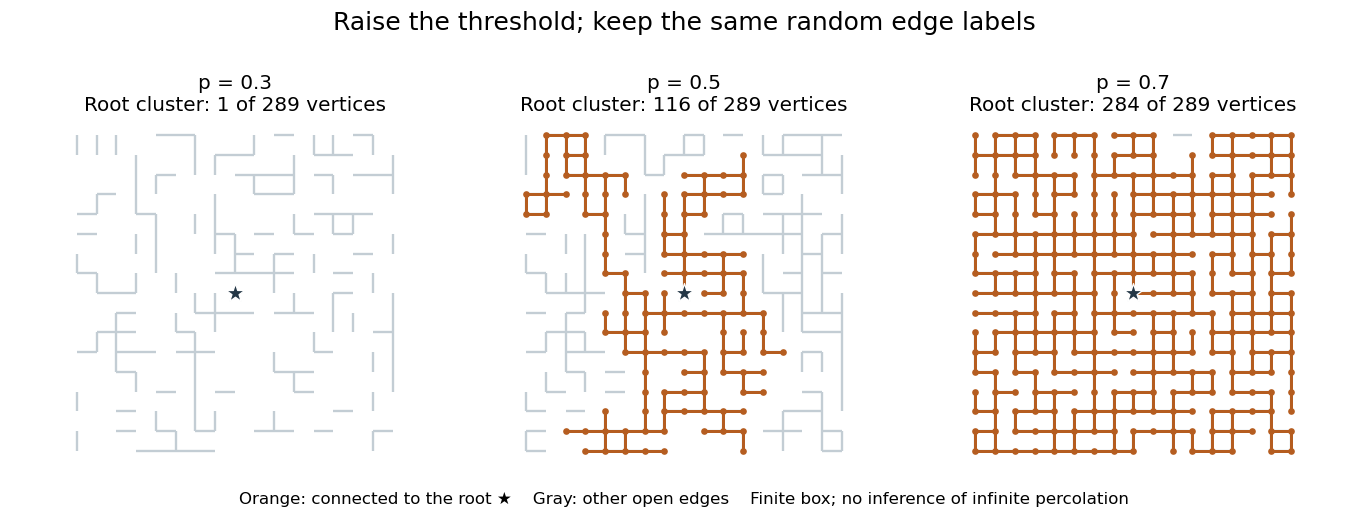
The three panels use one seeded collection of labels on a finite square lattice box. Colored edges and dots show the central root's percolation cluster; gray edges are open but disconnected from it. A percolation cluster can grow by many vertices when one newly opened edge joins it to another large percolation cluster. The panels illustrate a nested construction, not an estimate of or a proof of the Harris-Kesten theorem.
For independent bond percolation on an infinite graph with a specified root , let be its percolation cluster. The percolation probability isIt concerns the root, rather than the existence of an infinite percolation cluster somewhere else. Even above the percolation critical probability of the square lattice, an isolated root has probability , because its four incident edges can all be closed. Thus when . Positive percolation probability does not mean every vertex is connected to infinity.
On the square lattice, the events that is joined by an open path to the boundary of decrease as increases. Their probabilities converge to by continuity from above of a measure. This relates an infinite question to finite observations, without equating any one finite boundary connection with survival forever. The monotone coupling of Bernoulli percolation shows that is a monotone function of .
A stabilizer group is an abelian subgroup of the Pauli group that does not contain . Its simultaneous positive eigenspace is its stabilizer subspace.
An -qubit Pauli operator is a tensor product of single-qubit Pauli matrices, possibly multiplied by a phase. Hermitian Pauli operators have eigenvalues and .
Partial-wave unitarity restricts scattering in each angular-momentum channel because total outgoing probability cannot exceed the incident probability. For a single purely elastic channel, has unit modulus, and for distinguishable spinless particlesThe bound follows directly from .
If inelastic channels are open, the elastic diagonal element can have modulus smaller than one; the complete coupled-channel S-matrix remains unitary. A truncated perturbative prediction exceeding the applicable bound signals failure of that approximation or missing dynamics, rather than a physical probability larger than one. Spin, identical-particle symmetry and channel conventions change the appropriate partial-wave normalization.
For , prime-number estimates and partial summation give, for an absolute ,Indeed, comparison with the prime-density integral and the substitution reduce the left side to .
A parity-odd scalar interaction is rotationally invariant but changes sign under spatial reflection. It must contain a pseudoscalar contraction, such as a Levi-Civita symbol contracted with three spatial gradients.
A parity-invariant vacuum satisfies up to an irrelevant phase. Vacuum correlation functions then transform according to the product of the intrinsic parities of their insertions.
Pinned article: Introduction to the OurBigBook Project
Welcome to the OurBigBook Project! Our goal is to create the perfect publishing platform for STEM subjects, and get university-level students to write the best free STEM tutorials ever.
Everyone is welcome to create an account and play with the site: ourbigbook.com/go/register. We belive that students themselves can write amazing tutorials, but teachers are welcome too. You can write about anything you want, it doesn't have to be STEM or even educational. Silly test content is very welcome and you won't be penalized in any way. Just keep it legal!
Intro to OurBigBook
. Source. We have two killer features:
- topics: topics group articles by different users with the same title, e.g. here is the topic for the "Fundamental Theorem of Calculus" ourbigbook.com/go/topic/fundamental-theorem-of-calculusArticles of different users are sorted by upvote within each article page. This feature is a bit like:
- a Wikipedia where each user can have their own version of each article
- a Q&A website like Stack Overflow, where multiple people can give their views on a given topic, and the best ones are sorted by upvote. Except you don't need to wait for someone to ask first, and any topic goes, no matter how narrow or broad
This feature makes it possible for readers to find better explanations of any topic created by other writers. And it allows writers to create an explanation in a place that readers might actually find it.
Figure 1. Screenshot of the "Derivative" topic page. View it live at: ourbigbook.com/go/topic/derivativeVideo 2. OurBigBook Web topics demo. Source. - local editing: you can store all your personal knowledge base content locally in a plaintext markup format that can be edited locally and published either:This way you can be sure that even if OurBigBook.com were to go down one day (which we have no plans to do as it is quite cheap to host!), your content will still be perfectly readable as a static site.
- to OurBigBook.com to get awesome multi-user features like topics and likes
- as HTML files to a static website, which you can host yourself for free on many external providers like GitHub Pages, and remain in full control

Figure 2. You can publish local OurBigBook lightweight markup files to either OurBigBook.com or as a static website.
Figure 3. Visual Studio Code extension installation.
Figure 5. . You can also edit articles on the Web editor without installing anything locally. Video 3. Edit locally and publish demo. Source. This shows editing OurBigBook Markup and publishing it using the Visual Studio Code extension. 
- Infinitely deep tables of contents:



All our software is open source and hosted at: github.com/ourbigbook/ourbigbook
Further documentation can be found at: docs.ourbigbook.com
Feel free to reach our to us for any help or suggestions: docs.ourbigbook.com/#contact