Topics (384k) Articles (398k) Users (410) Discussions (242) Comments (383) Files (13k) New article

An atmospheric internal gravity wave is an internal gravity wave propagating through a stably stratified atmosphere. Flow across mountains can generate nearly stationary waves whose vertical propagation is controlled by the wind and buoyancy-frequency profiles.
The spherical mean of a function on averages it over a sphere of radius about :Here is surface measure on the unit sphere and is its total area. Using the unit sphere absorbs the physical surface-area factor into the change of variables. The expression requires an integrable restriction to that sphere; continuity near it is one sufficient condition.
For , expanding and using the zero average of gives . By contrast, the mean value property for harmonic functions gives when is harmonic on a neighborhood of the closed ball. Averaging over a boundary sphere and averaging over the whole ball are different operations, even though both have a mean-value property for harmonic functions.
A Volterra integral equation has a variable integration limit, so its value at a point depends only on earlier values. Repeated integration produces factorial decay, which often makes its Neumann series converge without a smallness assumption.
Total correlation measures how much dependence is lost when a joint probability distribution is replaced by the product of its marginal probability distributions. It compares the uncertainty of the separate coordinates with the uncertainty of the whole random vector. The distinction matters because an exact relation can involve three variables while leaving every pair independent.
For random variables with finite alphabets, defineHere is information entropy, the entropy of the full random vector is joint entropy, and is relative entropy. Base-two logarithms give bits; natural logarithms give nats. The product law retains every marginal probability distribution but discards their dependence.[ref]
Information Theoretical Analysis of Multivariate Correlation by Satosi Watanabe. Abstract, printed p. 66: total correlation for the partition into individual variables
A positive joint probability guarantees positive marginal probabilities at that outcome, so the displayed relative entropy is finite in this finite-alphabet setting.For two variables, total correlation is exactly mutual information. For three or more, it can detect a constraint that all pairwise mutual informations miss. Relative entropy nonnegativity gives , with equality exactly when the coordinates are jointly independent random variables.
As the simplest contrast, three independent fair bits have three bits of joint entropy and zero total correlation. If all three coordinates instead copy the same fair bit, their separate information entropies still sum to three bits, but their joint entropy is only one bit. Their total correlation is therefore two bits. The separate uncertainties count the same underlying choice three times.
A longest increasing subsequence is an increasing subsequence of maximum length. Write that length as , with for the empty sequence; a nonempty input has . Several selections can attain the same maximum. Here uses the weak convention ; write for the maximum length of a strictly increasing subsequence. For , these lengths are three and one respectively; for an input with distinct values they agree.
For , the answer is , attained at indices , while . One useful interpretation is the smallest number of deletions needed to make the surviving sequence nondecreasing:Indeed, keeping a longest increasing subsequence attains this bound, and any valid remaining sequence is an increasing subsequence, so cannot have more than terms. In this example the answer is . This makes a measure of how much order can be recovered without moving any observation.
A table that ends at each position. Let be the maximum length of an increasing subsequence ending specifically at position . The dynamic programming recurrence relation isThe zero covers a selection consisting only of . Otherwise its penultimate index is an eligible ; append to an optimal selection ending there. Fill entries in increasing index order. For strictly increasing subsequences, change the comparison to . The strict version and reconstruction are developed in University of Toronto, CSC373 tutorial 4 solutions (2018), exercise 2; the weak version follows by allowing equality at the append step.
In the worked input, the weak table is and the strict table is . At the second , equality extends the first in the weak table. The final entry is only one, although the optimum is four: the best increasing subsequence need not finish at the last input position. Record a maximizing predecessor whenever . Following these stored indices from any position maximizing , then reversing them, gives an actual longest increasing subsequence. For the weak example the backward chain is .
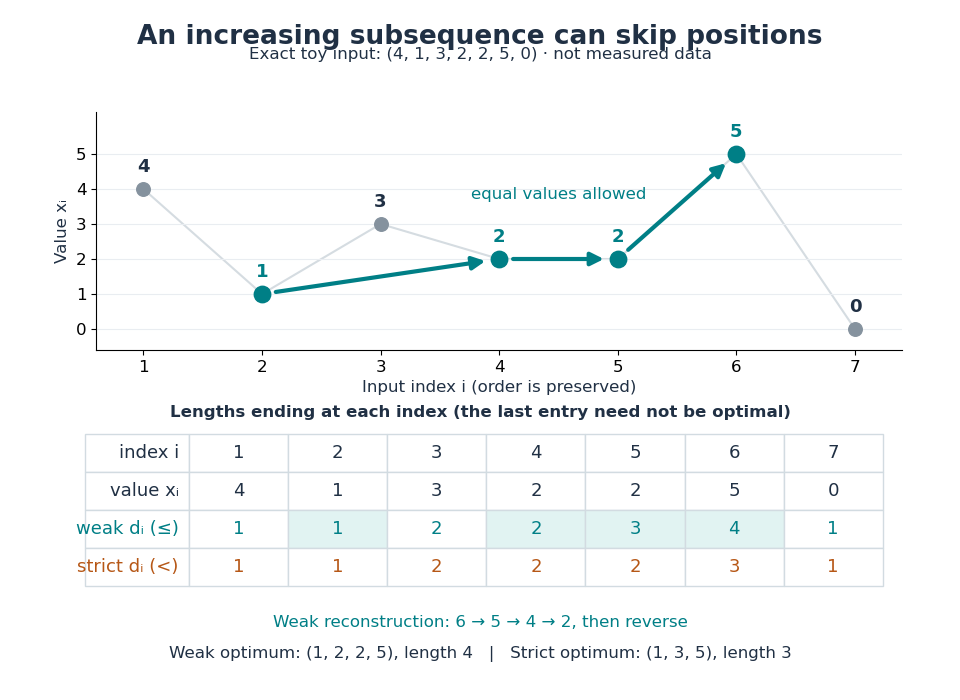
Skipping positions and allowing equal values changes the optimum
. An original toy input, not measured data. The colored selection keeps indices and values . The two dynamic programming rows give the best lengths ending at every position; the backward arrows reconstruct the weak longest increasing subsequence. Details.Scanning all earlier positions for each uses time complexity and space complexity for lengths and predecessors, using Big O notation and assuming constant-time comparisons and operations on indices.
Keep the easiest ending to extend. The faster algorithm maintains a minimum-tail table for increasing subsequences: is the smallest final value of any length- increasing subsequence in the processed prefix. For equal lengths, a smaller ending permits every future extension allowed by a larger ending. Thus only one best ending per length is needed. The table is nondecreasing, since removing the last term of a length- selection gives . Start with an empty table. On reading , use binary search to find the first entry strictly greater than : replace it by , or append if there is no such entry. Its position is one beyond the longest existing length whose ending is at most . See Liben-Nowell, Vee and Zhu, section 3.1 and Figure 1.
Duplicates determine the binary search rule: weak increase replaces the first , whereas strict increase replaces the first . In Python these positions are returned by
bisect_right(T, v) and bisect_left(T, v) respectively, counting positions from zero. Replace an entry or append; do not insert and shift the remaining entries. The documented equality rules are in Python documentation, bisect_left and bisect_right. Each search takes comparisons, giving time complexity , conventionally for , and space complexity for the weak length alone.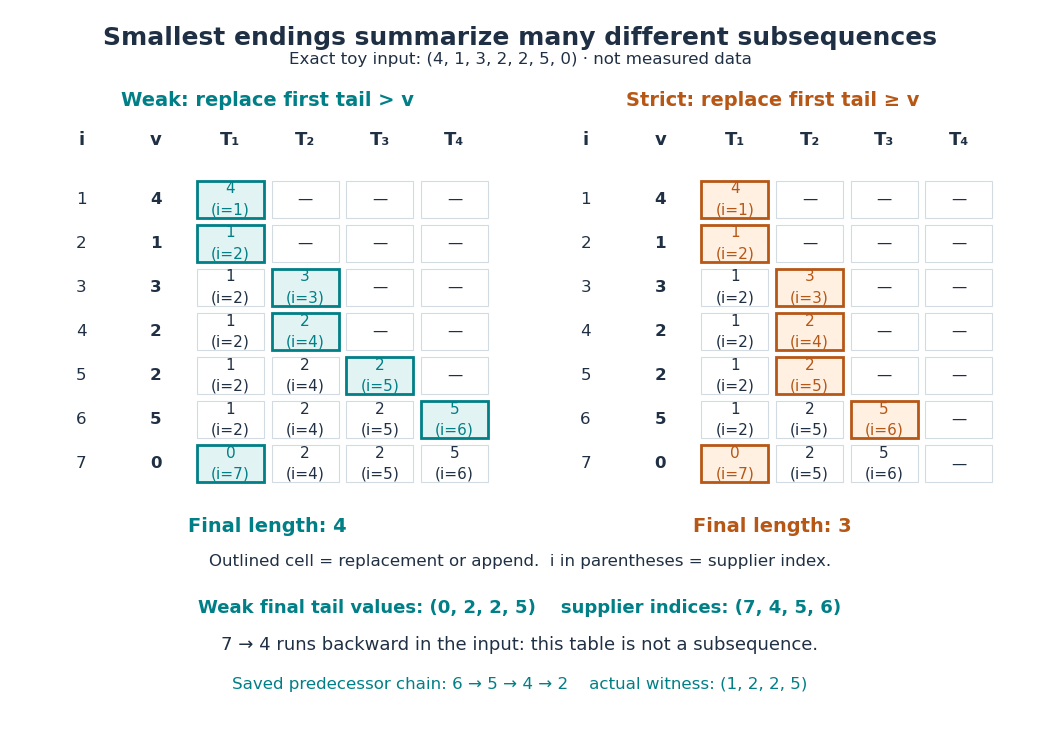
Two binary-search tie rules give different minimum-tail tables
. Original exact traces for the same toy input, not measured data. Each cell shows a tail value and the input index supplying it; the outlined cell was updated in that row. At the second , the weak algorithm appends and the strict algorithm replaces. The final weak table has length four, but its supplier indices are not in increasing order. Details.A length certificate needs separate reconstruction. The final weak tail values are , but they do not form an increasing subsequence of this input: the zero occurs last. Each table entry certifies a selection of its own length; the entries need not come from one compatible selection. To recover a longest increasing subsequence during the fast algorithm, store a supplier index for each tail and a predecessor index for each input position. Before replacing slot , save , or no predecessor if , then set . Later replacements leave saved unchanged. Follow predecessors from the final and reverse. This uses space complexity and returns indices for the weak trace. The same construction works with the strict comparator; compare the two auxiliary arrays in CP Algorithms contributors, restoring the subsequence after binary search.
Deleting or changing one term. If deletes position , thenDeleting cannot create a longer increasing subsequence; removing position from a previously optimal selection loses at most one term. If instead changes just the value at position , both inputs have the same deleted sequence, so their lengths each lie between its length and its length plus one. Consequently . These bounds also hold for strictly increasing subsequences. In the weak example, deleting either lowers the length to three, while deleting the final zero leaves it four. This is a Lipschitz bound for single-term edits, regardless of the numerical size of a replacement. Insertion has the same bound by reversing deletion, so insertions, deletions or replacements can change by at most .
For historical context, [ref]
https://doi.org/10.1016/0012-365X(75)90103-X. Fredman, On computing the length of longest increasing subsequences (1975)
studies the comparison count for distinct elements of a totally ordered set. Its distinctness assumption makes the weak and strict conventions coincide. No distinctness assumption is needed for the comparator-specific algorithms above.For lines and points in the real plane, the number of point-line incidences isConnecting consecutive incidence points on each line and applying the Crossing lemma proves the bound.
An isothermal atmosphere has the same temperature at every height in the region modeled. With an ideal gas, uniform downward gravity and constant mean particle mass , hydrostatic equilibrium gives and , where the scale height is .
The local gradient is therefore set by a balance: larger thermal energy spreads particles over a greater height, whereas larger particle mass or gravity concentrates them lower down. Measuring the ratio of pressures at two heights yields within this model. A real atmosphere can depart from the exponential law because temperature, composition or gravity changes with height. Being isothermal specifies a thermal profile; it does not independently establish that the fluid is at rest or in hydrostatic equilibrium.
A hyperbolic metric is a complete Riemannian metric of constant sectional curvature . On a surface it supplies local charts modeled on the hyperbolic plane.
For inviscid axisymmetric disturbances to a rotating flow, the Rayleigh discriminant measures the radial gradient of squared specific angular momentum.
Dissipation-induced instability occurs when damping one component of a coupled system moves an eigenvalue into the growing half-plane. Selective damping can alter the phase relation that previously stabilized two interacting waves or oscillators.
The Eady model describes quasi-geostrophic baroclinic instability in a uniformly stratified layer with constant vertical shear, zero interior potential-vorticity gradient, and two rigid horizontal boundaries.
Symmetric instability occurs in rotating stratified flow when perturbations aligned with the basic current can extract energy from vertical shear. It is excluded when the Ertel potential vorticity has the stable sign; for constant gradients this gives a condition relating stratification, rotation, and horizontal buoyancy gradient.
The energy-stability threshold is the parameter value below which a positive perturbation energy decreases monotonically for every disturbance. It can be lower than the linear instability threshold when non-normal transient growth is possible.
Individually decaying nonorthogonal modes can interfere constructively and produce temporary energy growth. This mechanism is absent for an orthogonal eigenbasis of a normal evolution operator.
Unambiguous quantum state discrimination allows an inconclusive outcome but forbids a wrong conclusive identification. Two distinct pure states admit such a measurement, whereas two full-rank density operators on the same support do not.
If and all local terms commute, thenexactly. Approximating each fixed-size factor to error at most and applying the telescoping bound for products of operators gives total operator norm error at most .
An integral of motion is a function on phase space that remains constant along every trajectory. If it has no explicit time dependence, is an integral exactly when its Poisson bracket with the Hamiltonian vanishes: .
Pinned article: Introduction to the OurBigBook Project
Welcome to the OurBigBook Project! Our goal is to create the perfect publishing platform for STEM subjects, and get university-level students to write the best free STEM tutorials ever.
Everyone is welcome to create an account and play with the site: ourbigbook.com/go/register. We belive that students themselves can write amazing tutorials, but teachers are welcome too. You can write about anything you want, it doesn't have to be STEM or even educational. Silly test content is very welcome and you won't be penalized in any way. Just keep it legal!
Intro to OurBigBook
. Source. We have two killer features:
- topics: topics group articles by different users with the same title, e.g. here is the topic for the "Fundamental Theorem of Calculus" ourbigbook.com/go/topic/fundamental-theorem-of-calculusArticles of different users are sorted by upvote within each article page. This feature is a bit like:
- a Wikipedia where each user can have their own version of each article
- a Q&A website like Stack Overflow, where multiple people can give their views on a given topic, and the best ones are sorted by upvote. Except you don't need to wait for someone to ask first, and any topic goes, no matter how narrow or broad
This feature makes it possible for readers to find better explanations of any topic created by other writers. And it allows writers to create an explanation in a place that readers might actually find it.
Figure 1. Screenshot of the "Derivative" topic page. View it live at: ourbigbook.com/go/topic/derivativeVideo 2. OurBigBook Web topics demo. Source. - local editing: you can store all your personal knowledge base content locally in a plaintext markup format that can be edited locally and published either:This way you can be sure that even if OurBigBook.com were to go down one day (which we have no plans to do as it is quite cheap to host!), your content will still be perfectly readable as a static site.
- to OurBigBook.com to get awesome multi-user features like topics and likes
- as HTML files to a static website, which you can host yourself for free on many external providers like GitHub Pages, and remain in full control

Figure 2. You can publish local OurBigBook lightweight markup files to either OurBigBook.com or as a static website.
Figure 3. Visual Studio Code extension installation.
Figure 5. . You can also edit articles on the Web editor without installing anything locally. Video 3. Edit locally and publish demo. Source. This shows editing OurBigBook Markup and publishing it using the Visual Studio Code extension. 
- Infinitely deep tables of contents:




All our software is open source and hosted at: github.com/ourbigbook/ourbigbook
Further documentation can be found at: docs.ourbigbook.com
Feel free to reach our to us for any help or suggestions: docs.ourbigbook.com/#contact