Topics (384k) Articles (398k) Users (410) Discussions (242) Comments (383) Files (13k) New article

An infrared divergence arises from contributions at arbitrarily low energy or long wavelength. A massless mode can produce such a problem because many soft excitations are available at very small energy, or because a long-distance fluctuation integral fails to converge.
Its interpretation depends on the observable. In scattering, an exclusive amplitude with no additional arbitrarily soft radiation need not be separately measurable; combining appropriately inclusive real-emission and virtual contributions can remove the relevant divergence. In equilibrium field theory, an infrared-divergent order parameter fluctuation can instead diagnose failure of an assumed ordered-state approximation. A finite size or detector resolution may regulate the calculation, but the dependence on that regulator must be interpreted rather than silently discarded.
An ultraviolet cutoff removes modes above a chosen energy or momentum scale. An effective field theory encodes the influence of those omitted short-distance modes in its couplings.
Heavy-field decoupling says that a field of mass affects processes with external momenta through renormalizations of existing low-energy couplings and local higher-dimensional operators suppressed by powers of .
The viscous stress tensor is the part of the Cauchy stress tensor associated with deformation rates. For an isotropic Newtonian fluid in incompressible flow,Here is pressure, is the identity matrix, is dynamic viscosity, and is the strain-rate tensor. The convention is ; denotes transpose and denotes trace. Across a plane with unit normal vector , the viscous traction is . The tensor makes this rule work for any plane orientation. [ref]
https://www.damtp.cam.ac.uk/user/tong/fluids/fluids.pdf. David Tong, Fluid Mechanics, section 3.1.1, equations (3.5)–(3.6)
In the worked Couette flow, , soIn particular, while the shear rate is ; the factor in recovers . On the upper face of a fluid slice, gives viscous traction ; on the lower face it is . Constant stress can therefore transmit a force between the plates even though its divergence, and the net viscous force on each slice, vanish.
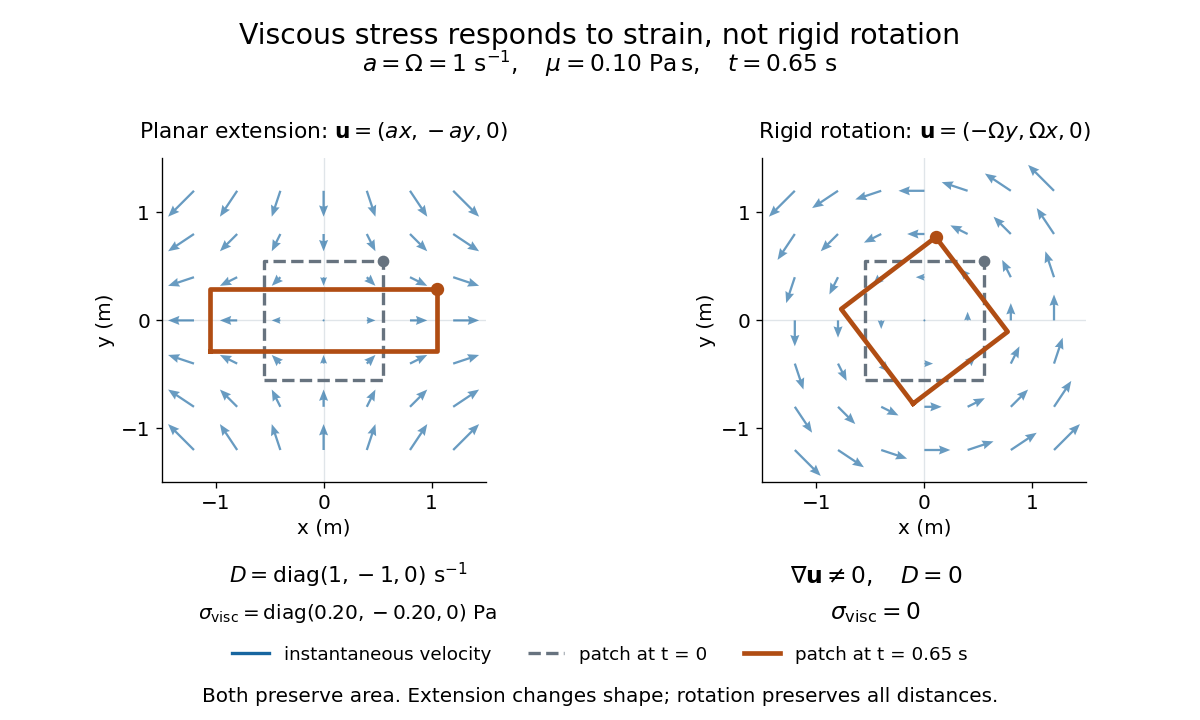
Compare planar extension with solid-body rotation :Extension changes lengths and produces viscous normal stresses . Rotation preserves distances and gives zero viscous stress, despite its nonzero velocity gradient and vorticity . For and , extension gives and ; rotation gives zero. A rotating fluid may still have a pressure gradient supplying its centripetal acceleration.
For an isotropic Newtonian fluid in three-dimensional compressible flow, separate shape change from volume change:The first term is deviatoric stress, with zero trace; is volume viscosity, also called bulk viscosity. For uniform expansion , and , so the shear contribution vanishes and the viscous stress is . Thus dynamic viscosity and volume viscosity describe distinct responses, and incompressible flow removes only the volume-change term. [ref]
https://notes.shreyasmandre.com/fluid-dynamics-notes/Ch2.html. Shreyas Mandre, Fluid Dynamics Lecture Notes, section 2.11.3, equation (2.49)
The aerodynamic stopping time is the characteristic time on which drag force damps a solid particle's velocity relative to the surrounding fluid. Linear drag gives relative acceleration .
For , the Riesz potential is convolution with a constant multiple of . Its Fourier multiplier is a constant multiple of .
For , the dilation of a distribution on is defined byFor a regular distribution this agrees with the function .
For a distribution and a smooth function , the product is defined by . It obeys the Leibniz rule; in one dimension, .
For an open set , the space carries the Fréchet topology in which exactly when every derivative converges uniformly on every compact set contained in .
Parity symmetry means invariance under spatial reflection, together with the intrinsic transformation rules of the fields.
Let be bounded, let be harmonic on and continuous on , and let be the first exit time of Brownian motion. The Itô formula makes a bounded martingale, soIf on the boundary, this becomes .
A rank- distribution on a smooth manifold is a rank- vector subbundle of its tangent bundle. It is involutive when the Lie bracket of vector fields of any two local sections is again a section.
A Morse function is a smooth real-valued function whose critical points are all nondegenerate. Near a critical point of index , the Morse lemma gives coordinates in which the function is a constant minus squares plus the remaining positive squares.
A volume form is a nowhere-vanishing differential form of top degree on an oriented manifold. A metric supplies the canonical local density and hence a metric volume form after choosing orientation.
A large diffeomorphism does not approach the identity at the relevant boundary or cannot be continuously deformed to the identity within the allowed gauge transformations. It may therefore act nontrivially on physical states or boundary data.
A purification of a density operator is a pure state on a larger system such that . A spectral decomposition gives the canonical construction .
The decision-tree depth of a Boolean function is the smallest possible maximum number of input coordinates queried along any root-to-leaf graph path of a decision tree computing :The actual depth of a particular decision tree can exceed this optimum. A constant function admits a depth-zero tree even though an inefficient algorithm could inspect its entire input before returning that constant. Expected query cost and coordinate revealment additionally require an input probability distribution; does not. The three-bit majority decision tree and three-bit parity both have optimal decision-tree depth three, although only the former has the two-query shortcuts described above.
Four-dimensional de Sitter spacetime has ten independent isometries. In the expanding flat slicing they act on the spatial boundary as three translations, three rotations, one dilation, and three special conformal transformations.
Warm dark matter has a primordial collisionless free streaming length large enough to suppress the formation of low-mass haloes, while remaining nonrelativistic early enough to cluster on galactic and larger scales.
Cold dark matter is nonrelativistic early enough that its primordial free-streaming length is small compared with the cosmological structures of interest.
Pinned article: Introduction to the OurBigBook Project
Welcome to the OurBigBook Project! Our goal is to create the perfect publishing platform for STEM subjects, and get university-level students to write the best free STEM tutorials ever.
Everyone is welcome to create an account and play with the site: ourbigbook.com/go/register. We belive that students themselves can write amazing tutorials, but teachers are welcome too. You can write about anything you want, it doesn't have to be STEM or even educational. Silly test content is very welcome and you won't be penalized in any way. Just keep it legal!
Intro to OurBigBook
. Source. We have two killer features:
- topics: topics group articles by different users with the same title, e.g. here is the topic for the "Fundamental Theorem of Calculus" ourbigbook.com/go/topic/fundamental-theorem-of-calculusArticles of different users are sorted by upvote within each article page. This feature is a bit like:
- a Wikipedia where each user can have their own version of each article
- a Q&A website like Stack Overflow, where multiple people can give their views on a given topic, and the best ones are sorted by upvote. Except you don't need to wait for someone to ask first, and any topic goes, no matter how narrow or broad
This feature makes it possible for readers to find better explanations of any topic created by other writers. And it allows writers to create an explanation in a place that readers might actually find it.
Figure 1. Screenshot of the "Derivative" topic page. View it live at: ourbigbook.com/go/topic/derivativeVideo 2. OurBigBook Web topics demo. Source. - local editing: you can store all your personal knowledge base content locally in a plaintext markup format that can be edited locally and published either:This way you can be sure that even if OurBigBook.com were to go down one day (which we have no plans to do as it is quite cheap to host!), your content will still be perfectly readable as a static site.
- to OurBigBook.com to get awesome multi-user features like topics and likes
- as HTML files to a static website, which you can host yourself for free on many external providers like GitHub Pages, and remain in full control

Figure 2. You can publish local OurBigBook lightweight markup files to either OurBigBook.com or as a static website.
Figure 3. Visual Studio Code extension installation.
Figure 5. . You can also edit articles on the Web editor without installing anything locally. Video 3. Edit locally and publish demo. Source. This shows editing OurBigBook Markup and publishing it using the Visual Studio Code extension. 
- Infinitely deep tables of contents:



All our software is open source and hosted at: github.com/ourbigbook/ourbigbook
Further documentation can be found at: docs.ourbigbook.com
Feel free to reach our to us for any help or suggestions: docs.ourbigbook.com/#contact