Topics (384k) Articles (398k) Users (410) Discussions (242) Comments (383) Files (13k) New article

A transposition is a permutation that exchanges two elements and fixes every other element. Every transposition has order two.
The functional measure is the formal integration measure over field configurations in a path integral. Its transformation under a symmetry can preserve the corresponding Ward identity or produce a quantum anomaly.
The settling velocity is a particle's vertical velocity relative to a stated frame. With height increasing upward, a sedimenting particle has .
A bidisperse particle suspension contains two distinguishable particle populations, commonly with different sizes, densities, or settling velocities.
A linear partial differential operator sends a function to a linear combination of its partial derivatives. If its coefficients are constant, the Fourier transform of a derivative turns it into multiplication by its polynomial symbol .
For a nonnegative integer and integer base , write its base-p expansion asThe base- digit sum is , with . When is a prime number, the Legendre formula becomesTo see the connection, divide the base-p expansion by and discard the fractional part. Swapping the resulting finite sums and using a finite geometric series givesIn particular, , so and . The leading numeral digit contributes thirteen, the next contributes eight, the next one, and the units contribute zero. Thus the base-p digit sum compresses the same contribution ledger into information already present in positional notation.
The p-adic integers retain arithmetic information modulo arbitrarily high powers of one prime number . They form the subringof the P-adic numbers. Their p-adic absolute value bounds the allowed denominators: belongs to , while does not. The name therefore describes a local arithmetic ring, not just the ordinary integers.[ref]
P-adic numbers by Jan-Hendrik Evertse. §3, printed pp. 6–7: definition of Zp, rational denominators and units
A concrete description gives an element by a compatible sequence of congruence classes:The inverse limit condition says that gaining more precision must preserve the digits already determined. Each is a residue modulo ; choosing its least nonnegative integer representative gives . The ordinary integer gives residues modulo .
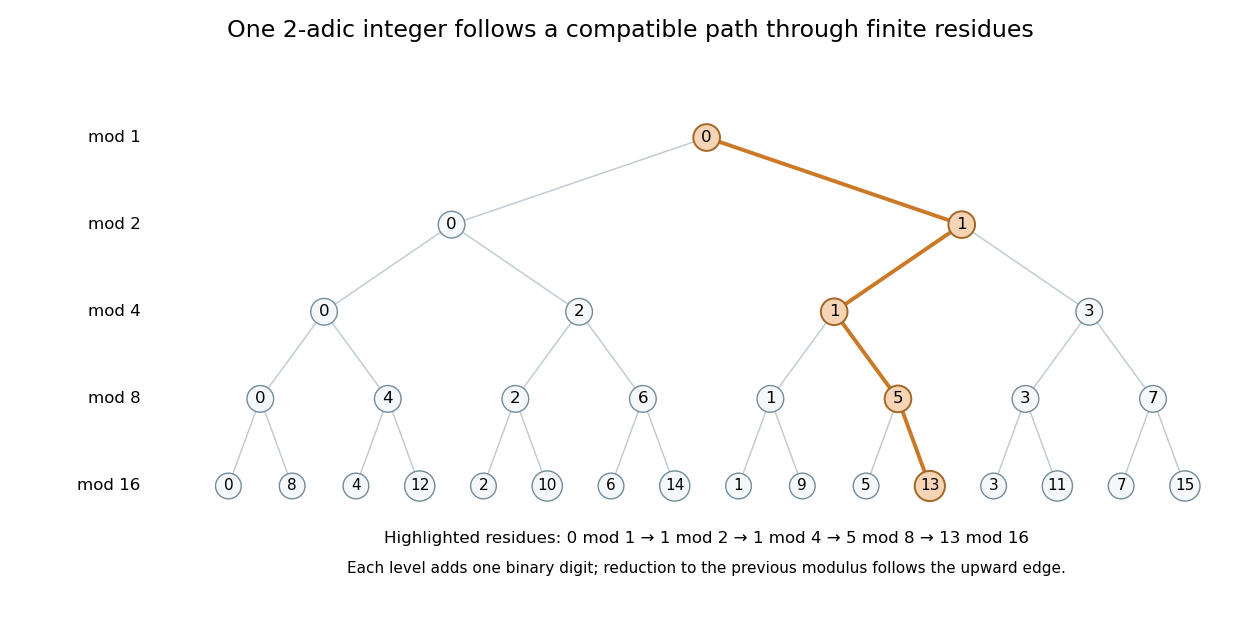
The useful feature is that one exact object organizes an unlimited family of finite modular arithmetic calculations. Addition and multiplication are performed modulo each , and the results remain compatible. A p-adic digit expansion makes this concrete:The expansion is unique and converges in the p-adic metric; its higher powers have smaller p-adic absolute value. The digit agreement and p-adic distance criterion tells exactly which finite digits a precision bound preserves.[ref]
Along a curve with tangent , a frame is parallel propagated when . Metric compatibility makes every inner product constant along the curve, so an initially orthonormal frame remains orthonormal.
For finite matrices , Strang splitting approximates the evolution byIt advances the dynamics for a half step, the dynamics for a full step, and the dynamics for a half step. Expanding the three matrix exponentials givesso the one-step local truncation error is . Bounded propagation on a fixed time interval gives global error . The identity expresses time symmetry. Commuting matrices make the product exact.[ref]
The finite-matrix assumptions are relevant when the method is applied after a spatial semidiscretization. Error constants can depend on the spatial mesh through commutators. A fixed-matrix second-order argument alone does not prove an error estimate uniform over increasingly fine spatial grids.
The finite element method replaces an infinite-dimensional weak formulation by finitely many unknowns attached to a finite element mesh. Simple local functions, often piecewise polynomial functions, join to form a global approximation. The attraction is that each finite element can be integrated separately, while the assembled equations enforce a global balance. A piecewise-linear hat function only meets its immediate neighbors, so a large problem can have a sparse matrix rather than a dense one. Gilbert Strang's MIT lecture develops this connection from the one-dimensional weak formulation through local hats to the stiffness matrix and load integrals.[ref]
https://ocw.mit.edu/courses/18-085-computational-science-and-engineering-i-fall-2008/676ba0a00eef45a6cb3823c4da61ee11_18-085F08-L18.pdf. Gilbert Strang, MIT 18.085, Lecture 18: Finite Elements in 1D, transcript pp. 2–8, 2008; accessed 2026-10-11
For the conforming Galerkin method, let be a real Hilbert space, a bounded coercive bilinear form, and a bounded linear functional. Given a conforming finite element space , the continuous and discrete problems areWriting in a basis of gives the linear systemHere is the stiffness matrix and is the vector of loads tested against the basis functions. The Galerkin method uses the same trial and test space in this construction. Finite element methods also use the Petrov-Galerkin method, with different trial and test spaces; testing against the trial space is therefore a property of this construction, rather than a definition of every finite element method.
The finite element solution of the one-dimensional Poisson equation below gives every entry explicitly. Refining the finite element mesh then improves the approximation by adding local degrees of freedom. For a symmetric coercive bilinear form, Galerkin orthogonality makes the discrete solution the best approximation in the energy norm; the geometry of orthogonal projection explains why this local construction yields a globally meaningful answer.
For a one-step approximation to an ordinary differential equation, insert the exact solution and define the unscaled local truncation errorConsistency of a numerical method requires uniformly on the finite interval being approximated, under the stated smoothness assumptions. Merely asking is too weak: the useless update has defect , which tends to zero but generally fails the scaled test. Here denotes Big O notation. MIT uses this division-by-step convention.[ref]
https://ocw.mit.edu/courses/18-330-introduction-to-numerical-analysis-spring-2012/a9d2bd9be098f0ada172af40379a17cc_MIT18_330S12_Chapter5.pdf. Laurent Demanet, MIT 18.330, Chapter 5, Definition 6, 2012
For the Euler method, Taylor's theorem gives . A bounded second derivative therefore gives local truncation error and a scaled defect . Under a uniform Lipschitz continuity assumption on in , within a region containing the exact and numerical solutions, numerical stability controls accumulation over about steps. This yields global error with exact starting data. Consistency of a numerical method checks each step; numerical stability controls their combination.
The two-dimensional defocusing cubic nonlinear Schrödinger equation is mass-critical: the scaling preserves the norm. The defocusing sign makes its nonlinear energy positive.
Let be a nonnegative, locally bounded measurable function on with as . Its confining-potential energy space isThe displayed quantity is a norm even though it omits an explicit L2 norm term. Choose a ball outside which . The weighted term controls outside that ball, and a local Poincaré inequality anchored on a surrounding annulus controls the interior L2 norm by the gradient and that annular mass. Thus the displayed norm is equivalent to the full graph norm containing .
A Cauchy sequence converges in and its weighted values converge in L2 space; an almost-everywhere convergent subsequence identifies the latter limit with . Hence is a Hilbert space. Growth of the potential makes bounded-energy mass tails small, which yields compact embedding of a confining-potential energy space.
The symmetric decreasing rearrangement of a measurable function is the radial, radially nonincreasing function whose superlevel sets are centered balls with the same measures as those of . It preserves norms, and the Pólya-Szegő inequality gives .
A Pohozaev identity is an integral relation obtained by testing a nonlinear partial differential equation against a scaling direction such as . For a sufficiently regular, rapidly decaying real solution ofwrite , and . The identity isOne derivation uses the stationary energy functional . Evaluate it on : the three terms scale as , and . Differentiating at gives the displayed formula, with decay justifying the scaling variation. Direct integration by parts with gives the same identity.
Testing against also gives . Combining the two relations at yields the Pohozaev identity for the mass-critical NLS ground state. The usefulness is that a differential equation imposes exact constraints on global kinetic, mass and nonlinear integrals.
The Gravitational Hartree equation couples a complex wave function to the attractive Newtonian gravitational potential generated by its own squared modulus. In dimension , a dimensionless convention iswhere and is the area of the unit sphere. The minus sign in the fundamental solution makes for nonnegative density, with the potential selected to decay at infinity when the convolution permits it.
The convolution makes the nonlinearity nonlocal: changing the density at one point changes the potential elsewhere. The Newtonian kernel and its dimension differ from a local cubic nonlinear Schrödinger equation. In three dimensions, the Hardy–Littlewood–Sobolev inequality controls the interaction energy and leads to Global H1 solutions of the three-dimensional gravitational Hartree equation.
Pinned article: Introduction to the OurBigBook Project
Welcome to the OurBigBook Project! Our goal is to create the perfect publishing platform for STEM subjects, and get university-level students to write the best free STEM tutorials ever.
Everyone is welcome to create an account and play with the site: ourbigbook.com/go/register. We belive that students themselves can write amazing tutorials, but teachers are welcome too. You can write about anything you want, it doesn't have to be STEM or even educational. Silly test content is very welcome and you won't be penalized in any way. Just keep it legal!
Intro to OurBigBook
. Source. We have two killer features:
- topics: topics group articles by different users with the same title, e.g. here is the topic for the "Fundamental Theorem of Calculus" ourbigbook.com/go/topic/fundamental-theorem-of-calculusArticles of different users are sorted by upvote within each article page. This feature is a bit like:
- a Wikipedia where each user can have their own version of each article
- a Q&A website like Stack Overflow, where multiple people can give their views on a given topic, and the best ones are sorted by upvote. Except you don't need to wait for someone to ask first, and any topic goes, no matter how narrow or broad
This feature makes it possible for readers to find better explanations of any topic created by other writers. And it allows writers to create an explanation in a place that readers might actually find it.
Figure 1. Screenshot of the "Derivative" topic page. View it live at: ourbigbook.com/go/topic/derivativeVideo 2. OurBigBook Web topics demo. Source. - local editing: you can store all your personal knowledge base content locally in a plaintext markup format that can be edited locally and published either:This way you can be sure that even if OurBigBook.com were to go down one day (which we have no plans to do as it is quite cheap to host!), your content will still be perfectly readable as a static site.
- to OurBigBook.com to get awesome multi-user features like topics and likes
- as HTML files to a static website, which you can host yourself for free on many external providers like GitHub Pages, and remain in full control

Figure 2. You can publish local OurBigBook lightweight markup files to either OurBigBook.com or as a static website.
Figure 3. Visual Studio Code extension installation.
Figure 5. . You can also edit articles on the Web editor without installing anything locally. Video 3. Edit locally and publish demo. Source. This shows editing OurBigBook Markup and publishing it using the Visual Studio Code extension. 
- Infinitely deep tables of contents:



All our software is open source and hosted at: github.com/ourbigbook/ourbigbook
Further documentation can be found at: docs.ourbigbook.com
Feel free to reach our to us for any help or suggestions: docs.ourbigbook.com/#contact