
| Matrix | Geometric action and parameters |
|---|---|
| A proper rotation about the -axis: . The angle is in radians, with the usual right-hand sense. | |
| A translation by : . | |
| Uniform scaling by : . Positive gives a uniform dilation; collapses the object to the origin; negative additionally reverses its direction through the origin. | |
| Perspective projection from the origin onto the plane , where is the focal length in the chosen coordinate units. |
The last operation produces . It requires a perspective divide: divide the first three components by the last. For ,This is why the last component of homogeneous coordinates cannot simply be discarded. Points with have no finite projected position, and a visible scene normally uses under this forward-axis convention. The first three transformations leave the last component equal to one and need no nontrivial divide. The displayed retains no depth variation after division; it describes projection onto the image plane, rather than a complete depth-buffer mapping.
Separate the two required orders. A writer must make all initialization store instructions to a fresh version visible before another CPU core can use the publication of its address. A reader must load
p before the load instructions of fields addressed through the saved pointer. Assume ordinary coherent cacheable computer memory, atomic aligned pointer accesses, immutable published versions, and the lifetime guarantee from part (ii). The sequences below are architectural operations; a compiler must preserve the stated accesses and dependencies.TSO. Total store order preserves store-to-store order, so initialization writes cannot become visible after the later pointer publication. It also preserves load-to-load order, so reading the pointer precedes reading its fields. Its store-to-load relaxation, illustrated in part (b), does not break either required ordering. ThereforeNo drain of every reader's store buffer and no explicit cache flush is required. This statement is about hardware ordering; unsynchronized ordinary C or C++ accesses to
p would still need the language's atomic operation and acquire-release synchronization facilities to avoid a data race and unwanted compiler transformations.Power/ARM. These weaker memory models can expose a new pointer before all the writer's initialization store instructions are visible. Put a write-ordering memory barrier between the last initialization write and the store of The scope must include every participating CPU core. A broader full barrier is sufficient but can cost more. Without the writer barrier, observing the new
p. A sufficient sequence uses lwsync on POWER architecture or an appropriately scoped DMB, such as DMB ISH, on the ARMv7 ARM architecture family:writer:
STORE [new + field1], value1
STORE [new + field2], value2
publication_barrier
STORE [p], newp and stale initialization data is exactly the unwanted message-passing outcome.[ref]Understanding POWER Multiprocessors (2011). §§2.1–2.2, message passing and ordering by
sync/lwsync, printed pp. 2–4For the reader as actually specified, the saved pointer is an address dependency: the loaded value directly determines each subsequent field's memory address.Both POWER architecture and the relevant ARM memory models respect such dependent reads. Thus no additional reader hardware fence is needed when every data access retains this real address dependency. The writer's publication barrier together with the dependent reads supplies the necessary ordering. A mere test of
reader:
    q := LOAD [p]
    a := LOAD [q + field1_offset]
b := LOAD [q + field2_offset]p followed by unrelated fixed-address reads would be a control dependency, which is not sufficient here.[ref]Understanding POWER Multiprocessors (2011). §2.2, “Using dependencies” and “Control dependencies, observable speculative reads, and isync”, printed p. 3
If that address dependency is not retained, use an acquire operation or an explicit read-ordering memory barrier after loading
p and before reading fields. DMB ISH on ARMv7 or lwsync on POWER architecture is a conservative sufficient choice for this load-to-load ordering; a suitable conditional branch followed by isync is another POWER acquire implementation. On later ARM instruction sets an acquire load instruction can express the reader requirement directly. Such stronger forms are often convenient even though they are not minimal for the dependent sequence in this question.| Model | Before publishing p | After reading p |
|---|---|---|
| Total store order | No extra hardware fence | No extra hardware fence |
| Power/ARM, genuine dependent field reads | Write-ordering publication barrier | Address dependency suffices |
| Power/ARM, general reads without the dependency | Write-ordering publication barrier | Acquire or sufficient read-ordering barrier |
The minimal answer is a writer publication barrier on Power/ARM, with the stated reader's address dependence doing the read-side ordering; TSO needs neither extra hardware fence. None of these choices repairs an invalid pointer, premature memory reclamation, or a lost update between writers.
O1 supplies mutual exclusion over each complete operation. A reader sees the protected state from a serial order of readers and writers; a writer can safely mutate the existing object while holding the common mutex. If an update reads the old state and modifies it, the entire read-modify-write can be protected against a lost update.
O2 has different semantics. Assume an indivisible aligned access to
p, correct publication ordering, and no later mutation of a published version. A reader chooses one version when it loads p; the subsequent load instructions use the same saved pointer, so an overlapping writer need not block that reader. The reader may continue observing the old complete version after the writer has published the new one. A sufficiently specified snapshot read can still be linearizable, with the load of p as its linearization point: a read overlapping a write is allowed to come before that write in the abstract order. Thus reading an old version during overlap does not by itself prove failure of linearizability.Multiple writers can each construct a valid replacement and race to publish it. If the operation is simply “replace the whole object”, atomic pointer stores give a last-publication order. If each writer instead computes a change from the previously published state, O2 alone does not preserve both changes. Two writers can both read a counter value zero, independently build a version containing one, and publish their respective versions; the final counter is one. A writer mutex or compare-and-swap with retry is needed when the required operation must avoid that lost update. Memory barriers alone do not provide this exclusion.
Releasing the old object's computer memory immediately after publishing a replacement is unsafe. For example:The final operation is a use-after-free: it may crash, see allocator metadata, or read a different object that reuses the same memory address. An atomic update of
reader: q := LOAD [p]          // gets the old object
writer: STORE [p], new_object
writer: free(old_object)
reader: LOAD [q + field] // accesses freed storagep does not update the reader's already copied pointer. Freeing the new object immediately would of course also invalidate p itself.Publication and reclamation are separate: publish a fully initialized version, and retain every old version until all readers that might hold it have finished. A read-copy-update grace period or a suitable hazard pointer protocol can provide that lifetime guarantee; naive reference-count acquisition after loading an unprotected pointer can itself race with freeing. Correct memory barriers in part (iii) ensure visibility, not object lifetime.
With O1, even readers must acquire and release the same mutex. Acquiring it normally uses an atomic read-modify-write on the lock's cache line; releasing writes that cache line again. As different CPU cores repeatedly read the data, ownership of the lock's cache line moves among them, causing cache coherence traffic and serializing the protected operations. If the lock shares a cache line with otherwise stable data, false sharing can also invalidate useful reader data. The actual data need not change for this lock traffic to occur.
With O2 and correctly ordered publication, readers perform only load instructions: copy
p once into a processor register, then read that version of the data. Multiple CPU cores can keep read-only shared copies of its cache lines. No per-reader exclusive ownership transfer is needed. During an update, a writer fills newly allocated computer memory privately; the old version's cache lines remain unchanged for readers already using it. Publishing the new pointer writes p and invalidates cached copies of that pointer's cache line, but this occurs only on updates.For many reads and rare updates, O2 avoids lock-line contention and permits concurrent readers, so it can be substantially faster. The costs are heap allocation, construction or copying of a whole replacement, first accesses to its newly populated cache lines, and deferred memory reclamation. Frequent updates or very large replacements can reverse the comparison. O1 can modify a small field in place and may then save copying and computer memory. These are workload-dependent comparisons, not a claim that removing every mutex always accelerates an operation.
The pointer to the next linked list node is unavailable until it has been read from the current linked list node; a software prefetch cannot invent that pointer. Once it is available, however, the current node's computation is useful independent work. Assuming the Here
next field shares the already loaded cache line, use this symbolic loop:p := head
while p != null:
q := LOAD [p + next_offset]
if q != null:
PREFETCH [q]
process_payload(p)
p := qprocess_payload must not change the next pointer, and its results must not be needed to determine q. Move the hint before this computation. The real load instruction for the next node still occurs in the next iteration and waits if the prefetch has not finished. The null test can be omitted when the hint's contract safely ignores that target; its cost, when retained, belongs in the loop overhead.Let be the additional demand cache miss penalty per node, the independent processing time after discovering
q, and the cost of issuing one hint. Ignore common loop and cache hit overhead, assume requests do not contend, and assume the prefetched cache line remains resident. Without prefetching, a long traversal takes approximately cycles per node. A hint followed by cycles of work leaves at most cycles of waiting, givingConsequently the ideal steady-state speedup isFor , and , the comparison is . Each hint has enough independent work behind it to hide the entire additional cache miss penalty. For instead, the comparison is : most of the wait remains. With negligible the one-node-ahead model approaches a factor of two when , not an unlimited speedup.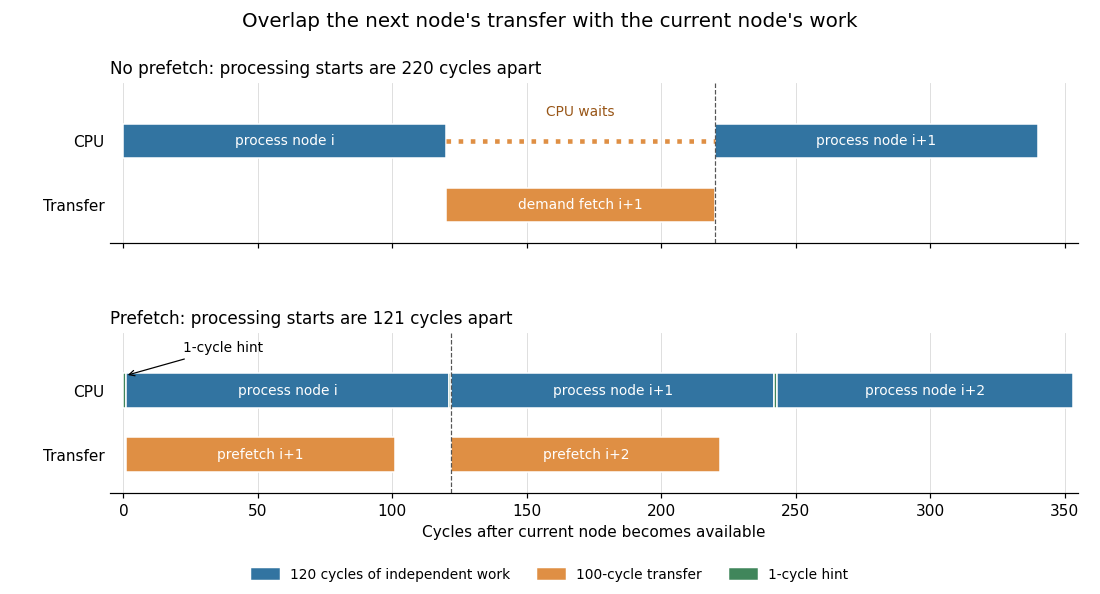
One-node-ahead software prefetch overlaps the next linked list node's transfer with processing of the current node; synthetic costs , , cycles, with the final processing interval shown only in part
. Details. The first linked list node still has a startup miss. A node occupying several cache lines may need several hints, and a separately missing
next field adds a genuine pointer chasing delay. Very short node computations, cache pollution or saturation of the data-transfer path can eliminate the benefit. The speedup comes from overlap with work on the current node; a prefetch does not remove the linked list's address dependence.In IF, fetch
PREFETCH normally. In ID, recognize its opcode, read the base processor register and immediate offset, and set controls selecting a prefetch request rather than a load instruction or store instruction. Ordinary register forwarding and data hazard interlocks still apply to that base processor register. In EX, use the arithmetic logic unit to form the effective memory address.Latch that memory address and a prefetch-valid control into EX/MEM. In MEM, put the memory address and any hint information on the dedicated request computer bus, or enqueue them in a small prefetch-request queue. The cache prefetching engine handles lookup, allocation and the later cache line return independently. Do not wait for the fill or select the returned data as a register file input. In WB, disable architectural processor register and processor condition flag writes; the instruction simply leaves the in-order pipeline.
If the request path is busy, dropping the hint is compatible with the contract in part (ii), and preserves its nonblocking purpose. A design that instead stalls until queue space exists can still be correct but reduces the performance benefit. A memory management unit must not turn a speculative hint into an ordinary protection fault: discard an invalid target, or use an appropriately checked nonfaulting translation path. Suppress device transactions for memory-mapped input-output and avoid speculative writes. Use the existing address-generation datapath, add a prefetch request/control path, and disable demand-load waiting and writeback.
Define
PREFETCH [a] as a software prefetch hint: initiate a request for the cache line containing memory address a, then continue without waiting for that cache line to arrive. It produces no value in a destination processor register, changes no program data and creates no data-result dependence for later instructions. It may be ignored if resources are unavailable. A useful hint is nonfaulting for an inaccessible or untranslated target: a later real load instruction must still perform its ordinary access checks. This is a proposed contract for the instruction, rather than a guarantee that the patent abstract alone fixes every detail of its semantics.For example, after reading the next pointer of a linked list node, prefetch that next linked list node while processing the current one. Replacing the hint by an otherwise unused ordinary load instruction on this in-order pipeline would wait in MEM on a cache miss before the current computation could start. It would also consume a destination processor register and might raise a synchronous processor exception. A harmless hint can be scheduled earlier, even on a path where the data will never be demanded. The crucial semantic difference is that cache filling may continue after the prefetch instruction itself has finished.
A software prefetch is not a memory barrier and does not establish acquire-release synchronization or promise that later accesses will hit. Its purpose is performance; correctness must survive the hint being ignored.
Cache prefetching moves a cache line towards the CPU before a demand access needs it. A correctly timed request overlaps the cache miss penalty with earlier computation, so a subsequent load instruction can find a cache hit instead of stopping the in-order pipeline in MEM. Requests directed at several levels of a cache hierarchy can prepare nearby data in a small fast memory cache while staging more distant future data in larger levels. The separate request computer bus avoids making those address requests compete directly with returning data; returned cache lines still consume transfer capacity.
For a store instruction, the gain depends on the write policy. With a write-allocate cache, fetching its target cache line early can avoid the allocation cache miss and help the store buffer drain. On a multicore processor, a write-oriented prefetch may additionally obtain cache coherence ownership; an ordinary read prefetch alone does not guarantee write permission. A store buffer can already hide an individual write's latency, so the visible gain may appear only when it would otherwise fill. With a no-write-allocate cache, fetching the cache line just to overwrite it can be unnecessary. Loads benefit directly from earlier data arrival; stores benefit when prefetching removes a required allocation or ownership delay.
An affine linear classifier in has VC dimension . The upper bound follows from the intersecting convex hull partition theorem: for any points, label the two parts oppositely. The two convex hulls cannot be strictly separated by an affine hyperplane, since they intersect. A weak boundary convention gives the same contradiction: an affine score is nonnegative on the positive convex hull and strictly negative on the negative convex hull. The lower bound comes from the affinely independent vertices of a simplex, because an affine score can interpolate arbitrary signs there.
Consequently, parts (i) and (ii) immediately giveThe one-sided orientation of the lifted separators permits the sharper, exact conclusionTo prove the remaining upper bound, take any distinct points and a nonzero affine dependence as in part (c). Write . Reverse every coefficient if necessary so that . Prescribe positive labels when and negative labels when ; zero coefficients may be labelled arbitrarily. If a Euclidean ball realized these labels, its score would satisfyIndeed, every positive-coefficient term is nonnegative and every negative-coefficient term is strictly positive, with at least one of the latter. On the other hand, expanding the score and using the two affine dependence identities givesa contradiction. No points are shattered, completing the exact determination of the VC dimension of Euclidean balls. In the exceptional zero-dimensional Euclidean space, every positive-radius Euclidean ball is the whole singleton space, so the VC dimension is zero.
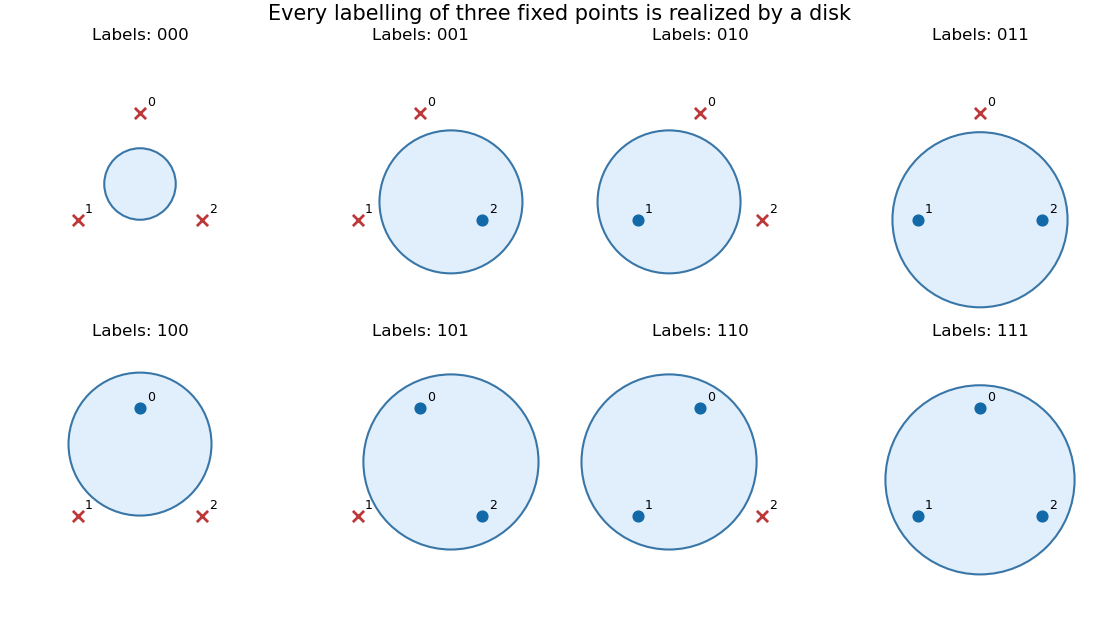
For , take the vertices of a regular simplex in , centered at zero and scaled so that . For example, realize them asin the -dimensional vector subspace , identified isometrically with . These vertices are affinely independent.
Assign arbitrary desired signs , positive for inclusion. Affine independence implies that there is an affine function with for every : the interpolation conditions form an invertible linear system. For a sufficiently small , chooseAt every vertex,Thus the Euclidean ball contains exactly the positively labelled vertices, with none on its boundary. This construction also covers the all-positive and all-negative labellings. Therefore


Expanding the squared Euclidean norm givesIn lifted coordinates , this is the closed half-spaceEvery labelling of the original points obtainable by a Euclidean ball is therefore obtainable on their lifted images by an affine linear classifier. The feature map is injective, since it preserves the first coordinates; distinct original points remain distinct. If the original points are shattered, every labelling of the lifted points is realized, as required.
Here “linear separator” means a separator with an intercept, namely an affine hyperplane. If a convention demands strict separation on the finite sample, increase the constant term of the positive score by a sufficiently small positive amount. Positive points then have strictly positive score, and the finitely many negative scores remain strictly negative. A homogeneous separator can alternatively be obtained after adjoining one more constant coordinate; this distinction matters for dimension counts.
The Sauer-Shelah lemma says that a hypothesis class of finite VC dimension satisfiesIn particular, for ,Here the binomial coefficients count small subsets. One way to obtain the last inequality is to set : since for ,Thus finite VC dimension replaces the unrestricted exponential number of labellings by a polynomial bound in the sample size.
The shattering coefficient, also called the growth function of a hypothesis class, counts the largest number of labellings obtainable on inputs:When has at least points, the same value is obtained by maximizing over -point sets . Always , with equality exactly when some -point set is shattered.
The VC dimension isIt is infinite if arbitrarily large finite sets are shattered. A hypothesis class has VC dimension zero when it shatters no one-point set; for a nonempty hypothesis class, the empty set is always shattered.
The hypothesis class shatters a set when it realizes every binary labelling of : for every function there is an with . Identifying each classifier with its positive set, this sayswhere is the power set. Different labellings may require different members of the hypothesis class.
Past exam of the communication Theory course of the University of Oxford 2011 3 c Solution 2026-10-31
For any chosen input distribution, the chain rule and nonnegativity of conditional mutual information giveand likewise . Choosing an input distribution attaining either marginal capacity proves .
For the upper bound, conditional independence implies , while entropy subadditivity gives . ThereforeMaximizing over the input law givesMore precisely, under the conditional-independence assumption,The outputs may be dependent through the common input, and this final term measures the information they share rather than add independently.
There are unlisted articles, also show them or only show them.