
Bra-ket notation 2026-10-31
A ket denotes a vector representing a quantum state, and its bra is the linear functional taking to . The map from a ket to its bra is conjugate-linear. In the physics convention, is conjugate-linear in and linear in . The adjoint operator is characterized by . Products such as are rank-one operators, while is a scalar inner product.
Transition probability for a rotated two-level observable Created 2026-10-31 Updated 2026-11-05
Let orthonormal energy eigenvectors be , and let a measured observable have eigenvectors and . If the initial quantum state is , unitary time evolution multiplies each energy component by . Its amplitude in is . The Born rule gives the displayed probability. The energy gap fixes the oscillation frequency, while the angle between the measurement and energy bases fixes its amplitude. Energy degeneracy or coinciding bases makes the transition probability vanish.
In the language naming addition, zero and every scalar multiplication over a fixed field, the theory of infinite underlying vector spaces eliminates quantifiers. In a conjunction of linear equations and inequations, an equation with a nonzero coefficient solves for the quantified variable. Otherwise the variable is excluded from only finitely many values, so infinitude supplies a witness. Disjunction and induction finish elimination. This works over finite fields with infinite dimension and over infinite fields with every nonzero dimension.
Morleyization 2026-10-31
Morleyization adds a predicate symbol for each first-order formula and an axiom equating that predicate symbol with its defining logical formula. Every original first-order model has a unique expansion. Translating an expanded logical formula back to the original first-order language and then using its named predicate symbol gives quantifier elimination. Completeness of the original first-order theory implies completeness of the expanded first-order theory.
Projective quadric 2026-10-31
A projective quadric is the zero set of a nonzero homogeneous quadratic polynomial in projective space. Over a field of characteristic different from two, represent it by a symmetric matrix , up to a nonzero scalar. The gradient at a representative is , so the singular locus is the projectivization of . Thus the quadric is nonsingular exactly when is invertible. In the complex projective plane, ranks three, two, and one give respectively a smooth projective conic, two distinct projective lines, and a double projective line.
Quadratic minimization along a line 2026-10-31
For a symmetric positive-definite matrix and a nonzero vector , minimizing over , where , gives the displayed optimizer. Put . Expansion gives , a strictly convex quadratic function of . At its minimum,Strict decrease is therefore equivalent to . This is minimization over a full line, so the optimizer can be negative. For an exact line search restricted to a nonnegative step size, the optimizer is instead .
The quadratic form gradient gives . Since is invertible, this linear map is nonzero exactly when . The regular level set theorem therefore makes every nonzero point of a smooth point of dimension . If , the entire level set is smooth.
If and the level set contains a nonzero point, the form is an indefinite quadratic form. Its only singular point is the origin. To prove this rather than merely observe a vanishing derivative, use Sylvester's law of inertia to write with both sign spaces nonzero. The null vectors span the whole ambient space. Their straight-line curves through the origin lie in the cone. If a relatively open neighborhood of the origin in the cone were an embedded submanifold, its tangent space would contain all these directions and hence have dimension . It would then be open in the ambient space, impossible for the zero set of this nonzero quadratic form. Thus the smooth locus is .
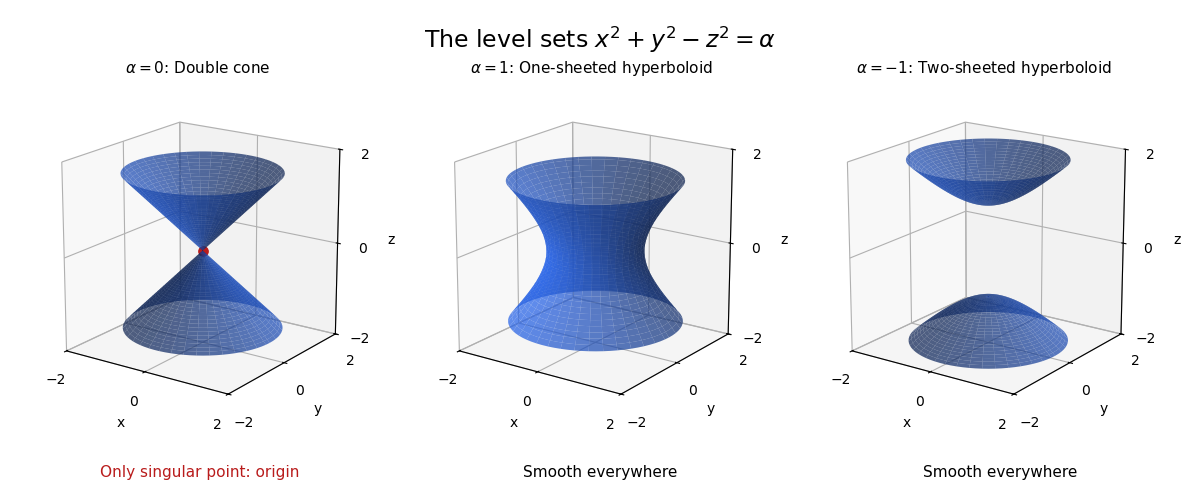
Three levels of an indefinite quadratic form in three dimensions
. Original diagrams and generic model calculations generated by the adjacent Python script. Details.
Differentiation of a parameter-dependent quadratic form Created 2026-10-31 Updated 2026-11-05
Apply the product rule to the scalar quadratic form and transpose its last scalar term: . Only the symmetric part of contributes to its value or its derivative with respect to . A varying matrix also contributes the independent term . No assumption that is symmetric is needed. Repeating this rule and the chain rule computes mixed derivatives when vector and matrix arguments depend on separate parameters.
QR shift 2026-10-31
A QR shift is a scalar subtracted before the QR factorization in a QR algorithm step and restored after reversing the factors:The final identity uses the orthogonality of , proving that the eigenvalues are preserved. Choosing a shift near an eigenvalue can accelerate block deflation in the QR algorithm. A common choice is the current bottom-right entry, but it can stall, as in Exact-shift diagonalization of a two-state swap matrix.
Exact-shift diagonalization of a two-state swap matrix Created 2026-10-31 Updated 2026-11-05
For , one shifted QR algorithm step with real QR shift gives, with a consistent choice of factor signs,To verify this, factor with . Its columns are orthonormal, and is upper triangular. Then . Thus is diagonal exactly when , the two eigenvalues. The bottom-right-entry shift is zero and leaves the matrix unchanged under the positive-diagonal factor convention. This illustrates why a poorly chosen QR shift can stall even a two-by-two symmetric eigenvalue computation.
Pushdown automaton configuration 2026-10-31
The control state , unread input word , and stack contents of a pushdown automaton. A fixed convention must say which end of is the top. With the top on the left, replacing top by changes into .
Acceptance by final state 2026-10-31
Square-root amplitude of a density operator 2026-10-31
The unique positive square root of a density operator is a Hilbert-Schmidt operator with . It reproduces expectations by . In chosen orthonormal bases, vectorizing its entries gives a normalized bipartite vector whose reduced density operator is . Thus the positive operator amplitude and the vector purification are related but distinct objects.
More generally a coefficient matrix purifies when . For square nonsingular , the matrix obeys and is unitary, so . In an eigenbasis of , ; its conjugated unitary columns give the second-factor Schmidt decomposition vectors. This is the matrix form of unitary freedom of purification.
Mydriasis Created 2026-10-31 Updated 2026-11-05
Multiplicative block-count language 2026-10-31
This formal language is not a context-free language. For pumping length , use . A pumpable window of length at most cannot meet both outer blocks. If pumping adds copies of , then and . Preserving the product constraint would require , impossible both when and when it is positive. This contradicts the pumping lemma for context-free languages.
Double negation 2026-10-31
In propositional logic with the usual two truth values, negating a proposition twice preserves its truth value. Thus the complement of a set taken twice, in one fixed universal set, is the original set.
Semantic entailment 2026-10-31
A propositional formula semantically entails when every Boolean valuation satisfying satisfies . Equivalently, is an unsatisfiable Boolean formula. Deciding semantic entailment is co-NP-complete: a counterexample Boolean valuation certifies failure in polynomial time, while reduces unsatisfiability to semantic entailment.
Atomic proposition 2026-10-31
An indivisible statement treated as either true or false. In a labelled transition system, an atomic proposition holds at state exactly when .
Resolution inference rule 2026-10-31
From Boolean clauses containing complementary Boolean literals, derive the Boolean clause formed by removing that complementary pair and taking the remaining Boolean literals. For example, resolving with gives . Backward proof search with a positive-headed Horn clause and an all-negative query is a restricted use of this rule.
Propositional variable 2026-10-31
A propositional variable is an atomic symbol assigned a truth value by a Boolean valuation. A propositional formula is built from these symbols by logical connectives. The variables carry no quantifiers over individuals; their values may be chosen independently.
There are unlisted articles, also show them or only show them.