
Well-formed weighted projective space 2026-10-14
A weighted projective space with positive integer weights is well-formed when the greatest common divisor of the weights with any one weight omitted is one. The quotient toric lattice is free and the images of the coordinate vectors are primitive toric rays. Its fan contains the cones on all proper subsets of these rays.
Weighted mean minimizes squared deviations 2026-10-14
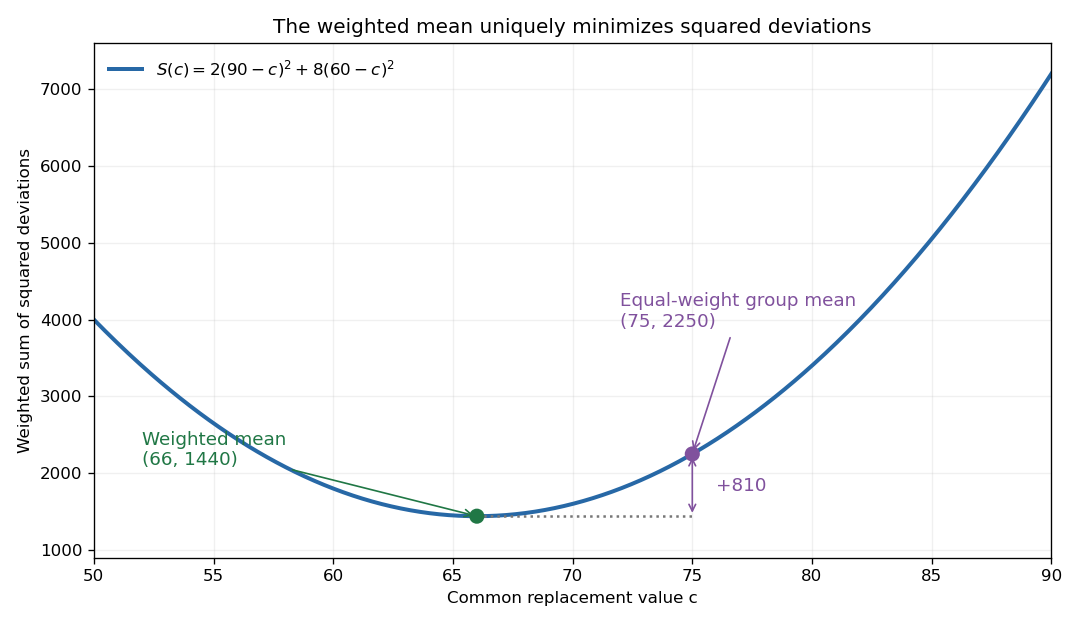
For a finite list of real numbers and nonnegative weights of positive total , the weighted mean uniquely minimizes the weighted sum of squared deviationsExpanding around and using givesEvery displacement from the weighted mean increases the objective. This is the simplest one-parameter weighted least squares problem: represent all entries by one common value.

Combining means of groups 2026-10-14
Suppose disjoint nonempty groups have sizes and arithmetic means . The arithmetic mean of all observations isEach group contributes the sum ; add those totals before dividing by the overall count. This is exactly a weighted mean of group means with weights equal to group sizes. [ref]
Take a synthetic example with two observations equal to and eight equal to . The two group means are and , and the combined mean is . Giving the two groups equal weights instead produces , which summarizes the two group means with equal influence. To summarize all ten individuals with equal influence, use their group counts.
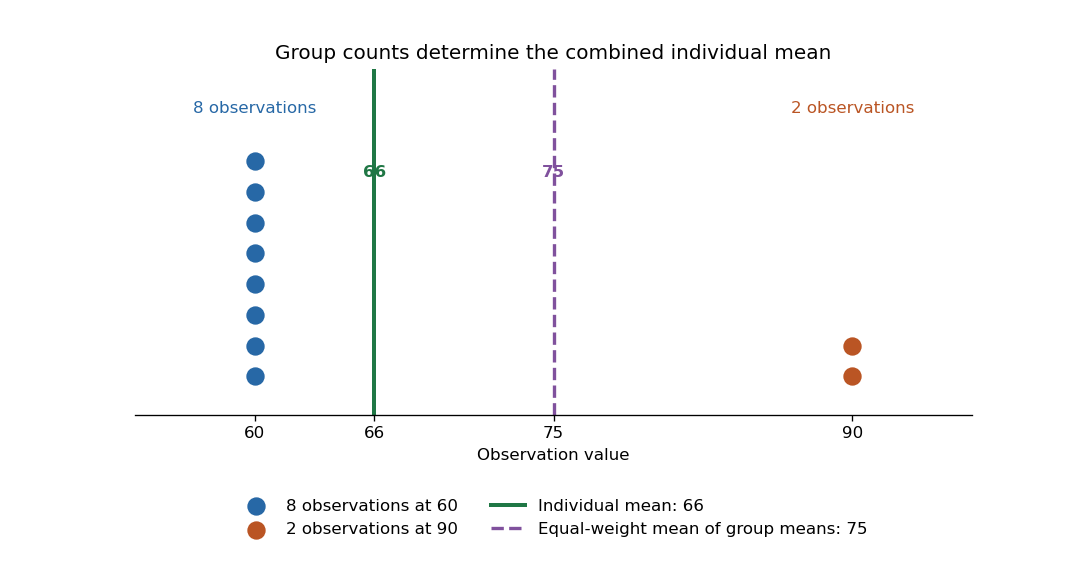

The group means and counts determine the combined arithmetic mean, but do not generally determine the combined variance. Variation within the groups is additional information.
Canonical product 2026-10-14
A canonical product builds a prescribed discrete zero set from Weierstrass elementary factors. Choose the orders so that the logarithms of tail factors converge uniformly on each compact subset. Infinite product convergence from logarithmic tails then gives an entire function with exactly those zeros, counted with the prescribed multiplicities. When , factors of order zero suffice.
Elliptic collinearity determinant 2026-10-14
The determinant of the columns , and vanishes identically. Its apparent cubic poles at have order at most two because the coefficient multiplying the cubic-pole entry vanishes linearly. Column coincidences give six zeros, unless is a lattice point, when they give four zeros with one multiple zero. In the half-period case, the two apparent zero locations at poles are removable zeros: and the two terms cancel, leaving . Thus the zero count exceeds possible pole order in every case. The argument principle proves the identity, which expresses collinearity of the three points on the Weierstrass equation of an elliptic curve.
For , the apparent double poles at on the left are canceled by its squared zero factor. Subtract the right side: the order-three principal parts at lattice points cancel by the even Laurent expansion of , leaving at most a simple pole per period cell. An elliptic function has total residue zero in a period cell, so that possible pole is removable. The resulting entire periodic function is constant, and its oddness makes the constant zero. This proves the identity without presupposing the elliptic differential equation.
The Normal convergence of the Weierstrass elliptic-function series allows its derivative to be written as an absolutely locally uniformly convergent sum of inverse cubes. For a period lattice , this derivative sum is invariant under translation by any lattice vector, by reindexing. Consequently is constant; its apparent poles cancel. The Weierstrass elliptic function is even, so for a primitive lattice generator , evaluation at makes that constant zero. Applying this to two generators proves that this is a periodic function, namely . This argument avoids separating the original convergent series into two divergent inverse-square sums.
Four totally ramified Weierstrass values 2026-10-14
The Weierstrass elliptic function has degree two on its period torus. Its three distinct half-period values have double local preimages, and its pole is double, so these four values are totally ramified. This also follows from and the principal part at the pole. A Möbius transformation with pole away from these values moves all four to finite values without changing local degrees.
Weierstrass sigma function 2026-10-14
For a period lattice, the displayed canonical product converges normally because its logarithmic tails are bounded by a constant times . It defines an odd entire function with simple zeros exactly at the lattice and derivative one at zero. Its logarithmic derivative is the Weierstrass zeta function, and the derivative of that logarithmic derivative is minus the Weierstrass elliptic function. Sigma is quasi-periodic rather than elliptic; balanced products of its translates construct meromorphic functions with prescribed divisors on a complex torus.
Weierstrass addition formula 2026-10-14
For generic fixed , regard the right side as an elliptic function of . The apparent pole at zero cancels, giving limiting value . At the slope ratio is finite. At , its squared slope has the same double principal part as and no simple pole term. These exhaust the possible poles because the Weierstrass elliptic function has degree two. The difference is therefore an entire elliptic function, hence constant by Liouville theorem, and its value at zero is zero. Meromorphic continuation extends the identity to the exceptional parameters.
For a symplectic left Lie group action, use actual fundamental fields and . They satisfy . Cartan's magic formula then gives . Thus every commutator generator has a globally exact contraction. A semisimple Lie algebra is perfect, so every generator has a global Hamiltonian. The separate semisimple moment-map equivariance result removes the constant two-cocycle obstruction and gives an equivariant moment map for a connected group.
Suppose linear operators and on a normed space satisfy , where has weak type with a normed domain, and all relevant suprema are measurable. If almost everywhere on a dense subspace, the same holds for every input. For a fixed approximation , the limiting error is at most . The measure where it exceeds is at most , which tends to zero as the approximation improves. This is a convergence-to-a-specified-limit version of almost-everywhere convergence from weak-type domination.
Suppose a family of linear operators, including its limiting operator, is pointwise dominated by a sublinear operator of weak type (1,1). Convergence almost everywhere on an -dense subspace then extends to every input. Approximate the input by errors of norm at most . The weak estimate and the Borel-Cantelli first lemma make the corresponding domination errors tend to zero almost everywhere. Linearity bounds the difference between the full and approximating convergence errors by twice that domination error. This argument does not need an uncountable supremum to be measurable.
Integral norm for weak Lq 2026-10-14
The integral expression for the weak Lq space is homogeneous, positive definite up to equality almost everywhere, and obeys the triangle inequality by integrating over each set. Its exponent is , not . The sharp comparison constant with the distribution-function quasi-norm is ; the power function on attains that ratio on initial intervals.
For independent and identically distributed random variables with characteristic function , suppose their sample mean converges in probability to a finite constant . Bounded exponential tests give uniformly on bounded intervals: the error is at most on . Taking the continuous complex logarithm vanishing at zero shows uniformly; an integer-valued branch difference is continuous and therefore zero. For arbitrary , put and , so . Dividing the uniform limit by proves , and thus . No absolute first moment is assumed.
Weak law without an absolute first moment 2026-10-14
Let have a symmetric probability distribution with for , mass at zero, and no mass with . Then , but independent copies satisfy the weak law of large numbers with limit zero. Indeed . Their symmetric truncations have mean zero and second moment , so Chebyshev's inequality gives in probability. A union bound shows that the original and truncated sums differ with probability tending to zero. This also gives a differentiable characteristic function at zero whose derivative cannot be interpreted as an absolutely convergent expectation.
Suppose a weak large deviation principle with rate function holds on a Hausdorff space, at speed , and the random elements are exponentially tight. For a finite , choose a compact set whose complement has upper exponential rate strictly below , with . The open-set lower bound on implies , so . Lower semicontinuity makes this sublevel set closed, hence compact. For any closed set , split its probability between the compact and . The upper exponential rate is at most . Letting proves the full large deviation principle with a good rate function.
Compact containment 2026-10-14
A family of path laws satisfies compact containment when for every finite horizon and every error tolerance there is a compact set which contains the whole path up to that horizon with at least the complementary probability, uniformly over the family. In Euclidean state space this is the displayed condition. It prevents escape to distant regions where local coefficient approximations give no control. A nonnegative Lyapunov function with uniformly bounded generator growth often proves it by the optional stopping theorem.
In a weak Alfvénic cascade at fixed , grows as the perpendicular scale shrinks. If its outer value is at , it reaches order one at the displayed scale. Beyond it the weak-interaction ordering fails and a critical balance model may become appropriate.
Local wavelength 2026-10-14
For a locally oscillatory wave written , the local wavevector is , where is the spatial gradient. The local wavelength measures local wave phase spacing normal to the wavefront. Interpreting it as a crest separation requires the amplitude and local wavevector to vary little over one wavelength, as in the WKB approximation. Along a unit direction the corresponding local repeat distance is , if that dot product is nonzero; oblique sampling measures this projected spacing.
A real snapshot alone does not uniquely specify and : their meaning requires a chosen oscillatory component or physical approximation. Strong interference, zeros of amplitude, and rapidly changing media can defeat a single-carrier description. If , the local reciprocal formula gives no finite wavelength; it does not establish an exact global spatial period.
There are unlisted articles, also show them or only show them.